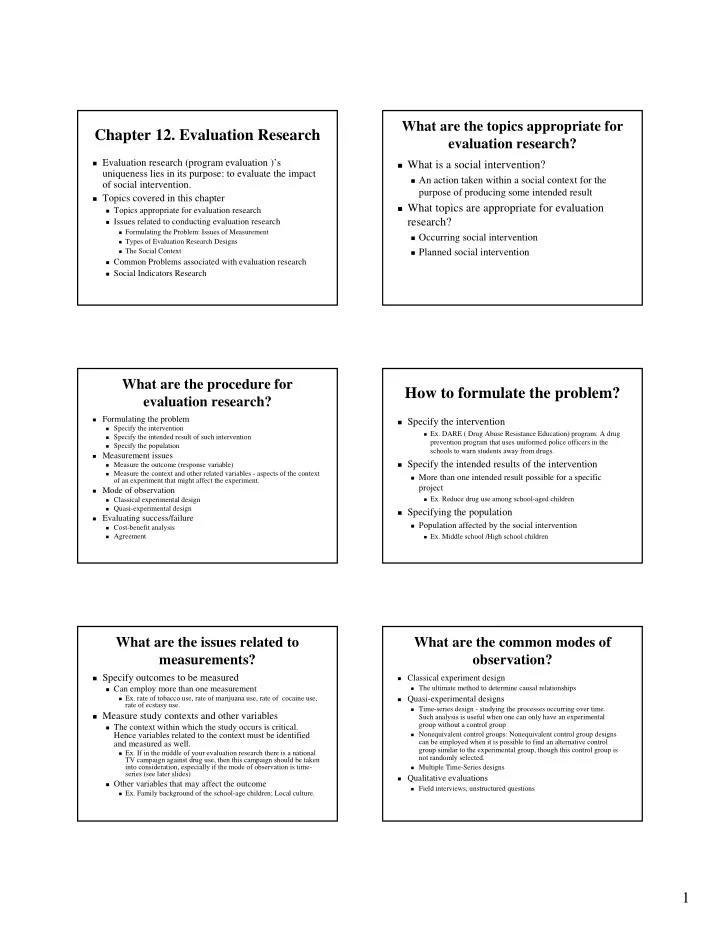
Chapter 12. Evaluation Research Chapter 12. Evaluation Research - - PDF document

chapter 12 evaluation research chapter 12 evaluation
SMART_READER_LITE
LIVE PREVIEW

Chapter 12. Evaluation Research Chapter 12. Evaluation Research - - PDF document

What are the topics appropriate for What are the topics appropriate for Chapter 12. Evaluation Research Chapter 12. Evaluation Research evaluation research? evaluation research? Evaluation research (program evaluation )s Evaluation


slide-1
SLIDE 1

1

Chapter 12. Evaluation Research Chapter 12. Evaluation Research

  • Evaluation research (program evaluation )’s

Evaluation research (program evaluation )’s uniqueness lies in its purpose: to evaluate the impact uniqueness lies in its purpose: to evaluate the impact

  • f social intervention.
  • f social intervention.
  • Topics covered in this chapter

Topics covered in this chapter

  • Topics appropriate for evaluation research

Topics appropriate for evaluation research

  • Issues related to conducting evaluation research

Issues related to conducting evaluation research

  • Formulating the Problem: Issues of Measurement

Formulating the Problem: Issues of Measurement

  • Types of Evaluation Research Designs

Types of Evaluation Research Designs

  • The Social Context

The Social Context

  • Common Problems associated with evaluation research

Common Problems associated with evaluation research

  • Social Indicators Research

Social Indicators Research

What are the topics appropriate for What are the topics appropriate for evaluation research? evaluation research?

  • What is a social intervention?

What is a social intervention?

  • An action taken within a social context for the

An action taken within a social context for the purpose of producing some intended result purpose of producing some intended result

  • What topics are appropriate for evaluation

What topics are appropriate for evaluation research? research?

  • Occurring social intervention

Occurring social intervention

  • Planned social intervention

Planned social intervention

What are the procedure for What are the procedure for evaluation research? evaluation research?

  • Formulating the problem

Formulating the problem

  • Specify the intervention

Specify the intervention

  • Specify the intended result of such intervention

Specify the intended result of such intervention

  • Specify the population

Specify the population

  • Measurement issues

Measurement issues

  • Measure the outcome (response variable)

Measure the outcome (response variable)

  • Measure the context and other related variables

Measure the context and other related variables -

  • aspects of the context

aspects of the context

  • f an experiment that might affect the experiment.
  • f an experiment that might affect the experiment.
  • Mode of observation

Mode of observation

  • Classical experimental design

Classical experimental design

  • Quasi

Quasi-

  • experimental design

experimental design

  • Evaluating success/failure

Evaluating success/failure

  • Cost

Cost-

  • benefit analysis

benefit analysis

  • Agreement

Agreement

How to formulate the problem? How to formulate the problem?

  • Specify the intervention

Specify the intervention

  • Ex. DARE ( Drug Abuse Resistance Education) program: A drug
  • Ex. DARE ( Drug Abuse Resistance Education) program: A drug

prevention program that uses uniformed police officers in the prevention program that uses uniformed police officers in the schools to warn students away from drugs. schools to warn students away from drugs.

  • Specify the intended results of the intervention

Specify the intended results of the intervention

  • More than one intended result possible for a specific

More than one intended result possible for a specific project project

  • Ex. Reduce drug use among school
  • Ex. Reduce drug use among school-
  • aged children

aged children

  • Specifying the population

Specifying the population

  • Population affected by the social intervention

Population affected by the social intervention

  • Ex. Middle school /High school children
  • Ex. Middle school /High school children

What are the issues related to What are the issues related to measurements? measurements?

  • Specify outcomes to be measured

Specify outcomes to be measured

  • Can employ more than one measurement

Can employ more than one measurement

  • Ex. rate of tobacco use, rate of marijuana use, rate of cocaine
  • Ex. rate of tobacco use, rate of marijuana use, rate of cocaine use,

use, rate of ecstasy use. rate of ecstasy use.

  • Measure study contexts and other variables

Measure study contexts and other variables

  • The context within which the study occurs is critical.

The context within which the study occurs is critical. Hence variables related to the context must be identified Hence variables related to the context must be identified and measured as well. and measured as well.

  • Ex. If in the middle of your evaluation research there is a nati
  • Ex. If in the middle of your evaluation research there is a national
  • nal

TV campaign against drug use, then this campaign should be taken TV campaign against drug use, then this campaign should be taken into consideration, especially if the mode of observation is tim into consideration, especially if the mode of observation is time e-

  • series (see later slides)

series (see later slides)

  • Other variables that may affect the outcome

Other variables that may affect the outcome

  • Ex. Family background of the school
  • Ex. Family background of the school-
  • age children; Local culture.

age children; Local culture.

What are the common modes of What are the common modes of

  • bservation?
  • bservation?
  • Classical experiment design

Classical experiment design

  • The ultimate method to determine causal relationships

The ultimate method to determine causal relationships

  • Quasi

Quasi-

  • experimental designs

experimental designs

  • Time

Time-

  • series design

series design -

  • studying the processes occurring over time.

studying the processes occurring over time. Such analysis is useful when one can only have an experimental Such analysis is useful when one can only have an experimental group without a control group group without a control group

  • Nonequivalent control groups: Nonequivalent control group design

Nonequivalent control groups: Nonequivalent control group designs s can be employed when it is possible to find an alternative contr can be employed when it is possible to find an alternative control

  • l

group similar to the experimental group, though this control gro group similar to the experimental group, though this control group is up is not randomly selected. not randomly selected.

  • Multiple Time

Multiple Time-

  • Series designs

Series designs

  • Qualitative evaluations

Qualitative evaluations

  • Field interviews, unstructured questions

Field interviews, unstructured questions

slide-2
SLIDE 2

2

An example of classical experimental An example of classical experimental design for evaluation research design for evaluation research

  • Suppose we want to evaluate whether DARE is successful in

Suppose we want to evaluate whether DARE is successful in Salt Lake County Salt Lake County

  • Randomly select a sample of high schools

Randomly select a sample of high schools

  • Randomly assign half of the schools in the experimental

Randomly assign half of the schools in the experimental group, the other half in the control group. Pretest the kids in group, the other half in the control group. Pretest the kids in these two groups to make sure they are similar. these two groups to make sure they are similar.

  • The experimental group will get the DARE program. The

The experimental group will get the DARE program. The control group won’t. control group won’t.

  • After a certain period of time (maybe a year), measure the

After a certain period of time (maybe a year), measure the usage rate of different drugs and tobacco. usage rate of different drugs and tobacco.

  • If the experimental group has significantly lower rate of usage,

If the experimental group has significantly lower rate of usage, then the program is successful. then the program is successful.

An example of time An example of time-

  • series method

series method

  • DARE as an example again

DARE as an example again

  • If DARE is implemented in all schools in Salt Lake County,

If DARE is implemented in all schools in Salt Lake County, then experimental design is not feasible then experimental design is not feasible

  • Researchers can collect data on drug use among high school

Researchers can collect data on drug use among high school students over time, both before and after DARE was students over time, both before and after DARE was implemented. implemented.

  • If there is a substantial decrease in the rate of drug use, then

If there is a substantial decrease in the rate of drug use, then the program is considered successful. the program is considered successful.

  • Note in such a design, contextual variables are especially

Note in such a design, contextual variables are especially

  • important. Suppose in the midst of your research a national
  • important. Suppose in the midst of your research a national

anti anti-

  • drug use TV campaign started. You may find a lower rate

drug use TV campaign started. You may find a lower rate

  • f drug use at the end of your research period. But it could be
  • f drug use at the end of your research period. But it could be

caused by the TV campaign, not the DARE program. caused by the TV campaign, not the DARE program.

Time Time-

  • series design: Patterns of rate of

series design: Patterns of rate of drug use in a longer historical period drug use in a longer historical period

  • Suppose we observe a

Suppose we observe a reduction in rate of drug use reduction in rate of drug use after the DARE program is after the DARE program is utilized (the Intervention utilized (the Intervention line shows when the line shows when the program started). We program started). We

  • bserve the rate of drug use
  • bserve the rate of drug use

before is higher than the rate before is higher than the rate

  • f drug use after the
  • f drug use after the
  • Intervention. But can we
  • Intervention. But can we

conclude that the DARE conclude that the DARE program is successful? program is successful?

Time Rate Intervention

Time series Time series -

  • Maturation

Maturation

  • There are several circumstances

There are several circumstances under which we might observe under which we might observe these the graph on the previous these the graph on the previous change. change.

  • Maturation

Maturation – – meaning that it is meaning that it is possible that over time, the drug possible that over time, the drug use rate will naturally decrease use rate will naturally decrease for the same group of students for the same group of students simply because they get more simply because they get more mature and know more. If that is mature and know more. If that is the case, then if more data points the case, then if more data points are collected, the pattern on drug are collected, the pattern on drug use rate will show as a decreasing use rate will show as a decreasing line (see graph). The line (see graph). The Intervention, in this case, does Intervention, in this case, does not have any effect. not have any effect.

Time Rate Intervention Maturation

Time series Time series -

  • Fluctuation

Fluctuation

  • Fluctuation

Fluctuation – – This is shown This is shown

  • n the graph to the right. In
  • n the graph to the right. In

this case, the rate of drug use this case, the rate of drug use fluctuate over time naturally, fluctuate over time naturally, may be due to seasonally may be due to seasonally

  • reasons. If one only collects
  • reasons. If one only collects

two data points (the blue two data points (the blue

  • nes), one would think the
  • nes), one would think the

DARE program is effective. DARE program is effective. But if one collects more data But if one collects more data points that shows a fluctuation points that shows a fluctuation pattern, then one would know pattern, then one would know the Intervention is not the Intervention is not effective as the two points just effective as the two points just happen to be at the high and happen to be at the high and low points on the fluctuation low points on the fluctuation curve. curve.

Time Rate Intervention Fluctuation

Time series Time series -

  • Intervention

Intervention

  • Intervention

Intervention – – This is This is the pattern where there the pattern where there is evidence that the is evidence that the Intervention is effective. Intervention is effective. With many data points With many data points showing a higher drug showing a higher drug use rate before the use rate before the Intervention and many Intervention and many data points showing a data points showing a lower drug rate after the lower drug rate after the Intervention. Intervention.

Time Rate Intervention Intervention

slide-3
SLIDE 3

3

Non Non-

  • equivalent control group design

equivalent control group design

  • Still using DARE program as an example

Still using DARE program as an example

  • Suppose the city of Salt Lake decided not to implement the progr

Suppose the city of Salt Lake decided not to implement the program, but am, but the city of West Valley decided to do it. the city of West Valley decided to do it.

  • One can treat Salt Lake City as the control group and West Valle

One can treat Salt Lake City as the control group and West Valley City as y City as the experimental group. But we all know that these two groups ar the experimental group. But we all know that these two groups are not e not equivalent, as people living in SLC are likely to be different f equivalent, as people living in SLC are likely to be different from people rom people living in WVC. living in WVC.

  • Researchers can randomly select some schools from both cities. T

Researchers can randomly select some schools from both cities. The drug he drug use rate before and after the DARE program will be measured. use rate before and after the DARE program will be measured.

  • If WVC shows a significant decrease in drug use rate but SLC doe

If WVC shows a significant decrease in drug use rate but SLC does not, s not, then one might be able to conclude that the DARE program is effe then one might be able to conclude that the DARE program is effective. ctive.

  • Caution: Different demographics should be taken into considerati

Caution: Different demographics should be taken into consideration. The

  • n. The

conclusion may not be generalizable, meaning the program might b conclusion may not be generalizable, meaning the program might be useful e useful for the people of WVC but not SLC due to demographic differences for the people of WVC but not SLC due to demographic differences. .

Multiple time Multiple time-

  • series designs

series designs

  • Multiple time

Multiple time-

  • series designs are the use of

series designs are the use of more than one set of data that were collected more than one set of data that were collected

  • ver time, as in accident rates of time in
  • ver time, as in accident rates of time in

several states or cities, so that comparison can several states or cities, so that comparison can be made. be made.

  • The difference between multiple time

The difference between multiple time-

  • series

series design and time design and time-

  • series design is the

series design is the involvement of more than one set of data. involvement of more than one set of data.

How to evaluate success/failure? How to evaluate success/failure?

  • The most critical aspect of evaluation research is to determine

The most critical aspect of evaluation research is to determine whether the program studied succeeded or failed. whether the program studied succeeded or failed.

  • There are almost never clear

There are almost never clear-

  • cut answers.

cut answers.

  • Two common ways of judgment.

Two common ways of judgment.

  • Cost

Cost-

  • benefit analysis

benefit analysis -

  • compare the cost of the program with the benefit

compare the cost of the program with the benefit

  • f the program.
  • f the program.
  • Quite often cost is easier to estimate than benefits. But with t

Quite often cost is easier to estimate than benefits. But with this approach his approach

  • ne has to estimate how much money is saved by saving one highsc
  • ne has to estimate how much money is saved by saving one highschooler

hooler from using drug, etc, in order to estimate benefits from using drug, etc, in order to estimate benefits

  • Agreement

Agreement -

  • Sometimes, the criteria of success and failure are often a

Sometimes, the criteria of success and failure are often a matter of agreement. The people responsible for the program may matter of agreement. The people responsible for the program may commit themselves in advance to a particular outcome that will b commit themselves in advance to a particular outcome that will be e regarded as an indication of success. regarded as an indication of success.

  • For example, if people agree that a reduction of 10% in drug use

For example, if people agree that a reduction of 10% in drug use rate rate attributed to the Intervention would be an indication of a succe attributed to the Intervention would be an indication of a success, then any ss, then any reduction equal to or greater than 10% would be a success. reduction equal to or greater than 10% would be a success.

What are the common problems What are the common problems with evaluation research? with evaluation research?

  • Logistical problem

Logistical problem -

  • problems with getting subjects to do what they are

problems with getting subjects to do what they are supposed to do supposed to do

  • Logistical problems emerge because evaluation researchers often

Logistical problems emerge because evaluation researchers often lack lack sufficient control over the design in real sufficient control over the design in real-

  • life contexts.

life contexts.

  • Reluctant participants

Reluctant participants

  • Administrative control

Administrative control

  • Ethical issues

Ethical issues

  • Particularly important when determining who receives or does not

Particularly important when determining who receives or does not receive what receive what type of stimulus. type of stimulus.

  • Social interventions being evaluated may raise ethical issues.

Social interventions being evaluated may raise ethical issues.

  • Evaluation research may be a mask for unethical behavior.

Evaluation research may be a mask for unethical behavior.

  • Use of research results

Use of research results

  • Evaluation research is designed to be used to make a difference

Evaluation research is designed to be used to make a difference in the in the execution of some programs. execution of some programs.

  • However, sometimes, research results do not really have a impact

However, sometimes, research results do not really have a impact. .

Why results are often ignored? Why results are often ignored?

  • Implications may not be presented in a way

Implications may not be presented in a way that nonresearchers can understand. that nonresearchers can understand.

  • Results sometimes contradict deeply held

Results sometimes contradict deeply held beliefs. beliefs.

  • Administration has bested interest in a

Administration has bested interest in a program (pet projects). program (pet projects).

Social Indicators Research Social Indicators Research

  • Social indicators are measurements that reflect the

Social indicators are measurements that reflect the quality or nature of social life, such as crime rates, quality or nature of social life, such as crime rates, infant mortality rates, number of physicians per infant mortality rates, number of physicians per 100,000 population, and so forth. Social indicators 100,000 population, and so forth. Social indicators are often monitored to determine the nature of social are often monitored to determine the nature of social change in a society. change in a society.

  • Social indicators research provides an understanding

Social indicators research provides an understanding

  • f broader social processes.
  • f broader social processes.
  • Researchers are developing more refined indicators.

Researchers are developing more refined indicators.

  • Research is being devoted to discovering the

Research is being devoted to discovering the relationships among variables within whole societies. relationships among variables within whole societies.

slide-4
SLIDE 4

4

An example of evaluation research An example of evaluation research

Mittelman, Mary S., Steven H. Ferris, Emma

Shulman, Gertrude Steinberg, Abby Ambinder, Joan

  • A. Mackell, & Jacob Cohen (1995). A comprehensive

support program: Effect on depression in spouse- caregivers of AD patients. The Gerontologist, 35(6), 792-802.

Evaluating the effectiveness of a multifaceted,

structured intervention for spouse-caregivers of Alzheimer’s disease patients. Program is at NYU- Aging and Dementia Research Center since 1987.

  • Specify the intervention

Specify the intervention

A multifaceted, structured intervention for spouse-

caregivers of Alzheimer’s disease patients.

  • Specify the intended results of the intervention

Specify the intended results of the intervention

  • Reduce the depression level of the spouse

Reduce the depression level of the spouse-

  • caregivers of AD

caregivers of AD patients patients

  • Specifying the population

Specifying the population

  • Those spouses who care for AD patients

Those spouses who care for AD patients

  • Specify outcomes to be measured

Specify outcomes to be measured

  • Changes in depression level of spouse

Changes in depression level of spouse-

  • caregivers of AD

caregivers of AD patients patients

  • Measure study contexts and other variables

Measure study contexts and other variables

  • Demographics. The severity of the symptoms, how long the
  • Demographics. The severity of the symptoms, how long the

patient has been sick. Caregiver health, other support patient has been sick. Caregiver health, other support

  • Sample:

Sample:

  • Spouses who care for AD patients. At least one close

Spouses who care for AD patients. At least one close relative living in the NYC metropolitan area. Caregivers relative living in the NYC metropolitan area. Caregivers who had received formal counseling or were participating who had received formal counseling or were participating in a support group were not eligible. in a support group were not eligible.

  • Recruitment of spouse

Recruitment of spouse-

  • caregivers from 1987

caregivers from 1987-

  • 1991

1991

  • Eligible patients seeking treatment at the NYU

Eligible patients seeking treatment at the NYU-

  • Aging Dementia

Aging Dementia Research center (91 spouse Research center (91 spouse-

  • caregivers)

caregivers)

  • Reference from the Alzheimer’s Association of New York City

Reference from the Alzheimer’s Association of New York City

  • Other day care centers and social services for elderly in the ar

Other day care centers and social services for elderly in the area ea

  • Final sample = 206 spouse

Final sample = 206 spouse-

  • caregivers

caregivers

  • Evaluation method:

Evaluation method:

  • Classical experimental design (note it’s called

Classical experimental design (note it’s called randomized treatment/control trial randomized treatment/control trial – – just a slightly just a slightly different term) different term)

  • Baseline interview, 4

Baseline interview, 4-

  • month follow

month follow-

  • up, 8

up, 8-

  • month

month follow follow-

  • up, 12

up, 12-

  • month follow

month follow-

  • up

up

  • Hypotheses:

Hypotheses:

  • Caregivers in the treatment group would become

Caregivers in the treatment group would become less depressed or remain stable, while caregivers in less depressed or remain stable, while caregivers in the control group would become more depressed the control group would become more depressed

  • Measurements:

Measurements:

  • Dep. Variables (change in depression):
  • Dep. Variables (change in depression):
  • Caregiver depression: Geriatric Depression scale, a 30

Caregiver depression: Geriatric Depression scale, a 30-

  • item

item questionnaire in a yes/no format. (0 questionnaire in a yes/no format. (0-

  • 30 possible scores)

30 possible scores)

  • Major independent variable:

Major independent variable:

  • Treatment group or control group

Treatment group or control group

  • Control variables:

Control variables:

  • See Table 1 for a list: caregiver physical health, reaction to

See Table 1 for a list: caregiver physical health, reaction to frequency of troublesome patient behaviors, telephone calls from frequency of troublesome patient behaviors, telephone calls from family and friends, visits from family and friends, help from fa family and friends, visits from family and friends, help from family mily and friends, family cohesion, satisfaction with social network, and friends, family cohesion, satisfaction with social network, formal services used, family income, caregiver gender, severity formal services used, family income, caregiver gender, severity of

  • f

patient impairment, amount of paid help, worried about financial patient impairment, amount of paid help, worried about financial future, amount of employment future, amount of employment

  • Analytical method

Analytical method

  • Multivariate analysis of co

Multivariate analysis of co-

  • variance (statistical

variance (statistical method that can control other variables while method that can control other variables while isolating out the importance of the treatment isolating out the importance of the treatment variable) variable)

  • Result:

Result:

  • This intervention (enhances social support) has the

This intervention (enhances social support) has the potential for alleviating some of the deleterious potential for alleviating some of the deleterious effects of caregiving on mental health. The effect effects of caregiving on mental health. The effect was not immediate in most cases, so that the was not immediate in most cases, so that the difference between treatment and control groups difference between treatment and control groups

  • nly become significant after 8 months.
  • nly become significant after 8 months.