Chapter 20 Network flow, duality and Linear Programming NEW CS - - PDF document

chapter 20 network flow duality and linear programming
SMART_READER_LITE
LIVE PREVIEW

Chapter 20 Network flow, duality and Linear Programming NEW CS - - PDF document

Chapter 20 Network flow, duality and Linear Programming NEW CS 473: Theory II, Fall 2015 November 5, 2015 20.1 Network flow via linear programming 20.1.1 Network flow: Problem definition 20.1.1.1 Network flow (A) Transfer as much


slide-1
SLIDE 1

Chapter 20 Network flow, duality and Linear Programming

NEW CS 473: Theory II, Fall 2015 November 5, 2015

20.1 Network flow via linear programming

20.1.1 Network flow: Problem definition

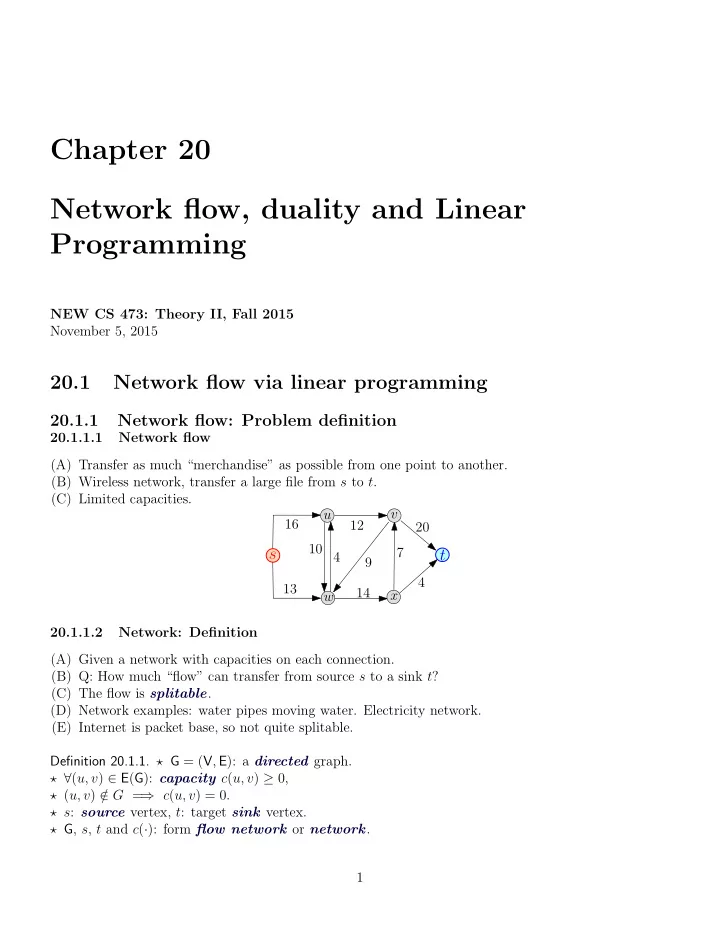
20.1.1.1 Network flow (A) Transfer as much “merchandise” as possible from one point to another. (B) Wireless network, transfer a large file from s to t. (C) Limited capacities. 13 4 10 14

t

7 4 12 20 9 16 u v w x

s

20.1.1.2 Network: Definition (A) Given a network with capacities on each connection. (B) Q: How much “flow” can transfer from source s to a sink t? (C) The flow is splitable. (D) Network examples: water pipes moving water. Electricity network. (E) Internet is packet base, so not quite splitable. Definition 20.1.1. ⋆ G = (V, E): a directed graph. ⋆ ∀(u, v) ∈ E(G): capacity c(u, v) ≥ 0, ⋆ (u, v) / ∈ G = ⇒ c(u, v) = 0. ⋆ s: source vertex, t: target sink vertex. ⋆ G, s, t and c(·): form flow network or network. 1

slide-2
SLIDE 2

20.1.1.3 Network Example

t

0/10 1/4 4 / 9 7 / 7 15/20 1 2 / 1 2 4 / 4 1 1 / 1 4

u v w x

s

11/16 8/13

(A) All flow from the source ends up in the sink. (B) Flow on edge: non-negative quantity ≤ capacity of edge. 20.1.1.4 Flow definition Definition 20.1.2 (flow). flow in network is a function f(·, ·) : E(G) → R: (A) Bounded by capacity: ∀(u, v) ∈ E f(u, v) ≤ c(u, v). (B) Anti symmetry: ∀u, v f(u, v) = −f(v, u). (C) Two special vertices: (i) the source s and the sink t. (D) Conservation of flow (Kirchhoff’s Current Law): ∀u ∈ V \ {s, t}

  • v

f(u, v) = 0. flow/value of f: |f| =

  • v∈V

f(s, v). 20.1.1.5 Problem: Max Flow (A) Flow on edge can be negative (i.e., positive flow on edge in other direction). Problem 20.1.3 (Maximum flow). Given a network G find the maximum flow in G. Namely, com- pute a legal flow f such that |f| is maximized.

20.1.2 Network flow via linear programming

20.1.2.1 Network flow via linear programming Input: G = (V, E) with source s and sink t, and capacities c(·) on the edges. Compute max flow in G. ∀(u, v) ∈ E 0 ≤ xu→v xu→v ≤ c(u → v) ∀v ∈ V \ {s, t}

  • (u,v)∈E

xu→v −

  • (v,w)∈E

xv→w ≤ 0

  • (u,v)∈E

xu→v −

  • (v,w)∈E

xv→w ≥ 0 maximizing

  • (s,u)∈E xs→u

2

slide-3
SLIDE 3

20.1.3 Min-Cost Network flow via linear programming

20.1.3.1 Min cost flow Input: G = (V, E): directed graph. s: source. t: sink c(·): capacities on edges, φ: Desired amount (value) of flow. κ(·): Cost on the edges. Definition - cost of flow cost of flow f: cost(f) =

  • e∈E

κ(e) ∗ f(e). 20.1.3.2 Min cost flow problem Min-cost flow minimum-cost s-t flow problem: compute the flow f of min cost that has value φ. min-cost circulation problem Instead of φ we have lower-bound ℓ(·) on edges. (All flow that enters must leave.) Claim 20.1.4. If we can solve min-cost circulation = ⇒ can solve min-cost flow.

20.2 Duality and Linear Programming

20.2.0.1 Duality... (A) Every linear program L has a dual linear program L′. (B) Solving the dual problem is essentially equivalent to solving the primal linear program original LP. (C) Lets look an example..

20.2.1 Duality by Example

20.2.1.1 Duality by Example max z = 4x1 + x2 + 3x3 s.t. x1 + 4x2 ≤ 1 3x1 − x2 + x3 ≤ 3 x1, x2, x3 ≥ 0 (A) η: maximal possible value of target function. (B) Any feasible solution ⇒ a lower bound on η. (C) In above: x1 = 1, x2 = x3 = 0 is feasible, and implies z = 4 and thus η ≥ 4. (D) x1 = x2 = 0, x3 = 3 is feasible = ⇒ η ≥ z = 9. (E) How close this solution is to opt? (i.e., η) (F) If very close to optimal – might be good enough. Maybe stop? 3

slide-4
SLIDE 4

20.2.1.2 Duality by Example: II max z = 4x1 + x2 + 3x3 s.t. x1 + 4x2 ≤ 1 3x1 − x2 + x3 ≤ 3 x1, x2, x3 ≥ 0 (A) Add the first inequality (multiplied by 2) to the second inequality (multiplied by 3): 2( x1 + 4x2 ) ≤ 2(1) +3(3x1 − x2 + x3) ≤ 3(3). (B) The resulting inequality is 11x1 + 5x2 + 3x3 ≤ 11. (20.1) 20.2.1.3 Duality by Example: II max z = 4x1 + x2 + 3x3 s.t. x1 + 4x2 ≤ 1 3x1 − x2 + x3 ≤ 3 x1, x2, x3 ≥ 0 (A) got 11x1 + 5x2 + 3x3 ≤ 11. (B) inequality must hold for any feasible solution of L. (C) Objective: z = 4x1 + x2 + 3x3 and x1,x2 and x3 are all non-negative. (D) Inequality above has larger coefficients than objective (for corresponding variables) (E) For any feasible solution: z = 4x1 + x2 + 3x3 ≤ 11x1 + 5x2 + 3x3 ≤ 11, 20.2.1.4 Duality by Example: III max z = 4x1 + x2 + 3x3 s.t. x1 + 4x2 ≤ 1 3x1 − x2 + x3 ≤ 3 x1, x2, x3 ≥ 0 (A) For any feasible solution: z = 4x1 + x2 + 3x3 ≤ 11x1 + 5x2 + 3x3 ≤ 11, (B) Opt solution is LP L is somewhere between 9 and 11. (C) Multiply first inequality by y1, second inequality by y2 and add them up: y1(x1 + 4x2 ) ≤ y1(1) + y2(3x1

  • x2

+ x3 ) ≤ y2(3) (y1 + 3y2)x1 + (4y1 − y2)x2 + y2x3 ≤ y1 + 3y2. 4

slide-5
SLIDE 5

20.2.1.5 Duality by Example: IV max z = 4x1 + x2 + 3x3 s.t. x1 + 4x2 ≤ 1 3x1 − x2 + x3 ≤ 3 x1, x2, x3 ≥ 0 (A) (y1 + 3y2)x1 + (4y1 − y2)x2 + y2x3 ≤ y1 + 3y2. 4 ≤ y1 + 3y2 1 ≤ 4y1 − y2 3 ≤ y2, (A) Compare to target function – require expression bigger than target function in each variable. = ⇒ z = 4x1 + x2 + 3x3 ≤ (y1 + 3y2)x1 + (4y1 − y2)x2 + y2x3 ≤ y1 + 3y2. 20.2.1.6 Duality by Example: IV Primal LP: max z = 4x1 + x2 + 3x3 s.t. x1 + 4x2 ≤ 1 3x1 − x2 + x3 ≤ 3 x1, x2, x3 ≥ 0 Dual LP: L min y1 + 3y2 s.t. y1 + 3y2 ≥ 4 4y1 − y2 ≥ 1 y2 ≥ 3 y1, y2 ≥ 0. (A) Best upper bound on η (max value of z) then solve the LP L. (B) L: Dual program to L. (C) opt. solution of L is an upper bound on optimal solution for L. 20.2.1.7 Primal program/Dual program max

n

  • j=1

cjxj s.t.

n

  • j=1

aijxj ≤ bi, for i = 1, . . . , m, xj ≥ 0, for j = 1, . . . , n. min

m

  • i=1

biyi s.t.

m

  • i=1

aijyi ≥ cj, for j = 1, . . . , n, yi ≥ 0, for i = 1, . . . , m. 5

slide-6
SLIDE 6

20.2.1.8 Primal program/Dual program max cTx

  • s. t.

Ax ≤ b. x ≥ 0. min yTb

  • s. t.

yTA ≥ cT. y ≥ 0. 20.2.1.9 Primal program/Dual program What happens when you take the dual of the dual? max

n

  • j=1

cjxj s.t.

n

  • j=1

aijxj ≤ bi, for i = 1, . . . , m, xj ≥ 0, for j = 1, . . . , n. min

m

  • i=1

biyi s.t.

m

  • i=1

aijyi ≥ cj, for j = 1, . . . , n, yi ≥ 0, for i = 1, . . . , m. 20.2.1.10 Primal program / Dual program in standard form max

n

  • j=1

cjxj s.t.

n

  • j=1

aijxj ≤ bi, for i = 1, . . . , m, xj ≥ 0, for j = 1, . . . , n. max

m

  • i=1

(−bi)yi s.t.

m

  • i=1

(−aij)yi ≤ −cj, for j = 1, . . . , n, yi ≥ 0, for i = 1, . . . , m. 6

slide-7
SLIDE 7

20.2.2 Dual program in standard form

20.2.2.1 Dual of a dual program max

m

  • i=1

(−bi)yi s.t.

m

  • i=1

(−aij)yi ≤ −cj, for j = 1, . . . , n, yi ≥ 0, for i = 1, . . . , m. min

n

  • j=1

−cjxj s.t.

n

  • j=1

(−aij)xj ≥ −bi, for i = 1, . . . , m, xj ≥ 0, for j = 1, . . . , n.

20.2.3 Dual of dual program

20.2.3.1 Dual of a dual program written in standard form min

n

  • j=1

−cjxj s.t.

n

  • j=1

(−aij)xj ≥ −bi, for i = 1, . . . , m, xj ≥ 0, for j = 1, . . . , n. max

n

  • j=1

cjxj s.t.

n

  • j=1

aijxj ≤ bi, for i = 1, . . . , m, xj ≥ 0, for j = 1, . . . , n. = ⇒ Dual of the dual LP is the primal LP! 20.2.3.2 Result Proved the following: Lemma 20.2.1. Let L be an LP, and let L′ be its dual. Let L′′ be the dual to L′. Then L and L′′ are the same LP.

20.2.4 The Weak Duality Theorem

20.2.4.1 Weak duality theorem Theorem 20.2.2. If (x1, x2, . . . , xn) is feasible for the primal LP and (y1, y2, . . . , ym) is feasible for the dual LP, then

  • j

cjxj ≤

  • i

biyi. Namely, all the feasible solutions of the dual bound all the feasible solutions of the primal. 7

slide-8
SLIDE 8

20.2.4.2 Weak duality theorem – proof Proof: By substitution from the dual form, and since the two solutions are feasible, we know that

  • j

cjxj ≤

  • j

m

  • i=1

yiaij

  • xj ≤
  • i
  • j

aijxj

  • yi ≤
  • i

biyi . (A) y being dual feasible implies cT ≤ yTA (B) x being primal feasible implies Ax ≤ b (C) ⇒ cTx ≤ (yTA)x ≤ yT(Ax) ≤ yTb 20.2.4.3 Weak duality is weak... (A) If apply the weak duality theorem on the dual program, (B) = ⇒

m

  • i=1

(−bi)yi ≤

n

  • j=1

−cjxj, (C) which is the original inequality in the weak duality theorem. (D) Weak duality theorem does not imply the strong duality theorem which will be discussed next.

20.3 The strong duality theorem

20.3.0.1 The strong duality theorem Theorem 20.3.1 (Strong duality theorem.). If the primal LP problem has an optimal solution x∗ = (x∗

1, . . . , x∗ n) then the dual also has an optimal solution, y∗ = (y∗ 1, . . . , y∗ m), such that

  • j

cjx∗

j =

  • i

biy∗

i .

Proof is tedious and omitted.

20.4 Some duality examples

20.4.1 Maximum matching in Bipartite graph

20.4.1.1 Max matching in bipartite graph as LP Input:G = (L ∪ R, E). max

  • uv∈E

xuv s.t.

  • uv∈E

xuv ≤ 1 ∀v ∈ G. xuv ≥ 0 ∀uv ∈ E 8

slide-9
SLIDE 9

20.4.1.2 Max matching in bipartite graph as LP (Copy) Input:G = (L ∪ R, E).

max

  • uv∈E

xuv s.t.

  • uv∈E

xuv ≤ 1 ∀v ∈ G. xuv ≥ 0 ∀uv ∈ E

20.4.1.3 Max matching in bipartite graph as LP (Notes)

20.4.2 Shortest path

20.4.2.1 Shortest path max dt s.t. ds ≤ 0 du + ω(u, v) ≥ dv ∀(u, v) ∈ E, dx ≥ 0 ∀x ∈ V. Equivalently: max dt s.t. ds ≤ 0 dv − du ≤ ω(u, v) ∀(u, v) ∈ E, dx ≥ 0 ∀x ∈ V. (A) G = (V, E): graph. s: source , t: target (B) ∀(u, v) ∈ E: weight ω(u, v) on edge. (C) Q: Comp. shortest s-t path. (D) No edges into s/out of t. (E) dx: var=dist. s to x, ∀x ∈ V. (F) ∀(u, v) ∈ E: du + ω(u, v) ≥ dv. (G) Also ds = 0. (H) Trivial solution: all variables 0. (I) Target: find assignment max dt. (J) LP to solve this! 20.4.2.2 The dual

max dt s.t. ds ≤ 0 dv − du ≤ ω(u, v) ∀(u, v) ∈ E, dx ≥ 0 ∀x ∈ V.

min

  • (u,v)∈E

yuvω(u, v) s.t. ys −

  • (s,u)∈E

ysu ≥ 0 (∗)

  • (u,x)∈E

yux −

  • (x,v)∈E

yxv ≥ 0 ∀x ∈ V \ {s, t} (∗∗)

  • (u,t)∈E

yut ≥ 1 (∗ ∗ ∗) yuv ≥ 0, ∀(u, v) ∈ E, ys ≥ 0. 20.4.2.3 The dual – details (A) yuv: dual variable for the edge (u, v). (B) ys: dual variable for ds ≤ 0 (C) Think about the yuv as a flow on the edge yuv. (D) Assume that weights are positive. 9

slide-10
SLIDE 10

(E) LP is min cost flow of sending 1 unit flow from source s to t. (F) Indeed... (**) can be assumed to be hold with equality in the optimal solution... (G) conservation of flow. (H) Equation (***) implies that one unit of flow arrives to the sink t. (I) (*) implies that at least ys units of flow leaves the source. (J) Remaining of LP implies that ys ≥ 1. 20.4.2.4 Integrality (A) In the previous example there is always an optimal solution with integral values. (B) This is not an obvious statement. (C) This is not true in general. (D) If it were true we could solve NPC problems with LP.

20.4.3 Set cover...

20.4.3.1 Details in notes... Set cover LP: min

  • Fj∈F

xj s.t.

  • Fj∈F,

ui∈Fj

xj ≥ 1 ∀ui ∈ S, xj ≥ 0 ∀Fj ∈ F.

20.4.4 Set cover dual is a packing LP...

20.4.4.1 Details in notes... max

  • ui∈S

yi s.t.

  • ui∈Fj

yi ≤ 1 ∀Fj ∈ F, yi ≥ 0 ∀ui ∈ S. 20.4.4.2 Network flow max

  • (s,v)∈E

xs→v xu→v ≤ c(u → v) ∀(u, v) ∈ E

  • (u,v)∈E

xu→v −

  • (v,w)∈E

xv→w ≤ 0 ∀v ∈ V \ {s, t} −

  • (u,v)∈E

xu→v +

  • (v,w)∈E

xv→w ≤ 0 ∀v ∈ V \ {s, t} 0 ≤ xu→v ∀(u, v) ∈ E. 10

slide-11
SLIDE 11

20.4.4.3 Dual of network flow... min

  • (u,v)∈E

c(u → v) yu→v du − dv ≤ yu→v ∀(u, v) ∈ E yu→v ≥ 0 ∀(u, v) ∈ E ds = 1, dt = 0. Under right interpretation: shortest path (see notes).

20.4.5 Duality and min-cut max-flow

20.4.5.1 Details in class notes Lemma 20.4.1. The Min-Cut Max-Flow Theorem follows from the strong duality Theorem for Linear Programming. 11