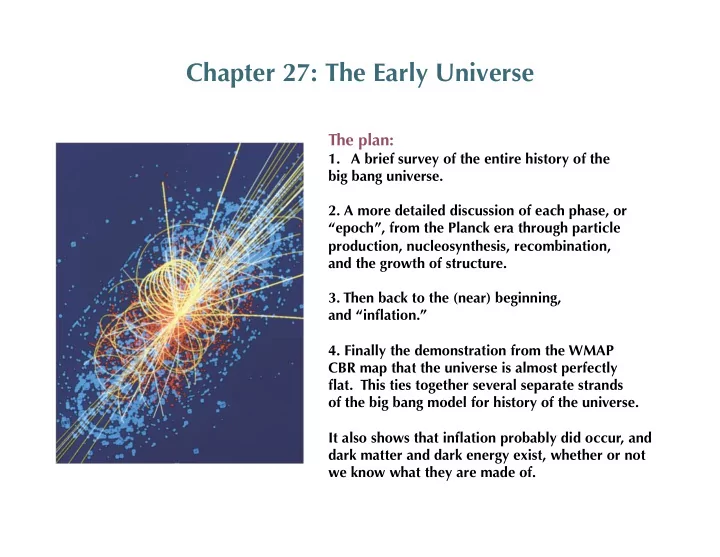
SLIDE 1 Chapter 27: The Early Universe
The plan:
- 1. A brief survey of the entire history of the
big bang universe.
- 2. A more detailed discussion of each phase, or
“epoch”, from the Planck era through particle production, nucleosynthesis, recombination, and the growth of structure.
- 3. Then back to the (near) beginning,
and “inflation.”
- 4. Finally the demonstration from the WMAP
CBR map that the universe is almost perfectly
- flat. This ties together several separate strands
- f the big bang model for history of the universe.
It also shows that inflation probably did occur, and dark matter and dark energy exist, whether or not we know what they are made of.
SLIDE 2
27.1 Back to the Big Bang 27.2 The Evolution of the Universe
More on Fundamental Forces
27.3 The Formation of Nuclei and Atoms 27.4 The Inflationary Universe 27.5 The Formation of Structure in the Universe 27.6 Cosmic Structure and the Microwave Background
Units of Chapter 27
SLIDE 3
The total energy of the universe consists of both radiation and matter. As the Universe cooled, it went from being radiation dominated to being matter dominated. Dark energy becomes more important as the Universe expands.
27.1 Back to the Big Bang
SLIDE 4 In the very early Universe, one of the most important processes was pair production: Virtual particles and photons were created from the high-energy vacuum state, from
- nothing. The temperature and density were
trillions of times their current values. The upper diagrams show how two gamma rays can unite to make an electron‒positron pair, and vice versa. Electron-positron pairs are matter- antimatter pairs, and annihilate, producing gamma rays again. These two processes come into balance, or equilibrium. The lower picture is of such an event
- ccurring at a high-energy particle
accelerator.
27.1 Back to the Big Bang
SLIDE 5
When the temperature had decreased to about 1 billion K, the photons no longer had enough energy for pair production, and were “frozen out.” This means the remaining photons (still gamma rays) were now permanent, although still frequently scattered by the electrons in the surrounding gas.
We now see these photons, greatly redshifted, as the cosmic background radiation.
27.1 Back to the Big Bang
In the very early Universe, the pair production and recombination processes were in equilibrium: Equal rates of production and destruction, no particle or photon permanent.
SLIDE 6
This table lists the main events in the different epochs of the Universe. You don’t have to memorize the numbers, or even all the epochs (I’ll tell you which ones are important to remember), but you should be able to read from the top to the bottom and understand it is a summary of the primary components of the universe at each time.
27.2 The Evolution of the Universe
SLIDE 7 Current understanding of the forces between elementary particles is that they are accomplished by exchange
Different forces “freeze out” when the energy of the Universe becomes too low for the exchanged particle to be formed through pair production.
27.2 The Evolution of the Universe
SLIDE 8 If we extrapolate the Big Bang back to the beginning, it yields a singularity—infinite density and temperature. This result is probably artificial, reflecting our lack of understanding concerning matter at temperatures and densities so large that gravity had not yet “frozen out” from the other
- forces. Any occurrence in physics or math of a “singularity,” where physical quantities
appear to become infinite, is a sign of missing physics (or a mistake). This is called the era of “quantum gravity,” when quantum effects and gravitational effects were important on the same size scales. This is the same reason we can’t say what happens when something falls into a black hole-- another “singularity.” We can only (hope we) understand what happens back to 10!43 seconds after the Big Bang. Therefore, we cannot predict anything about what happened before the Big Bang; indeed, the question may be meaningless. We don’t even understand whether “time” would have been relevant during these earliest of times, in which case talk of “before” and “after would not even make sense. However a lot happens after that time, and theories of big bang cosmology predict certain crucial events that can be observationally tested.
Time = 0 ? No singularity, just ignorance
SLIDE 9 This first 10!43 seconds after the Big Bang are called the Planck era. This is called the era of “quantum gravity,” when quantum effects and gravitational effects were important on the same size scale. There were no separate forces. At the end of that era, the gravitational force “freezes out” from all the others, becomes separate. That is why today we can speak of “gravity” as if it acted independently from other forces.
Planck era, GUT era, …
The next era is the GUT (Grand Unified Theory) era. Here, the strong nuclear force, the weak nuclear force, and electromagnetism are all
- unified. At the end of it, there was not enough energy for the
corresponding production of heavy particles, and the forces (which were just one unified force before this time) became separate forces.
SLIDE 10 The next era is called the quark era; during this era all the elementary particles were in equilibrium with radiation. About 10!4 s after the Big Bang, the Universe had cooled enough that photons could no longer produce the heavier elementary particles; the only
- nes still in equilibrium were electrons, positrons, muons, and neutrinos.
This is called the lepton era.
…quark era, lepton era
About 1 second after the Big Bang, the Universe became transparent to
- neutrinos. (Note: this is the equivalent of the era of recombination for
photons, to come much later; so there should be a “cosmic neutrino background” all around us, those same neutrinos from when the universe was 1 second old; no one has proposed a way to detect them.) After 100 seconds, photons became too low in energy for electron‒ positron pair creation—this marks the end of the radiation era, and the end of particle creation.
SLIDE 11 Epochs in cosmic history !
The evolution of the universe in a single graph--look at it slowly, especially as a review
- tool. Yellow and grey bands show how the density and temperature decreased as a
function of time (horizontal axis). Notice, on the bottom right, the transformation from fundamental particles, to atoms, and finally to galaxies and stars. ! Meanwhile the mysterious “dark energy” has been increasing in importance.
SLIDE 12 The next major era occurs when photons no longer are able to ionize atoms as soon as they form. This allows the formation of hydrogen and helium atoms to form, taking out the free electrons. This “era of recombination,” about a million years after the big bang, frees the photons because their former interactions with electrons no longer occur (the electrons are “recombined” in atoms). The cosmic background radiation is then “frozen,” never to interact with matter again, and available for observation by us. It contains an imprint of the vibrations or waves of spacetime that were to become galaxies and larger structures. This formation of cosmic structure from these waves probably took a tenth of a billion years or so. It had to wait until the temperatures in some regions had dropped low enough for gravity to dominate pressure. For the next 3 billion years, galaxies begin to form. These correspond to the galaxies we see at the highest redshifts (distances). After that, they merge; larger and larger structures arise, galaxies evolve into the
- nes we see now, and star formation goes through many generations.
The era of recombination releases the cosmic background radiation;! formation of structure like galaxies follows
SLIDE 13
More Precisely 27-1: More on Fundamental Forces!
You do NOT have to know this terminology for the exam, except for the four kinds of forces.
Table 27-2 lists the four fundamental forces and the particles on which they act. There are six types of quarks (up, down, charm, strange, top, bottom) and six types of leptons (electron, muon, tau, and neutrinos associated with each). All matter is made of quarks and leptons. Dark matter is believed to be made of particles created when the universe was very young, but it is still “matter,” created by interactions of fundamental particles. We don’t know where dark energy fits in at all, only that it probably exists.
SLIDE 14 More Precisely 27-1: More on Fundamental Forces!
(Again, not on exam--read for your own interest)
The theories of the weak and electromagnetic forces have been successfully unified in what is called the electroweak
- theory. At a temperature of 1015 K, these forces should have
equal strength. Considerable work has been done on unifying the strong and electroweak theories; these forces should have equal strength at a temperature of 1028 K. One prediction of many such theories is supersymmetry—the idea that every known particle has a supersymmetric partner.
SLIDE 15 More Precisely 27-1: More on Fundamental Forces (cont’d) !
(Again, not on exam--read for your own interest)
Unification of the other three forces with gravity has been
- problematic. One theory that showed early promise is string theory
—the idea that elementary particles are oscillations of little loops
- f “string,” rather than being point particles. This avoids the
unphysical results that arise when point particles interact. It does, however, require that the strings exist in 11-dimensional space. The extra seven dimensions are assumed to be very small.
SLIDE 16 Hydrogen was the first atomic nucleus to be formed, as it is just a proton, so it was there from the very early time when particles as massive as protons were created. Much later, a few minutes after the big bang, the average temperature of the universe fell to about a billion degrees, and for a short time temperatures were right for nuclear fusion. This is the era of nucleosynthesis. However only one element was produced in appreciable quantities, helium. Helium can form through fusion reactions that are just the proton-proton cycle that occurs in stars:
2H + 1H " 3He + energy 2H + 2H " 3He + neutron + energy 3He + neutron " 4He + energy
Your textbook has a great derivation of the fraction of He produced from protons during this era: 25 percent (by mass; 8 percent by number). It is difficult to get a much different answer! This is a major prediction of big bang model. Everything in the universe should have at least 25 percent helium. At the time it was made, no one was sure what the helium abundance was in, say, distant galaxies.
Note: Helium is the only major element that was not primarily produced by fusion inside of stars: stars produce only a few percent.
27.3 The Formation of Nuclei and Atoms !
The era of nucleosynthesis
SLIDE 17
This diagram illustrates that fusion process: Note that it is not the same as the fusion process that now goes on in the Sun’s core.
The Formation of Nuclei and Atoms
SLIDE 18 This would lead one to expect that " of the mass of atoms in the universe would be helium, which is consistent with
- bservation (remembering that nucleosynthesis is ongoing
in stellar cores).
The Formation of Nuclei and Atoms
SLIDE 19
Most deuterium fused into helium as soon as it was formed, but some did not. Deuterium is not formed in stars, so any deuterium we see today must be primordial. This gives us a very sensitive way to estimate the present-day matter density of the universe.
Deuterium as a probe of “Omega”
SLIDE 20
As with galaxy measurements, the total matter density determined by deuterium abundance shows that the matter density is only a few percent of the critical density.
Today’s deuterium abundance tells us the average ! density of baryonic matter in the universe. !
Recall that we needed that in order to estimate “omega nought” in discussing the future of the universe and the shape of spacetime.
SLIDE 21
The time during which nuclei and electrons combined to form atoms is referred to as the decoupling epoch. This is when the cosmic background radiation originated.
The era of decoupling: nuclei become atoms, electrons are no longer free, CBR “released” for us to see today
SLIDE 22
The horizon problem: When observed in diametrically opposite directions from Earth, cosmic background radiation appears the same even though there hasn’t been enough time since the Big Bang for them to be in thermal contact.
27.4 The Inflationary Universe
SLIDE 23 The flatness problem: In
have survived this long, its density in the early stages must have differed from the critical density by no more than 1 part in 1015.
The Inflationary Universe
SLIDE 24
Between the GUT epoch and the quark epoch, some parts of the Universe may have found themselves stuck in the unified condition longer than they should have been. This resulted in an extreme period of inflation, as shown on the graph. Between 10!35 s and 10!32 s, this part of the Universe expanded by a factor of 1050!
The Inflationary Universe
SLIDE 25
Inflation, if correct, would solve both the horizon and the flatness problems. This diagram shows how the horizon problem is solved—the points diametrically opposite from Earth were, in fact, in contact at one time:
The Inflationary Universe
SLIDE 26
The flatness problem is solved as well—after the inflation, the need to be exceedingly close to the critical density is much more easily met:
The Inflationary Universe
SLIDE 27 Cosmologists realized that galaxies could not have formed just from instabilities in normal matter:
- Before decoupling, background radiation kept
clumps from forming.
- Variations in the density of matter before
decoupling would have led to variations in the cosmic microwave background.
- Galaxies, or quasars, must have begun forming
by a redshift of 6, and possibly as long ago as a redshift of 10 to 20.
27.5 The Formation of Structure in the Universe
SLIDE 28
- Because of the overall expansion of the universe,
any clumps formed by normal matter could only have had 50‒100 times the density of their surroundings. Dark matter, being unaffected by radiation, would have started clumping long before decoupling.
27.5 The Formation of Structure in the Universe (cont.)
SLIDE 29
Galaxies could then form around the dark- matter clumps, resulting in the Universe we see.
27.5 The Formation of Structure in the Universe
SLIDE 30
This figure is the result of simulations, beginning with a mixture of 4% normal matter, 23% cold dark matter, and 73% dark energy:
27.5 The Formation of Structure in the Universe
SLIDE 31 Although dark matter does not interact directly with radiation, it will interact through the gravitational force, leading to tiny “ripples” in the cosmic background radiation. These ripples have now been
27.6 Cosmic Structure and the Microwave Background
SLIDE 32
This is a much higher-precision map of the cosmic background radiation, and the crowning achievement of current-day observational cosmology. (Until the Planck telescope, just launched, collects its data…)
27.6 Cosmic Structure and the Microwave Background
SLIDE 33
Here, the red dots are measurements derived from the data in the last image, and the blue curve is a prediction for a universe with Ω0 = 1, showing excellent agreement. The placement of the large peak is particularly sensitive to Ω0. Notice the secondary peaks, which are sensitive to additional combinations of parameters (like the age of the universe, and the contributions of dark energy and dark matter.
The strongest (and strangest) evidence that we live in a flat universe,! and that inflation remains a likely (if bizarre) event that is! responsible for the existence of all structure in the universe
SLIDE 34
- At present the Universe is matter dominated; at its
creation it was radiation dominated.
- Matter was created by pair production.
- We do not understand the physics of the universe
before 10!43 seconds after it was created.
- Before that, we believe all four forces were unified.
- Gravity “froze out” first, then the strong force, then
the weak and electromagnetic forces.
Summary of Chapter 27
SLIDE 35
- Most helium, and nearly all deuterium, in the
Universe was created during primordial nucleosynthesis.
- When the temperature became low enough for
atoms to form, radiation and matter decoupled.
- The cosmic background radiation we see dates
from that time.
- Horizon and flatness problems can be solved by
inflation.
Summary of Chapter 27, (cont.)
SLIDE 36
- The density of the Universe appears to be the
critical density; 2/3 of the density comes from dark energy, and dark matter makes up most of the rest.
- Structure of Universe today could not have
come from fluctuations in ordinary matter.
- Fluctuations in dark matter can account for
what we see now.
Summary of Chapter 27 (cont.)