Chapter 3: Data Abstraction Modularity and Abstraction Abstraction, - - PowerPoint PPT Presentation

chapter 3 data abstraction modularity and abstraction
SMART_READER_LITE
LIVE PREVIEW

Chapter 3: Data Abstraction Modularity and Abstraction Abstraction, - - PowerPoint PPT Presentation

Chapter 3: Data Abstraction Modularity and Abstraction Abstraction, modularity,


slide-1
SLIDE 1

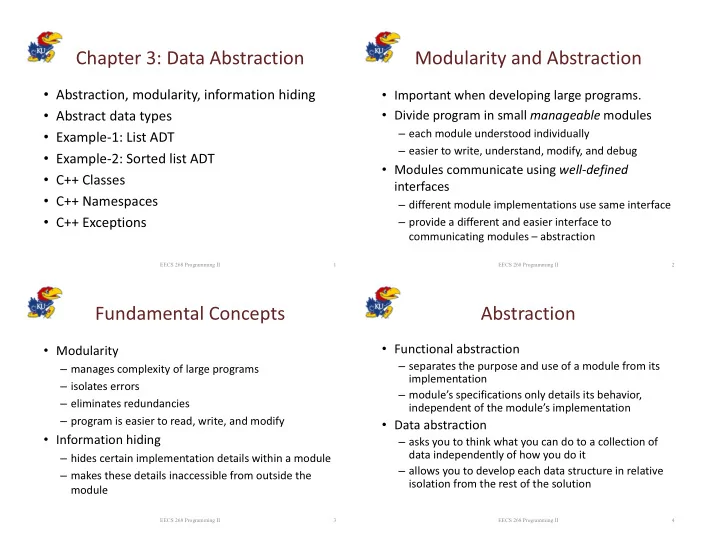
Chapter 3: Data Abstraction

Abstraction, modularity, information hiding Abstract data types Example-1: List ADT Example-2: Sorted list ADT C++ Classes C++ Namespaces C++ Exceptions

EECS 268 Programming II 1

Modularity and Abstraction

Important when developing large programs. Divide program in small manageable modules

each module understood individually easier to write, understand, modify, and debug

Modules communicate using well-defined interfaces

different module implementations use same interface provide a different and easier interface to communicating modules abstraction

2 EECS 268 Programming II

Fundamental Concepts

Modularity

manages complexity of large programs isolates errors eliminates redundancies program is easier to read, write, and modify

Information hiding

hides certain implementation details within a module makes these details inaccessible from outside the module

3 EECS 268 Programming II

Abstraction

Functional abstraction

separates the purpose and use of a module from its implementation

  • Data abstraction

asks you to think what you can do to a collection of data independently of how you do it allows you to develop each data structure in relative isolation from the rest of the solution

4 EECS 268 Programming II

slide-2
SLIDE 2

Isolated Tasks

5 EECS 268 Programming II

Isolation of Modules is Not Total

how it interacts with other modules

6

Figure 3-2 A slit in the wall

EECS 268 Programming II

Abstract Data Type (ADT)

An ADT is composed of

collection of data set of operations on that data

Specifications of an ADT indicate

what the ADT operations do, not how to implement them

Implementation of an ADT

includes choosing a particular data structure

7 EECS 268 Programming II

Abstract Data Types

8

Figure 3-4 A wall of ADT operations isolates a data structure from the program that uses it

EECS 268 Programming II

slide-3
SLIDE 3

Designing an ADT

The design of an ADT should evolve naturally during the problem-solving process Questions to ask when designing an ADT

What data does a problem require? What operations does a problem require?

9 EECS 268 Programming II

List ADT Example

ADT for a list of items: grocery list, TO-DO list What operations do we perform on/with a list?

add item, delete item, find item, read, etc. cannot think of everything?

should refine iteratively!

How to store the data

implementation detail hidden from users of the list arrays or linked lists

10 EECS 268 Programming II

List ADT Example Properties

Except for the first and last items, each item has a unique predecessor and successor Items are referenced by their position in the list Specifications of the ADT operations

Define an operation contract for the ADT list Do not specify how to store the list or how to perform the operations

ADT operations can be used in an application without the knowledge of how the operations will be implemented

11 EECS 268 Programming II

List ADT Example Operations

Create an empty list Destroy a list Determine whether a list is empty Determine the number of items in a list Insert an item at a given position in the list Delete the item at a given position in the list Retrieve the item at a given position in the list

12 EECS 268 Programming II

slide-4
SLIDE 4

List ADT Operation Contract

createList() destroyList() isEmpty():boolean {query} getLength():integer {query} insert(in index:integer, in newItem:ListItemType,

  • ut success:boolean)

remove(in index:integer, out success:boolean) retrieve(in index:integer, dItem:ListItemType,

  • ut success:boolean) {query}

13 EECS 268 Programming II

List ADT Example Operations

Create the list -- milk, eggs, butter

aList.createList() aList.insert(1, milk, success) aList.insert(2, eggs, success) aList.insert(3, butter, success)

Insert bread after milk

aList.insert(2, bread, success) milk, bread, eggs, butter

Insert juice at end of list

aList.insert(5, juice, success) milk, bread, eggs, butter, juice

14 EECS 268 Programming II

List ADT Example Operations

Remove eggs

aList.remove(3, success) milk, bread, butter, juice

Insert apples at beginning of list

aList.insert(1, apples, success) apples, milk, bread, butter, juice

15 EECS 268 Programming II

List ADT Example -- Operations

Algorithm description independent of list implementation, as long as each item has an index Pseudocode function that displays a list displayList(in aList:List){

for (position=1 to aList.getLength()){ aList.retrieve(position, dataItem, success) display dataItem } }

16 EECS 268 Programming II

slide-5
SLIDE 5

List ADT Example -- Implementation

How to implement the List ADT ? th item is stored in items[k-1] To insert an item, make room in the array

17 EECS 268 Programming II

List ADT Example -- Implementation

To delete an item, remove gap in array

18

Figure 3-13 (a) Deletion causes a gap; (b) fill gap by shifting

List ADT Options

Many other design options are possible

retrieve items by name, instead of by index sort items by name or some other factor display list in some sorted order

Several data structures can be used during implementation

arrays, linked lists, trees, hash-tables, etc. different advantages, restrictions, and costs

19 EECS 268 Programming II

ADT Sorted List -- Properties

Maintains items in sorted order Inserts and deletes items by their values, not their positions

20 EECS 268 Programming II

slide-6
SLIDE 6

ADT Sorted List Operation Contract

sortedIsEmpty():boolean{query} sortedGetLength():integer{query} sortedInsert(in nItem:ListItemType, out success:boolean) sortedRemove(in index:integer, out success :boolean) sortedRetrieve(in index:integer, out dItem:ListItemType,

  • ut success :boolean){query}

locatePosition(in anItem:ListItemType,

  • ut isPresent:boolean):integer{query}

21 EECS 268 Programming II

Implementing ADTs

Choosing the data structure to represent the

  • Choice of a data structure depends on

Context in which the operations will be used

Implementation details should be hidden behind a wall of ADT operations

A program (client) should only be able to access the data structure by using the ADT operations

22 EECS 268 Programming II

Hiding Data Structures and Code

EECS 268 Programming II 23

Figure 3-8 ADT operations provide access to a data structure

Violating Information Hiding

24

Figure 3-9 Violating the wall of ADT operations

EECS 268 Programming II

slide-7
SLIDE 7

C++ Classes

  • perations to form an object

an object is an instance of a class a class defines a new data type a class contains data members and methods (member functions) by default, all data members in a class are private

but, can specify them as public can only be accessed by other class members

some member functions have to be public encapsulation hides implementation details

25 EECS 268 Programming II

C++ Classes

EECS 268 Programming II 26

Figure 3-10

  • are encapsulated

C++ Classes

Each class definition is placed in a header file

Classname.h

placed in an implementation file

Classname.cpp

27 EECS 268 Programming II

C++ Classes: Constructors

Constructors

create and initialize new instances of a class

invoked when you declare an instance of the class

have the same name as the class have no return type, not even void

A class can have several constructors

a default constructor has no arguments compiler will generate a default constructor if you do not define any constructors

28 EECS 268 Programming II

slide-8
SLIDE 8

C++ Classes: Constructors

The implementation of a method qualifies its name with the scope resolution operator :: The implementation of a constructor

sets data members to initial values can use an initializer

Sphere::Sphere() : theRadius(1.0) { } // end default constructor

cannot use return to return a value

29 EECS 268 Programming II

C++ Classes: Destructors

Destructor

lifetime ends called automatically for local variables on subroutine exit called explicitly by delete operator primary duty is to de-allocate dynamic memory

Each class has one destructor

for many classes, you can omit the destructor

if they do not allocate any memory

the compiler will generate a destructor if you do not define

  • ne

30 EECS 268 Programming II

C++ Classes: The header file

/** @file Sphere.h */ const double PI = 3.14159; class Sphere { public: Sphere(); // Default constructor Sphere(double initialRadius); // Constructor void setRadius(double newRadius); double getRadius() const double getDiameter() const; double getCircumference() const; double getArea() const; double getVolume() const; void displayStatistics() const; private: double theRadius; // data members should be private }; // end Sphere

31 EECS 268 Programming II

C++ Classes: The implementation file

/** @file Sphere.cpp */ #include <iostream> #include "Sphere.h" // header file using namespace std; Sphere::Sphere() : theRadius(1.0) { } // end default constructor Sphere::Sphere(double initialRadius) { if (initialRadius > 0) theRadius = initialRadius; else theRadius = 1.0; } // end constructor

32 EECS 268 Programming II

slide-9
SLIDE 9

C++ Classes: The implementation file

void Sphere::setRadius(double newRadius) { if (newRadius > 0) theRadius = newRadius; else theRadius = 1.0; } // end setRadius

  • The constructor could call setRadius

33 EECS 268 Programming II

C++ Classes: The implementation file

double Sphere::getRadius() const { return theRadius; } // end getRadius . . . double Sphere::getArea() const { return 4.0 * PI * theRadius * theRadius; } // end getArea . . .

34 EECS 268 Programming II

C++ Classes: Using the class Sphere

#include <iostream> #include "Sphere.h" // header file using namespace std; int main() // the client { Sphere unitSphere; Sphere mySphere(5.1); cout << mySphere.getDiameter() << endl; . . . } // end main

35 EECS 268 Programming II

Inheritance in C++

Inheritance is a way to reuse the code (and behavior) of existing classes

existing class is called the base or super or parent class the new class is called derived or sub class

Derived class inherits any of the publicly defined methods or data members of a base class

public members are accessible by any function protected members are accessible only in base and derived classes

36 EECS 268 Programming II

slide-10
SLIDE 10

Inheritance in C++

Derived classes can add new data members and member functions

methods with the same prototype (name as well as number and types of arguments) in the derived class

  • verride base class methods

distinct from overloading same function name but different set of parameters

An instance of a derived class is considered to also be an instance of the base class

can be used anywhere an instance of the base class can be used

An instance of a derived class can invoke public methods of the base class

37 EECS 268 Programming II

Inheritance Example

  • enum Color {RED, BLUE, GREEN, YELLOW};

class ColoredSphere: public Sphere { public:

  • Color getColor() const;
  • private:

Color c; } // end ColoredSphere

38 EECS 268 Programming II

C++ Namespaces

Mechanism for logically grouping declarations and definitions into one declarative region The contents of the namespace can be accessed by code inside or outside the namespace

use the scope resolution operator (::) to access elements from outside the namespace alternatively, the using declaration allows the names of the elements to be used directly

39 EECS 268 Programming II

C++ Namespaces

Creating a namespace

namespace smallNamespace { int count = 0; void abc(); } // end smallNamespace

Using a namespace

using namespace smallNamespace; count +=1; abc();

40

see C3-namespace.cpp

EECS 268 Programming II

slide-11
SLIDE 11

C++ Exceptions

Mechanism for handling errors at runtime

pre-defined as well as user-defined default action is often to kill the program

A function can indicate that an error has

  • ccurred by throwing an exception

Code that deals with the exception is said to handle it

uses a try block and catch blocks

41 EECS 268 Programming II

C++ Exceptions

Place a statement that might throw an exception within a try block

try { statement(s); }

Write a catch block for each type of exception handled

  • rder is not important

catch(ExceptionClass identifier) { statement(s); } catch(ExceptionClass identifier2) { statement(s); }

42 EECS 268 Programming II

C++ Exceptions

When a statement in a try block causes an exception

rest of try block is ignored

destructors of objects local to the block are called

control passes to catch block corresponding to the exception after a catch block executes, control passes to statement after last catch block associated with the try block if a catch block for the exception is not found, the program typically aborts

43

see C3-exceptions.cpp

EECS 268 Programming II

C++ Exceptions

Throwing exceptions

A throw statement throws an exception Methods that throw an exception have a throw clause

void myMethod(int x) throw(MyException) { if (. . .) throw MyExceptionMyException . . . } // end myMethod

You can use an exception class in the C++ Standard Library or define your own

44 EECS 268 Programming II

slide-12
SLIDE 12

List Implemented Using Exceptions

We define two exception classes

#include <stdexcept> #include <string> using namespace std; class ListIndexOutOfRangeException : public out_of_range { public: ListIndexOutOfRangeException(const string &

  • : out_of_range(message.c_str())

{}

}; // end ListException

45 EECS 268 Programming II

List Implemented Using Exceptions

#include <stdexcept> #include <string> using namespace std; class ListException : public logic_error { public: ListException(const

: logic_error(message.c_str()) {}

}; // end ListException

46 EECS 268 Programming II

List Implemented Using Exceptions

/** @file ListAexcept.h */

ListException.h ListIndexOutOfRangeException.h

. . . class List { public: . . . void insert(int index, const ListItemType& newItem) throw(ListIndexOutOfRangeException, ListException); . . . } // end List

47 EECS 268 Programming II

List Implemented Using Exceptions

/** @file ListAexcept.cpp */ void List::insert(int index, const ListItemType& newItem) throw(ListIndexOutOfRangeException, ListException); { if (size > MAX_LIST) throw

  • . . .

} // end insert

48 EECS 268 Programming II

slide-13
SLIDE 13

Summary

Data abstraction controls the interaction between a program and its data structures Abstract data type (ADT): a set of data- management operations together with the data values upon which they operate Define an ADT fully before making any decisions about an implementation C++ classes used to implement ADT

encapsulates both data and operations

49 EECS 268 Programming II

Summary

Members of a class are private by default

data members are typically private public methods can be provided to access them

Namespace: a mechanism to group classes, functions, variables, types, and constants You can throw an exception if you detect an error during program execution

use try and catch blocks to handle exceptions

50 EECS 268 Programming II