
SLIDE 1
Chapter 3: Using.
Creating, Testing, and Using Simulations of the Galaxy Population in the era of surveys of 10 billion galaxies
Risa Wechsler KIPAC @ Stanford & SLAC
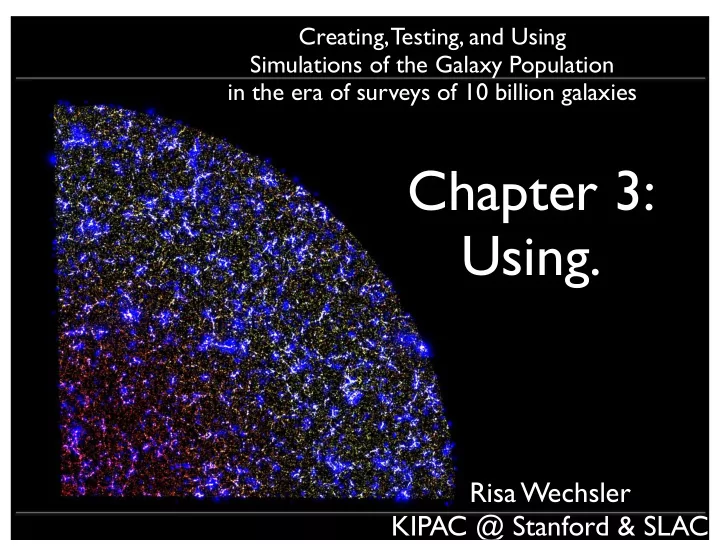
Chapter 3: Using. Risa Wechsler KIPAC @ Stanford & SLAC large - - PowerPoint PPT Presentation
Creating, Testing, and Using Simulations of the Galaxy Population in the era of surveys of 10 billion galaxies Chapter 3: Using. Risa Wechsler KIPAC @ Stanford & SLAC large cosmological simulations allow you to do many analyses in new
Creating, Testing, and Using Simulations of the Galaxy Population in the era of surveys of 10 billion galaxies
Risa Wechsler KIPAC @ Stanford & SLAC
large cosmological simulations allow you to do many analyses in new ways
that you observe.
you think reproduces those properties well.
you would statistically expect to find many
cosmological model in your simulation is identical to the true cosmological model of our universe)
be thought of as the prior PDF on the properties
your observable data, to get the posterior PDF of some underlying property of the object in question.
Busha, Marshall et al (2011); Marshall, Busha, RW 2012 in prep
masses, proper motions
millions of dark matter halos
motions, internal properties of each one at every output time, plus their assembly histories
density function for galaxy halos
the LMC and SMC
Observational Constraints on the Milky Way
–Not a “satellite” of a larger structure –Has exactly two satellites with vmax > 50 km/s –No other substructures within 300 kpc with vmax > 25km/s
Sagittarius is next brightest with vmax ~ 20 km/s (Strigari et al 10)
Watkins, Evans, & An 2010; Kallivayalil, van der Marel, & Alcock 06; Krachentsev et al 04; van der Marel et al 02 LMC SMC vmax ~65 km/s ~60 km/s r0 50 kpc 60 kpc vrad 89 ± 4 km/s 23 ± 7 km/s Speed 378 ± 18 km/s 301 ± 52 km/s
motion of the MCs: observing the motion of stars relative to background quasars over a baseline of several years)
dynamical models
true cosmological context; dynamics generated by an LCDM universe
galaxies with vmax > 50 km/s, the LMC and SMC
satellite galaxies with vmax > 50 km/s.
e.g. mass, concentration, assembly history...
properties, given the data?
Prior PDF: P1 ( {Mhost,r1,v1,r2,v2,...} ¦ H )
Likelihood P2 ( [r1,obs,v1obs,r2,obs,v2,obs] ¦ {x}, H)
Posterior PDF P3 ( {x} ¦ [d], H ) P1 x P2
samples from P1. Look at integrals:
<x> = \int x P3 dx = \int x (P3/P1) P1 dx = \int x P2 P1 dx ̃ \sum{ x P2 }
weighted by the likelihood
like galaxies have two Magellanic clouds (Busha et al 2011b)
surprisingly close, and are moving surprisingly fast! What else can we learn?
see also Boylan-Kolchin, Besla & Hernquist 2010
Visualization: Ralf Kaehler see Sky & Telescope cover, October 2012!
samples, that then dominate the posterior
Large volumes are needed: we can then assert that we are studying the MW in its cosmological context (Copernicus, cf SDSS, etc) / larger volumes for rarer objects! 400 samples lie within 2- volume, but Neff = 104 Sampling noise is included in the statistical error bars, estimated by bootstrap resampling Additional uncertainty from Neff = 104 sampling noise
–apply more/tighter priors (e.g. new measurements of the LMC proper motions!) –look at the posterior distribution of other intrinsic properties, and learn more about the MW (e.g. satellite population, distribution and speeds of dark matter particles, etc.)
the same way? Consuelo: ~100x Bolshoi volume
Local group masses are dominated by M31 (around 3 times heavier than MW): formal uncertainty around 50% log M200 estimates: MW: 12.0 +/- 0.1 prior M31: 12.66 +/- 0.15 M33: 11.7 +/- 0.3 LG: 12.8 +/- 0.1 (errors are correlated)
Isolated groups of 3 halos, with M31 and M33 distance and radial velocity likelihoods
M33 exists +M31 kinematics +M33 kinematics +MW mass
MMW MM31 MM33 MLG MLG MM33 MM31
M31’s radial orbit suggests a simple toy model for the Local Group collapse (Kahn & Woltjer 1959) We can calibrate this by computing MTA for each LG analog: M200 = MTA / A200 log A200 estimates: Prior: -0.10 +/- 0.23 Posterior: -0.06 +/- 0.10 Li & White: 0.0+/-0.4
time Big Bang
0 Gyr 13.7 Gyr
r = a (1 - cos ) t = (a3/GM)1/2 ( - sin ) v = (GM/a)1/2 sin / (1 - cos )
r, v, t
Isolated groups of 3 halos, with M31 and M33 distance and radial velocity likelihoods
M33 exists +M31 kinematics +M33 kinematics +MW mass
MLG MTA A200 vrad vrad A200 MTA
the same way? Consuelo: ~100x Bolshoi volume
satellite” population do we predict?
importance sampling break down? How can we sample PDFs in (100 epochs x 100 parameters*) = 10000D? Importance sampling is very inefficient (need large volumes), but constrained realizations are expensive... Middle ground?
* e.g. 2 mass profile params, 6D phase space, 3 angular momentum vector, 6 inertia tensor = 17 per halo x 5-6 halos ~ 100
scale structure?
relate to properties well predicted in simulations, and some intrinsic property you are interested in!
large cosmological simulations allow you to do many analyses in new ways
large cosmological simulations allow you to do many analyses in new ways... but care must be taken to properly estimate the impact of uncertainties
cosmology:
–find the clusters –weigh the clusters
–depends on relating these
predictions of the mass function of halos in a given cosmological model