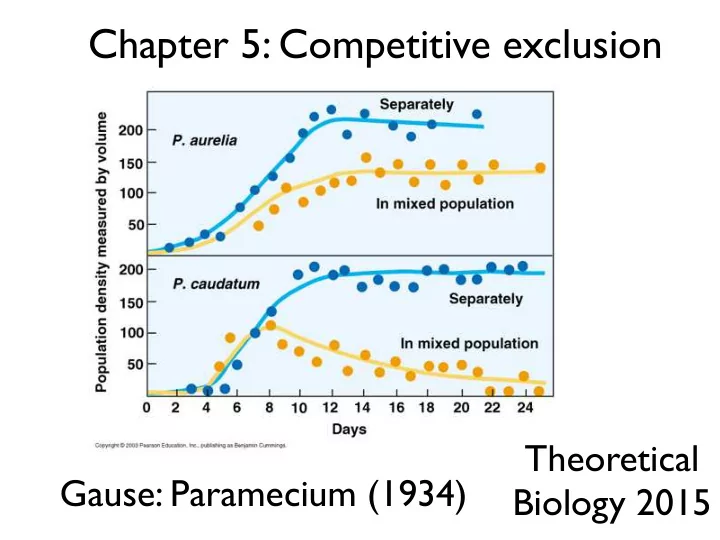
chapter 5 competitive exclusion

Chapter 5: Competitive exclusion Theoretical Gause: Paramecium - PowerPoint PPT Presentation

Chapter 5: Competitive exclusion Theoretical Gause: Paramecium (1934) Biology 2015 Competitive exclusion Tilman 1981 Two species of diatom feeding on silica: Af: Asterionella formosa Su: Synedra ulna , Si: silica From: Smith & Smith,


  1. Chapter 5: Competitive exclusion Theoretical Gause: Paramecium (1934) Biology 2015

  2. Competitive exclusion Tilman 1981 Two species of diatom feeding on silica: Af: Asterionella formosa Su: Synedra ulna , Si: silica From: Smith & Smith, Elements of Ecology

  3. Question 6.5 on immune responses d T d I d t = σ − δ T T − β TI , d t = β TI − δ I I − k 1 IE 1 − k 2 IE 2 , d E 1 d E 2 d t = α 1 E 1 I − δ E E 1 and d t = α 2 E 2 I − δ E E 2 . dE./dt gives: I= δ E / α 1 and I= δ E / α 2 . E 1 and E 2 have to be solved from dI/dt=0. Substitute I= δ E / α 1 into dE 2 /dt: d E 2 = δ E E 2 ( α 2 / α 1 − 1) < 0 d t

  4. Simplest mathematical model Resource (e.g., amount of nitrogen available): R = 1 − N 1 − N 2 Two consumers dN 1 dN 2 = N 1 ( b 1 R − d 1 ) and = N 2 ( b 2 R − d 2 ) dt dt With a fitness of R 0 1 = b 1 /d 1 R 0 2 = b 2 /d 2 and

  5. Nullclines Substitution of R = 1 − N 1 − N 2 into d N 1 = N 1 ( b 1 R − d 1 ) d t yields d N 1 = N 1 ( b 1 (1 − N 1 − N 2 ) − d 1 ) d t which has nullclines N 1 = 0 and 1 N 2 = 1 − − N 1 R 0 1

  6. 1 − 1 Nullclines R 0 N 2 1 − 1 N 1 R 0 Similarly the d N 2 / d t = 0 nullcline is found to be 1 N 2 = 1 − − N 1 R 0 2 Thus, plotting N 2 as a function of N 1 the two nullclines run parallel with slope − 1.

  7. Paradox of the plankton, bacteria in the gut, ... How can so many species co-exist? co-existence not an equilibrium? Space is not homogeneous? Species are so similar that exclusion is slow? Species are largely controlled by parasites?

Recommend


More recommend


Explore More Topics

Stay informed with curated content and fresh updates.