Characterization of a Cortex-M4 microcontroller with backside - PowerPoint PPT Presentation
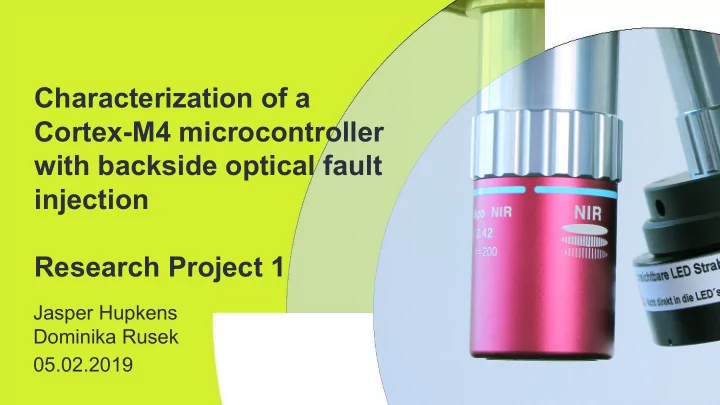
Characterization of a Cortex-M4 microcontroller with backside optical fault injection Research Project 1 Jasper Hupkens Dominika Rusek 05.02.2019 1 Introduction to the world of fault injection Research project at Riscure Fault
Characterization of a Cortex-M4 microcontroller with backside optical fault injection Research Project 1 Jasper Hupkens Dominika Rusek 05.02.2019 1
Introduction to the world of fault injection • Research project at Riscure • Fault injection techniques introduce faults into a target by controlled environmental changes, in order to alter its intended behavior • 5 types - clock, voltage, electromagnetic, optical, temperature • Our focus - optical (laser) fault injection 2 Introduction
Why? • Secure software relies on hardware functioning in the intended way • You can have the best lock in the world on your door, but if your door is made out of paper, it is useless • Used e.g in bypassing secure boot of Nintendo consoles 3 Introduction
Research question What is the security impact of injecting laser glitches into an ARM based, Cortex-M4 microcontroller (MCU)? • How may laser glitches be injected into the MCU so that it results in a fault? • What are the optimal variables for the laser to introduce glitches in the ARM Cortex-M4 MCU? • What behavioral changes occur in the MCU when injecting laser glitches? 4 Research setup
Device Under Test - Cortex-M4 5 Research setup
Test environment 6 Research setup
Test environment 7 Research setup
Methodology • Global vs detailed scan • Several laser parameters • Color coding of the results: • Red/pink – success • Green – expected • Yellow – mute • Orange – reset • Cyan – timeout • Glitch repeatability 8 Research setup
Results: Counter increment Code in C: • Goal: verify the setup, check if glitches can occur • Result: 0.012% successful glitches Code in ARM assembly: • Different memory and register operations 9 Results
Results: Counter increment 10 Results
Results: Bitwise increment • Goal: setting bits in a byte with a consecutive power of 2 • Result: 36.14% successful glitches • 0xff: 1111 1111 • 0xfb: 1111 1011 • 0xf7: 1111 0111 11 Results
Results: Bitwise increment 12 Results
Results: Register value modification • Goal: Modify value while in register • How: Initialize registers with known values • Result: 1.50% successful glitches • But we are modifying instructions instead 13 Results
Results: Register value modification • Register values: • r0: fa ca de 00 r6 : de ad be ef r4: ca fe ba be r5: fa ce fe ed • NOP instruction: mov r1, r1 • MOV transformed into Linear Shift Left (LSL) • Expected output: 0xfacade00deadbeefcafebabefacefeed 14 Results
Results: ADD loop • Goal: Increment a counter to 10,000 using a single instruction • Instruction: add.w r1, r1 #1 repeated 10,000 times • Result: 50.77% successful glitches • 0xdeadd77f • 0xeadc0789 • 0x1890 15 Results
Results: ADD loop • 16 Results
Results: ADD loop (0xdeadd77f) • Register r0 was first loaded with 0xdeadbeef • This value now shows up in r1 • Subtract 0x1890 from the result 17 Results
Results: ADD loop (0xeadc0789) • The same was true for this result • When we subtract 0x1890 from result 18 Results
Results: ADD loop • So how can this happen? • We modified the processor instruction, instead loading r1 it loads r0 19 Results
Results: ADD loop • How could we obtain the value of 0x1890 • Probably the counter was restarted, also this can be explained using a modified instruction • The AND instruction sets the counter back to 1 or 0 20 Results
Bypass authentication • Goal: Attack a real-world scenario, in this case, password verification • Result: 0.22% successful glitches • Lots of possibilities for introducing glitches 21 Results
Results: Bypass authentication 22 Results
Conclusion What is the security impact of injecting laser • There are two ways laser injection can be glitches into an ARM performed - backside and frontside based, Cortex-M4 microcontroller (MCU)? • Power 20-25% of the maximum 20W seemed to be most efficient • Other variables differ per experiment • We have proven to be able to modify processor instructions 23 Conclusion
Future work • Use of different objectives: magnitude 20x or 50x to have smaller spotsize and more precise aim • Target specific features of the board e.g. the Read Data Protection (RDP) byte • Test other processors in Cortex family with more advanced security features e.g. TrustZone or Memory Protection Unit (MPU) 24 Conclusion
Thank you! Questions? 25 Conclusion
Recommend
More recommend
Explore More Topics
Stay informed with curated content and fresh updates.