Charles Snow Gillingham The Payload Team Katariina Lehtiniemi, Step - - PowerPoint PPT Presentation

charles snow gillingham the payload team
SMART_READER_LITE
LIVE PREVIEW

Charles Snow Gillingham The Payload Team Katariina Lehtiniemi, Step - - PowerPoint PPT Presentation

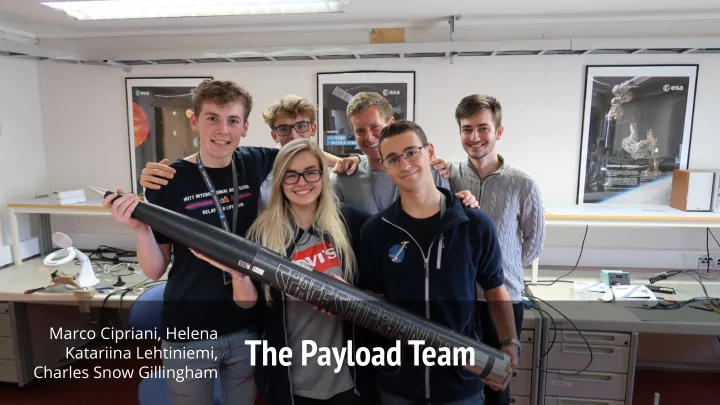
Marco Cipriani, Helena Charles Snow Gillingham The Payload Team Katariina Lehtiniemi, Step 1: adding the transmitter (Boris) and the encoder (Ottorino) Near the back and the external connector (Sans) They must be connected to the antennas


slide-1
SLIDE 1

Marco Cipriani, Helena Katariina Lehtiniemi, Charles Snow Gillingham The Payload Team
slide-2
SLIDE 2

Step 1: adding the transmitter (Boris) and the encoder (Ottorino)

  • Near the back and the external connector

(Sans)

  • They must be connected to the antennas

and to all the sensors

slide-3
SLIDE 3

Step 2: Johnny

  • Internal temperature

sensor (PCB) to measure how hot the circuits are

  • External sensor (Henry)

near the antenna to measure outer temperature

  • Signal amplification
slide-4
SLIDE 4

Step 3: Nacht Nina

  • Named after Tina!
  • Current sensor: connected

between the batteries and the load

  • Battery voltage sensor
  • Connected to the IMU
slide-5
SLIDE 5

Measuring the current

Detect voltage drop between the leads of the small R1 resistor and then use Ohm’s law (V=R*I)

slide-6
SLIDE 6

Measuring battery voltage

Vmeasured=Vin*R1/(R1+R2)

slide-7
SLIDE 7

Step 4: all the other sensors

  • Qualification tests needed!
  • No mounting on plate if without name
  • Pressure sensor: Chris
  • Light: Turboneger
  • Magnetometer: Magneto
  • Acceleration (X/Y): Alexandria
  • Temperature Array: Arthur
  • IMU: Colombus
  • GPS: George
slide-8
SLIDE 8

Step 5: wirings

  • Make loads and loads of

wires…

slide-9
SLIDE 9

Step 6: charging and testing

  • Don’t touch the metal!
  • Slow charging during pre-flight
  • Testing together with Telemetry
slide-10
SLIDE 10

Step 7: tighten all the wires!

With tape and strings

slide-11
SLIDE 11

Step 8: give it a name and sign it!

slide-12
SLIDE 12

The end

slide-13
SLIDE 13

The results of the Payload team!

slide-14
SLIDE 14

External temperature

  • Temperature drop at

launch time: possibly due to airflow when the engine starts

  • Becomes higher later:

possibly due to air pressure

slide-15
SLIDE 15

Internal temperature

Fast increase of temperature: maybe heat from engines?

slide-16
SLIDE 16

However, Chris doesn’t think so

  • He was upside down and didn’t

measure the air pressure on the nose cone (which is in charge of the increase of temperature)

slide-17
SLIDE 17
slide-18
SLIDE 18

Comparison with temperature array

slide-19
SLIDE 19

Comparison with the vertical speed

slide-20
SLIDE 20

Comparison with height

slide-21
SLIDE 21

Temperature in Troposphere

slide-22
SLIDE 22

Battery voltage

slide-23
SLIDE 23

The end!