Che hemical ical Prod oduction ction Presented to Side event - - PowerPoint PPT Presentation

che hemical ical prod oduction ction
SMART_READER_LITE
LIVE PREVIEW

Che hemical ical Prod oduction ction Presented to Side event - - PowerPoint PPT Presentation

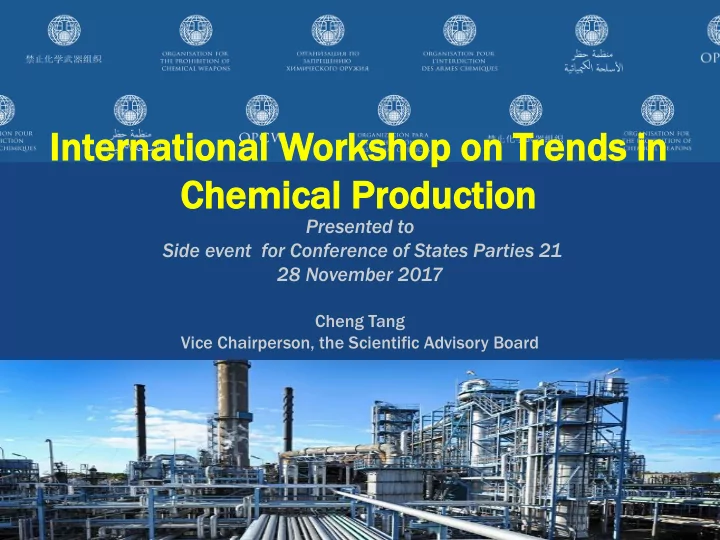
Int nternational ernational Worksh orkshop op on on Tre rend nds s in in Che hemical ical Prod oduction ction Presented to Side event for Conference of States Parties 21 28 November 2017 Cheng Tang Vice Chairperson, the


slide-1
SLIDE 1

www.opcw.org

1

Int nternational ernational Worksh

  • rkshop
  • p on
  • n Tre

rend nds s in in Che hemical ical Prod

  • duction

ction

Presented to Side event for Conference of States Parties 21 28 November 2017

Cheng Tang Vice Chairperson, the Scientific Advisory Board

slide-2
SLIDE 2

www.opcw.org

2

slide-3
SLIDE 3

www.opcw.org

Plan

  • Summary of the Workshop on Trends in Chemical

Production (Cheng Tang)

  • Experiments of making ice creams (Chris, Jonathan, Siqing

and Amy ) Science ABC relevant to the experiment

  • Outcomes of the workshop
  • Conclusions and the future plan (Jonathan Forman)
  • Additional ice cream test & observations
  • Road map towards the Fourth Review Conference

3

slide-4
SLIDE 4

www.opcw.org

4

Funded by

International Workshop on Trends in Chemical Production

3-5 October 2017, Zagreb, Croatia

City of Zagreb Under the auspices of the Croatia President Kolinda Grabar-Kitarović

slide-5
SLIDE 5

www.opcw.org

The fourth and final workshop of a series intended to inform the SAB report for the 4TH RevCom with 38 listed participants

  • Dr. C. Timperley
  • Dr. Z. Kovarik
  • Dr. J. Forman
slide-6
SLIDE 6

www.opcw.org

The fourth and final workshop of a series intended to inform the SAB report for the 4TH RevCom with 38 listed participants

  • Dr. C. Timperley
  • Dr. Z. Kovarik
  • Dr. J. Forman

Mr Mario Antonić

State Secretary Ministry of Economy, Entrepreneurship and Crafts of Croatia “achievements in the field of chemistry should be exclusively used to the benefit of humans in a manner not forbidden by the Convention, by means of promoting free trade in chemical”

  • Mr. Mario Antonić
slide-7
SLIDE 7

www.opcw.org

Overview workshop sessions and discussions

7

slide-8
SLIDE 8

www.opcw.org

Trends in chemical production

Examined trends in all sectors

  • f the chemical industry

Chemical economy Commodity chemicals Pharmaceuticals Fine/speciality chemicals Custom automated synthesis Proteins and nucleic acids Agricultural chemicals Regulatory issues

slide-9
SLIDE 9

www.opcw.org

The workshop discussed in 10 different sessions:

9

slide-10
SLIDE 10

www.opcw.org

10

slide-11
SLIDE 11

www.opcw.org

11

slide-12
SLIDE 12

www.opcw.org

12

slide-13
SLIDE 13

www.opcw.org

13

slide-14
SLIDE 14

www.opcw.org

Highlights of the trend of chemical production and the implementation of CWC

14

slide-15
SLIDE 15

www.opcw.org

Trends in the European and global chemical industry

  • Dr René

né van an Slot

  • ten from
  • m cefi

fic (Eu Europ

  • pe

e Chemica emical l Industr dustry y Council uncil) ) discussed cussed the e evoluti lution n of chemical emical produ roduction ction af after er entr try into

  • force

force of the e Convention. ention.

  • 1997 as “tripolar”, with the European Union (EU), the

United States of America (USA), and Japan as the top three chemical producing regions;

  • The world has since witnessed the emergence of multiple

new production platforms in Brazil, India, the Middle East, South East Asia, and Korea. Roughly 40% of world chemical production now occurs in China.

15

slide-16
SLIDE 16

www.opcw.org

Trends in the European and global chemical industry

  • Dr René

né van an Slot

  • ten from
  • m cefi

fic (Eu Europ

  • pe

e Chemica emical l Industr dustry y Council uncil) ) discussed cussed the e evoluti lution n of chemical emical produ roduction ction af after er entr try into

  • force

force of the e Convention. ention.

  • 1997 as “tripolar”, with the European Union (EU), the

United States of America (USA), and Japan as the top three chemical producing regions;

  • The world has since witnessed the emergence of multiple

new production platforms in Brazil, India, the Middle East, South East Asia, and Korea. Roughly 40% of world chemical production now occurs in China.

16

slide-17
SLIDE 17

www.opcw.org

Trends in the European and global chemical industry

  • Dr René

né van an Slot

  • ten from
  • m cefi

fic (Eu Europ

  • pe

e Chemica emical l Industr dustry y Council uncil) ) discussed cussed the e evoluti lution n of chemical emical produ roduction ction af after er entr try into

  • force

force of the e Convention. ention.

  • 1997 as “tripolar”, with the European Union (EU), the

United States of America (USA), and Japan as the top three chemical producing regions;

  • The world has since witnessed the emergence of multiple

new production platforms in Brazil, India, the Middle East, South East Asia, and Korea. Roughly 40% of world chemical production now occurs in China.

17

slide-18
SLIDE 18

www.opcw.org

18

slide-19
SLIDE 19

www.opcw.org

19

  • A shale gas boom has revived the chemical industry in

the USA;

  • EU chemical industry are seeking to move up the

innovation ladder by developing products that provide solutions to global challenges that include climate change, energy, water, health, and food.

slide-20
SLIDE 20

www.opcw.org

20

  • A shale gas boom has revived the chemical industry in

the USA;

  • EU chemical industry are seeking to move up the

innovation ladder by developing products that provide solutions to global challenges that include climate change, energy, water, health, and food.

slide-21
SLIDE 21

www.opcw.org

Experiment I: Liquid Nitrogen Ice Cream Preparation

  • Background: The workshop discussed production of

chemicals in large scales … liquid nitrogen ice cream preparation is very much like the process of an industry scale production of chemicals with different raw materials …

  • Science ABC: Examples of large scale industry

production of chemicals

  • Action now: A team work ... Assitance with Chris,

Jonathan, Siqing & Amy ....

21

slide-22
SLIDE 22

www.opcw.org

22

slide-23
SLIDE 23

www.opcw.org

23

  • chemicals represent one of the largest and most research and

development (R&D) intensive manufacturing sectors in all of the advanced economies, whose patterns of innovation can profoundly impact economic growth;

  • highlighted some areas of significant change occurring in the

European chemical industry with the aim of lowering environmental impact, while maintaining competitiveness

slide-24
SLIDE 24

www.opcw.org

24

slide-25
SLIDE 25

www.opcw.org

25

slide-26
SLIDE 26

www.opcw.org

26

slide-27
SLIDE 27

www.opcw.org

27

slide-28
SLIDE 28

www.opcw.org

28

slide-29
SLIDE 29

www.opcw.org

29

slide-30
SLIDE 30

www.opcw.org

30

slide-31
SLIDE 31

www.opcw.org

31

slide-32
SLIDE 32

www.opcw.org

32

slide-33
SLIDE 33

www.opcw.org

33

Science ABC related to the large scale industry production of chemicals

slide-34
SLIDE 34

www.opcw.org

34

Example of producing bio-based chemicals

slide-35
SLIDE 35

www.opcw.org

35

slide-36
SLIDE 36

www.opcw.org

36

slide-37
SLIDE 37

www.opcw.org

37

slide-38
SLIDE 38

www.opcw.org

38

slide-39
SLIDE 39

www.opcw.org

39

slide-40
SLIDE 40

www.opcw.org

40

slide-41
SLIDE 41

www.opcw.org

41

slide-42
SLIDE 42

www.opcw.org

42

Evolution of bioreactor and its trends / developments

slide-43
SLIDE 43

www.opcw.org

43

slide-44
SLIDE 44

www.opcw.org

44

slide-45
SLIDE 45

www.opcw.org

45

slide-46
SLIDE 46

www.opcw.org

46

slide-47
SLIDE 47

www.opcw.org

47

slide-48
SLIDE 48

www.opcw.org

  • Background: the workshop discussed disposable

bioreactors ...making ice cream in a small palstic bag is very much like the approach producing chemcials in disposable bioreactors ...

  • Science ABC: Evolution of bioreactor and its trends

/ developments

  • Action now: making ice cream in a small plastic

bag.... Assistance with Chris, Jonathan, Siqing & Amy ....

48

Experiment II:

Making ice cream in a small plastic bag

slide-49
SLIDE 49

www.opcw.org

49

slide-50
SLIDE 50

www.opcw.org

50

slide-51
SLIDE 51

www.opcw.org

51

slide-52
SLIDE 52

www.opcw.org

52

slide-53
SLIDE 53

www.opcw.org

53

slide-54
SLIDE 54

www.opcw.org

Contract Chemicals

Contract Chemicals Company Profile

R E A C T I N G T O Y O U R R E Q U I R E M E N T S

  • established in1977
  • privately owned
  • turnover ca. €30m per annum
  • sales in over 40 countries
  • employ around 100 people
  • based in Knowsley, UK
slide-55
SLIDE 55

www.opcw.org

CMO’s - Custom, Toll, Contract Manufacture

  • CMO:

Custom/Contract Manufacturing Organisation

  • Custom manufacturing:

the process of making products or product lines to a customer's unique specifications.

  • Toll Manufacturing:

the process of a company providing its raw materials or semi-finished goods to a third-party CMO who often has specialized equipment or chemistry, to carry manufacturing processes on its behalf using those materials or goods for a fee or toll.

  • Contract Manufacturing:

either of the above, with a term/conditions contract in place

slide-56
SLIDE 56

www.opcw.org

CMO’s - Custom, Toll, Contract Manufacture

  • CMO:

Custom/Contract Manufacturing Organisation

  • Custom manufacturing:

the process of making products or product lines to a customer's unique specifications.

  • Toll Manufacturing:

the process of a company providing its raw materials or semi-finished goods to a third-party CMO who often has specialized equipment or chemistry, to carry manufacturing processes on its behalf using those materials or goods for a fee or toll.

  • Contract Manufacturing:

either of the above, with a term/conditions contract in place

slide-57
SLIDE 57

www.opcw.org

Page 57

The Need for Contract Manufacture

The customer company:-

  • fills its capacity, but needs more product
  • develops a new product and wants to test the market

before investing in a new plant

  • does not have the equipment and/or chemistry to produce

a new product

  • wants to outsource early stages, but produce the final

compound in-house

  • wants local production for local markets
  • needs building blocks (intermediates) for its products or

formulations manufactured to bespoke specifications

slide-58
SLIDE 58

www.opcw.org

Page 58

Choosing a CMO

  • Every chemical company is a CMO!
  • Almost every toll manufacturing process is carried out

under a non-disclosure agreement

  • These can be onerous and restrictive
  • Choose a company whose equipment, chemistry

and regulatory position fits the process/product

  • Large amounts of information available through

Web, trade shows, trade press and company literature

  • Be prepared to invest
slide-59
SLIDE 59

www.opcw.org

Chemical Weapons Manufacture

slide-60
SLIDE 60

www.opcw.org

Chemical Weapons Manufacture

slide-61
SLIDE 61

www.opcw.org

Thematic Discussions: four topics considered

61

Interactive Discussions

slide-62
SLIDE 62

www.opcw.org

Topic 1:

Advances in chemical production technologies and the synthesis of chemicals scheduled under the Chemical Weapons Convention

Facilitated by Jonathan Forman

  • What has changed and what impact

might it have on recognizing a relevant process?

  • If the answer changes when considering

different production scales?

62

slide-63
SLIDE 63

www.opcw.org

Topic 2:

Advances in biological production technologies and the synthesis of bioregulators and/or biological toxins

Facilitated by Cheng Tang

  • What is the current status of the chemical

synthesis of bioregulators and/or biological toxins?

  • Is there an impact to the Chemical Weapons

Convention given the capabilities available for production of bioregulators and/or toxins?

63

slide-64
SLIDE 64

www.opcw.org

Topic 3:

New synthesis tools and technologies for enhancing the capabilities of the OPCW Designated Laboratories

Facilitated by Chris Timperley

  • What synthetic tools and methods are available

for enhancing the capabilities of OPCW Designated Labs?

  • And which synthetic technologies being adopted in

academia and/or industry could benefit the Designated Labs?

64

slide-65
SLIDE 65

www.opcw.org

Topic 4:

The impact of current trends and future directions in chemical production on the Chemical Weapons Convention verification regime

Facilitated by Stephanie Dare-Doyen

  • Which current trends and potential future

directions in chemical production would be of concern for the Convention?

  • In light of advances in science and technology,

and a changing security environment, are revisions to the verification approach necessary?

65

slide-66
SLIDE 66

www.opcw.org

The Final Report (SAB-26/WP.2 )

(REPORT OF THE SCIENTIFIC ADVISORY BOARD'S WORKSHOP ON TRENDS IN CHEMICAL PRODUCTION)

66

slide-67
SLIDE 67

www.opcw.org

The Final Report (SAB-26/WP.2 )

(REPORT OF THE SCIENTIFIC ADVISORY BOARD'S WORKSHOP ON TRENDS IN CHEMICAL PRODUCTION)

67

Available in the OPCW webpage https://www.opcw.org/fileadmin/OPCW/SAB/en/ sab-26-wp02_e_.pdf

slide-68
SLIDE 68

www.opcw.org

Summary

  • utcomes of the workshop

68

slide-69
SLIDE 69

www.opcw.org

Outcomes of the workshop

69

a) A fit-for-purpose verification regime should maintain up to date operational knowledge of chemical (and biological) production methods (including aspects of synthesis and analysis). b) Drew attention to previous advice from the SAB’s temporary working group (TWG) on Verification that considered risk-benefit approaches as a means to focus verification, including consideration of relevant chemicals not on the current schedules. c) Recognized a number of areas with potentially transferable learnings from industrial practices. These include approaches to trace analysis and tools for chemical risk assessment.

slide-70
SLIDE 70

www.opcw.org

Outcomes of the workshop (continue)

70

d) Several significant developments in the global chemical industry observed over the past 20 years were not recognized until they actually took shape (e.g. they were unanticipated in the years just before they happened). e) Synthesis tools being developed for chemical discovery purposes (complemented with machine learning approaches for predicting chemistry) can potentially enable capabilities for laboratories to quickly generate large sets of analytical data, screen for reactivity and toxicity properties, and elucidate degradation pathways

  • f a broad range of chemical classes.
slide-71
SLIDE 71

www.opcw.org

Outcomes of the workshop (continue)

71

f) The technical presentations and content of the workshop served as a reminder of the highly trans-disciplinary (convergent) nature of 21st century technology development, with scientific disciplinary convergence going well beyond the fields of chemistry and biology. Sharing of experience on science advice with other relevant disarmament communities (especially the Biological Weapons Convention stakeholders) should be encouraged. g) In the discussion of changing realities and the relevance of current verification practices, it was acknowledged that greater levels of science and technology engagement, and knowledge sharing amongst States Parties could also support

slide-72
SLIDE 72

www.opcw.org

Outcomes of the workshop (continue)

72

f) The technical presentations and content of the workshop served as a reminder of the highly trans-disciplinary (convergent) nature of 21st century technology development, with scientific disciplinary convergence going well beyond the fields of chemistry and biology. Sharing of experience on science advice with other relevant disarmament communities (especially the Biological Weapons Convention stakeholders) should be encouraged. g) In the discussion of changing realities and the relevance of current verification practices, it was acknowledged that greater levels of science and technology engagement, and knowledge sharing amongst States Parties could also support

slide-73
SLIDE 73

www.opcw.org

  • The SAB will prepare a report to the Forth Review

Conference based on the series of four workshops conducted :

  • Chemical Forensic (Helsinki, June 2016)
  • Medical Countermeasures (Paris, October, 2016)
  • Innovative Technologies for Chemical Security (Rio De Janeiro, July

2017)

  • Trends in Chemical Industry (Zagreb, October 2017)
  • Jonathan will explain more…

73

The next steps

slide-74
SLIDE 74

www.opcw.org

Thank you for your attention!

74