Chemical Biology of Tea Catechins Tsutomu NAKAYAMA Laboratory of - - PowerPoint PPT Presentation

chemical biology of tea catechins
SMART_READER_LITE
LIVE PREVIEW

Chemical Biology of Tea Catechins Tsutomu NAKAYAMA Laboratory of - - PowerPoint PPT Presentation

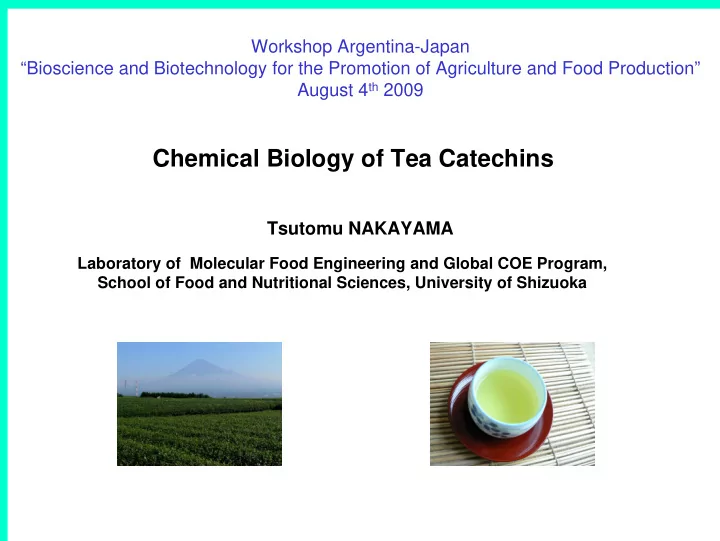
Workshop Argentina-Japan Bioscience and Biotechnology for the Promotion of Agriculture and Food Production August 4 th 2009 Chemical Biology of Tea Catechins Tsutomu NAKAYAMA Laboratory of Molecular Food Engineering and Global COE


slide-1
SLIDE 1

Chemical Biology of Tea Catechins

Tsutomu NAKAYAMA

Laboratory of Molecular Food Engineering and Global COE Program, School of Food and Nutritional Sciences, University of Shizuoka

Workshop Argentina-Japan “Bioscience and Biotechnology for the Promotion of Agriculture and Food Production” August 4th 2009

slide-2
SLIDE 2

A C B galloyl

Epicatechin [EC] Epigallocatechin [EGC] Epicatechin gallate [ECg] Epigallocatechin gallate [EGCg]

What are tea catechins ?

Inactivation of influenza virus ECg > EGCg >> EGC Antibacterial effect EGCg > ECg > EGC > EC

The four analogues show substantially different activities in assays in vitro. Tea catechins are present in green tea and black tea. EC 6%, EGC 19%, ECg 14%, EGCg 59% In green tea.

Antioxidant activity Antibacterial effect Antimutagenicity Antihypercholesterolemia etc…

slide-3
SLIDE 3

Part 1

Interaction between catechins and proteins (albumin)

slide-4
SLIDE 4

nitroblue tetrazolium nitroblue tetrazolium (NBT) (NBT) nitroblue formazan nitroblue formazan

PVDF membrane PVDF membrane

ROS ROS

1 1-

  • 1. Detection of EGCg
  • 1. Detection of EGCg-
  • binding proteins with

binding proteins with redox cycling staining redox cycling staining

PVDF membrane PVDF membrane

OH OH O O

ROS (superoxide) ROS (superoxide)

O O HO OH OH OH OH O OH OH OH

Glycine, alkaline pH Glycine, alkaline pH R electrophoresis

slide-5
SLIDE 5

1. Tea catechins bind covalently human serum albumin, but only under oxidative conditions. 2. Under these conditions, human serum albumin is also oxidized. 3. A LC-MS study conducted in our laboratory revealed that the covalent binding occurred between EGCg and cystein of human serum albumin.

  • Mol. Nutr. Food Res., 53, 709-715, 2009

Albumin stabilizes (-)-epigallocatechin gallate in human serum: Binding capacity and antioxidant property

Conclusions obtained by the redox cycling staining

slide-6
SLIDE 6

1-2. Dynamic analysis of non-covalent binding of catechins to proteins by Quartz-Crystal Microbalance (QCM)

1 /τ = Kon[Y]+Koff

  • Conc. of catechins

1 /τ

Catechins AT-cut Quartz Gold electrode HSA

Binding amount injection

Time (min)

Complex XY Host X Guest Y

+

Kon Koff Ka = [XY] [X] [Y] = Kon/Koff QCM cells

slide-7
SLIDE 7

Catechins Kon [M-1S-1] Koff [S-1] Ka [M-1] EC 5.9 ×100 2.8 ×10⁻³ 5.8×10³ EGC 8.5 ×100 3.0 ×10⁻³ 3.4×10³ ECg 5.0 ×10² 3.6 ×10⁻³ 4.3×10⁵ EGCg 2.2 ×10² 8.9×10⁻⁴ 4.3×10⁵

Binding constants of catechins to human serum albumin (HSA)

OH OH HO OH OH O

EC EGC ECg EGCg

OH OH HO OH OH O OH OH OH HO O OH O OH OH OH OH O OH OH HO O OH O OH OH OH O

slide-8
SLIDE 8

1-3. Affinity of catechins to HSA analyzed by HPLC with HSA column

HPLC condition Column: SUMICHIRAL HSA (4.0×150 mm) Mobile phase: 20% acetonitrile in 0.1 M sodium phosphate buffer pH 5.0 Flow rate: 0.9 mL/min Injection volume: 10 μL UV detection: 200 nm

KHSA = (tR - t0) / t0

tR: retention time of a catechin (min) t0: retention time of unretained molecules (i.e., citric acid) (min) Si N H O NH

HSA

3-aminopropyl silica-gel Si N H O NH

HSA

slide-9
SLIDE 9

100 100 100 100 20 40 60 Retention time (min)

EC EGC ECg EGCg

HPLC chromatogram of catechins with HSA column

2.89 3.12 16.90 20.82

KHSA 0.65 0.78 8.65 10.89

slide-10
SLIDE 10

Summary of Part 1

Structural factors governing affinity of catechins for HSA

OH OH HO O OH O OH OH OH OH O

The presence of galloyl moiety producing hyrophobic region Number of hydroxy group

  • f the B-ring contributing

hydrogen bonding Hydrophobic region

slide-11
SLIDE 11

Part 2

Interaction between catechins and phospholipids investigated by HPLC and NMR

slide-12
SLIDE 12

Tea catechins

Phospholipids

How do tea catechins interact with lipid membranes?

slide-13
SLIDE 13

2-1. Immobilized Artificial Membrane (IAM) column

HPLC chromatogram with an IAM column tR: The retention time of the compound t0: The time for unretained molecules (i.e., citric acid)

slide-14
SLIDE 14

Phospholipophilicity of tea catechins

The KIAM values correlated well with the amounts incorporated into the liposomes and with the partition coefficient obtained from n-octanol/PBS system.

slide-15
SLIDE 15

2-2. Solution NMR study

DMPC DHPC

B0

Isotropic bicelle solutions were prepared by the following conditions: DMPC : DHPC = 1 : 2 tea catechins : DMPC = 0.24 : 1 final lipid concentration: 8% w/v (D2O)

isotropic bicelle

slide-16
SLIDE 16

1H NMR spectra (ECg)

1H NMR (400 MHz, D2O)

The B-ring and galloyl moiety interact with phospholipid membranes. galloyl B-ring

B A C galloyl ECg (free) ECg + bicelles

slide-17
SLIDE 17

Comparison of 1H chemical shift change values (bicelles)

[ppm]

γ β α

G3 G2 G1a G1b C2 C3 (CH2) (CH3) 0.04 0.02 0.00 –0.02 –0.04 –0.06 –0.08 –0.10 –0.12

slide-18
SLIDE 18

1H spin-lattice relaxation times (T1)

2 3 4a 4b 6/8 2′ 5′ 6′ 2″ , 6″ T1 [sec] 0.0 1.0 2.0 3.0 4.0 5.0 6.0 T1

[sec]

FAST

τc

Catechins + bicelles Catechins (free)

SLOW

※ Overlapped ※ ※

Molecular motion of B-ring and galloyl moiety was restricted in the presence bicelles.

Inversion recovery method (PD: 40 s)

B ring galloyl

slide-19
SLIDE 19

Location of ECg in the model membrane clarified by solution NMR

catechin (ECg)

O O O O O P O O O (H3C)3N O O OH HO O OH OH OH OH OH C12H25 C10H21

intermolecular NOE

in aqueous solution interacting with bicelles

slide-20
SLIDE 20

Summary of Part 2

Chemical shifts (1H NMR) T1 relaxation times (1H NMR) NOE effects (1H–1H, 1H–13C) B-ring and galloyl moiety of ECg and EGCg, and phospholipids γ-H, are involved in the interaction. The molecular-level interactions of tea catechins with lipid bilayers have been clarified based on: B-ring and galloyl moiety are closely located to γ-H of phospholipids

Solution NMR

  • J. Agric. Food Chem. 55, 9986–9992 (2007).

HPLC

IAM column Affinity of tea catechins for phospholipid membranes

  • Biosci. Biotechnol. Biochem. 72, 3289–3292 (2008).
slide-21
SLIDE 21
  • 1. Affinity for proteins

EGCg > ECg >> EGC > EC Presence of galloyl moiety is the most decisive factor. Presence of hydroxy moiety in the B ring increases the affinity. Catechins interact with proteins both by hydrophobic bonding and hydrogen bonding.

  • 2. Affinity for phospholipids

ECg > EGCg >> EC > EGC Presence of galloyl moiety is the most decisive factor. Presence of hydroxy moiety decreases the affinity. Catechins interact with phospholipids in the surface of membranes

  • nly by hydrophobic bonding.
  • 3. These results should be useful to clarify the mechanisms of the

functions of tea catechins.

Conclusions