Chemistry Chemistry is the science of matter and the changes it - - PDF document

chemistry
SMART_READER_LITE
LIVE PREVIEW

Chemistry Chemistry is the science of matter and the changes it - - PDF document

Chemistry Chemistry is the science of matter and the changes it undergoes What is matter? (as it is related to biology) Matter Matter is anything that takes up space and has mass All living and nonliving matter is composed of


slide-1
SLIDE 1

Chemistry

(as it is related to biology)

What is matter?

Chemistry is the science of matter and the changes it undergoes Matter is anything that takes up space and has mass http://en.wikipedia.org/wiki/Matter Mass = quantity of matter an object has

  • different from weight = force of gravity on an
  • bject (weight = mass * gravity)

Matter

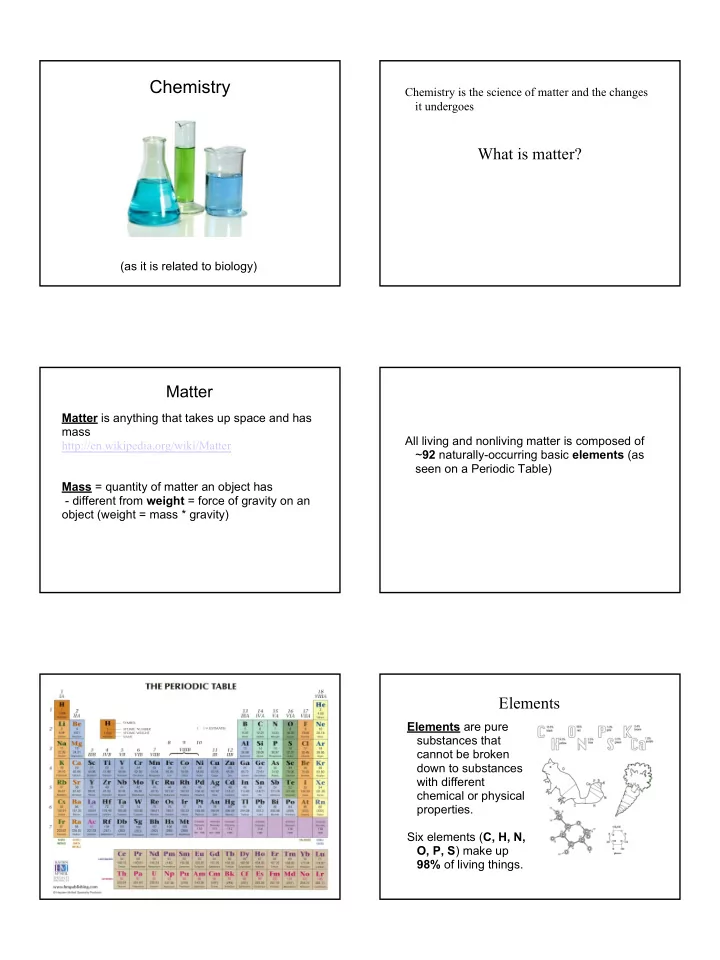
All living and nonliving matter is composed of ~92 naturally-occurring basic elements (as seen on a Periodic Table) Elements are pure substances that cannot be broken down to substances with different chemical or physical properties. Six elements (C, H, N, O, P, S) make up 98% of living things.

Elements

slide-2
SLIDE 2

Atoms

  • Atom = the simplest particle of an element that

has all the properties of that element

  • Scientists use models to describe the structure of

atoms Atomic Models

  • we will use the model proposed by Danish

physicist Niels Bohr in 1913

  • Bohr model of an atom = electrons 'orbit' nucleus

like planets orbit the sun Chemical and physical properties of elements depend upon the subatomic particles of the atom. Atoms of an element contains a specific number of protons, neutrons, and electrons.

Atomic Structure The Nucleus

Protons - positively (+) charged particles Neutrons – particles with no charge Both - have about 1 atomic mass unit (amu)

  • f mass (aka 1 dalton)
  • in nucleus of atoms

The Electron 'Cloud'

Electrons - negatively (-) charged particles

  • move around nucleus
  • negligible mass (~0 amu)

The Properties of an Element Relative Atomic mass ('weight') of an atom is about equal to the sum of its protons and neutrons. Atomic number = the number of protons

  • you can find the number of neutrons by

subtracting the atomic number from the atomic mass!

  • each element has a chemical symbol
slide-3
SLIDE 3

Some models of some elements: The Properties of an Element

An atom of a pure element is electrically neutral because... Neutrons have no charge The number of protons always equals the number of electrons An electron is as negative as a proton is positive

Isotopes

Isotopes are atoms with the same number of protons but a different number of neutrons

  • for ex. - a carbon atom has six protons but may

have more or less than usual six neutrons.

Isotopes

  • because neutrons are electrically neutral they

don't affect the element's chemical properties, unless there are just too many or too few neutrons then the isotope may become unstable (radioactive)

  • radioactive isotopes decay
  • ver time

Isotopes

  • for ex. - A carbon with eight rather than six

neutrons is unstable; it releases rays and subatomic particles and is a radioactive isotope

Half-Life

  • one half-life = the amount of time it takes for

half the mass of a substance to decay

slide-4
SLIDE 4

Isotopes in Biology

  • Low levels of radiation such as radioactive iodine or

glucose allow researchers to trace the location & activity of the atom in living tissues

  • these are called tracers (used in CAT scans)
  • High levels of radiation can cause cancer/destroy

cells

  • careful use of radiation can sterilize products & kill

cancer cells

  • measuring the amount of radioactive isotopes and

comparing that to the non-rad. isotopes allows scientists to tell how old something is

  • ex. radiocarbon dating for fossils

Electrons

  • electron cloud = 'cloud' around nucleus where e-

are

  • electron shell = 'shell' or ring around nucleus

where e- are found

  • energy level = describes an e- location based on

how much energy it has

Electrons and Energy

more energy = farther away from nucleus less energy = closer to nucleus inner e- shells = lower energy level

  • uter e- shells = higher energy level

Orbitals

  • orbital = a volume of space where an e- is most likely to

be found

atomic structure http://youtu.be/pV822HfqT44

slide-5
SLIDE 5
  • the 1st shell is

complete with 2 e-

  • the 2nd shell is

complete with 8 e-

  • 3rd is stable with 8 e-

but full w/18

  • every atom 'wants' to

have a complete outer shell

Electron Shells

Electron shells

Electron Shells

in the shell model: electron configuration = # of e- in each e- shell

  • ex. S - 2,8,6

C - 2,4 Na - 2,8,1 valence number = # of e- in the outer e- shell

  • determines how an element will react

The Octet Rule

generally, atoms want to have 8 electrons in their outer e- shell http://www.sciencemusicvideos.com/the-

  • ctet-rule-song/

Noble Gases

  • some elements have a full outermost e- shell –

these are called the noble gases – and they won't react with other elements they’re in group 18, far right of PT:

Helium Neon Argon Krypton Xenon Radon

Electron Dot Structures show the valence e- as dots surrounding the elemental symbol

  • Cl has 7

valence e-

  • they are

drawn in pairs so unpaired e- are visible

slide-6
SLIDE 6

Chemical Reactions

  • most elements tend to undergo -

chemical reactions = atoms combining in

  • rder to become more stable (fill their
  • utermost e- shell)

Compounds

  • When two or more different elements react or bond

together, they form a compound (ex. H2O)

  • compound = pure substance made of 2 or more

elements

  • ex. water, methane (CH4), glucose (C6H12O6)
  • molecule = smallest part of a compound

that has the properties of the compound (one molecule of water vs. a lot of water molecules) compound is the type of molecule like element is the type of atom

Chemical Bonds

  • Bond = an attachment between atoms
  • Electrons possess energy -> bonds that exist

between atoms in molecules contain energy

  • > it requires energy to break & form chemical

bonds

  • Ionic bonds = form when e- are transferred

from one atom to another

  • By losing or gaining e-, atoms in ionic

reactions fill their outer e- shells, and are more stable

Ionic Bonding

  • ions = charged particles that have lost or

gained e-

  • positive ions = cations = lost e-
  • negative ions = anions = gained e-

Ionic Bonding

slide-7
SLIDE 7

Ionic Bonding

  • Example: sodium (Na) with one less e- has
  • pos. charge; chlorine (Cl) has extra e- that

has neg. charge

  • Attraction of oppositely charged ions holds

the 2 atoms together in an ionic bond

Ionic bonding video http://youtu.be/xTx_DWboEVs

How do we tell what elements will form ions and/or ionic bonds?

  • # of valence electrons -

if low, will tend to lose e- if high, will tend to gain e-

Ionic Bonds

tend to form between metals and nonmetals

position on periodic table ion charge Metal left positive Nonmetal right negative

  • Covalent bonds = 2 atoms share 1 or more

e- so each atom has full outer e- shell

  • H can form either ionic or covalent bonds
  • can lose an e- to become H+ or share an e-

complete its outer shell of two e-

Covalent Bonds

slide-8
SLIDE 8

Structural Formulas

  • shared e- are shown as a line between two

atoms

  • ex. single covalent bond (H-H), double

covalent bond (O=O)

  • 3D shape of molecules is not represented

by structural formulas, but can show bond angles

Oxygen shares 2 electrons to form a double covalent bond Molecular Models

Covalent bonding video http://youtu.be/1wpDicW_MQQ

How do we tell what elements will form covalent bonds?

  • they tend to form between 2 (or more)

nonmetals

  • # valence e- - elements still ‘want’ to

complete outer e- shells

slide-9
SLIDE 9
  • oxidation number = the hypothetical

charge an atom would have if all bonds it formed were 100% ionic for ions - charge = oxidation # for elements in covalent bonds = what the charge would be if it were ionic… for pure elements = zero

  • nonpolar covalent

bonds = sharing of e- is equal

  • polar covalent

bonds = sharing of e- is unequal

  • ex. In water (H2O),

sharing of e- by oxygen and hydrogen is not equal Nonpolar and Polar Covalent Bonds

Electronegativity

  • Attraction of an atom for electrons in a

covalent bond is called electronegativity

  • more protons = more electronegative
  • the oxygen atom is more electronegative

than the hydrogen atom

  • the pair of e- shared in water is more

attracted to the Oxygen atom

  • oxygen takes on a partial negative charge
  • the hydrogen atoms in water take on a

partial positive charge

  • hydrogen bond = weak attractive force

between slightly positive hydrogen atom of one molecule and slightly negative atom in another

  • r the same molecule
  • Many hydrogen bonds taken together are

relatively strong

  • Hydrogen bonds between complex molecules
  • f cells help maintain structure and function

Hydrogen Bonding

Hydrogen Bonding Energy

  • energy = the capacity to do work
  • electrons have energy → atoms have energy →

all things are made of atoms → all things have energy

  • electrons are moving → atoms are moving → all

things are made of atoms → all things are moving

  • the amount of movement of atoms determines the

state of matter

slide-10
SLIDE 10

Solids

  • the least amount of

movement (vibration

  • nly)
  • particles have the

least energy

  • fixed volume and

shape

Liquids

  • more movement/

energy

  • takes shape of its

container

Gases

  • even more movement/

energy

  • fills volume of

container

  • no definite shape

Plasma

  • ionized gas
  • ions and electrons
  • also no definite shape
  • r volume
  • may generate

magnetic fields and electric currents

  • ex. Stars, lightning

The 4 States of Matter Energy and Chemical Reactions

  • chemical reactions involve the transferring or

sharing of electrons and therefore involve energy

  • all reactions require energy to begin
  • activation energy = amount of energy needed to

start a chemical reaction (EA)

https://www.youtube.com/watch? v=VbIaK6PLrRM

slide-11
SLIDE 11

https://www.youtube.com/watch?v=VbIaK6PLrRM

Energy and Chemical Reactions

Exergonic reactions = release free energy Endergonic reactions = absorb free energy Free energy = energy available for work

  • gonic vs. -thermic

rxns can also be described as exothermic - releases heat energy; feels warm endothermic - absorbs heat energy; feels cold these terms are specific to heat energy & are not the same as exer/ender-gonic

Catalysts

  • catalyst = substance

which reduces the amount of activation energy needed for a reaction

  • cause reactions to
  • ccur more quickly
  • extremely important

in biological reactions

  • many biological

catalysts are enzymes

Chemical Reactions

  • shown in chemical

equations

  • reactants = substances

participating in the reaction

  • products = substances

that result from the reaction

  • most reactions can

proceed in either direction

Solutions

  • solution = a mixture in which one substance is

evenly distributed in another

  • evenly distributed = dissolved
  • the solute is dissolved in the solvent
  • concentration = amount of solute in a fixed

amount of solvent

Example: 10 g of sugar in 100 mL water Concentration = 10 g / 100 mL = 0.10 g/mL

slide-12
SLIDE 12

Solutions

Examples:

Kool-aid – solute is powder, solvent is water Salt water – solute is salt, solvent is water

  • solutions where water is the solvent are called

aqueous solutions

  • aqua = water
  • solvents dissolve solutes but do not lose their
  • wn properties

Acids and Bases

Water molecules dissociate (break into ions) Creates an equal number of H+ and OH- ions Pure water is neither an acid or a base – its neutral

Acids

Acid = solution with more H+ than OH- ions or substance which increases H+/H3O+ in solution Called acidic H+ combines with H2O to form H3O+ Example: HCl – Hydrochloric acid HCl → H+ + Cl- H+ + H2O → H3O+

Bases

Base = solution with more OH- than H+/H3O+ or substance which increases OH- in a solution Called alkaline Example: NaOH - Sodium Hydroxide NaOH → Na+ + OH-

Properties of Acids/Bases

Acids Sour taste Can be highly corrosive at high concentrations increase H3O+ concentration Low pH Bases Bitter taste Feel slippery Interact w/oil in skin to form soap increase OH- concentration High pH

slide-13
SLIDE 13

pH scale

Scale for comparing relative conc. of H3O+ and OH- in a solution

0 to 14 0 – very acidic 7 – neutral 14 – very basic

Logarithmic scale – moving up/down scale represents 10X amount of OH-/H3O+ per # neutralization = hydroxide and hydrogen ions combine to form water H+ + OH- → H2O happens in any solution with these ions and when an acid and base are mixed

Neutralization

Buffers

Buffer = substance neutralizes an acid or base in a solution Can be an acid or a base or neutral depending on what you're trying to buffer Important in living systems b/c organisms can only function within an optimal pH range

  • utside of optimal range, biological molecules

breakdown and can’t function