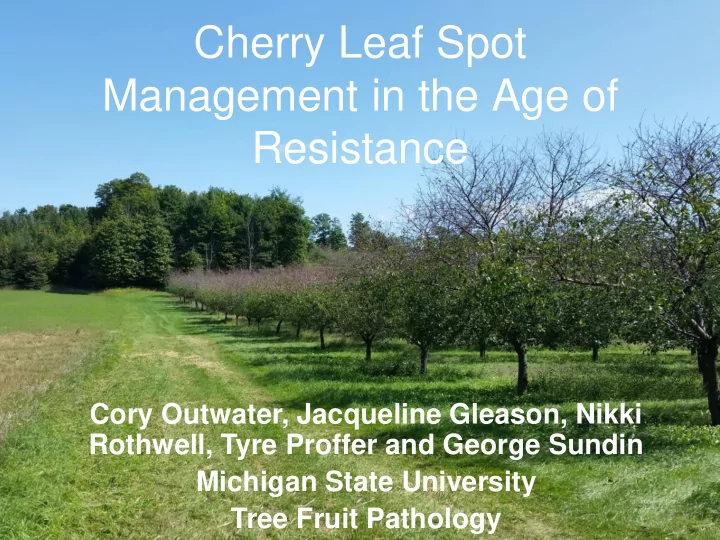
Cherry Leaf Spot Management in the Age of Resistance Cory - - PowerPoint PPT Presentation
Cherry Leaf Spot Management in the Age of Resistance Cory Outwater, Jacqueline Gleason, Nikki Rothwell, Tyre Proffer and George Sundin Michigan State University Tree Fruit Pathology Cherry Leaf Spot Blumeriella jaapii Most important
Cherry Leaf Spot
Blumeriella jaapii
- Most important disease affecting tart
cherry production in the Great Lakes region
- Causes leaf infections that lead to heavy
defoliation
- Early defoliation (prior to harvest)
– Causes uneven ripening and yield loss
- Defoliation before September
– Affects the ability of the tree to
- verwinter
– Poor fruit set or death the following year
CLS Chemical Management in 2000
- DMI’s first used in
Michigan in 1987
- Control failure observed
in commercial orchards in 2002
- Associated with over
expression of CYP51 gene
- Loss of DMIs as an
effective control for cherry leaf spot
Fungicide Class Efficacy
Bravo Chlorothalonil Excellent Rally DMI Fair Orbit DMI Poor/fair Elite DMI Fair Rubigan DMI Fair Indar DMI Fair Pristine SDHI and QoI Excellent Gem QoI Excellent Syllit Dodine Excellent Copper Multi-site Excellent Captan Multi-site Excellent
Pristine Fungicide (BASF)
- A premix of a succinate dehrdrogenase
inhibitor (Boscalid) and a QoI/Strobilurin (pyraclostrobin)
- Two unique modes of action
– SDHI (Boscalid)
- Inhibits respiration at complex II in the mitochondrial
respiratory chain
– Strobilurin
- Inhibits respiration at complex III in the mitochondrial
respiratory chain
Pristine Field Trials at NWMHRC
First two applications are Bravo Weather Stik, 4 pts
10 20 30 40 50 60 70 80 90 100 Pristine Control
% Defoliation
2002 2012
d a b a
2010 and 2011 B. jaapii Isolates
2010 276 isolates, 20 orchards 2011 762 isolates, 18 orchards 2010 47 isolates, 1 orchard 2011 150 isolates, 3 orchards 2010 0 isolates, 0 orchards 2011 58 isolates, 4 orchards Non-treated trees in Ohio 2010 44 isolates, 2 orchards 2011 9 isolates, 1 orchard
Grand total of 1,346 isolates
Resistant Sensitive Reduced Sensitivity
MMEA Control
0.1 μg/ml 0.5 μg/ml 1 μg/ml 2.5 μg/ml 5 μg/ml 10 μg/ml 25 μg/ml
Boscalid Sensitivity 2010-2011
10 20 30 40 50 60 70 80 90 100 0.1 0.5 1 2.5 5 10 25 > 25 Minimum Inhibitory Concentration µg/ml Frequency Distribution %
2010 Comercial 2010 Non-treated 2011 Comercial 2011 Non-treated
SDHI Mode of Action
Leroux et al. (2010)
Alignment of Deduced Amino Acid Sequences
Second cysteine-rich cluster Third cysteine-rich cluster
Next Generation SDHIs
- Introduction of new SDHI fungicides
– Fluopyram – Fluxapyroxad
- Have the same mode of action as boscalid
– Target complex II of the fungal respiration pathway
- CLS management utilizing new SDHIs
– Luna Sensation (Bayer)
- Premix of fluopyram and trifloxystrobin
– Merivon (BASF)
- Premix of fluxapyroxad and pyraclostrobin
2012 CLS Fungicide Efficacy Field Trial Data
10 20 30 40 50 60 70 80 90 100 Untreated control Bravo Pristine Merivon Luna Sensation Gem Percent CLS Defoliation
29-Jun 1-Aug
B A B B B B A CD B E DE CD
Boscalid Sensitivity for Pristine Treatments
10 20 30 40 50 60 70 80 90 100 0.1 0.5 1 2.5 5 10 25 > 25 Frequency Distribution % Minimum Inhibitory Concentration µg/ml
June 1 August 1 August 23
Fast forward four years
- Merivon and Luna Sensation are widely
used by growers for CLS and brown rot control
- Control failures have been reported by
numerous growers
- Statewide sensitivity survey was
conducted during 2016-2017
~ 65% resistance, both years Increasing top end ~ 17% resistance, 2016 ~ 30% resistance, 2017
Fluopyram Fluxapyroxad
2018 SDHI Sensitivity Screening
- 32 orchards sampled from new locations
– Sampled from sites not in the vicinity of previously sampled orchards
- B. jaapii ioslates screened for sensitivity to
fluopyram and fluxapyroxad
– 2.5 and 35 ppm fungicide concentrations
- Sensitive – no growth at 2.5 ppm
- Shifted – growth at 2.5 but not at 35 ppm
- Resistant – growth at 35 ppm
2018 population at the NWMHRC fungicide efficacy test site
- 30 isolates – obtained from unsprayed
control trees
Sensitive Shifted Resistant Number of isolates Fluopyram Fluxapyroxad 1 15 14 5 25 0
10 20 30 40 50 60 70 80 90 100
Untreated control Luna Sensation Luna Privilege Flint Extra
30-Aug Infection 30-Aug Defoliation
2018 NWMHRC fungicide efficacy trial Luna Sensation (fluopyram)
A
First two applications are Bravo Weather Stik, 4 pts
A BC C AB B C E C
Fluopyram: 1 15 14
2018 NWMHRC fungicide efficacy trial Merivon (fluxapyroxad)
First two applications are Bravo Weather Stik, 4 pts 10 20 30 40 50 60 70 80 90 100 Untreated control Merivon Sercadis Cabrio 30-Aug Infection 30-Aug Defoliation
A A C B BC C B BC
Fluxapyroxad: 5 25
1 0 15 5 9 11 0 2 0 13 7 9 11 0 3 6 14 0 18 2 0 4 0 9 11 7 13 0 5 0 5 19 4 20 0 6 0 13 7 11 8 1 7 0 17 3 13 6 1 8 0 8 12 3 17 0 9 4 13 3 11 7 2 10 10 7 3 7 11 2 11 0 14 6 14 6 0 1 15 14 5 25 0 Sensitive Shifted Resistant FLUOPYRAM (# isol.) Sensitive Shifted Resistant FLUXAPYROXAD (# isol.)
NWMHRC
2018 SDHI Resistance Screening NW MI
1 10 7 5 9 11 1 2 0 17 0 4 13 0 3 0 15 5 3 17 0 4 0 8 12 0 19 1 5 0 16 4 0 19 1 6 0 11 9 6 14 0 7 0 7 19 0 25 1 8 0 14 13 5 21 1 9 0 1 27 0 25 3 10 0 7 23 4 12 14 1 15 14 5 25 0 Sensitive Shifted Resistant FLUOPYRAM (# isol.) Sensitive Shifted Resistant FLUXAPYROXAD (# isol.)
NWMHRC
2018 SDHI Resistance Screening West Central MI
Strategies for CLS management
10 20 30 40 50 60 70 80 90 100 30-Aug Infection 30-Aug Defoliation First two applications are Bravo Weather Stik, 4 pts
2018 NWMHRC efficacy trial
A A B G DE BC CD DEF FG EFG B D C B C D D D
SDHI fungicides and B. jaapii in Michigan
- Fluopyram
– Resistance appears to be developing quicker – ~40 to 60% of MI isolates are resistant
- Fluxapyroxad
– ~10 to 30% of MI isolates are resistant – Merivon should still be effective in most orchards
- Tank mixing with Captan for both fungicides is
essential
- Use of protectants such as Bravo, Ziram and copper
as primary control may have to play a bigger role
Acknowledgments
Michigan State University
- George Sundin
- Tyre Proffer
- Sundin Lab
- Nikki Rothwell
- Dave Jones
- Bill Klein
- Emily Pochubay
- Karen Powers
- MI Cherry Committee