Chicagoland Collaborative: Models for Climate Resilience A Case - - PowerPoint PPT Presentation

chicagoland collaborative models for climate resilience
SMART_READER_LITE
LIVE PREVIEW

Chicagoland Collaborative: Models for Climate Resilience A Case - - PowerPoint PPT Presentation

Chicagoland Collaborative: Models for Climate Resilience A Case Study in Cross-Agency Collaboration metroplanning.org @metroplanners Sharing Exercise What are the climate change impacts that your region is grappling with? Have you identified


slide-1
SLIDE 1

metroplanning.org @metroplanners
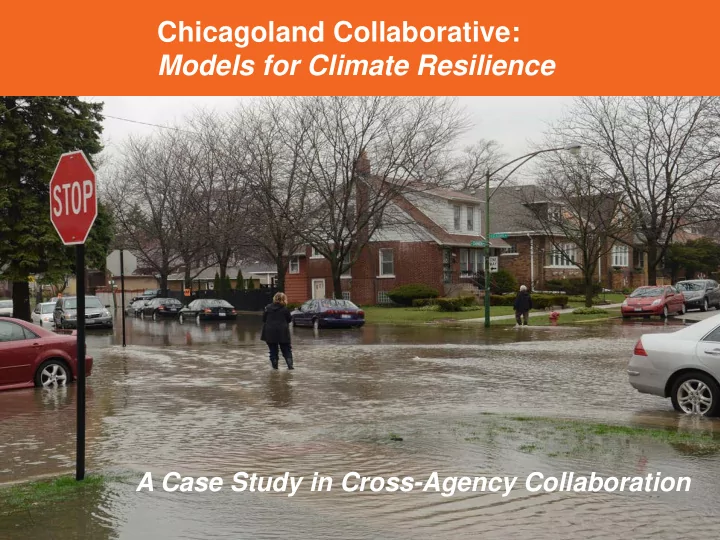
A Case Study in Cross-Agency Collaboration

Chicagoland Collaborative: Models for Climate Resilience

slide-2
SLIDE 2

metroplanning.org @metroplanners

Sharing Exercise

What are the climate change impacts that your region is grappling with? Have you identified vulnerable populations hardest hit by these impacts? What would you say is the #1 challenge in addressing this problem?

slide-3
SLIDE 3

metroplanning.org @metroplanners

Session outline

  • Introductions
  • Urban flooding challenges in Chicago region
  • Establishing the Calumet Stormwater Collaborative
  • Collaborative achievements
  • Member-led initiatives
  • Lessons learned
  • Open discussion/ Q&A
slide-4
SLIDE 4

metroplanning.org @metroplanners

Immediate and long-term solutions Connect region’s assets Partnerships with governments, communities and business

slide-5
SLIDE 5

metroplanning.org @metroplanners

slide-6
SLIDE 6
  • Official regional planning organization

and MPO for northeastern Illinois

  • Adopted GO TO 2040 regional plan in

2010

  • Local Technical Assistance Program

Chicago Metropolitan Agency for Planning

slide-7
SLIDE 7

Chicago Metropolitan Agency for Planning

slide-8
SLIDE 8

metroplanning.org @metroplanners

slide-9
SLIDE 9

URBAN FLOODING CHALLENGES

slide-10
SLIDE 10

metroplanning.org @metroplanners

The Issue: urban flooding

slide-11
SLIDE 11

metroplanning.org @metroplanners

The Impacts: damage payouts

$907 million in flood relief from 2003 to 2015 62% occurred in Cook County Damages are likely higher

Total flooding damage payments associated with NFIP, IA, and SBA programs per 2010 household by zip code in the Chicago region from 2003 to 2015. Source: CMAP

slide-12
SLIDE 12

metroplanning.org @metroplanners

The Impacts: vulnerable populations

Below 60% of regional median income by household size AND Greater than regional average non-white population OR Greater than regional average limited- English proficiency population

slide-13
SLIDE 13

metroplanning.org @metroplanners

The Impacts: community capacity

Varying community financial and technical capabilities

– Limited revenue and no dedicated fund for stormwater – Limited staff who may lack expertise

Current approaches often depend on reinvestment in infrastructure and new development Competing community priorities

slide-14
SLIDE 14

metroplanning.org @metroplanners

Climate Change: increasing precipitation

slide-15
SLIDE 15

metroplanning.org @metroplanners

Climate Change: increasing precipitation

Difference between projected and current 10-year, 24-hr storms. High levels of uncertainty.

Source: Illinois State Water Survey Cook County, Year 2046-2065

slide-16
SLIDE 16

ESTABLISHING THE CALUMET STORMWATER COLLABORATIVE

slide-17
SLIDE 17

metroplanning.org @metroplanners

Calumet Stormwater Collaborative (CSC)

Mission Statement The Calumet Stormwater Collaborative builds intergovernmental and cross-sector partnerships to increase the effectiveness of stormwater management initiatives for the communities and ecosystems of the Calumet region through knowledge sharing, coordination and deployment of interventions at appropriate scales.

slide-18
SLIDE 18

metroplanning.org @metroplanners

CSC Members

Government Agencies

Cook County Cook County Land Bank Authority Illinois Department of Natural Resources Illinois Environmental Protection Agency Illinois-Indiana Sea Grant Metropolitan Mayors Caucus Metropolitan Water Reclamation District of Greater Chicago South Suburban Mayors and Managers Association U.S. Army Corps of Engineers U.S. Environmental Protection Agency

Planning, Land Managers + Academics

Chicago Metropolitan Agency for Planning Chicago Park District Forest Preserves of Cook County

Private Companies

Baxter & Woodman CH2M Christopher B. Burke Engineering Environmental Design International Geosyntec Consultants Robinson Engineering

NGOs

Center for Neighborhood Technology Chicago Wilderness Delta Institute Elevate Energy Faith in Place Foresight Design Initiative Friends of the Chicago River Historic Chicago Bungalow Association Metropolitan Planning Council Morton Arboretum OAI Chicago Southland/Highbridge Openlands

Communities

Calumet City City of Blue Island City of Chicago Village of Homewood Village of Midlothian Village of Park Forest Village of Steger

slide-19
SLIDE 19

metroplanning.org @metroplanners

CSC Overview

  • Convening since April 2014
  • Yearly work plans
  • Regular meetings of all

stakeholders

  • Work groups with specific

initiatives

slide-20
SLIDE 20

metroplanning.org @metroplanners

Structure

Calumet Stormwater Collaborative Monthly Member Meetings Education & Engagement Work Group Planning & Policy Work Group Data & Modeling Work Group Training & Maintenance Work Group

slide-21
SLIDE 21

Achievements

  • 1. Creating tools + sharing data
  • Repository to capture joint knowledge of collaborative
  • Regional mapping viewer + data extents layers
  • Green infrastructure design guidelines
slide-22
SLIDE 22
  • 2. Expanding education + engagement
  • Community engagement process + local community workshops
  • Needs assessment for training + maintenance of green

infrastructure

  • Sharing lessons learned: tour + session at WEFTEC

Achievements

slide-23
SLIDE 23
  • Complete Streets Project: local technical assistance grant
  • Section 319 Watershed Plans: community eligibility for grant
  • Local Revenue Funding: dedicated revenue streams
  • 3. Leveraging funding sources

Achievements

https://www.metroplanning.org/steadystreams

slide-24
SLIDE 24

Achievements

  • 4. Expert review of member projects
  • Planning-level stormwater analysis
  • Regional modeling framework
  • Investigating stormwater detention credit trading
slide-25
SLIDE 25

MEMBER-LED INITIATIVES

slide-26
SLIDE 26

CMAP Planning-level stormwater analysis

LTA experience: communities struggle to address stormwater management issues. Developing planning-level stormwater analysis to reduce flooding damages in the region by:

  • Incorporating stormwater into local and regional plans
  • Engaging land use and transportation professionals

Funding assistance provided by MacArthur Foundation, applied in communities with support by the Cook County Community Development Block Grant Disaster Recovery

slide-27
SLIDE 27

Planning-level stormwater analysis

Collect data Identify properties at risk Identify past problem areas

  • Flood insurance

claims

  • Village rebate program
  • Results of community
  • utreach
slide-28
SLIDE 28

Planning-level stormwater analysis

Prioritize based on flood risk indicators

  • Vulnerable properties
  • Reported flood claims
  • Impervious cover
  • Soils
  • Historic streams
  • Age of structure

Identify opportunities

slide-29
SLIDE 29

Planning-level stormwater analysis

https://datahub.cmap.illinois.gov/

slide-30
SLIDE 30

metroplanning.org @metroplanners

Investigating Stormwater Detention Credit Trading

  • StormStore is a name coined by

TNC and MPC for a possible market

  • r exchange for stormwater credits
  • Funding assistance provided

by Grand Victoria Foundation

slide-31
SLIDE 31

Investigating Stormwater Detention Credit Trading

  • Potential Benefits:

– Opportunities for range of new collaborations across sectors – Enable more optimal siting of stormwater improvements – Re-use marginal land – Make infill and Transit-oriented Development less expensive – Reduce development costs

slide-32
SLIDE 32

Investigating Stormwater Detention Credit Trading

  • Three components of

the feasibility study:

– Policy Analysis – Real Estate Demand Analysis – Land and Hydrological Analysis “Opportunities Map”

slide-33
SLIDE 33

White Paper – Regional Planning Framework

www.metroplanning.org

slide-34
SLIDE 34

LESSONS LEARNED IN COLLABORATION

slide-35
SLIDE 35

metroplanning.org @metroplanners

Tips for building + sustaining collaboration

slide-36
SLIDE 36

metroplanning.org @metroplanners

  • 1. Go slow to go fast
slide-37
SLIDE 37

metroplanning.org @metroplanners

  • 2. Have the right mix of stakeholders
slide-38
SLIDE 38

metroplanning.org @metroplanners

  • 3. Have fresh discussion on ‘the problem’
slide-39
SLIDE 39

metroplanning.org @metroplanners

  • 4. Align mission, structure + work plan

Mission Driven Urgency Driven Does it address our fundamental challenges? Is it a foundational step? Does it require collaboration? Is there temporal urgency?

slide-40
SLIDE 40

metroplanning.org @metroplanners

  • 5. Steward funding opportunities
slide-41
SLIDE 41

metroplanning.org @metroplanners

  • 6. Fun & inspiring – create VALUE
slide-42
SLIDE 42

metroplanning.org @metroplanners

QUESTIONS AND DISCUSSION

slide-43
SLIDE 43

metroplanning.org @metroplanners

Group Discussion

What aspects about this case study may be resonating with you and your own collaborative planning efforts?

slide-44
SLIDE 44

metroplanning.org @metroplanners

Thank you!

Nora Beck, CMAP nbeck@cmap.illinois.gov Sarah Cardona, MPC scardona@metroplanning.org Danielle Gallet, MPC dgallet@metroplanning.org