Cinematic Game Design II Storytelling Richard Rouse III and Marty - - PowerPoint PPT Presentation

cinematic game design ii storytelling
SMART_READER_LITE
LIVE PREVIEW

Cinematic Game Design II Storytelling Richard Rouse III and Marty - - PowerPoint PPT Presentation

Cinematic Game Design II Storytelling Richard Rouse III and Marty Stoltz Game Developers Conference, 2007 Introductions Richard Rouse III Director of Game Design, Midway The Suffering, The Suffering: Ties That Bind, Drakan: The


slide-1
SLIDE 1

Cinematic Game Design II

Richard Rouse III and Marty Stoltz

Game Developer’s Conference, 2007
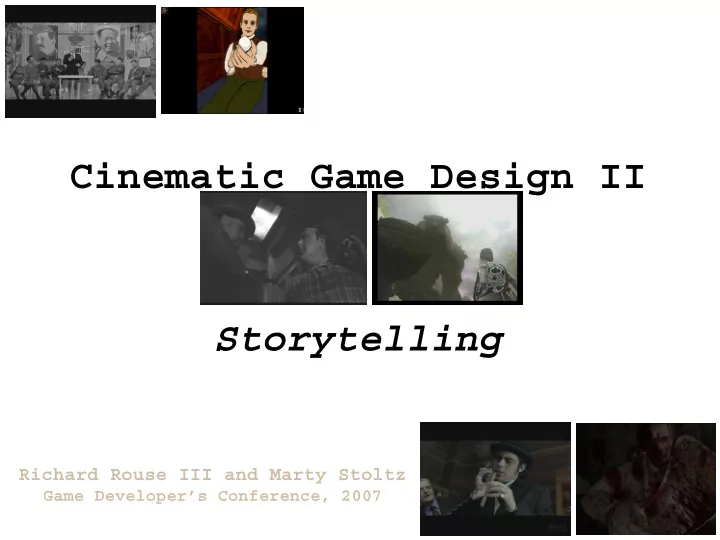
Storytelling

slide-2
SLIDE 2

Introductions

Richard Rouse III

Director of Game Design, Midway

The Suffering, The Suffering: Ties That Bind, Drakan: The Ancients’ Gates, Odyssey, Game Design: Theory & Practice

Marty Stoltz

Studio Cinematic Director, Midway Chicago

Stranglehold, The Suffering: Ties That Bind, Mortal Kombat: Armageddon/Deception/Shaolin Monks, Psi-Ops, Sanitarium

slide-3
SLIDE 3

What is a “Cinematic” Game?

  • Often misused term
  • Our definition for Cinematic Game Design:
  • Draw from cinema’s 100-year-old library of

techniques

  • Integrate these devices into gameplay
  • Not just “Hollywood envy”
  • Expands our medium
slide-4
SLIDE 4

Last Year: Cinematic Game Design The First

1. Rim Lighting 2. Camera Following Character 3. Slow Motion 4. Subjective P.O.V. 5. Parallel Editing 6. Split Screen 7. Building Tension 8. Emotional Setup 9. (Mis)Leading the Audience (Slides available – link at end of presentation)

slide-5
SLIDE 5

This Year: Storytelling

  • Nine new techniques
  • Not just for cut-scenes, but in-game

storytelling

  • Integrate the story into the core

experience

  • Game storytelling is less about plot and

more about character and tone – these techniques work accordingly

slide-6
SLIDE 6

Technique #1: Exaggerated Camera Angles

  • Angles have a psychological effect on the

viewer

  • Near/far relationships of characters and
  • bjects is important
  • Framing showcases elements in scene
  • Example from:

Touch of Evil

slide-7
SLIDE 7

Exaggerated Camera Angles: Gameplay Application

  • Get away from stiff follow-camera
  • Provide a compelling composition while

leaving the player in control

  • Don’t be afraid to change the camera

based on different situations

  • Convey information about your character
  • Example from:

Shadow of the Colossus

slide-8
SLIDE 8
slide-9
SLIDE 9
slide-10
SLIDE 10

Technique #2: Voice Over Narration

  • Originally, film narration was for

communicating plot

  • Was a “cheap” way of telling a story
  • Modern uses add layers of meaning to a

scene

  • Example from:

Fight Club

slide-11
SLIDE 11

Voice Over Narration: Gameplay Application

  • Different than “Earpiece Chatter”
  • Great for pointing out crucial details or restating
  • bjectives, also good for adding meaning
  • Can be connective if used during both cut-

scenes and gameplay

  • Can be distancing: narrator knows more than

the player, story feels pre-determined

  • Example from:

Max Payne 2

slide-12
SLIDE 12

Technique #3: Image Juxtaposition

  • First example from:

“Kuleshov Experiment”

slide-13
SLIDE 13

Technique #3: Image Juxtaposition

  • Specific psychological impact of a close up on a

face preceding or following another image

  • Placing images next to each other in quick edits

changes the meaning of those images

  • Built on the artificial landscape and mental map
  • Second example from:

The Godfather

slide-14
SLIDE 14

Image Juxtaposition: Gameplay Application

  • Tricky to use in games
  • Be careful not to disrupt play
  • Can significantly effect player’s emotions

and set tone

  • Example from:

The Suffering: Ties that Bind

slide-15
SLIDE 15

Technique #4: Audio Juxtaposition

  • Use of audio that isn't directly connected

to visuals

  • Communicate information on multiple

levels

  • Can change the tone of the scene
  • Example from:

M*A*S*H

slide-16
SLIDE 16

Audio Juxtaposition: Gameplay Application

  • Use real environmental sounds: radios,

PAs, overheard conversations

  • Perfect for overlaying on exploration
  • Good for establishing tone and backstory
  • Example from:

Grand Theft Auto III

slide-17
SLIDE 17

Technique #5: Visualized Thoughts

  • Unique to film in the way it breaks reality
  • Plays off the Kuleshov Experiement
  • Filmic version of the “inner voice”
  • Examples from:

A Clockwork Orange and Snatch

slide-18
SLIDE 18

Visualized Thoughts: Gameplay Application

  • Not often done in games
  • Good way to insert a non-interactive

sequence that doesn’t take players too far out

  • Less is more
  • Good for introducing a character
  • Example from:

Call of Cthulhu: Dark Corners of the Earth

slide-19
SLIDE 19

Technique #6: Altered Reality

  • Mixing of the real world and the dream world
  • Confuse the audience at first, clarity comes later
  • Sometimes audio is real while visuals are fake
  • Visual elements from the real world intrude on

the dream world

  • Example from:

The Manchurian Candidate

slide-20
SLIDE 20

Altered Reality

  • More stylized/modern take
  • Use reality break to trigger dream

sequence

  • Audio stays "real" while world is imagined
  • Example from:

The Life & Death of Peter Sellers

slide-21
SLIDE 21

Altered Reality: Gameplay Application

  • Underused in games, though has been done

well

  • Start with something close to reality
  • Gameplay dream sequences can be even more

like a real dream

  • Make the dream interactive – changes based on

where the player looks, forces them to repeat actions, etc.

  • Example from:

The Last Express

slide-22
SLIDE 22

Technique #7: Misdirection

  • Tell the audience that everything is OK

then surprise them with an event

  • Dull the audience's emotional barrier
  • Involves some slight of hand
  • Example from:

The Thing

slide-23
SLIDE 23

Misdirection: Gameplay Application

  • Get the audience used to certain game

mechanics and situations

  • Then introduce a new situation which

looks the same but acts differently

  • Make it logical: avoid the “cheap shot”
  • Example from:

Prince of Persia

slide-24
SLIDE 24
slide-25
SLIDE 25
slide-26
SLIDE 26
slide-27
SLIDE 27
slide-28
SLIDE 28
slide-29
SLIDE 29
slide-30
SLIDE 30
slide-31
SLIDE 31
slide-32
SLIDE 32
slide-33
SLIDE 33
slide-34
SLIDE 34

Technique #8: Picture within Picture

  • Mini-story that happens in the

background of a scene

  • Can be used to juxtapose two narratives
  • r themes
  • Example from:

Citizen Kane

slide-35
SLIDE 35

Picture within Picture: Gameplay Application

  • Depending on a game’s camera &

perspective, differently techniques apply

  • Careful placement makes scenes non-

disruptive but also likely to be seen

  • Example from:

Another World / Out of this World

slide-36
SLIDE 36

Technique #9: Visual Storytelling

  • Inform the viewer about person and place
  • Scene works without dialog/exposition
  • Start wide and end close: close shots at

end for progression and impact

  • Example from:

Rear Window

slide-37
SLIDE 37

Visual Storytelling: Gameplay Application

  • Player should learn about the fiction

through play

  • Every element is important: art,

animation, voice, audio, etc

  • Repetition of key details is necessary
  • Example from:

Half Life 2

slide-38
SLIDE 38

Nine Cinematic Storytelling Techniques

  • 1. Exaggerated Camera Angles
  • 2. Voice Over Narration
  • 3. Image Juxtaposition
  • 4. Audio Juxtaposition
  • 5. Visualized Thoughts
  • 6. Altered Reality
  • 7. Misdirection
  • 8. Picture within Picture
  • 9. Visual Storytelling
slide-39
SLIDE 39

Questions?

  • Contact:

Richard: rr3@paranoidproductions.com Marty: mstoltz@midway.com

  • Final slides (+ last year’s slides) available at:

http://www.paranoidproductions.com/