City of Szekesfehervar Royal traditions Dominant economic role 1000 - - PowerPoint PPT Presentation

city of szekesfehervar
SMART_READER_LITE
LIVE PREVIEW

City of Szekesfehervar Royal traditions Dominant economic role 1000 - - PowerPoint PPT Presentation

City of Szekesfehervar Royal traditions Dominant economic role 1000 years of mobility Strategic location nowadays Mid-East Transdanubian Region Capital of Fejr County 170 km 2 Gyr, Vienna 100 000 inhabitants Budapest


slide-1
SLIDE 1

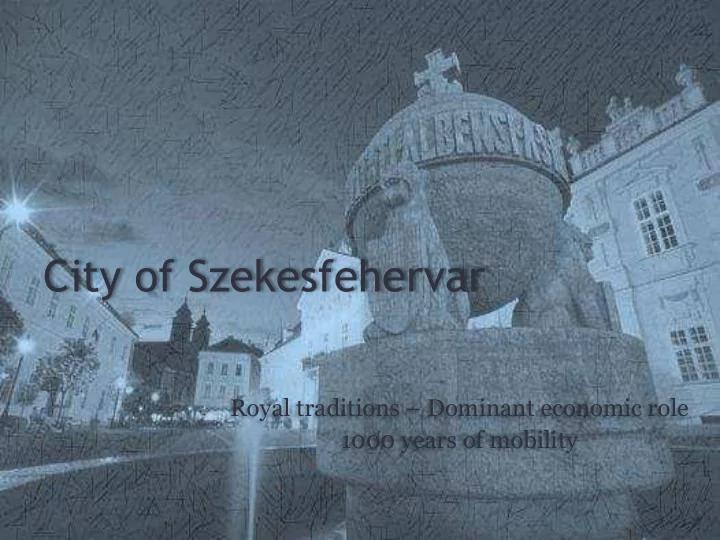
City of Szekesfehervar

Royal traditions – Dominant economic role 1000 years of mobility

slide-2
SLIDE 2

Strategic location nowadays…

Budapest Graz Győr, Vienna Zagreb, Trieste 65 km

  • Mid-East Transdanubian

Region

  • Capital of Fejér County
  • 170 km2
  • 100 000 inhabitants
  • At the intersection of

European transport corridors

  • Half way from the Capital

to Lake Balaton by Motorway 7 (E71)

  • Economical center of the

region – logistic service center

slide-3
SLIDE 3

Strategic location nowadays… Roads of Szekesfehervar

  • Ring-road
  • Motorway 7 (E71) –

Toll road

  • About 42 km of national

roads

  • About 85 km of municipal

roads

  • About 230 km of

residential roads

  • About 30 km of bicycle

roads

  • Historical center is car free

19 679 8 731 4 361 13 980 8 363 8 424 22 247 5 486 4 257 12 194

slide-4
SLIDE 4

...and it’s historical background

  • Roman roads in Pannonia

– City of Gorsium

  • The military road to

Fehérvár as a landmark

  • Crusades’ routes –

pilgrims station

  • Roads built on former

canals

  • 19-20th century: intensive

growth

slide-5
SLIDE 5

City of Champions

  • Ice Hockey – in the Austrian

League

  • Football – National Champ

2011, 2015

  • Basketball –National Champ

2000, 2013

  • Women Handball
  • Penthatlon
  • Athletics
  • Sailing
slide-6
SLIDE 6

Population

2015: 97000 residents 13000 temporary inhabitants

slide-7
SLIDE 7

Population – density 595/km2

The number of inhabitants doubled in 50 years

  • Commieblocks around the

city center

  • Mobility problems in town:

▫ No inner ring roads ▫ All routes pass near the city center ▫ Missing raliway crossing possibilities

slide-8
SLIDE 8

Moto-evolution

25 000 27 000 29 000 31 000 33 000 35 000 37 000

Number of registered cars

200 400 600 800 1 000 1 200 1 400 1 600

Number of registered motorbikes

354 motorized vehicles/ 1000 inhabitants in 2012

436 in 2015

slide-9
SLIDE 9

‚The city with no unemployment’

  • Employment rate over 45 %
  • Industrial rate over 44,5 %
  • Manpower needed exceeds

the number of workers in the city

  • 25-30 km of agglomeration
  • More than third of all

workers of the agglo- meration works in the city

slide-10
SLIDE 10

Commuters

Elementary school students: 18,8 % High school students: 58 % Employees: 30% In a workday:

  • 100K inhabitants
  • 27K commuters
  • 13K students

Over 140K on the move

Rate of commuters Travel time

slide-11
SLIDE 11

Distribution of travels in time

sport, leisure, etc.

slide-12
SLIDE 12

City’ s modal split

20,8% 0,9% 58,6% 19,6%

Regional commuter’s travel mode

Bus Train Contracted bus Individual

Travel modes

slide-13
SLIDE 13

Challenges in Urban Mobility – ‚Not without my car!’

slide-14
SLIDE 14

Challenges in Urban Mobility – Public Transport

  • 41 bus lines
  • 74 buses
  • 3.2M vehicle kms
  • 407K trips
  • 1 million € loss (23%
  • f total costs)
  • Missing connections
  • Changes in city layout
  • Changes in travel

patterns

slide-15
SLIDE 15

Challenges in Urban Mobility – Public Transport New network – under tendering:

  • New areas taken into

service

  • More connections

(hospital, railwaystation)

  • More direct lines
  • Less overlapping lines
  • 51 bus lines
  • 60 buses
  • 3.4 million vehicle km
slide-16
SLIDE 16

Challenges in Urban Mobility – Bike and Ride

Commuters’ bike storage problems

  • There is no enough bike-stands
  • Local bus decentrums
  • Railway- and bus station

Bike routes are rarely connected

slide-17
SLIDE 17

Challenges in Urban Mobility – School areas

Need for:

  • Car-free zones - space

for culture and fun

  • Kiss&Ride lanes
  • Dedicated walking

paths, safe pedestrian crossings

  • School mobility plans
slide-18
SLIDE 18

Intermodality

Railway reconstruction:

  • Rails, underpass and

signalling

  • 129 million EUR

Intermodal junction:

  • 24 million EUR
slide-19
SLIDE 19

Problem Tree

Maintenance

  • Condition of roads,

sidewalks, bike-routes, parks and paths

  • Low frequency of

maintenance

Network

  • Long walking distances
  • Need for expanded bus bays
  • Lack of B+R and P+R

possibilities - intermodality

  • Lack of parking facilities
  • Tight East-West corridors
  • No practice in demand-based

and integrated planning

Traffic

  • Bus network and

frequency

  • Lack of public-bike system
  • Harmonization of

different public transport networks and timetables

  • Lack of road-safety audits

Legal and political regulation

  • Lack of public and stakeholders

involvement

  • Governmental level for agglomeration

does not exist

  • Duration of investment preparation
  • Pay parking system
  • Lack of available information
  • Project indicators do not meet the aims
slide-20
SLIDE 20

The way to SUMP

  • Transport and Road

Development Strategy

  • 2009
slide-21
SLIDE 21

The way to SUMP

  • Transport and Road

Development Strategy

  • Feher-Bike concept 2011

▫ Version 2.0 - 2015

slide-22
SLIDE 22

The way to SUMP

  • Transport and Road

Development Strategy

  • Feher-Bike concept
  • QUEST project 2013
slide-23
SLIDE 23

The way to SUMP

  • Transport and Road

Development Strategy

  • Feher-Bike concept
  • QUEST project
  • Integrated Urban

Development Strategy 2014

Transport related measures:

  • Various mobility optimized

transport networks

  • Sustainable road

development (modality, reconstruction, connection)

slide-24
SLIDE 24

The way to SUMP

  • Transport and Road

Development Strategy

  • Feher-Bike concept
  • QUEST project
  • Integrated Urban

Development Strategy

  • BUMP project 2014
slide-25
SLIDE 25

The way to SUMP

  • Transport and Road

Development Strategy

  • Feher-Bike concept
  • QUEST project
  • Integrated Urban

Development Strategy

  • BUMP project
  • Ecotale project 2014
slide-26
SLIDE 26

CIVITAS – Magyar CIVINET

Magyar CIVINET- Hungarian-speaking regional CIVITAS network

  • National workshops
  • n sustainable urban

mobility and more

  • Szekesfehervár is a

founding member

  • Chairman: Attila

Mészáros, Vice- Mayor of Szekesfehervar

slide-27
SLIDE 27

The way to SUMP

  • Transport and Road

Development Strategy

  • Feher-Bike concept
  • QUEST project
  • Integrated Urban

Development Strategy

  • BUMP project
  • Ecotale project
  • Magyar CIVINET
  • SUMP

▫ Reviewing

 available datasets,  conceptions,  policies

▫ Analysing mobility situation

slide-28
SLIDE 28

Sustainable city - What we achieved

Inner city rehabilitation

  • 2013: Main Street

Led light strips, car free zone

  • 2015: Várkörút (‚Castle boulevard’)

Cycling Infrastructure

  • 2015: Sóstó bike route
  • 2014-2015: bike-lanes

road space reallocation

▫ Rákóczi u. ▫ Balatoni u. ▫ Várkörút

slide-29
SLIDE 29

Sustainable city - future

Modern City program:

  • Green city: new trees, leisure park,

forest playground

  • Expansion of inner city –

connecting Zichy Park to the Main street

  • Budapest – Balaton Bike Highway
slide-30
SLIDE 30

City full of life… leisure

slide-31
SLIDE 31

City full of life… culture

slide-32
SLIDE 32

Organization structure:

  • Mayor’s Office

▫ Office of City Architect

▫ Transport Office (legal and authority-works, planning, investments, controlling,

traffic rules and road safety)

▫ Investments Office ▫ City Maintenance and Utility Supply Office

  • Business Organization for City Maintenance („Citykeeper”)

Decision maker: Local Government (City Council) of Szekesfehervar

slide-33
SLIDE 33

Process of local planning: Plans in hierarchy – managed by City Architect

  • National Development Plan
  • Regional Development Plan
  • Master Plan (Land use, transport network) (2004)
  • Urban Development Plan (traffic flow and infrastructure) (2001)

„New way” of thinking:

  • Integrated City Development Strategy (2009, 2014) -> Action Plan (2015)
  • Transport Development Strategy (2010)
slide-34
SLIDE 34

SWOT on planning

S

  • Feher-Bike Network concept
  • Changes in pay -parking policy
  • Green-city project
  • Cooperation with:
  • Cycling Club
  • Police – road safety department
  • Local environmentalist association
  • Chamber of Architects
  • Association for Transport Sciences

W

Lack of

  • sustainable policy
  • integrated data collection and analysis
  • Integrated planning (focus on road

safety)

  • evaluation process of measures
  • public and stakeholders’ involvement

(only politicians’ local forums)

  • campaigns to change vision (shared

space, sustainable mobility modes)

O

  • City leader in CIVINET
  • Calls requiring integrated and sustainable

actions

  • Industrial companies’s involvement in

investments

  • ‚Senate’: mayors’ consultancy (elder,

recognized, potent people, mainly not experts)

T

  • Local government members’ pressure
  • Demand base
  • everyone knows better how to organize

traffic

  • one can think only on one way
  • mass or volume?
  • Vision of sustainability is not clear
  • National<– >municipal interests
  • SUMP 1.0 without workgroup
  • Measures to match EU calls
  • Political lobby on national level without

professional background

slide-35
SLIDE 35

SUMP oriented planning - fears

  • Planning process is not known in policy and by citizens
  • Until maintenance is still a problem higher visions are not in interest
  • Vision of Sustainable City is not clear (road safety and green city so far)
  • Members and their roles in WorkGroup - transport experts try to convince

leaders and citizens

  • City development practice <-> European sustainable policies
  • Vision and objectives could be too wide
  • Bottom – up planning: calls->projects->measures->priorities
  • Communication (consequences of project Várkörut, reactions on mobility

solutions...)

slide-36
SLIDE 36

SUMP oriented planning – what we did

  • Identified stakeholders and key actors
  • Reviewed the resources -> the city will not contract out

the writing of SUMP

  • Reviewed national and regional frameworks & plans
  • Conducted self-assessment (~190 pages)
  • Planning long-term bike route network
slide-37
SLIDE 37

SUMP oriented planning – where we are

  • The workgroup is established:

▫ Hungarian Bicycle Club ▫ Hungarian Automobile Club ▫ Gaia Environmental Organization ▫ Institute for Transport Sciences ▫ Department of City Architect ▫ Citykeeper of Szekesfehervar Ltd. ▫ Local public transport company ▫ Hungarian State Railways ▫ City Police

Two meetings held in the previous weeks and collected problems.

slide-38
SLIDE 38

SUMP oriented planning – next steps

  • Preparing analysis of problems and opportunities
  • Setting up a vision, long-term and mid-term goals,

indicators

  • Developing scenarios
  • Latest news:

National government decided last week to support the intermodal center, but SUMP is a requirement for the

  • subsidy. Therefore the mobility plan will be prepared

focusing on the intermodal center due to the insufficient time.

slide-39
SLIDE 39

Thank you for your attention!

City of Szekesfehervar Transport Office Marton Papp marton.papp@pmhiv.szekesfehervar.hu http://www.szekesfehervar.hu