Civil War - Points of Conflict Missouri (Maine) Compromise (1820) - - PDF document

civil war points of conflict
SMART_READER_LITE
LIVE PREVIEW

Civil War - Points of Conflict Missouri (Maine) Compromise (1820) - - PDF document

Civil War - Points of Conflict Missouri (Maine) Compromise (1820) in the early 1800s, tensions began to rise between ____________________ and ____________________ groups across the country by 1819 there were _____ free states and _____


slide-1
SLIDE 1

Civil War - Points of Conflict

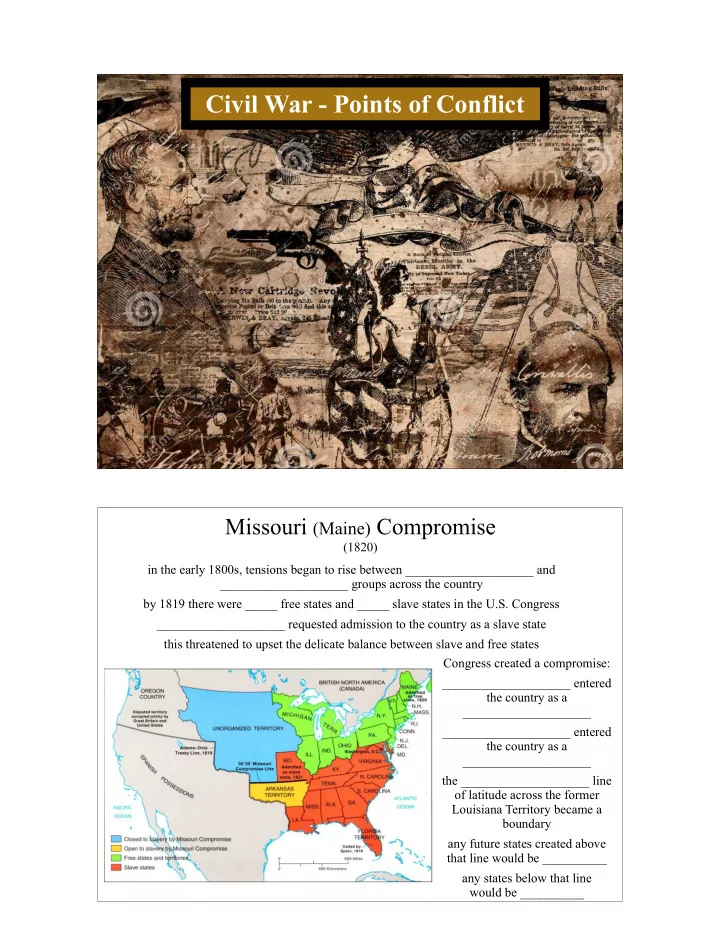
Missouri (Maine) Compromise

(1820) Congress created a compromise:

  • ____________________ entered

the country as a ____________________

  • ____________________ entered

the country as a ____________________

  • the ____________________ line
  • f latitude across the former

Louisiana Territory became a boundary

  • any future states created above

that line would be __________

  • any states below that line

would be __________ in the early 1800s, tensions began to rise between ____________________ and ____________________ groups across the country

  • by 1819 there were _____ free states and _____ slave states in the U.S. Congress
  • ____________________ requested admission to the country as a slave state
  • this threatened to upset the delicate balance between slave and free states
slide-2
SLIDE 2

Wilmot Proviso (1846)

  • suggested outlawing slavery in any territory acquired the Mexican-American War

(named for Congressman David Wilmot, a Democrat from Pennsylvania - ____________________)

  • “Provided, That, as an express and fundamental condition to the acquisition of any territory from the Republic
  • f Mexico by the United States, by virtue of any treaty which may be negotiated between them, and to the use by

the Executive of the moneys herein appropriated, neither slavery nor involuntary servitude shall ever exist in any part of said territory, except for crime, whereof the party shall first be duly convicted.”

Mexican Session

(lands gained from the Mexican War - should they be free or slave?)

slave trade (not slavery itself) ____________________ in DC

  • new, stronger ____________________________________

required citizens to assist in the recovery of fugitive slaves

  • denied a fugitive's right to a jury trial
  • cases handled by commissioners
  • were paid $_____ if an alleged fugitive were released
  • $_____ if they were sent “back” to slavery

Compromise of 1850

  • CA admitted as a free state
  • ther territory split (UT & NM) = ________________________

let the voters of a territory decide whether they are to be free or slave to get the southern Congressmen to vote for it, he introduced a bill to organize the Nebraska Territory into 2 sections (Kansas and Nebraska) and that would be open to ________________________________________

  • assumed that the northern area would oppose slavery and the southern one would permit it

basically repealed the ________________________________________

Kansas-Nebraska Act

(1854)

  • Sen. ____________________ of IL wanted to

wanting to ensure a northern _________________________ route that would allow his Illinois voters to profit from railroad terminals throughout the area

  • southern senators objected

(wanted a ____________________ route)

slide-3
SLIDE 3

a sequence of violent events involving ____________________ and pro-slavery elements

  • several abolitionist organizations from the North organized and funded the settlement of several

thousand people in Kansas so they could vote to make it a free state

  • Minister Henry Ward Beecher armed settlers with “____________________________________”
  • thousands of armed Southerners (nicknamed “______________________________”)

arrived to vote for slavery (few of them actually owned slaves; they were too poor!)

  • ____________________ forces won the election
  • President Franklin Pierce continued to recognize the proslavery legislature

Bleeding Kansas

(1856) ____________________ traveled north to an antislavery settlement burned a hotel, destroyed printing presses, and ransacked homes & stores

  • abolitionist ____________________ led an attack on

a proslavery settlement at ___________________________________ dragged five proslavery men from their homes and hacked them to death in all, approximately 55 people died

  • Kansas entered the Union as a free state in 1861

Sumner-Brooks Incident

(1856 - occurred during Bleeding Kansas crisis) MA Senator __________________________________ made an antislavery speech in Congress, insulting SC Senator __________________________________

  • made several mocking references to Butler’s speech

impediment (caused by a stroke)

  • two days later, South Carolina Representative

_____________________________ (Butler's nephew) confronted Sumner as he sat writing at his desk in the almost empty Senate chamber

“Mr. Sumner, I have read your speech twice over carefully. It is a libel on South Carolina, and

  • Mr. Butler, who is a relative of mine.”
  • __________________ beat __________________ over the head with a thick

cane with a gold head

  • Sumner, blinded by his own blood, staggered up the aisle and collapsed
  • Brooks continued to beat the motionless Sumner until his cane broke
  • Sumner became a __________________ in the North and

Brooks a hero in the South

  • was symbolic of the

extreme hatred the two sides of the slavery issue had for each other

slide-4
SLIDE 4

Dred Scott had been the __________________

  • f Dr. John Emerson who died in 1843
  • Scott sued for his freedom because he had lived in areas

where slavery was __________________

  • multiple appeals brought the case the US Supreme Court

Dred Scott Decision

(1857) Chief Justice Roger B. Taney delivered the majority opinion:

  • slaves are __________________, not __________________, and are
  • protected by the __________________ __________________, which
  • says property cannot be taken away without “due process”
  • essentially made slavery legal __________________ in the country
  • Scott was returned to his original owners and granted his freedom
  • died 18 months later from tuberculosis

a series of seven debates in Illinois between Republican candidate Abraham Lincoln and incumbent Democratic Senator Stephen Douglas

  • at the time, U.S. senators were elected by state legislatures, so Lincoln and Douglas were really

campaigning for their respective parties to win control of the Illinois state legislature

  • the main issue discussed in all seven debates was slavery

Lincoln-Douglas Debates

(1858) Douglas said slavery could be prevented from any territory by the refusal of the people living there to pass laws that supported to slavery

  • Douglas was reelected but alienated Southern Democrats
  • would eventually be key to his loss in the 1860 presidential election

Freeport Doctrine

named this because it happened at the Freeport, IL debate

Lincoln tried to trip Douglas up, forcing him to choose either popular sovereignty (as in his Kansas-Nebraksa Act) or the Dred Scott decision (slavery can’t be excluded from the territories)

slide-5
SLIDE 5

armory surrounded by US troops under the command of

  • Lt. Col. ________________________ (?!)
  • Brown and his men told they would be spared

if they surrendered

  • Brown refused; troops stormed the building
  • 10 of Brown's men were killed (including his 2 sons)
  • Brown's men killed four of the troops, wounded nine
  • Brown later hanged for __________________

John Brown’s Raid

(1859) Brown and 18 men were armed with 200 rifles supplied by northern abolitionist societies

  • attacked

____________________________ (armory for weapons)

  • plan was to arm local slaves and

head south, starting a revolution Abraham Lincoln, Stephen Douglas, John Breckinridge, John Bell

  • election was noteworthy for exaggerated _______________________ of the vote
  • Lincoln not even on the ballot in nine Southern states
  • Lincoln captured less than 40% of the popular vote but 180 electoral votes
  • November 6 - __________________ officially wins Presidency
  • December 24 - South Carolina secedes from the Union

Election of 1860