Clark-Wilson Integrity Model Integrity defined by a set of - - PowerPoint PPT Presentation

clark wilson integrity model
SMART_READER_LITE
LIVE PREVIEW

Clark-Wilson Integrity Model Integrity defined by a set of - - PowerPoint PPT Presentation

Clark-Wilson Integrity Model Integrity defined by a set of constraints Data in a consistent or valid state when it satisfies these Example: Bank D todays deposits, W withdrawals, YB yesterdays balance, TB todays balance


slide-1
SLIDE 1

May 10, 2005 ECS 235, Computer and Information Security Slide #1

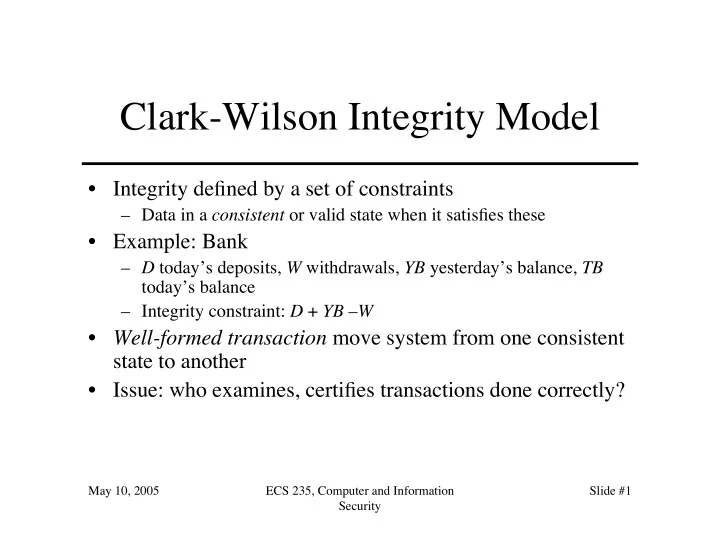
Clark-Wilson Integrity Model

  • Integrity defined by a set of constraints

– Data in a consistent or valid state when it satisfies these

  • Example: Bank

– D today’s deposits, W withdrawals, YB yesterday’s balance, TB today’s balance – Integrity constraint: D + YB –W

  • Well-formed transaction move system from one consistent

state to another

  • Issue: who examines, certifies transactions done correctly?
slide-2
SLIDE 2

May 10, 2005 ECS 235, Computer and Information Security Slide #2

Entities

  • CDIs: constrained data items

– Data subject to integrity controls

  • UDIs: unconstrained data items

– Data not subject to integrity controls

  • IVPs: integrity verification procedures

– Procedures that test the CDIs conform to the integrity constraints

  • TPs: transaction procedures

– Procedures that take the system from one valid state to another

slide-3
SLIDE 3

May 10, 2005 ECS 235, Computer and Information Security Slide #3

Certification Rules 1 and 2

CR1 When any IVP is run, it must ensure all CDIs are in a valid state CR2 For some associated set of CDIs, a TP must transform those CDIs in a valid state into a (possibly different) valid state

– Defines relation certified that associates a set of CDIs with a particular TP – Example: TP balance, CDIs accounts, in bank example

slide-4
SLIDE 4

May 10, 2005 ECS 235, Computer and Information Security Slide #4

Enforcement Rules 1 and 2

ER1 The system must maintain the certified relations and must ensure that only TPs certified to run on a CDI manipulate that CDI. ER2 The system must associate a user with each TP and set of CDIs. The TP may access those CDIs on behalf

  • f the associated user. The TP cannot access that CDI
  • n behalf of a user not associated with that TP and

CDI.

– System must maintain, enforce certified relation – System must also restrict access based on user ID (allowed relation)

slide-5
SLIDE 5

May 10, 2005 ECS 235, Computer and Information Security Slide #5

Users and Rules

CR3 The allowed relations must meet the requirements imposed by the principle of separation of duty. ER3 The system must authenticate each user attempting to execute a TP

– Type of authentication undefined, and depends on the instantiation – Authentication not required before use of the system, but is required before manipulation of CDIs (requires using TPs)

slide-6
SLIDE 6

May 10, 2005 ECS 235, Computer and Information Security Slide #6

Logging

CR4 All TPs must append enough information to reconstruct the operation to an append-only CDI.

– This CDI is the log – Auditor needs to be able to determine what happened during reviews of transactions

slide-7
SLIDE 7

May 10, 2005 ECS 235, Computer and Information Security Slide #7

Handling Untrusted Input

CR5 Any TP that takes as input a UDI may perform only valid transformations, or no transformations, for all possible values of the UDI. The transformation either rejects the UDI or transforms it into a CDI.

– In bank, numbers entered at keyboard are UDIs, so cannot be input to TPs. TPs must validate numbers (to make them a CDI) before using them; if validation fails, TP rejects UDI

slide-8
SLIDE 8

May 10, 2005 ECS 235, Computer and Information Security Slide #8

Separation of Duty In Model

ER4 Only the certifier of a TP may change the list of entities associated with that

  • TP. No certifier of a TP, or of an entity

associated with that TP, may ever have execute permission with respect to that entity.

– Enforces separation of duty with respect to certified and allowed relations

slide-9
SLIDE 9

May 10, 2005 ECS 235, Computer and Information Security Slide #9

Comparison With Requirements

1. Users can’t certify TPs, so CR5 and ER4 enforce this 2. Procedural, so model doesn’t directly cover it; but special process corresponds to using TP

  • No technical controls can prevent programmer from developing

program on production system; usual control is to delete software tools

3. TP does the installation, trusted personnel do certification

slide-10
SLIDE 10

May 10, 2005 ECS 235, Computer and Information Security Slide #10

Comparison With Requirements

  • 4. CR4 provides logging; ER3 authenticates

trusted personnel doing installation; CR5, ER4 control installation procedure

  • New program UDI before certification, CDI

(and TP) after

  • 5. Log is CDI, so appropriate TP can

provide managers, auditors access

  • Access to state handled similarly
slide-11
SLIDE 11

May 10, 2005 ECS 235, Computer and Information Security Slide #11

Comparison to Biba

  • Biba

– No notion of certification rules; trusted subjects ensure actions obey rules – Untrusted data examined before being made trusted

  • Clark-Wilson

– Explicit requirements that actions must meet – Trusted entity must certify method to upgrade untrusted data (and not certify the data itself)

slide-12
SLIDE 12

May 10, 2005 ECS 235, Computer and Information Security Slide #12

Chinese Wall Model

Problem:

– Tony advises American Bank about investments – He is asked to advise Toyland Bank about investments

  • Conflict of interest to accept, because his

advice for either bank would affect his advice to the other bank

slide-13
SLIDE 13

May 10, 2005 ECS 235, Computer and Information Security Slide #13

Organization

  • Organize entities into “conflict of interest”

classes

  • Control subject accesses to each class
  • Control writing to all classes to ensure

information is not passed along in violation

  • f rules
  • Allow sanitized data to be viewed by

everyone

slide-14
SLIDE 14

May 10, 2005 ECS 235, Computer and Information Security Slide #14

Definitions

  • Objects: items of information related to a

company

  • Company dataset (CD): contains objects related

to a single company

– Written CD(O)

  • Conflict of interest class (COI): contains datasets
  • f companies in competition

– Written COI(O) – Assume: each object belongs to exactly one COI class

slide-15
SLIDE 15

May 10, 2005 ECS 235, Computer and Information Security Slide #15

Example

Bank of America Citibank Bank of the West Bank COI Class Shell Oil Union ’76 Standard Oil ARCO Gasoline Company COI Class

slide-16
SLIDE 16

May 10, 2005 ECS 235, Computer and Information Security Slide #16

Temporal Element

  • If Anthony reads any CD in a COI, he can

never read another CD in that COI

– Possible that information learned earlier may allow him to make decisions later – Let PR(S) be set of objects that S has already read

slide-17
SLIDE 17

May 10, 2005 ECS 235, Computer and Information Security Slide #17

CW-Simple Security Condition

  • s can read o iff either condition holds:

1. There is an o′ such that s has accessed o′ and CD(o′) = CD(o)

– Meaning s has read something in o’s dataset

2. For all o′ ∈ O, o′ ∈ PR(s) ⇒ COI(o′) ≠ COI(o)

– Meaning s has not read any objects in o’s conflict of interest class

  • Ignores sanitized data (see below)
  • Initially, PR(s) = ∅, so initial read request

granted

slide-18
SLIDE 18

May 10, 2005 ECS 235, Computer and Information Security Slide #18

Sanitization

  • Public information may belong to a CD

– As is publicly available, no conflicts of interest arise – So, should not affect ability of analysts to read – Typically, all sensitive data removed from such information before it is released publicly (called sanitization)

  • Add third condition to CW-Simple Security

Condition:

3.

  • is a sanitized object
slide-19
SLIDE 19

May 10, 2005 ECS 235, Computer and Information Security Slide #19

Writing

  • Anthony, Susan work in same trading house
  • Anthony can read Bank 1’s CD, Gas’ CD
  • Susan can read Bank 2’s CD, Gas’ CD
  • If Anthony could write to Gas’ CD, Susan

can read it

– Hence, indirectly, she can read information from Bank 1’s CD, a clear conflict of interest

slide-20
SLIDE 20

May 10, 2005 ECS 235, Computer and Information Security Slide #20

CW-*-Property

  • s can write to o iff both of the following

hold:

  • 1. The CW-simple security condition permits

s to read o; and

  • 2. For all unsanitized objects o′, if s can read
  • ′, then CD(o′) = CD(o)
  • Says that s can write to an object if all the

(unsanitized) objects it can read are in the same dataset

slide-21
SLIDE 21

May 10, 2005 ECS 235, Computer and Information Security Slide #21

Formalism

  • Goal: figure out how information flows

around system

  • S set of subjects, O set of objects, L = C×D

set of labels

  • l1:O→C maps objects to their COI classes
  • l2:O→D maps objects to their CDs
  • H(s, o) true iff s has or had read access to o
  • R(s, o): s’s request to read o
slide-22
SLIDE 22

May 10, 2005 ECS 235, Computer and Information Security Slide #22

Axioms

  • Axiom 7-1. For all o, o′ ∈ O,

if l2(o) = l2(o′), then l1(o) = l1(o′)

– CDs do not span COIs.

  • Axiom 7-2. s ∈ S can read o ∈ O iff,

for all o′ ∈ O such that H(s, o′), either l1(o′) ≠ l1(o) or l2(o′) = l2(o)

– s can read o iff o is either in a different COI than every other o′ that s has read, or in the same CD as o.

slide-23
SLIDE 23

May 10, 2005 ECS 235, Computer and Information Security Slide #23

More Axioms

  • Axiom 7-3. ¬H(s, o) for all s ∈ S and o ∈

O is an initially secure state

– Description of the initial state, assumed secure

  • Axiom 7-4. If for some s ∈ S and all o ∈ O,

¬H(s, o), then any request R(s, o) is granted

– If s has read no object, it can read any object

slide-24
SLIDE 24

May 10, 2005 ECS 235, Computer and Information Security Slide #24

Which Objects Can Be Read?

  • Suppose s ∈ S has read o ∈ O. If s can read
  • ′ ∈ O, o′ ≠ o, then l1(o′ ) ≠ l1(o) or l2(o′ )

= l2(o).

– Says s can read only the objects in a single CD within any COI

slide-25
SLIDE 25

May 10, 2005 ECS 235, Computer and Information Security Slide #25

Proof

Assume false. Then

H(s, o) ∧ H(s, o′) ∧ l1(o′) = l1(o) ∧ l2(o′) ≠ l2(o)

Assume s read o first. Then H(s, o) when s read o, so by Axiom 7-2, either l1(o′) ≠ l1(o) or l2(o′) = l2(o), so

(l1(o′) ≠ l1(o) ∨ l2(o′) = l2(o)) ∧ (l1(o′) = l1(o) ∧ l2(o′) ≠ l2(o))

Rearranging terms,

(l1(o′) ≠ l1(o) ∧ l2(o′) ≠ l2(o) ∧ l1(o′) = l1(o)) ∨ (l2(o′) = l2(o) ∧ l2(o′) ≠ l2(o) ∧ l1(o′) = l1(o))

which is obviously false, contradiction.

slide-26
SLIDE 26

May 10, 2005 ECS 235, Computer and Information Security Slide #26

Lemma

  • Suppose a subject s ∈ S can read an object
  • ∈ O. Then s can read no o′ for which

l1(o′) = l1(o) and l2(o′) ≠ l2(o).

– So a subject can access at most one CD in each COI class – Sketch of proof: Initial case follows from Axioms 7-3, 7-4. If o′ ≠ o, theorem immediately gives lemma.

slide-27
SLIDE 27

May 10, 2005 ECS 235, Computer and Information Security Slide #27

COIs and Subjects

  • Theorem: Let c ∈ C and d ∈ D. Suppose there are n
  • bjects oi ∈ O, 1 ≤ i ≤ n, such that l1(oi) = d for 1 ≤ i ≤ n,

and l2(oi) ≠ l2(oj), for 1 ≤ i, j ≤ n, i ≠ j. Then for all such

  • , there is an s ∈ S that can read o iff n ≤ |S|.

– If a COI has n CDs, you need at least n subjects to access every

  • bject

– Proof sketch: If s can read o, it cannot read any o′ in another CD in that COI (Axiom 7-2). As there are n such CDs, there must be at least n subjects to meet the conditions of the theorem.

slide-28
SLIDE 28

May 10, 2005 ECS 235, Computer and Information Security Slide #28

Sanitized Data

  • v(o): sanitized version of object o

– For purposes of analysis, place them all in a special CD in a COI containing no other CDs

  • Axiom 7-5. l1(o) = l1(v(o)) iff l2(o) = l2(v(o))
slide-29
SLIDE 29

May 10, 2005 ECS 235, Computer and Information Security Slide #29

Which Objects Can Be Written?

  • Axiom 7-6. s ∈ S can write to o ∈ O iff the following hold

simultaneously

1. H(s, o) 2. There is no o′ ∈ O with H(s, o′), l2(o) ≠ l2(o′), l2(o) ≠ l2(v(o)), l2(o′) = l2(v(o)). – Allow writing iff information cannot leak from one subject to another through a mailbox – Note handling for sanitized objects

slide-30
SLIDE 30

May 10, 2005 ECS 235, Computer and Information Security Slide #30

How Information Flows

  • Definition: information may flow from o to
  • ′ if there is a subject such that H(s, o) and

H(s, o′).

– Intuition: if s can read 2 objects, it can act on that knowledge; so information flows between the objects through the nexus of the subject – Write the above situation as (o, o′)

slide-31
SLIDE 31

May 10, 2005 ECS 235, Computer and Information Security Slide #31

Key Result

  • Set of all information flows is

{ (o, o′) | o ∈ O ∧ o′ ∈ O ∧ l2(o) = l2(o′) ∨ l2(o) = l2(v(o)) }

  • Sketch of proof: Definition gives set of flows:

F = {(o, o′) | o ∈ O ∧ o′ ∈ O ∧ ∃ s ∈ S such that H(s, o) ∧ H(s, o′))}

Axiom 7-6 excludes the following flows:

X = { (o, o′) | o ∈ O ∧ o′ ∈ O ∧ l2(o) ≠ l2(o′) ∧ l2(o) ≠ l2(v(o)) }

So, letting F* be transitive closure of F,

F* – X = {(o, o′) | o ∈ O ∧ o′ ∈ O ∧ ¬(l2(o) ≠ l2(o′) ∧ l2(o) ≠ l2(v(o))) }

which is equivalent to the claim.

slide-32
SLIDE 32

May 10, 2005 ECS 235, Computer and Information Security Slide #32

Compare to Bell-LaPadula

  • Fundamentally different

– CW has no security labels, B-LP does – CW has notion of past accesses, B-LP does not

  • Bell-LaPadula can capture state at any time

– Each (COI, CD) pair gets security category – Two clearances, S (sanitized) and U (unsanitized)

  • S dom U

– Subjects assigned clearance for compartments without multiple categories corresponding to CDs in same COI class

slide-33
SLIDE 33

May 10, 2005 ECS 235, Computer and Information Security Slide #33

Compare to Bell-LaPadula

  • Bell-LaPadula cannot track changes over time

– Susan becomes ill, Anna needs to take over

  • C-W history lets Anna know if she can
  • No way for Bell-LaPadula to capture this
  • Access constraints change over time

– Initially, subjects in C-W can read any object – Bell-LaPadula constrains set of objects that a subject can access

  • Can’t clear all subjects for all categories, because this violates CW-

simple security condition

slide-34
SLIDE 34

May 10, 2005 ECS 235, Computer and Information Security Slide #34

Compare to Clark-Wilson

  • Clark-Wilson Model covers integrity, so consider
  • nly access control aspects
  • If “subjects” and “processes” are interchangeable,

a single person could use multiple processes to violate CW-simple security condition

– Would still comply with Clark-Wilson Model

  • If “subject” is a specific person and includes all

processes the subject executes, then consistent with Clark-Wilson Model

slide-35
SLIDE 35

May 10, 2005 ECS 235, Computer and Information Security Slide #35

Clinical Information Systems Security Policy

  • Intended for medical records

– Conflict of interest not critical problem – Patient confidentiality, authentication of records and annotators, and integrity are

  • Entities:

– Patient: subject of medical records (or agent) – Personal health information: data about patient’s health

  • r treatment enabling identification of patient

– Clinician: health-care professional with access to personal health information while doing job

slide-36
SLIDE 36

May 10, 2005 ECS 235, Computer and Information Security Slide #36

Assumptions and Principles

  • Assumes health information involves 1

person at a time

– Not always true; OB/GYN involves father as well as mother

  • Principles derived from medical ethics of

various societies, and from practicing clinicians

slide-37
SLIDE 37

May 10, 2005 ECS 235, Computer and Information Security Slide #37

Access

  • Principle 1: Each medical record has an

access control list naming the individuals

  • r groups who may read and append

information to the record. The system must restrict access to those identified on the access control list.

– Idea is that clinicians need access, but no-one

  • else. Auditors get access to copies, so they

cannot alter records

slide-38
SLIDE 38

May 10, 2005 ECS 235, Computer and Information Security Slide #38

Access

  • Principle 2: One of the clinicians on the

access control list must have the right to add other clinicians to the access control list.

– Called the responsible clinician

slide-39
SLIDE 39

May 10, 2005 ECS 235, Computer and Information Security Slide #39

Access

  • Principle 3: The responsible clinician must

notify the patient of the names on the access control list whenever the patient’s medical record is opened. Except for situations given in statutes, or in cases of emergency, the responsible clinician must

  • btain the patient’s consent.

– Patient must consent to all treatment, and must know of violations of security

slide-40
SLIDE 40

May 10, 2005 ECS 235, Computer and Information Security Slide #40

Access

  • Principle 4: The name of the clinician, the

date, and the time of the access of a medical record must be recorded. Similar information must be kept for deletions.

– This is for auditing. Don’t delete information; update it (last part is for deletion of records after death, for example, or deletion of information when required by statute). Record information about all accesses.

slide-41
SLIDE 41

May 10, 2005 ECS 235, Computer and Information Security Slide #41

Creation

  • Principle: A clinician may open a record,

with the clinician and the patient on the access control list. If a record is opened as a result of a referral, the referring clinician may also be on the access control list.

– Creating clinician needs access, and patient should get it. If created from a referral, referring clinician needs access to get results of referral.

slide-42
SLIDE 42

May 10, 2005 ECS 235, Computer and Information Security Slide #42

Deletion

  • Principle: Clinical information cannot be

deleted from a medical record until the appropriate time has passed.

– This varies with circumstances.

slide-43
SLIDE 43

May 10, 2005 ECS 235, Computer and Information Security Slide #43

Confinement

  • Principle: Information from one medical

record may be appended to a different medical record if and only if the access control list of the second record is a subset

  • f the access control list of the first.

– This keeps information from leaking to unauthorized users. All users have to be on the access control list.

slide-44
SLIDE 44

May 10, 2005 ECS 235, Computer and Information Security Slide #44

Aggregation

  • Principle: Measures for preventing aggregation of patient

data must be effective. In particular, a patient must be notified if anyone is to be added to the access control list for the patient’s record and if that person has access to a large number of medical records.

– Fear here is that a corrupt investigator may obtain access to a large number of records, correlate them, and discover private information about individuals which can then be used for nefarious purposes (such as blackmail)

slide-45
SLIDE 45

May 10, 2005 ECS 235, Computer and Information Security Slide #45

Enforcement

  • Principle: Any computer system that

handles medical records must have a subsystem that enforces the preceding

  • principles. The effectiveness of this

enforcement must be subject to evaluation by independent auditors.

– This policy has to be enforced, and the enforcement mechanisms must be auditable (and audited)

slide-46
SLIDE 46

May 10, 2005 ECS 235, Computer and Information Security Slide #46

Compare to Bell-LaPadula

  • Confinement Principle imposes lattice

structure on entities in model

– Similar to Bell-LaPadula

  • CISS focuses on objects being accessed; B-

LP on the subjects accessing the objects

– May matter when looking for insiders in the medical environment

slide-47
SLIDE 47

May 10, 2005 ECS 235, Computer and Information Security Slide #47

Compare to Clark-Wilson

– CDIs are medical records – TPs are functions updating records, access control lists – IVPs certify:

  • A person identified as a clinician is a clinician;
  • A clinician validates, or has validated, information in the medical

record;

  • When someone is to be notified of an event, such notification occurs;

and

  • When someone must give consent, the operation cannot proceed until

the consent is obtained

– Auditing (CR4) requirement: make all records append-only, notify patient when access control list changed

slide-48
SLIDE 48

May 10, 2005 ECS 235, Computer and Information Security Slide #48

ORCON

  • Problem: organization creating document

wants to control its dissemination

– Example: Secretary of Agriculture writes a memo for distribution to her immediate subordinates, and she must give permission for it to be disseminated further. This is “originator controlled” (here, the “originator” is a person).

slide-49
SLIDE 49

May 10, 2005 ECS 235, Computer and Information Security Slide #49

Requirements

  • Subject s ∈ S marks object o ∈ O as ORCON on behalf of
  • rganization X. X allows o to be disclosed to subjects

acting on behalf of organization Y with the following restrictions:

1.

  • cannot be released to subjects acting on behalf of other
  • rganizations without X’s permission; and

2. Any copies of o must have the same restrictions placed on it.

slide-50
SLIDE 50

May 10, 2005 ECS 235, Computer and Information Security Slide #50

DAC Fails

  • Owner can set any desired permissions

– This makes 2 unenforceable

slide-51
SLIDE 51

May 10, 2005 ECS 235, Computer and Information Security Slide #51

MAC Fails

  • First problem: category explosion

– Category C contains o, X, Y, and nothing else. If a subject y ∈ Y wants to read o, x ∈ X makes a copy o′. Note o′ has category C. If y wants to give z ∈ Z a copy, z must be in Y—by definition, it’s

  • not. If x wants to let w ∈ W see the document, need a new

category C′ containing o, X, W.

  • Second problem: abstraction

– MAC classification, categories centrally controlled, and access controlled by a centralized policy – ORCON controlled locally

slide-52
SLIDE 52

May 10, 2005 ECS 235, Computer and Information Security Slide #52

Combine Them

  • The owner of an object cannot change the access controls
  • f the object.
  • When an object is copied, the access control restrictions of

that source are copied and bound to the target of the copy.

– These are MAC (owner can’t control them)

  • The creator (originator) can alter the access control

restrictions on a per-subject and per-object basis.

– This is DAC (owner can control it)

slide-53
SLIDE 53

May 10, 2005 ECS 235, Computer and Information Security Slide #53

RBAC

  • Access depends on function, not identity

– Example:

  • Allison, bookkeeper for Math Dept, has access to

financial records.

  • She leaves.
  • Betty hired as the new bookkeeper, so she now has

access to those records

– The role of “bookkeeper” dictates access, not the identity of the individual.

slide-54
SLIDE 54

May 10, 2005 ECS 235, Computer and Information Security Slide #54

Definitions

  • Role r: collection of job functions

– trans(r): set of authorized transactions for r

  • Active role of subject s: role s is currently in

– actr(s)

  • Authorized roles of a subject s: set of roles s is

authorized to assume

– authr(s)

  • canexec(s, t) iff subject s can execute transaction t

at current time

slide-55
SLIDE 55

May 10, 2005 ECS 235, Computer and Information Security Slide #55

Axioms

  • Let S be the set of subjects and T the set of

transactions.

  • Rule of role assignment:

(∀s ∈ S)(∀t ∈ T) [canexec(s, t) → actr(s) ≠ ∅].

– If s can execute a transaction, it has a role – This ties transactions to roles

  • Rule of role authorization:

(∀s ∈ S) [actr(s) ⊆ authr(s)].

– Subject must be authorized to assume an active role (otherwise, any subject could assume any role)

slide-56
SLIDE 56

May 10, 2005 ECS 235, Computer and Information Security Slide #56

Axiom

  • Rule of transaction authorization:

(∀s ∈ S)(∀t ∈ T) [canexec(s, t) → t ∈ trans(actr(s))].

– If a subject s can execute a transaction, then the transaction is an authorized one for the role s has assumed

slide-57
SLIDE 57

May 10, 2005 ECS 235, Computer and Information Security Slide #57

Containment of Roles

  • Trainer can do all transactions that trainee

can do (and then some). This means role r contains role r′ (r > r′). So:

(∀s ∈ S)[ r′ ∈ authr(s) ∧ r > r′ → r ∈ authr(s) ]

slide-58
SLIDE 58

May 10, 2005 ECS 235, Computer and Information Security Slide #58

Separation of Duty

  • Let r be a role, and let s be a subject such that r ∈ auth(s).

Then the predicate meauth(r) (for mutually exclusive authorizations) is the set of roles that s cannot assume because of the separation of duty requirement.

  • Separation of duty:

(∀r1, r2 ∈ R) [ r2 ∈ meauth(r1) → [ (∀s ∈ S) [ r1∈ authr(s) → r2 ∉ authr(s) ] ] ]

slide-59
SLIDE 59

May 10, 2005 ECS 235, Computer and Information Security Slide #59

Key Points

  • Hybrid policies deal with both

confidentiality and integrity

– Different combinations of these

  • ORCON model neither MAC nor DAC

– Actually, a combination

  • RBAC model controls access based on

functionality