Classical Cryptosystems Debdeep Mukhopadhyay Assistant Professor - - PDF document

classical cryptosystems
SMART_READER_LITE
LIVE PREVIEW

Classical Cryptosystems Debdeep Mukhopadhyay Assistant Professor - - PDF document

Classical Cryptosystems Debdeep Mukhopadhyay Assistant Professor Department of Computer Science and Engineering Indian Institute of Technology Kharagpur INDIA -721302 Objectives Definitions Kerckhoffs Principle Monoalphabetic


slide-1
SLIDE 1

1

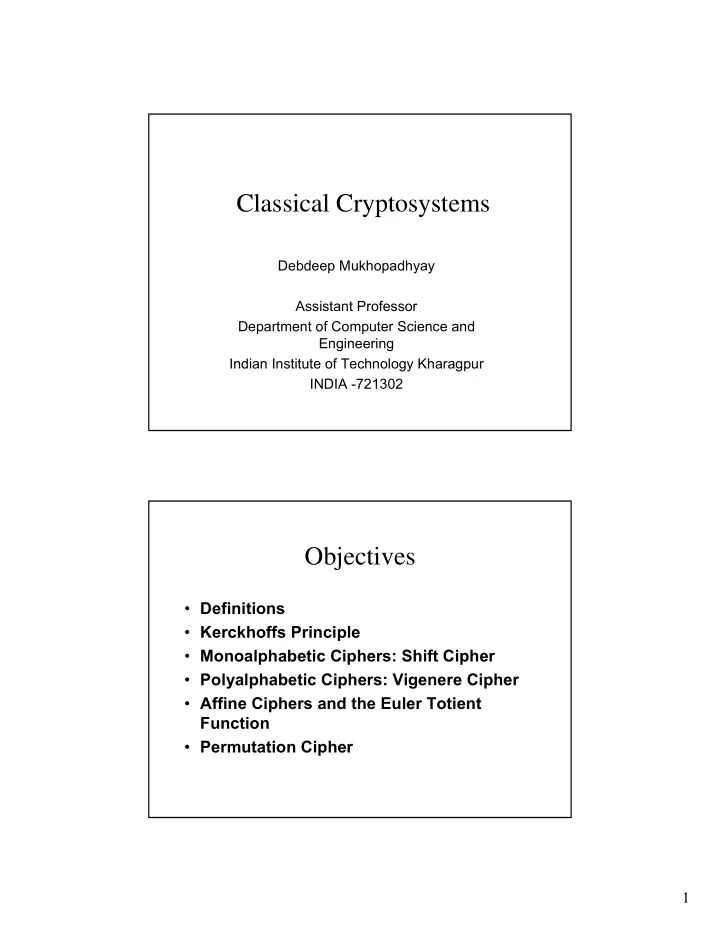
Classical Cryptosystems

Debdeep Mukhopadhyay Assistant Professor Department of Computer Science and Engineering Indian Institute of Technology Kharagpur INDIA -721302

Objectives

  • Definitions
  • Kerckhoffs Principle
  • Monoalphabetic Ciphers: Shift Cipher
  • Polyalphabetic Ciphers: Vigenere Cipher
  • Affine Ciphers and the Euler Totient

Function

  • Permutation Cipher
slide-2
SLIDE 2

2

Definitions

  • A cipher or cryptosystem is used to

encrypt the plaintext

  • The result of encryption is ciphertext
  • We decrypt ciphertext to recover plaintext
  • A key is used to configure a cryptosystem
  • A symmetric key cryptosystem uses the

same key to encrypt as to decrypt

  • A public key cryptosystem uses a public

key to encrypt and a private key to decrypt.

Kerckhoffs Principle

  • Basis assumption

– The system is completely known to the attacker – Only the key is secret

  • Also known as Kerckhoffs Principle

– Crypto algorithms are not secret

  • Why do we make this assumption?

– Experience has shown that secret algorithms are weak when exposed – Secret algorithms never remain secret – Better to find weaknesses beforehand

slide-3
SLIDE 3

3

Cryptographic Communication

plaintext

key key

plaintext ciphertext

A generic use of crypto

encrypt decrypt

Cryptosystem

A cryptosystem is a five-tuple (P,C,K,E,D), where the following are satisfied: 1. P is a finite set of possible plaintexts 2. C is a finite set of possible ciphertexts 3. K, the keyspace, is a finite set of possible keys 4. KK, eKE (encryption rule), dKD (decryption rule). Each eK: PC and dK: CP P are functions such that xP, dK(eK(x)) = x.

slide-4
SLIDE 4

4

Encryption Function is Injective

  • y=eK(x) : Denotes the encryption

transformation.

  • if y=eK(x1) = eK(x2), then Bob does

not know whether y has come from x1 or x2.

  • If the Plaintext set and ciphertext set

are same, then the encryption function is just a permutation.

Classical Cryptography

  • Monoalphabetic Ciphers

Once a key is chosen, each alphabetic character of a plaintext is mapped onto a unique alphabetic character of a ciphertext. –The Shift Cipher (Caesar Cipher) –The Substitution Cipher –The Affine Cipher

slide-5
SLIDE 5

5

Classical Cryptography

  • Polyalphabetic Ciphers

Each alphabetic character of a plaintext can be mapped onto m alphabetic characters of a ciphertext. Usually m is related to the encryption key. –The Vigenère Cipher –The Hill Cipher –The Permutation Cipher

Shift cipher

  • Consider,

– P=C=K=Z26. – For 0≤K≤25, define

» eK(x)=x+K mod 26 » dk(x) = y-K mod 26 – (x,y Є Z26)

  • It is easy to see that, x=dK(ek(x)).
slide-6
SLIDE 6

6

Simple Substitution

  • Plaintext:

fourscoreandsevenyearsago

B A Z Y X W V U T S R Q P O N M L K J I H G F E D y x w v u t s r q p

  • n

m l k j i h g f e d c b a C z

  • Ciphertext:

IRXUVFRUHDAGVHYHABHDUVDIR

  • Shift by 3 is “Caesar’s cipher”

Plaintext Ciphertext

Note that the use of smaller letter for plaintext and capital letters for ciphertext is only to improve readibility

Ceasar’s Cipher Decryption

  • Plaintext: spongebobsquarepants

B A Z Y X W V U T S R Q P O N M L K J I H G F E D y x w v u t s r q p

  • n

m l k j i h g f e d c b a C z Plaintext Ciphertext

  • Suppose we know a Ceasar’s

cipher is being used

  • Ciphertext:

VSRQJHEREVTXDUHSDQWU

slide-7
SLIDE 7

7

Not-so-Simple Substitution

  • Shift by n for some n  {0,1,2,…,25}
  • Then key is n
  • Example: key = 7

F E D C B A Z Y X W V U T S R Q P O N M L K J I H y x w v u t s r q p

  • n

m l k j i h g f e d c b a G z Plaintext Ciphertext

Properties required of the encryption

  • Each of encryption and decryption function

should be easily computable.

  • An opponent, on seeing a ciphertext string y,

should be unable to determine the key K, that was used, or the plaintext string x.

  • “Cryptanalysis” is the process of attempting to

know the key from given information.

slide-8
SLIDE 8

8

Cryptanalysis: Try all possibilities

  • Ciphertext:

JBCRCLQRWCRVNBJENBWRWN

  • Try all the 26 possible keys (Exhaustive or

brute force search)

  • jbcrclqrwcrvnbjenbwrwn

iabqbkpqvbqumaidmavqvm hzapajopuaptlzhclzupul … astitchintimessavesnine: key = 9

Substitution Cipher

  • Key is some permutation of letters
  • Need not be a shift
  • For example

G L U N P M F H R Z T Q B W K D V Y E S X A C I J y x w v u t s r q p

  • n

m l k j i h g f e d c b a O z Plaintext Ciphertext

  • Then 26! ≈ 4 x 1026 > 288 possible keys!

But still the cipher can be attacked quite easily.

slide-9
SLIDE 9

9

The Affine Cipher

Let P = C = Z26, let K K = {(a, b)  Z26  Z26 | gcd(a, 26) = 1}. xP, yC, K K, define eK(x) = ax + b (mod 26) and dK(y) = a-1(y – b) (mod 26). The encryption is injective if and

  • nly if gcd(a,26)=1

Multiplicative Inverse of an Element

  • Suppose a is an element from Zm.

Then the multiplicative inverse of an element is an element b also in Zm, such that ab=1 (mod m).

– Then, gcd(a,m)=1

  • Note that if m=prime number, p then

every element has an inverse. Then Zp is called a field.

slide-10
SLIDE 10

10

Inverse of Affine Cipher

  • Affine Cipher is invertible if a has a

multiplicative inverse.

– That is gcd(a,m)=1 – {1,3,5,7,9,11,15,17,19,21,23,25} have elements which are co-prime to m – Thus, 1-1=1, 3-1=9, 5-1=21, 7-1=15, 11-1=19, 15-1=7, 17-1=23, 25-1=25 – Thus, the inverse of an element belongs to the above set. Why?

Key Size of Affine Cipher

  • The possible values of a such that

gcd(a,26)=1 are:

{1,3,5,7,9,11,15,17,19,21,23,25} Thus, there are 12 possible a’s The coefficient b can be any 26 value: Total key size is 12 x 26 = 312 Key size is thus too small…can we generalize the affine cipher?

slide-11
SLIDE 11

11

Generalized Affine Cipher

  • Euler's Totient function : Suppose

a≥1 and m≥2 are integers. If gcd(a,m)=1, then we say that a and m are relatively prime.

  • The number of integers in Zm (m>1),

that are relatively prime to m and does not exceed m is denoted by Φ(m), called Euler’s Totient function

  • r phi function.

Example

  • m=26 => Φ(26)=12
  • If p is prime, Φ(p)=p-1
  • If n=1,2,…,24 the values of Φ(n) are:

– 1,1,2,2,4,2,6,4,6,4,10,4,12,6,8,8,16,6,18,8, 12,10,22,8 – Thus we see that the function is very irregular.

slide-12
SLIDE 12

12

Properties of Φ

  • If m and n are relatively prime

numbers,

– Φ(mn)= Φ(m) Φ(n)

  • Φ(77)= Φ(7 x 11)=6 x 10 = 60
  • Φ(1896)= Φ(3 x 8 x 79)=2 x 4 x 78

=624

  • This result can be extended to more

than two arguments comprising of pairwise coprime integers.

An Important Result

  • If m and n are relatively prime,

Φ(mn)=Φ(m)Φ(n)

1 2 … k … n n+1 n+2 … n+k … n+n … (m-1)n+1 (m-1)n+2 … (m-1)n+k … (m-1)n+n

there are Φ(m) elements which are co-prime to m there are Φ(n) columns in which all the elements are co-prime to n.

slide-13
SLIDE 13

13

contd.

  • Thus, there are Φ(n) columns with

Φ(m) elements in each which are co- prime to both m and n.

  • Thus there are Φ(m) Φ(n) elements

which are co-prime to mn.

– This proves the result…

Further Result

  • Φ(pa)=pa-pa-1

– Evident for a=1 – For a>1, out of the elements 1, 2, …, pa the elements p, p2, pa-1p are not co- prime to pa. Rest are co-prime. Thus Φ(pa)=pa-pa-1 =pa(1-1/p)

slide-14
SLIDE 14

14

contd.

  • n=p1

a1p2 a2…pk ak

  • Thus, Φ(n)= Φ(p1

a1) Φ(p2 a2) … Φ(pk ak)

=n(1-1/p1)(1-1/p2)…(1-1/pk) Thus, if m=60=4x3x5 Φ(60)=60(1-1/2)(1-1/3)(1-1/5)=16 Hence, no of Affine keys = 16 x 60 = 960.

Monoalphabetic Ciphers

  • Once a key is chosen, each

alphabetic character is mapped to a unique alphabetic character in the ciphertext.

– Example: Shift and Substitution Cipher

slide-15
SLIDE 15

15

Polyalphabetic Ciphers

  • In such ciphers, a plaintext can be

mapped into more than one possible characters in ciphertexts.

  • They are harder to cryptanalyze.
  • Example: Vigenere, Hill Cipher

Vigenere Cipher

  • Vigenere cipher is a kind of

polyalphabetic cipher: –Each key consists of m characters, called keyword. –Encrypt m characters at a time –Devised by Blaise de Vigenere in the sixteen century.

slide-16
SLIDE 16

16

Example

– thiscryptosystemisnotsecure

  • Let m=6 and key=(2,8,15,7,4,17)
  • Convert the plaintext into residues

modulo 26.

  • Write them in groups of 6, and then

add the keyword

Example

15 22 21 8 23 8 6 25 23 15 21 17 4 7 15 8 2 17 4 7 15 8 2 24 18 14 19 15 24 17 2 18 8 7 19

So, this part of the ciphertext is : VPXZGIAXIVWP Note that character ‘t’ is mapped to ‘V’ and ‘I’. Thus, polyalphabetic.

slide-17
SLIDE 17

17

Vigenere cipher—key size

What is the key space? Suppose the keyword length is m. There are total 26m possible keys. Suppose m=5, then 265 = 1.1  107 , which is large enough to preclude exhaustive key search by hand. We see that one character could be mapped into m different characters when the character is in m different positions. However, we will see that there will be a systemic method to break Vigenere cipher.

Hill cipher -- introduction

  • Another polyalphabetic cipher.
  • Invented in 1929 by Lester S. Hill.
  • Let m be an positive integer, and let P = C

P = C (Z26

26)m

  • First divide the characters in plaintext into

blocks of m characters, take m linear combinations of the m characters, thus producing the m characters in ciphertext.

slide-18
SLIDE 18

18

Hill cipher -- example

Suppose m=2, a plaintext element is written as x=(x1,x2) and a ciphertext element as y=(y1,y2). Here y1 would be a linear combination of x1 and x2, as would y2. Suppose we take: y1=(11x1 + 3x2) mod 26 y2=(8x1 + 7x2) mod 26 then y1 and y2 can be computed from x1 and x2 We can write the above computations in matrix notation: (y1, y2) = (x1, x2) ( ) 11 8 3 7

  • r y = xK where y=(y1, y2) , x=(x1, x2), and K=( )

11 8 3 7 Assume all operations are performed by modulo 26.

Hill cipher – theoretical foundation

  • Given plaintext x, we get ciphertext y =

xK

  • If given ciphertext y, we should get plaintext x

by yK-1

Thus, for Hill cipher to work, the matrix K must have an inverse K-1. From linear algebra, suppose Im is an identity matrix, K is mm matrix, Then KK-1=Im. So, yK-1=xKK-1=xIm=x.

slide-19
SLIDE 19

19

Hill cipher – example

Suppose key is: K=( ) K-1=( ) 11 8 3 7 then 7 18 23 11

Check that K and K-1 are indeed inverses.

Hill cipher – algebra foundation

  • 1. Determinant of a matrix A, denoted by det A :
  • - if A(aij) is 22, then det A =a11a22 – a12a21
  • - if A(aij) is 33, then det A =a11a22a33 + a12a23a31 + a13a21a32
  • a13a22a31 - a12a21a33 - a11a23a32
  • 2. Theorem: suppose K=( )

k11 k12 k21 k22 with kij  Z26 Then K has an inverse if and only if det K is invertible in Z26

26

if and only if gcd(det K, 26)=1 Moreover, K-1=(det K)-1( ) k22 -k12

  • k21 k11

Where det K = k11k22 – k12k21

slide-20
SLIDE 20

20

Hill cipher – formal definition

  • Let m  2, be a positive integer. Let P = C

P = C = = (Z26

26)m and let

K,= K,= {mm invertible matrices over Z26

26}

For each key K, define: eK(x) = xK and dK(y) = yK-1 where all operations are performed in Z26.

26.

Permutation cipher--introduction

  • All previous ciphers include substitutions:

plaintext characters are replaced by different ciphertext characters.

  • The permutation cipher will keep the plaintext

characters unchanged, but alter their position by rearranging them using a permutation.

  • Suppose X is a finite set,

a permutation over X is a bijective function : XX. thus the inverse permutation -1: XX is defined by the rule: -1(x) = x´ if and only if (x´) = x

slide-21
SLIDE 21

21

  • Let m be a positive integer, Let P = C =

P = C = (Z26

26)m and

let K K consists of all permutations of {1,2,…, m}. For a key (i.e., a permutation)  Define e(x1,…,xm) = (x(1),…, x(m)) and d(y1,…,ym) = (y-1(1),…, y-1(m)) where -1 is the inverse permutation of .

Permutation cipher—formal definition Permutation cipher—example

  • Suppose m=6.

x || 1 | 2 | 3 | 4 | 5 | 6

(x)|| 3 | 5 | 1 | 6 | 4 | 2

Then x || 1 | 2 | 3 | 4 | 5 | 6

-1(x)|| 3 | 6 | 1 | 5 | 2 | 4

Given plaintext: shesellsseashellsbytheseashore first split by m=6: shesel lsseas hellsb ythese ashore Get ciphertext by : ELSEHS…

Comments: the permutation cipher is a special case of Hill cipher.

slide-22
SLIDE 22

22

Points to Ponder

  • Comment on whether the Euler

Totient Function for n>1 is even or

  • dd?
  • Express permutation cipher as a Hill

cipher.

References

  • B. A. Forouzan, “Cryptography and

Network Security”, TMH

slide-23
SLIDE 23

23

Next Days Topic

  • Cryptanalysis of Classical Ciphers