
SLIDE 1
1
Wind Energy Hydro-Energy Bio-Energy Solar-Energy
Clean Energy Sources
Educational Training on Clean Energy Technologies to School Students in Jaffna District
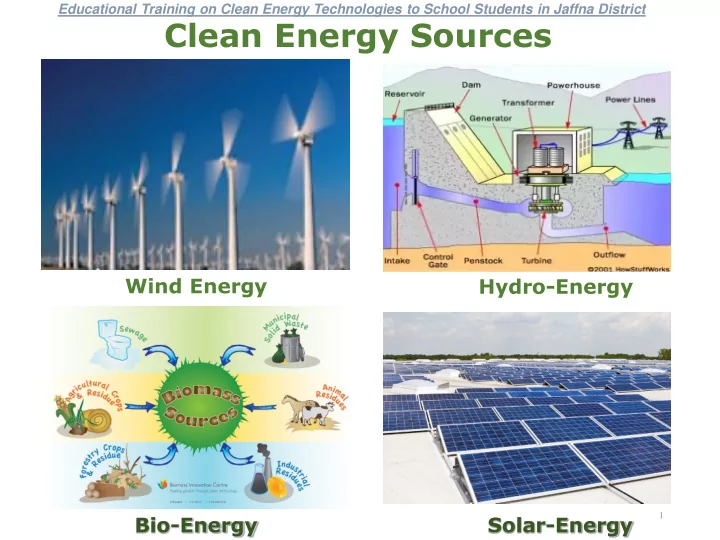
Clean Energy Sources Wind Energy Hydro-Energy Bio-Energy - - PowerPoint PPT Presentation
Educational Training on Clean Energy Technologies to School Students in Jaffna District Clean Energy Sources Wind Energy Hydro-Energy Bio-Energy Solar-Energy 1 Why Clean Energy Sources ? World energy consumption Fuel Depletion-A Global
1
Wind Energy Hydro-Energy Bio-Energy Solar-Energy
Educational Training on Clean Energy Technologies to School Students in Jaffna District
is expected to rise by more than 50 % over the next two decades.
World energy consumption Fuel Depletion-A Global Threat
waste products to the environment
3
Department of Electrical and Electronic Engineering1 and Department of Physics2, University of Jaffna
atpu@eng.jfn.ac.lk, atheva79@yahoo.com, svinothine@eng.jfn.ac.lk
March 2018
Sponsored by Collaborators
Educational Training on Clean Energy Technologies to School Students in Jaffna District
4
5
wind power to pump water for irrigating crops 4,000 years ago, and sailing boats were around long before that.
6
and we feel a wind blowing.
7
8
maximum terrestrial solar irradiance of about 1 kW/m2.
9
Regions with Mean Annual Wind Speed > 7.0 m/s at 50m above Ground Level are marked in colour Available wind resources in Sri Lanka:
10
11
Source: SEA Presentation by Mr. Harsha Wickramasinghe
Source: SEA Presentation by Mr. Harsha Wickramasinghe
12
13
days have no wind.
the coast, where land is expensive.
people feel that covering the landscape with these towers is unsightly.
strong winds. Splat!
nearby.
14
15
16
Convert Potential Energy of Water Into Kinetic Energy to Run a Generator
17
University of Jaffna
kethees@eng.jfn.ac.lk1, meena.senthilnanthanan@gmail.com 2 March 2018
Educational Training on Clean Energy Technologies to School Students in Jaffna District
Sponsored by Collaborators
Or Organic ic mat materi rial al whic which has has st stor
unligh ght in n the he form
f chem chemic ical al ene nergy gy
Energy crops Agricultural and forestry residues Processing wastes
footprint
Sunflower Corn Soybeans Rapeseed Sweet sorghum Switch grass Sugarcane Cattail Microalgae
Corn Stover Rice/wheat Straw Wood chip Husk/shell/peel from seeds
Municipal solid waste Food waste Animal waste
form gaseous mixture
chemical products such as hydrogen or methanol
high in organic carbon and can be used as a soil amendment)
sweet sorghum)
Sugar Ethanol
Glucose
Yeast addition + CO2
producing electricity
food source
2nd Generation
parts of current crops
wastes e.g. switch grass, wood chips, skins and pulp from fruit pressing etc.
3rd Generation: Algal biofuel
32
(food, feed, materials, chemicals) and energy (fuels, power, heat) from biomass
equipment to produce fuels, power, and value-added chemicals from biomass.
produces multiple fuels and products from petroleum
University of Jaffna
pravirajan@univ.jfn.ac.lk1, srtharsha12@gmail.com 2 March 2018
Educational Training on Clean Energy Technologies to School Students in Jaffna District
Sponsored by Collaborators
35
Solar energy originates with the thermonuclear fusion reactions
solar energy at wavelengths that cover the UV, VIS and IR bands.
The Sun
Solar energy received by the earth ~100 000 TW ~over 66,000 times greater than the annual world wide electricity consumption (1.5 TW)
Applications of Solar energy: Thermal energy conversion (Solar Thermal), Eg.
Solar cooker, water heater, dryer, desalination etc
Photo-energy conversion (Solar PV): Eg. Solar cells UV VIS IR
Solar Thermal energy conversion
Solar desalination Solar Cooker Solar water Heater Solar dryer
38
sunlight into electrical power.
Si Si Si Si Si Si P Si Si
Free electron Si Si Si Si Si Si Al Si Si Electron vacancy (hole)
Operating principle of Solar cells
n-type semiconductor p-type semiconductor The absorption
light, generating electron-hole (e-h) pairs The separation of charge carriers of
The separate extraction of those carriers (e, h) to an external circuit
40
Evaluating Solar cells
ISC VOC FF
FF - Fill factor
OC SC max
V J P
and this occurs at zero current (i.e., when the solar cell is open circuited). JSC =
𝐽𝑇𝐷 𝐵 , where A is the area of the solar cell and ISC is the short-circuit current which is
the current through the solar cell when the voltage across the solar cell is zero (i.e., when the solar cell is short circuited). VOC - Open circuit voltage
ISC - short-circuit current
41
Application of Solar cells
42
Required components for installation of a solar array
Module Array Cells Module
Components in a solar array
Need new technology for making cheap solar cells
Nanotechnology may bring the cost down!
Soft Hard
Advantages Low cost (<1 US$(LKR 155)/W) Low weight Low material requirements Ease of manufacture Mechanical flexibility Large field of application
encapsulant
metal deposition solution deposition
substrate
Solution Metal Deposition deposition
Substrate
Encapsulation
March 5, 2018 44 Prof.P.Ravirajan
low efficiency for commercialisation.
Technology deals with materials in nanoscale.
ferently in
Surface area of the particles tremendously increases when the size
particles decreases
Water splitting
46
Solar Cells
+ + +
+ +
dye layer glass glass seal + V platinum layer SnO2 layer TiO2 film
(a) Polymer blend solar cells (b) Dye Sensitized Solar Cells
http://www.thejsa.org/ http://project.jfn.ac.lk/hrncet/
This outreach activity was sponsored by