CLEAN-UP OF A MAJOR DIESEL SPILL IN WESTERN AUSTRALIA R Stewart 1 , - PowerPoint PPT Presentation
THE USE OF REMSCAN TO ACCELERATE THE CLEAN-UP OF A MAJOR DIESEL SPILL IN WESTERN AUSTRALIA R Stewart 1 , G Webster 1 , E Travers 1 , J Filmer 1 , J Elsworth 1 , C Lawrence 1 , S Forrester 2 , L Janik 2 , M McLaughlin 2 1 Ziltek Pty Ltd, 40-46
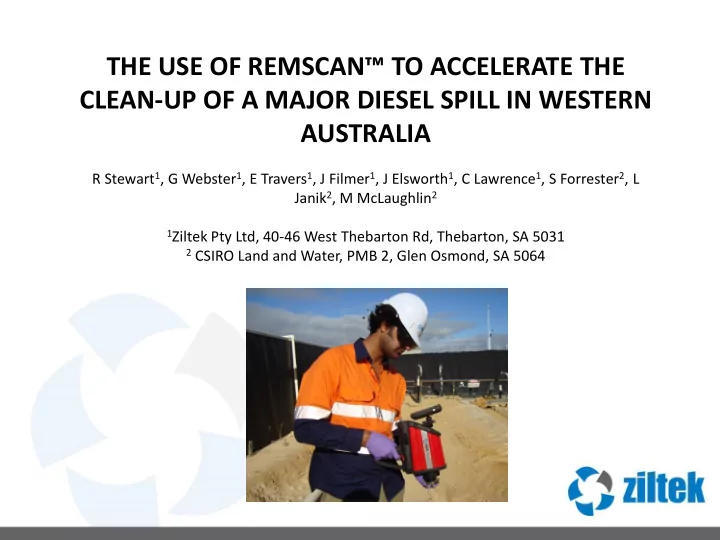
THE USE OF REMSCAN ™ TO ACCELERATE THE CLEAN-UP OF A MAJOR DIESEL SPILL IN WESTERN AUSTRALIA R Stewart 1 , G Webster 1 , E Travers 1 , J Filmer 1 , J Elsworth 1 , C Lawrence 1 , S Forrester 2 , L Janik 2 , M McLaughlin 2 1 Ziltek Pty Ltd, 40-46 West Thebarton Rd, Thebarton, SA 5031 2 CSIRO Land and Water, PMB 2, Glen Osmond, SA 5064
What is RemScan? • Handheld infrared instrument for the direct measurement of TPH in soil • User simply pulls the trigger for a 15 second readout of TPH (C 10 - C 36 ) in mg/kg • No consumables or chemicals required
Diesel Spill at Tank Farm Site, WA
The Spill Response • Project under a high level of scrutiny • Sensitive surrounding environment • Ongoing investigation • Required rapid response • Minimise risk of further release • Avoid storm water impacts • Clean up criteria • 400 mg/kg TPH (C 10 to C 36 ) • Total removal of impacted materials
Clean Up Validation • Ziltek was engaged to supply and operate a RemScan unit to assist site validation works by: • Accelerating project closure - same day decisions • Increasing confidence - more data • Minimising lab costs – accurate screening tool • It was decided to build a site-specific calibration model in the RemScan unit to: • Reduce soil interferences (e.g. carbonates) • Lower detection limit
Building a Site Specific Calibration Collect 36 samples from site Scan using RemScan (5x) Infrared spectra Build model NATA lab analysis TPH Data Load RemScan *Entire process completed in 5 days
Cross Validation of RemScan versus Lab 35,000 30,000 Detection limit = 78 mg/kg R 2 = 0.997 RemScan TPH concentration (mg/kg) Relative error <10% 25,000 20,000 15,000 10,000 5,000 0 0 5,000 10,000 15,000 20,000 25,000 30,000 35,000 NATA accredited lab TPH concentration (mg/kg)
Site Validation Process
Independent RemScan Verification • The environmental superintendent selected 19 blind samples for verification • The samples were measured on site using RemScan and then sent for NATA laboratory analysis • Each samples was scanned 5 times and the average was compared with lab data
Cross Validation of RemScan versus Lab 35,000 30,000 RemScan TPH concentration (mg/kg) 25,000 20,000 15,000 10,000 5,000 0 0 5,000 10,000 15,000 20,000 25,000 30,000 35,000 NATA accredited lab TPH concentration (mg/kg)
Cross Validation of RemScan versus Lab 35,000 35,000 30,000 30,000 RemScan TPH concentration (mg/kg) RemScan TPH concentration (mg/kg) 25,000 25,000 20,000 20,000 15,000 15,000 10,000 10,000 5,000 5,000 0 0 0 0 5,000 5,000 10,000 10,000 15,000 15,000 20,000 20,000 25,000 25,000 30,000 30,000 35,000 35,000 NATA accredited lab TPH concentration (mg/kg) NATA accredited lab TPH concentration (mg/kg)
Project Outcomes • Site specific calibration developed in 5 days • Detection limit of 78 mg/kg TPH C 10 -C 36 • Relative error <10% • Completed site validation works in 4 days • Cost savings estimated by client at >$30,000 • RemScan sets a new precedent for rapid screening of TPH in soil
Technology Partners This project has been supported with assistance from the Australia Government through Commercialisation Australia.
Recommend
More recommend
Explore More Topics
Stay informed with curated content and fresh updates.