
SLIDE 1
Clil project An English splash into the Mediterranean Sea
Prof.ssa Caterina Moccia Prof.ssa Chiara Buono
Clil project An English splash into the Mediterranean Sea Prof.ssa - - PowerPoint PPT Presentation
Clil project An English splash into the Mediterranean Sea Prof.ssa Caterina Moccia Prof.ssa Chiara Buono C L I L content and language integrated learning teaching students about a subject in a foreign language Brain-storming Flashcard
Clil project An English splash into the Mediterranean Sea
Prof.ssa Caterina Moccia Prof.ssa Chiara Buono
content and language integrated learning
teaching students about a subject in a foreign language
Brain-storming
Flashcard Mediterranean sea: vocabulary | Quizlet
LABEL THE MEDITERRANEAN AREA
Use the following words: Europe Adriatic Sea Ionian Sea Africa Asia Tyrrhenian Sea Anatolia Aegean Sea Strait of Gibraltar Spain Morocco Egypt Levant Greece
MEDITERRANEAN DERIVES FROM THE LATIN MEDITERRANEUS
IN THE MIDDLE OF LAND
medius + terra
The Mediterranean Sea has historically had several names
The Ancient Greek name was
Mesogeios
The Romans called it
Mare Nostrum
The Carthaginians called it
Syrian Sea
In ancient Syrian, texts it was known as Great sea In Ottoman Turkish it has been called the Pure White Sea
The origin of the Mediterranean sea
Mediterranean sea is only a ______ ________ __ ________ that makes up less than 1% of the world total _______ ________. Millions of years ago, continuous movements of the Earth mantle led the formation of huge ___________ _________ separated by a single ocean. The blocks of _________ and ____________ converged by moving towards each other. Points of communication between the _____________ and the Pacific sites became _________ _____ ___________. The Mediterranean sea was ____________ due to the convergence of the continental blocks which cut off the Mediterranean basin from the ____________ _____________. Huge natural__________ were formed. Our sea was then ________ by a massive cascading _______ water. The flow of water first filled the ________ ________and then the ________ basins. It is possible to divide the Basin into______ distinct units: the Western region included the ___________ sea, the Balearic sea and _________ sea. Corsica, _______ and ____________ marked the perimeter of the ____________ basin which is separated from the Adriatic sea by the Apennine mountain chain. The Ionian, ____________ and _________ Seas make up the ___________ Mediterranean. Watch the video and complete the
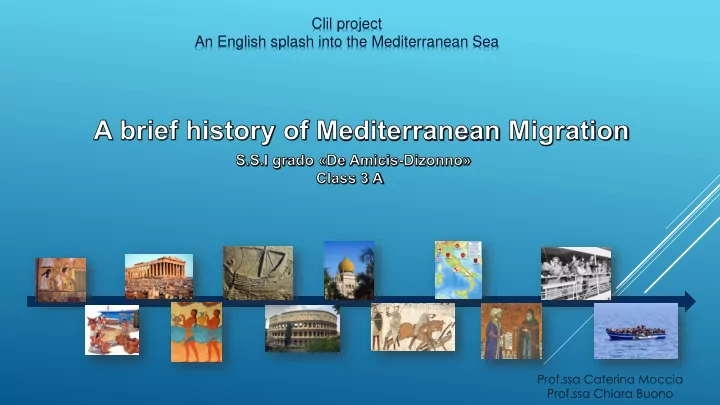
A BRIEF HISTORY OF MEDITERRANEAN MIGRATIONS
The sea was an important ruote for merchants and travelers of ancient Times. The history of the Mediterranean region is crucial to understanding the origins and development of many modern societies.
Several ancient civilisations were located around the Mediterranean shores, and were greatly influenced by their proximity to the sea. It provided routes for trade, colonisation, and war, as well as food for numerous communities throughout the ages
What civilizations flourished along the Mediterranean shores ? What reasons pushed them to migrate? What were the main trade routes? What traces did invaders and colonizers leave in the Mediterranean region? What did Mediterranean sea represent in history?
The history of the Mediterranean is still being written today, as we are living right now the new changes in the Balkans, in Palestine, the elimination of barries and the dramatic migrations from the poorer countries to the wealthier ones
The two wars Post war period The closure of frontiers Migration crisis Arabs Normans Maritime Republics Ottoman Empire Egyptians Mesopotamians Minoans Greeks Romans Phoenicians End of the last ice age Primitive man Neolithic Revolution
10000-5000 BC 4000 BC-400 AD 700 -1700 1800 - 2017
Improve English language