Climbing towards NLU: On Meaning, Form, and Understanding in the - - PowerPoint PPT Presentation

climbing towards nlu on meaning form and understanding in
SMART_READER_LITE
LIVE PREVIEW

Climbing towards NLU: On Meaning, Form, and Understanding in the - - PowerPoint PPT Presentation

Climbing towards NLU: On Meaning, Form, and Understanding in the Age of Data Emily M. Bender, University of Washington Alexander Koller, Saarland University ACL 2020 This position paper talk in a nutshell Human-analogous natural language


slide-1
SLIDE 1

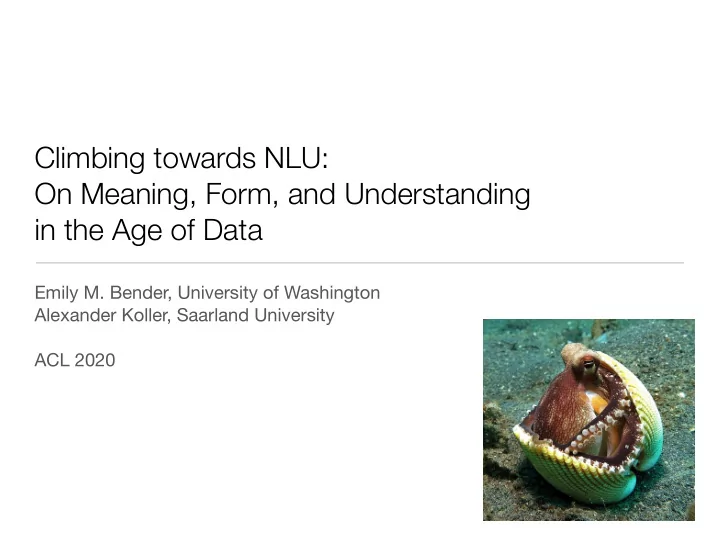
Climbing towards NLU: On Meaning, Form, and Understanding in the Age of Data

Emily M. Bender, University of Washington Alexander Koller, Saarland University ACL 2020

slide-2
SLIDE 2

This position paper talk in a nutshell

  • Human-analogous natural language understanding (NLU) is a grand challenge
  • f AI
  • While large neural language models (LMs) are undoubtedly useful, they are

not nearly-there solutions to this grand challenge

  • Despite how they are advertised
  • Any system trained only on linguistic form cannot in principle learn meaning
  • Genuine progress in our field depends on maintaining clarity around big

picture notions such as meaning and understanding in task design and reporting of experimental results.

slide-3
SLIDE 3

What is meaning?

  • Competent speakers easily conflate ‘form’ and ‘meaning’ because we can
  • nly rarely perceive one without the other
  • As language scientists & technologists, it’s critical that we take a closer look
slide-4
SLIDE 4

Working definitions

  • Form : marks on a page, pixels or bytes, movements of the articulators
  • Meaning : relationship between linguistic form and something external to

language

  • : pairs of expressions and communicative intents
  • : pairs of expressions and their standing meanings
  • Understanding : given an expression e, in a context, recover the

communicative intent i

M ⊆ E × I

<latexit sha1_base64="1aMEQp5k4fS9sg6Ro9oDmof9PTM=">ACAXicbVDJSgNBEO2JW4xb1IvgpTERPIWZXPQYFEPQgSzQGYIPZ2apEnPYneNEK8+CtePCji1b/w5t/YWQ6a+KDg8V4VfX8RAqNtv1tZaWV1bXsu5jc2t7Z387l5dx6niUOxjFXTZxqkiKCGAiU0EwUs9CU0/P7F2G8gNIiju5wkIAXsm4kAsEZGqmdPyjeUFenvgaEe3pJXRQhaHpdbOcLdsmegC4SZ0YKZIZqO/ldmKehAhl0zrlmMn6A2ZQsEljHJuqiFhvM+60DI0YmaPN5x8MKLHRunQIFamIqQT9fEkIVaD0LfdIYMe3reG4v/ea0UgzNvKIkRYj4dFGQSoxHcdBO0IBRzkwhHElzK2U95hiHE1oOROCM/yIqmXS45dcm7Lhcr5LI4sOSRH5IQ45JRUyBWpkhrh5JE8k1fyZj1ZL9a79TFtzVizmX3yB9bnD1UplYI=</latexit><latexit sha1_base64="1aMEQp5k4fS9sg6Ro9oDmof9PTM=">ACAXicbVDJSgNBEO2JW4xb1IvgpTERPIWZXPQYFEPQgSzQGYIPZ2apEnPYneNEK8+CtePCji1b/w5t/YWQ6a+KDg8V4VfX8RAqNtv1tZaWV1bXsu5jc2t7Z387l5dx6niUOxjFXTZxqkiKCGAiU0EwUs9CU0/P7F2G8gNIiju5wkIAXsm4kAsEZGqmdPyjeUFenvgaEe3pJXRQhaHpdbOcLdsmegC4SZ0YKZIZqO/ldmKehAhl0zrlmMn6A2ZQsEljHJuqiFhvM+60DI0YmaPN5x8MKLHRunQIFamIqQT9fEkIVaD0LfdIYMe3reG4v/ea0UgzNvKIkRYj4dFGQSoxHcdBO0IBRzkwhHElzK2U95hiHE1oOROCM/yIqmXS45dcm7Lhcr5LI4sOSRH5IQ45JRUyBWpkhrh5JE8k1fyZj1ZL9a79TFtzVizmX3yB9bnD1UplYI=</latexit><latexit sha1_base64="1aMEQp5k4fS9sg6Ro9oDmof9PTM=">ACAXicbVDJSgNBEO2JW4xb1IvgpTERPIWZXPQYFEPQgSzQGYIPZ2apEnPYneNEK8+CtePCji1b/w5t/YWQ6a+KDg8V4VfX8RAqNtv1tZaWV1bXsu5jc2t7Z387l5dx6niUOxjFXTZxqkiKCGAiU0EwUs9CU0/P7F2G8gNIiju5wkIAXsm4kAsEZGqmdPyjeUFenvgaEe3pJXRQhaHpdbOcLdsmegC4SZ0YKZIZqO/ldmKehAhl0zrlmMn6A2ZQsEljHJuqiFhvM+60DI0YmaPN5x8MKLHRunQIFamIqQT9fEkIVaD0LfdIYMe3reG4v/ea0UgzNvKIkRYj4dFGQSoxHcdBO0IBRzkwhHElzK2U95hiHE1oOROCM/yIqmXS45dcm7Lhcr5LI4sOSRH5IQ45JRUyBWpkhrh5JE8k1fyZj1ZL9a79TFtzVizmX3yB9bnD1UplYI=</latexit><latexit sha1_base64="1aMEQp5k4fS9sg6Ro9oDmof9PTM=">ACAXicbVDJSgNBEO2JW4xb1IvgpTERPIWZXPQYFEPQgSzQGYIPZ2apEnPYneNEK8+CtePCji1b/w5t/YWQ6a+KDg8V4VfX8RAqNtv1tZaWV1bXsu5jc2t7Z387l5dx6niUOxjFXTZxqkiKCGAiU0EwUs9CU0/P7F2G8gNIiju5wkIAXsm4kAsEZGqmdPyjeUFenvgaEe3pJXRQhaHpdbOcLdsmegC4SZ0YKZIZqO/ldmKehAhl0zrlmMn6A2ZQsEljHJuqiFhvM+60DI0YmaPN5x8MKLHRunQIFamIqQT9fEkIVaD0LfdIYMe3reG4v/ea0UgzNvKIkRYj4dFGQSoxHcdBO0IBRzkwhHElzK2U95hiHE1oOROCM/yIqmXS45dcm7Lhcr5LI4sOSRH5IQ45JRUyBWpkhrh5JE8k1fyZj1ZL9a79TFtzVizmX3yB9bnD1UplYI=</latexit>

C ⊆ E × S

<latexit sha1_base64="WGzELMRck2qTZ/Ni7ikaSvX2y/E=">ACAXicbVDLSgNBEJyNrxhfq14EL4OJ4Cns5qLHYBA8RjQPyIYwO+kQ2YfzvQKIcSLv+LFgyJe/Qtv/o2TZA+aWNBQVHXT3eXHUmh0nG8rs7K6tr6R3cxtbe/s7tn7B3UdJYpDjUcyUk2faZAihBoKlNCMFbDAl9Dwh5Wp3gApU3uEohnbA+qHoCc7QSB37qFChnk58DQj39Ip6KALQ9LbQsfNO0ZmBLhM3JXmSotqxv7xuxJMAQuSad1ynRjbY6ZQcAmTnJdoiBkfsj60DA2Z2dMez6Y0FOjdGkvUqZCpDP198SYBVqPAt90BgwHetGbiv95rQR7F+2xCOMEIeTzRb1EUozoNA7aFQo4ypEhjCthbqV8wBTjaELmRDcxZeXSb1UdJ2ie1PKly/TOLkmJyQM+KSc1Im16RKaoSTR/JMXsmb9WS9WO/Wx7w1Y6Uzh+QPrM8fVFeVg=</latexit><latexit sha1_base64="WGzELMRck2qTZ/Ni7ikaSvX2y/E=">ACAXicbVDLSgNBEJyNrxhfq14EL4OJ4Cns5qLHYBA8RjQPyIYwO+kQ2YfzvQKIcSLv+LFgyJe/Qtv/o2TZA+aWNBQVHXT3eXHUmh0nG8rs7K6tr6R3cxtbe/s7tn7B3UdJYpDjUcyUk2faZAihBoKlNCMFbDAl9Dwh5Wp3gApU3uEohnbA+qHoCc7QSB37qFChnk58DQj39Ip6KALQ9LbQsfNO0ZmBLhM3JXmSotqxv7xuxJMAQuSad1ynRjbY6ZQcAmTnJdoiBkfsj60DA2Z2dMez6Y0FOjdGkvUqZCpDP198SYBVqPAt90BgwHetGbiv95rQR7F+2xCOMEIeTzRb1EUozoNA7aFQo4ypEhjCthbqV8wBTjaELmRDcxZeXSb1UdJ2ie1PKly/TOLkmJyQM+KSc1Im16RKaoSTR/JMXsmb9WS9WO/Wx7w1Y6Uzh+QPrM8fVFeVg=</latexit><latexit sha1_base64="WGzELMRck2qTZ/Ni7ikaSvX2y/E=">ACAXicbVDLSgNBEJyNrxhfq14EL4OJ4Cns5qLHYBA8RjQPyIYwO+kQ2YfzvQKIcSLv+LFgyJe/Qtv/o2TZA+aWNBQVHXT3eXHUmh0nG8rs7K6tr6R3cxtbe/s7tn7B3UdJYpDjUcyUk2faZAihBoKlNCMFbDAl9Dwh5Wp3gApU3uEohnbA+qHoCc7QSB37qFChnk58DQj39Ip6KALQ9LbQsfNO0ZmBLhM3JXmSotqxv7xuxJMAQuSad1ynRjbY6ZQcAmTnJdoiBkfsj60DA2Z2dMez6Y0FOjdGkvUqZCpDP198SYBVqPAt90BgwHetGbiv95rQR7F+2xCOMEIeTzRb1EUozoNA7aFQo4ypEhjCthbqV8wBTjaELmRDcxZeXSb1UdJ2ie1PKly/TOLkmJyQM+KSc1Im16RKaoSTR/JMXsmb9WS9WO/Wx7w1Y6Uzh+QPrM8fVFeVg=</latexit><latexit sha1_base64="WGzELMRck2qTZ/Ni7ikaSvX2y/E=">ACAXicbVDLSgNBEJyNrxhfq14EL4OJ4Cns5qLHYBA8RjQPyIYwO+kQ2YfzvQKIcSLv+LFgyJe/Qtv/o2TZA+aWNBQVHXT3eXHUmh0nG8rs7K6tr6R3cxtbe/s7tn7B3UdJYpDjUcyUk2faZAihBoKlNCMFbDAl9Dwh5Wp3gApU3uEohnbA+qHoCc7QSB37qFChnk58DQj39Ip6KALQ9LbQsfNO0ZmBLhM3JXmSotqxv7xuxJMAQuSad1ynRjbY6ZQcAmTnJdoiBkfsj60DA2Z2dMez6Y0FOjdGkvUqZCpDP198SYBVqPAt90BgwHetGbiv95rQR7F+2xCOMEIeTzRb1EUozoNA7aFQo4ypEhjCthbqV8wBTjaELmRDcxZeXSb1UdJ2ie1PKly/TOLkmJyQM+KSc1Im16RKaoSTR/JMXsmb9WS9WO/Wx7w1Y6Uzh+QPrM8fVFeVg=</latexit>
slide-5
SLIDE 5

BERT fanclub

  • “In order to train a model that understands sentence relationships, we pre-train for a

binarized next sentence prediction task that can be trivially generated from any monolingual corpus.” (Devlin et al 2019)

  • “Using BERT, a pretraining language model, has been successful for single-turn machine

comprehension …” (Ohsugi et al 2019)

  • “The surprisingly strong ability of these models to recall factual knowledge without any fine-

tuning demonstrates their potential as unsupervised open-domain QA systems.” (Petroni et al 2019)

slide-6
SLIDE 6

BERT fanclub

  • “In order to train a model that understands sentence relationships, we pre-train for a

binarized next sentence prediction task that can be trivially generated from any monolingual corpus.” (Devlin et al 2019)

  • “Using BERT, a pretraining language model, has been successful for single-turn machine

comprehension …” (Ohsugi et al 2019)

  • “The surprisingly strong ability of these models to recall factual knowledge without any

fine-tuning demonstrates their potential as unsupervised open-domain QA systems.” (Petroni et al 2019)

slide-7
SLIDE 7

BERTology

  • Strand 1: What are BERT and similar learning about language structure?
  • Distributional similarities between words (Lin et al 2015, Mikolov et al 2013)
  • Something analogous to dependency structure (Tenney et al 2019, Hewitt &

Manning 2019)

  • Strand 2: What information are the Transformers using to ‘beat’ the tasks?
  • Niven & Kao (2019): in ARCT, BERT is exploiting spurious artifacts
  • McCoy et al (2019): in NLI, BERT leans on lexical, subsequence, & constituent
  • verlap heuristics
  • Our contribution: Theoretical perspective on why models exposed only to form

can never learn meaning

slide-8
SLIDE 8

So how do babies learn language?

  • Interaction is key: Exposure to a language via TV or radio alone is not

sufficient (Snow et al 1976, Kuhl 2007)

  • Interaction allows for joint attention: where child and caregiver are attending

to the same thing and mutually aware of this fact (Baldwin 1995)

  • Experimental evidence shows that more successful joint attention leads to

faster vocabulary acquisition (Tomasello & Farrar 1986, Baldwin 1995, Brooks & Meltzoff 2005)

  • Meaning isn’t in form; rather, languages are rich, dense ways of providing

cues to communicative intent (Reddy 1979). Once we learn the systems, we can use them in the absence of co-situatedness.

slide-9
SLIDE 9

Thought Experiment: Java

  • Model: Any model type at all
  • For current purposes: BERT (Devlin et al 2019), GPT-2 (Radford et al 2019),
  • r similar
  • Training data: All well-formed Java code on GitHub
  • but only the text of the code; no output; no understanding of what unit

tests mean

  • Test input: A single Java program, possibly even from the training data
  • Expected output: Result of executing that program
slide-10
SLIDE 10

That’s not fair!

  • Of course not! What’s interesting about this thought experiment is what

makes the test unfair

  • It’s unfair because the training data is insufficient for the task
  • What’s missing: Meaning — in the case of Java, what the machine is

supposed to do, given the code

  • What would happen with a more intelligent and motivated learner?
slide-11
SLIDE 11

Thought experiment: Meaning from form alone

What a pretty sunset

Reminds me of lava lamps A B O

slide-12
SLIDE 12

Thought experiment: Meaning from form alone

I made a coconut catapult! Let me tell you how…

Cool idea! Great job!

A B O

slide-13
SLIDE 13

Thought experiment: Meaning from form alone

Help! I’m being chased by a bear!

A B O

slide-14
SLIDE 14

Thought experiment: Meaning from form alone

All I have is a stick! What do I do?

The bear is chasing me!*

*Reply generated by GPT2 demo

A B O

slide-15
SLIDE 15

Thought experiment: Meaning from form alone

*Reply generated by GPT2 demo

All I have is a stick! What do I do?

You’re not
 going to get
 away with this!*

A B O

slide-16
SLIDE 16

Octopus Test: Analysis

  • O did not learn to communicate successfully, and the reason is that


O did not learn meaning.

  • This is because O could only observe forms, 


and meaning can’t be learned from form alone. 
 
 Learning the meaning relation requires access to the outside world 
 so communicative intents can be hypothesized and tested.

  • To the extent that A finds O’s utterances meaningful,


it was not because O’s utterances made sense;
 it is because A, as a human active listener, could make sense of them.

slide-17
SLIDE 17

Broader point

  • The field of computational linguistics is making rapid progress, but


we have made rapid progress before (grammar-based; statistical; …).
 
 How do we know this time it’s different?

  • One can look at progress in a field of science from two perspectives:


top-down and bottom-up.

slide-18
SLIDE 18

Top-down progress

“Semantics with no treatment of truth-conditions is not semantics.” We have not succeeded until we have succeeded completely. Are we making progress towards our end goal?

  • Lewis 1972
slide-19
SLIDE 19

Bottom-up progress

“Using BERT … has been successful 
 for single-turn machine comprehension.”

  • Ohsugi et al. 2019

So much winning! And there will be 
 more winning! Yeah! We need thoughtful balance of 
 bottom-up (rapid, fun hillclimbing) and top-down (climbing the right hill?).

slide-20
SLIDE 20

Onwards!

  • Value both error analysis and success analysis: 


When a system does well on natural language “understanding” tasks, 
 does it do that in a way which leads towards the end goal?
 (Don’t allow the octopus to game the system.)

  • Create tasks and datasets which ground language in reality/interaction.

Models trained on these don’t have to learn from form alone.

  • Science over marketing: Let’s be careful with terms like ‘understanding’,

‘meaning’, and ‘comprehension’.

slide-21
SLIDE 21

Come talk to us!

Q&A Sessions at ACL 2020
 9A THEME-1: Tue July 7, 17:00 UTC+0 10A THEME-2: Tue July 7, 20:00 UTC+0 We also invite you to listen to our audiopaper:


https://soundcloud.com/emily-m-bender/climbingtowardsnlu-audiopaper/s-0ZT7112K1Ep