CLINICAL MICROBIOLOGY, VIROLOGY AND BIOEMERGENCY BSL4 FACILITY - - PowerPoint PPT Presentation

clinical microbiology virology and bioemergency bsl4
SMART_READER_LITE
LIVE PREVIEW

CLINICAL MICROBIOLOGY, VIROLOGY AND BIOEMERGENCY BSL4 FACILITY - - PowerPoint PPT Presentation

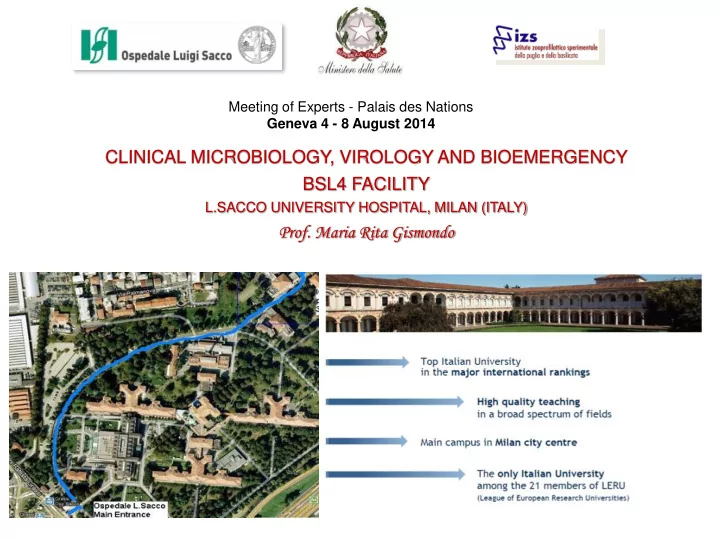
Meeting of Experts - Palais des Nations Geneva 4 - 8 August 2014 CLINICAL MICROBIOLOGY, VIROLOGY AND BIOEMERGENCY BSL4 FACILITY L.SACCO UNIVERSITY HOSPITAL, MILAN (ITALY) Prof. Maria Rita Gismondo Meeting of Experts - Palais des Nations


slide-1
SLIDE 1

Meeting of Experts - Palais des Nations Geneva 4 - 8 August 2014

CLINICAL MICROBIOLOGY, VIROLOGY AND BIOEMERGENCY BSL4 FACILITY

L.SACCO UNIVERSITY HOSPITAL, MILAN (ITALY)

  • Prof. Maria Rita Gismondo
slide-2
SLIDE 2

Meeting of Experts - Palais des Nations Geneva 4 - 8 August 2014 CLINICAL MICROBIOLOGY, VIROLOGY AND BIOEMERGENCY BSL4 FACILITY

L.SACCO UNIVERSITY HOSPITAL, MILAN (ITALY)

  • Prof. Maria Rita Gismondo

RESEARCH ACTIVITIES Antibiotic Resistance, Antiviral Resistance, New Tropical Diseases, Multiresistan Mycobacteria etc… Results are published in open scientific literature

slide-3
SLIDE 3

Meeting of Experts - Palais des Nations Geneva 4 - 8 August 2014 CLINICAL MICROBIOLOGY, VIROLOGY AND BIOEMERGENCY BSL4 FACILITY

L.SACCO UNIVERSITY HOSPITAL, MILAN (ITALY)

  • Prof. Maria Rita Gismondo

INTERNATIONAL PARTNERSHIPS AND PROJECTS Capacity – Building Gap Analysis Training (E-learning / In-presence) and Sharing Experience Hands-on courses (BSL2; BSL3 and BSL4) tailored to countries local needs Workshops and seminars

slide-4
SLIDE 4

Meeting of Experts - Palais des Nations Geneva 4 - 8 August 2014 CLINICAL MICROBIOLOGY, VIROLOGY AND BIOEMERGENCY BSL4 FACILITY

L.SACCO UNIVERSITY HOSPITAL, MILAN (ITALY)

  • Prof. Maria Rita Gismondo

INTERNATIONAL PARTNERSHIPS AND PROJECTS – ONGOING

1.The Master Euro-Africain: Biosécurité et Biosûreté 2.Biorisk Assessment Mission, Tiblisi 3.CBRN CoE Initiative (P3, P6, P7, P13 and P18) 4.Instrument for Stability

slide-5
SLIDE 5

Meeting of Experts - Palais des Nations Geneva 4 - 8 August 2014 CLINICAL MICROBIOLOGY, VIROLOGY AND BIOEMERGENCY BSL4 FACILITY

L.SACCO UNIVERSITY HOSPITAL, MILAN (ITALY)

  • Prof. Maria Rita Gismondo

Georgia, Tbilisi

slide-6
SLIDE 6

Meeting of Experts - Palais des Nations Geneva 4 - 8 August 2014 CLINICAL MICROBIOLOGY, VIROLOGY AND BIOEMERGENCY BSL4 FACILITY

L.SACCO UNIVERSITY HOSPITAL, MILAN (ITALY)

  • Prof. Maria Rita Gismondo

International conference “Biosecurity and Biosafety: future trends and solutions”

slide-7
SLIDE 7

Meeting of Experts - Palais des Nations Geneva 4 - 8 August 2014 CLINICAL MICROBIOLOGY, VIROLOGY AND BIOEMERGENCY BSL4 FACILITY

L.SACCO UNIVERSITY HOSPITAL, MILAN (ITALY)

  • Prof. Maria Rita Gismondo

Develop a holistic and multidisciplinary approach on bio-related issues: bio-threats analysis, biosafety, biosecurity, biorisk assessment and management and biohazardous waste containment Support and foster a risk mitigation culture Support the harmonization of international bio-safety and bio-security standards among the participating countries Strengthen regional and international collaboration and cooperation so as knowledge sharing and lessons learned exchange Enhance networking and awareness raising on bio-related issues and and support synergies among scientific communities and institutions.
slide-8
SLIDE 8

Meeting of Experts - Palais des Nations Geneva 4 - 8 August 2014 CLINICAL MICROBIOLOGY, VIROLOGY AND BIOEMERGENCY BSL4 FACILITY

L.SACCO UNIVERSITY HOSPITAL, MILAN (ITALY)

  • Prof. Maria Rita Gismondo
  • Prof. Maria Rita Gismondo, MD

mariarita.gismondo@unimi.it

Address: Via G. B. Grassi, 74, 20157 Milan (Italy) Phone: +39 02 39042239 / +39 02 50319831 Fax: +39 02 50319832

  • Dott. Francesca Cerutti

secretary@bioemergency.eu

slide-9
SLIDE 9

“TRAINING ON FIELD” A practical training for the isolation of Bacillus anthracis from environmental samples in high-risk areas

Meeting of Experts Palais des Nations, Geneva 4 - 8 August 2014.

Antonio Fasanella Istituto Zooprofilattico Sperimentale di Puglia e Basilicata Foggia, Italy

slide-10
SLIDE 10

NETWORK OF ISTITUTI ZOOPROFILATTICI SPERIMENTALI

slide-11
SLIDE 11
  • Control of zoonosis
  • Food security programs
  • Management of emergency ( brucellosis, tuberculosis,

avian flu, anthrax, blue tongue )

  • Research on animal infectious diseases
  • Development of vaccines for veterinary use
  • Cooperation with national and international scientific
  • rganizations
slide-12
SLIDE 12

Anthrax Reference Institute of Italy

slide-13
SLIDE 13

Major tasks of the Anthrax Reference Institute of Italy

  • Anthrax vaccine production
  • Molecular epidemiology and genotype database
  • Disease control
  • Bioterrorism emergency ( Italian Laboratory Reference)
  • Animal model
  • Research
slide-14
SLIDE 14

Anthrax in Italy

The low diversity of B. anthracis genotypes in Italy suggests a single, dominant historical introduction, followed by localized differentiation In Italy, anthrax is a sporadic disease. Every year, few

  • utbreaks occur in the known

risk areas of central-southern Italy and in the major islands.

slide-15
SLIDE 15

Pollino National Park ( Basilicata Region – South Italy) epidemic map, with the representation of the single

  • utbreaks identified by GIS

information. Foggia

During the 2004 summer in the Pollino National Park in Basilicata it was registered an anthrax epidemic that involved 41 farms of 13 towns in an area

  • f about 900 Km2 in which there

were about 7.000 cattle and 33.000 sheep and goats. In 4 weeks 81 cattle died, as well as 15 sheep, 9 goats,11 horses and 8 deer.

Epidemic outbreak of 2004

slide-16
SLIDE 16

Bovine Carcass burial Horse Red Deer

Epidemic outbreak of 2004

slide-17
SLIDE 17

More than 17% of the population of deer in the park died during the outbreak of anthrax

(Fasanella A. et al. 2007 Anthrax in Red Deer (Cervus elaphus), Italy. Emerg Infect Dis. 13(7): 1118–1119)

Epidemic outbreak of 2004

slide-18
SLIDE 18

Epidemic outbreak of 2004

Two human suspect cases

slide-19
SLIDE 19

Outdoor laboratory

In some restricted areas of the park, for several time were buried animals died of anthrax Vaccination programs ensure the control of the disease in animals that graze in that area. These areas represent a valuable environment for the study of the ecology of Bacillus anthracis

slide-20
SLIDE 20

Since 2010, the Anthrax Reference Institute

  • f

Italy use this

  • utdoor

laboratory for trainings direct to researchers (from foreign countries) regarding the technique of isolation of spores from contaminated environments.

Outdoor laboratory

These training activities have been continued in the framework

  • f

the subsequent Joint Action QUANDHIP. For further information on QUANDHIP, please, see website on next slide. The “training on field” was included in the EU funded project EQADeBa, as an educational activity.

slide-21
SLIDE 21

http://www.quandhip.eu/

slide-22
SLIDE 22

Training on field: Program

  • First day:

– Arrival at the airport of Bari and departure to Pollino National Park . Overnight

  • Second day:

– Sampling of soils in areas of National Park. Return to Foggia and overnight

  • Third day:

– Processing of collected samples at the BL3 laboratory of the National Reference Centre for anthrax. Isolation of Bacillus anthracis using GABRI or WHO method

  • Fourth day:

– Biomolecular analysis of suspect colonies and final meeting

  • Fifth day:

– Departure from Bari airport

slide-23
SLIDE 23

Training on field

Processing of collected samples

slide-24
SLIDE 24

Training on field

Biomolecular analysis of suspect colonies: reading of plates

slide-25
SLIDE 25

List of Institutes that participated in the training

  • 1. Österreichische Agentur für Gesundheit und Ernährungssicherheit (AGES) –

Austria

  • 2. Friedrich-Loeffler-Institut / Bundesforschungsinstitut für Tiergesundheit (FLI) –

Germany

  • 3. FoHM: Folkhälsomyndigheten – Public Healt Agency of Sweden – Sweden
  • 4. Public Healt England – England
  • 5. Polish National Institute of Hygiene (PZH) – Poland
  • 6. Infectiology Centre of Latvia (LIC) – Lithuania
  • 7. Federal Office for Civil Protection (FOCP), Spiez Laboratory – Switzerland
  • 8. Robert Koch Institute – Germany
  • 9. Basurto University Hospital, Bilbao – Spain
  • 10. ANSES – France
  • 11. Faculty of Veterinary Medicine of Tirana – Albania
  • 12. Faculty of Medicine, Mu’tah University, Al-karak – Jordan
  • 13. Biotechnology Institute of a National Academy of Sciences of the Kyrgyz

Republic - Kyrgyzstan

slide-26
SLIDE 26

Positive contribution

– Many researchers have the opportunity to observe B. anthracis in its natural environment – Exchange of opinions and experiences – Incentive to improve the technique of isolation – Start of new collaborations

  • The aim of the training is to prepare the researchers in the techniques of

collection of contaminated soil samples.

  • This training aims to verify the contamination level of environment

(natural or with suspect of a deliberate release).

  • The training is free and is directed to researchers prior

approval of the Italian government authorities

slide-27
SLIDE 27

Contacts: Antonio FASANELLA a.fasanella@izsfg.it Angela ACETI acetiangela@hotmail.com Istituto Zooprofilattico Sperimentale della Puglia e della Basilicata

WEB SITE: www.izsfg.it