CLINICAL PRESENTATION, RISK FACTORS AND ETIOLOGY OF LUNG ABSCESS - - PDF document

clinical presentation risk factors and etiology of lung
SMART_READER_LITE
LIVE PREVIEW

CLINICAL PRESENTATION, RISK FACTORS AND ETIOLOGY OF LUNG ABSCESS - - PDF document

each individual, patients with T-score -2.5 on single minutes at 37C. Testosterone in the sample com ORIGINAL ARTICLE CLINICAL PRESENTATION, RISK FACTORS AND ETIOLOGY OF LUNG ABSCESS Ashok Kumar 1 , Maria Malik 2 , Shaista Ghazal 3 , Ravi


slide-1
SLIDE 1

08

minutes at 37◦C. Testosterone in the sample com each individual, patients with T-score ≥-2.5 on single ing to estrogen receptors (ERα and ERβ)

PAKISTAN JOURNAL OF MEDICINE AND DENTISTRY 2018, VOL. 7 (04)

CLINICAL PRESENTATION, RISK FACTORS AND ETIOLOGY OF LUNG ABSCESS

Ashok Kumar1, Maria Malik2, Shaista Ghazal3, Ravi Mahat4, Taimur Masood5, Anusheh Zia6, Nadeem Rizvi6

1Consultant Pulmonary and Critical Care Medicine

  • 2SMO. NHS. UK 3 Birmingham University Hospital, UK. 4Consultant Pulmonologist, Nepal.

5Student, Ziauddin University 6Student, Ziauddin University

ORIGINAL ARTICLE

ABSTRACT

Background: A lung abscess is characterized by a necrotic lesion with marked cavitation and exudate within the lung parenchyma. The objective of this study was to identify the most common causative agent

  • f lung abscess within our target population.

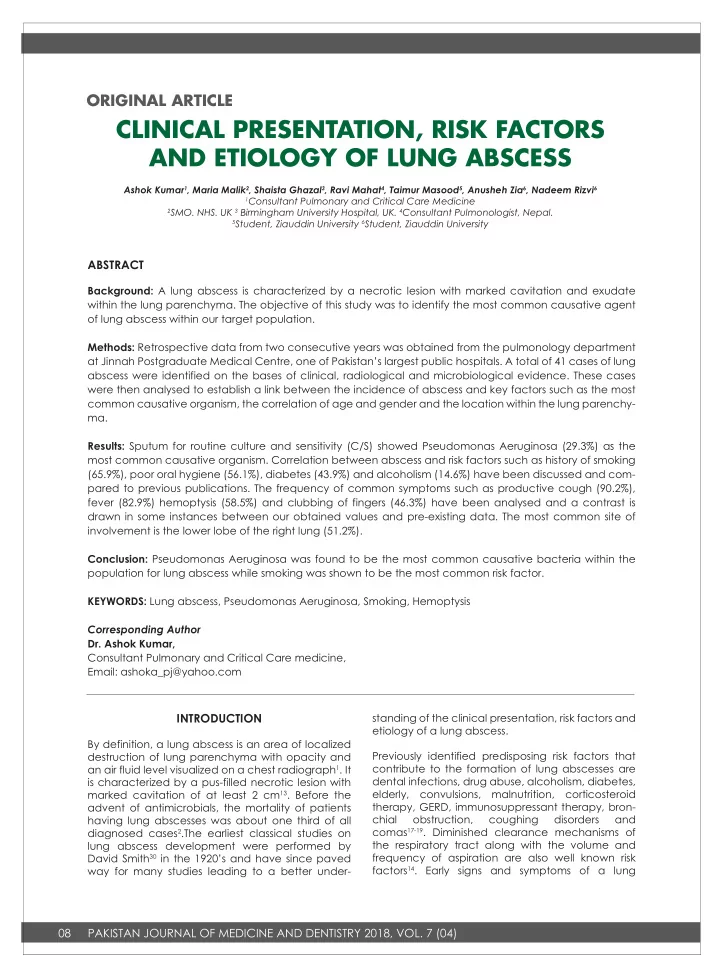
Methods: Retrospective data from two consecutive years was obtained from the pulmonology department at Jinnah Postgraduate Medical Centre, one of Pakistan’s largest public hospitals. A total of 41 cases of lung abscess were identified on the bases of clinical, radiological and microbiological evidence. These cases were then analysed to establish a link between the incidence of abscess and key factors such as the most common causative organism, the correlation of age and gender and the location within the lung parenchy- ma. Results: Sputum for routine culture and sensitivity (C/S) showed Pseudomonas Aeruginosa (29.3%) as the most common causative organism. Correlation between abscess and risk factors such as history of smoking (65.9%), poor oral hygiene (56.1%), diabetes (43.9%) and alcoholism (14.6%) have been discussed and com- pared to previous publications. The frequency of common symptoms such as productive cough (90.2%), fever (82.9%) hemoptysis (58.5%) and clubbing of fingers (46.3%) have been analysed and a contrast is drawn in some instances between our obtained values and pre-existing data. The most common site of involvement is the lower lobe of the right lung (51.2%). Conclusion: Pseudomonas Aeruginosa was found to be the most common causative bacteria within the population for lung abscess while smoking was shown to be the most common risk factor. KEYWORDS: Lung abscess, Pseudomonas Aeruginosa, Smoking, Hemoptysis Corresponding Author

  • Dr. Ashok Kumar,

Consultant Pulmonary and Critical Care medicine, Email: ashoka_pj@yahoo.com

INTRODUCTION

By definition, a lung abscess is an area of localized destruction of lung parenchyma with opacity and an air fluid level visualized on a chest radiograph1. It is characterized by a pus-filled necrotic lesion with marked cavitation of at least 2 cm13. Before the advent of antimicrobials, the mortality of patients having lung abscesses was about one third of all diagnosed cases2.The earliest classical studies on lung abscess development were performed by David Smith30 in the 1920’s and have since paved way for many studies leading to a better under- standing of the clinical presentation, risk factors and etiology of a lung abscess. Previously identified predisposing risk factors that contribute to the formation of lung abscesses are dental infections, drug abuse, alcoholism, diabetes, elderly, convulsions, malnutrition, corticosteroid therapy, GERD, immunosuppressant therapy, bron- chial

  • bstruction,

coughing disorders and comas17-19. Diminished clearance mechanisms of the respiratory tract along with the volume and frequency of aspiration are also well known risk

  • factors14. Early signs and symptoms of a lung
slide-2
SLIDE 2

09 09

minutes at 37◦C. Testosterone in the sample com each individual, patients with T-score ≥-2.5 on single ing to estrogen receptors (ERα and ERβ) abscess cannot be easily differentiated from those found in pneumonia. These signs include fever, night sweats, cough, shivering, weight loss, dyspnea, chest pain and fatigue. Later signs include productive cough with haemoptysis and clubbing of the fingers23. For many decades, anaerobic bacteria were the dominant microbes found in a lung abscess15 but now, over 90% of cases are diagnosed with polymi- crobial infections16. The most commonly isolated bacteria in lung abscesses are usually the gram-negative anaerobes (Bacteroidesfragilis, Fusobacterium Capsulatum and Necrophorum) and gram positive anaerobes (Peptostreptococci and microaerophillic streptococci). Aerobic bacte- ria also isolated include Staph aureus, strep pneu- monia (and pyogenes), Klebsiella pneumonia, Pseudomonas Aerigunosa, H. Influenza, Aciteno- bacterspp, E. coli and Legionella20-22. Due to the recent advancements in antimicrobial therapy, many excellent drug choices are available to treat lung abscesses today. The prognosis is highly dependent on the initial therapy; however the

  • utcome remains poor in elderly, malnourished,

debilitated and diabetic patients3. Prognosis was also shown to be poor in patients with a large lung abscess, when an abscess is located in the right lower lobe and when patients are infected with Pseudomonas aerigunosa, Staphylococcus aureus and Klebsiella Pneumoniae3.

METHODS

A retrospective study was conducted in the Depart- ment of Pulmonology at Jinnah Postgraduate Medi- cal Centre, in Karachi, Pakistan. The past records of the department were reviewed to extract data of two consecutive years, after which a total of 41 cases were diagnosed with having lung abscesses. These cases were included in the study based on clinical, radiological and microbiological evidence. Patient history of relevant risk factors, that could be directly causative of the abscess (i.e. Tuberculosis, smoking, poor oral hygiene, diabetes, malignancy, sinusitis and pneumonia) were also taken into account while evaluating the collected data. The presentation of clinical symptoms (i.e. cough, fever, haemoptysis and clubbing along with lung and lobar involvement) were studied as well. The retro- spective results of routine culture and sensitivity (C/S) were obtained previously by carrying out Acid Fast Bacilli (AFB) smear along with gram stain of sputum and blood, and sputum.

RESULT

In this study, the ratio of males to females with lung abscesses was found to be 2.73:1.Out of the 41 patients taken into consideration, 73.2% were males and 26.8% were females. Distribution of age group varied from 16 to 86and the mean age of the patients was calculated to be 44.10±15.90. The most affected age group was found to be between 41-60 years (51.2%) followed by 20-40 years (29.3%). TABLE 1: AGE DISTRIBUTION OF LUNG ABSCESS PATIENTS Of all the Microbiological diagnostic tests performed, blood cultures were found to be the least sensitive (80.5% of the cases revealed no growth of any organisms. Other diagnostic tests such as sputum gram staining indicated the presence of Gram negative rods and Gram positive cocci in 36.6% of all cases. The Acid Fast Bacilli (AFB) smear test was positive in 22% of the 41 cases. Sputum for routine culture and sensitivity (C/S) was done and Pseudomonas Aeruginosa was found to be the most common organism (in 29.3% of all cases).

ASHOK KUMAR, MARIA MALIK, SHAISTA GHAZAL, RAVI MAHAT, TAIMUR MASOOD, ANUSHEH ZIA, NADEEM RIZVI

PAKISTAN JOURNAL OF MEDICINE AND DENTISTRY 2018, VOL. 7 (04)

Figure 1: Number of lung abscess cases with common bacteria. N N% <20 4 9.8% 20-40 12 29.3% 41-60 21 51.2% >60 4 9.8

16 14 12 10 8 6 4 2 BACTEROIDER NO GROWTH KLEBSIEELA MYCOBACTERIUM... ENTEROBACTER PEPTOCOCCUS SPECIES PNEUMOCOCCUS PSEUDOMONAS AERIGUNOSA STREPTOCOCCUS PYOGENS STAPHYLOCOCCUS AUREUS

SPUTUM FOR ROUTINE C/S

slide-3
SLIDE 3

10

minutes at 37◦C. Testosterone in the sample com each individual, patients with T-score ≥-2.5 on single ing to estrogen receptors (ERα and ERβ)

CLINICAL PRESENTATION, RISK FACTORS AND ETIOLOGY OF LUNG ABSCESS

When the presenting symptoms of all the cases were taken into consideration, 90.2% of the patients presented with productive cough and 82.9% of all patients also presented with fever. A radiological investigation of all the cases revealed that bilateral lung involvement was common and the most common site of involvement

  • f a lung abscess is the lower lobe of the right lung.

Figure 2: Percentage of cases that presented with common clinical symptoms of the total number of patients41 in the study.

TABLE 2: LUNG LOBE INVOLVEMENT IN ALL CASES. TABLE 3: PERCENTAGE OF CASES WITH PREDISPOSING RISK FACTORS

*Percentage of people having these risk factors as opposed to people who present with lung abscesses without a history of these risk factors.

An assessment of predisposing factors showed that poor oral hygiene was a possible common cause. Some history of smoking (past or current) and a history of alcoholism have also been correlated with the formation of lung abscess. An investigation of chronic diseases revealed that from the 41 patients assessed, Diabetes and tuberculosis were common while sinusitis, Pneumonia and a history of malignan- cy were also associated with lung abscess patient.

DISCUSSION

Lung abscess can be classified based on certain factors such as duration (less than 6 weeks is consid- ered acute and more than 6 weeks is considered chronic)23. Another means of classifying a lung abscess is by etiology: Lung abscesses can be primary due to aspiration of oropharyngeal secre- tions, necrotizing pneumonia and immunodeficien- cy; or secondary due to some bronchial obstruc- tion, hematogenic dissemination, and spread of infection from the mediastinum (or subphrenium) or because of a coexisting lung disease15. The mecha- nism of formation of a lung abscess is either bron- chogenic (the major mode being aspiration of microbes from the oral cavity) or hematogenic

PAKISTAN JOURNAL OF MEDICINE AND DENTISTRY 2018, VOL. 7 (04)

N N% LUNG INVOLVEMENT SINGLE 18 43.9% BOTH 23 56.1% RIGHT LUNG RIGHT UPPER LOBE 10 24.4% RIGHT MIDDLE LOBE 10 24.4% RIGHT LOWER LOBE 21 51.2% LEFT LUNG NO INVOLVEMENT 17 41.5% UPPER LOBE 5 12.2% LOWER LOBE 17 41.5% UPPER AND LOWER LOBE 2 4.9% 100.00% 90.00% 80.00% 70.00% 60.00% 50.00% 40.00% 30.00% 20.00% 10.00% 0.00%

PRODUCTIVE COUGH DRY COUGH NO COUGH FEVER HEMOPTYSIS CLUBBING

PERCENTAGE OF CASES WITH COMMON CLINICAL SYMPTOMS

POOR HISTORY HISTORY DIABETES TUBERCULOSIS SINUSITIS PNEUMONIA ORAL OF OF HYGIENE SMOKING ALCOHOL NUMBER 56.1%23 65.9%27 14.6%6 43.9%18 39%16 26.8%11 22%9 OF CASES 41

slide-4
SLIDE 4

11

minutes at 37◦C. Testosterone in the sample com each individual, patients with T-score ≥-2.5 on single ing to estrogen receptors (ERα and ERβ) (disseminated from another infected site) 15. After analysis of the data obtained in this study, the male to female ratio of patients with lung abscesses was found to be 2.73:1, which is similar to the 3.5:1 ratio found in previous literature 6. The mean age of patients was calculated as being 44.10±15.90, which is quite similar to the age groups observed by Bhattacharyya (45.15 years)1 and Hirshberg (52 years)3. According to Takeshi Mori the incidence of lung abscess is greater in the age group of 40-60 years4, similarly in our research the most affected age group was found to be between 41-60 years. Other studies have also observed this age group as being more affected than others1. The observed site of lung involvement was consis- tent with existing literature. Therefore, the most com- monly involved site was the lower lobe of the right lung, present in 51.2% of cases. This data is similar to the 64.5 % involvement of the right lung and 35.5%

  • f the left in a study by Hardy and Hagan8, 73% and

27% involvement of the right and left respectively in a study by Schweppe9 and 81 (67.5%) and 36 (30%) involvement of the right and left lungs respectively in a study by Bhattacharyya 1. In the initial stages of disease, lung abscess presents with chills, fever, fatigue, chest pain and cough that is often non-productive. With progression of the disease the cough may be accompanied with blood and in chronic cases clubbing of the fingers23. The most common presenting symptom was puru- lent cough, noted in 90.2% followed by fever in 82.9%, matching with previously seen patterns1, 6. Our study showed that 58.5% of the patients had

  • hemoptysis. Older studies1,6 showed that 38.3% and

34% of the cases presented with hemoptysis. The frequency of clubbing in our study was 46.3% which was lower than in previous literature, showing statistics of 68.5% and 78% 1,6. Digital clubbing presents bilaterally and is usually painless, and unno- ticed by the patient. This is a strong indicator of chronic illness and is most predictive of underlying pulmonary diseases including lung abscess26. It is thought to be caused by platelet-derived growth factor and vascular endothelial growth factor although the exact pathophysiology is yet to be discovered27. History of smoking was identified as the most import- ant risk factor for lung abscess, with 65.9% of the patients being smokers. As per published data from a study in Japan12, 75% of the patients were found to be smokers, as compared to 57.5% of the patients being smokers in a study in India1 and 57% in a study in Taiwan11. Diabetes Mellitus is also a noticeable predisposing factor for lung abscess in our study, with 43.9% of the subjects suffering from it, just as it has been established as an important risk factor in several previously published studies11, 12, 13. Poor Oral hygiene was noticed in 56.1% in our study, which is comparatively lower than the 64% seen in the study by Bhattacharyya1. History of Tuberculosis was found positive in 39% of the patients, whereas history

  • f sinusitis was evident in 26.8%. Previously alcohol

intake has been correlated with a decrease in alveolar macrophage activity7 and heavy drinking has been strongly associated with causing lung

  • infections24. History of alcohol was found in about

14.6% of the cases in this study in contrast to 18.5% 8, 22.5% 9 and 33% 10 which was noted in various other

  • studies. This value may be a limiting factor due to

the social stigma associated with consumption of alcohol in our society, and the consequent hesita- tion in disclosing alcohol related history. A deep inquiry on the subject has revealed that Mycobacterium spp, Aspergillus, Cryptococcus, Histoplasma, Blastomyces, Coccidioides, Entamoe- ba histolytica, Paragominus westermani are all known causative pathogens for lung abscesses 25. In this study the most common organism on sputum culture and sensitivity was found to be Pseudomo- nas Aeroginosa with a 29.3% positive result contrary to other studies, where Klebsiella pneumonia has been found to be the most common cause of lung abscesses 10. Affecting the right lung more than the left 1, 5, 6. Initial management is carried out using broad spec- trum antibiotics for the treatment of lung abscess. If there is no response to the drug therapy, then surgi- cal or percutaneous drainage is often carried out 28. Actinomyces and Nocardiaasteroides are also known etiological pathogens but they require a longer duration (6 months) of antibiotic administra- tion 25. A lung abscess often forms as a consequence of aspiration of anaerobes, resulting in aspiration pneumonitis which eventually progresses to an abscess due to tissue necrosis. Periodontal disease,

  • ropharyngeal infection and tricuspid valve endo-

carditis can lead up to the development and formation of lung abscess29. Smoking has been highlighted by our data as the most concerning risk factor for lung abscess in the setting of a tertiary care public hospital. To prevent the occurrences of this potentially fatal disease, careful attention must be paid to the minimization of aspiration. This can be achieved by carrying out various precautionary measures in a medical setup such as maintaining the reclined angle of patients who are at risk at 30°.Immediate intubation should be considered in patients who are likely to aspirate by coughing or recurrent gag reflex29. Infection by anaerobes can also be avoided by paying more attention to and creating awareness about oral hygiene and the associated dangers with lack thereof.

PAKISTAN JOURNAL OF MEDICINE AND DENTISTRY 2018, VOL. 7 (04)

ASHOK KUMAR, MARIA MALIK, SHAISTA GHAZAL, RAVI MAHAT, TAIMUR MASOOD, ANUSHEH ZIA, NADEEM RIZVI

slide-5
SLIDE 5

12

minutes at 37◦C. Testosterone in the sample com each individual, patients with T-score ≥-2.5 on single ing to estrogen receptors (ERα and ERβ)

CLINICAL PRESENTATION, RISK FACTORS AND ETIOLOGY OF LUNG ABSCESS

CONCLUSION

The occurrence of lung abscess in our target popu- lation has shown the greatest association with Pseu- domonas Aeruginosa, preexisting diseases such as diabetes and the presence of signs and symptoms such as clubbing. Further inquiry of recurrence within this population could help identify preventa- tive factors that can reduce incidence and decrease mortality from lung abscess.

ACKNOWLEDGEMENTS

We would like to acknowledge Wasfa Farooq for her technical help and guidance for the entire duration of this study and its writing process.

REFRENCES

  • 1. Bhattacharyya SK, Mandal A, Thakur SB.

Clinico-radiological profile of lung abscess: analysis

  • f 120 cases. Int J of Med Medicinal Sci 2010;

2(7):222-5.

  • 2. Bartlett JG. The role of Anaerobic Bacteria in Lung
  • Abscess. Clin Infectious Dis 2005; 40: 923–5.
  • 3. Hirshberg B, Sklair-Levi M, Nir-Paz R, Ben-Sira L,

Krivoruk V, Kramer MR. Factors predicting the mortality of patients with lung abscess. Chest 1999; 115(3): 746-50.

  • 4. Takeshi M, Tsukasa E, Mayumi T, Hiroshi I, Hideo I,
  • ToyokoO. Lung Abscess: Analysis of 66 cases from

1979 to 1991. Int Medicine 1993; 32(4): 278-84.

  • 5. Agarwal RL, Agrawal V. A clinical study of lung

abscess: An analysis of 50 cases J Assoc Phys India 1962; 10: 203-7.

  • 6. SA Adebonojo, O Osinowo, O Adebo. Lung

abscess: A review of three years’ experience at the University College Hospital, Ibadan. J Natl Med Assoc 1979; 71(1): 39-43.

  • 7. Brayton RG, Stokes PE, Schwartz MS, Louria DB.

Effect of alcohol and various diseases on leukocyte mobilization, phagocytosis and intracellular bacteri- al killing. N Engl J Med 1970; 282(3):123–8.

  • 8. Hagan JL, Hardy JD. Lung abscess revisited. A

survey of 184 cases. Ann Surg 1983; 197(6): 755–62.

  • 9. Schweppe, HI, Knowles JH, Kane L. Lung abscess:

an analysis of the Massachusetts General Hospital cases from 1943 through 1956. New Engl J Med 1961; 265:1039-43.

  • 10. Chidi CC, Mendelsohn HJ. Lung abscess: A study
  • f the results of treatment based on 90 consecutive
  • cases. J Thorac Cardiovasc Surg 1974;68:168–72.
  • 11. Jiun-Ling W, Kuan-Yu C, Chi-Tai F, Po-Ren H,

Pan-Chyr Y, Shan-Chwen C. Changing Bacteriology

  • f Adult Community-Acquired Lung Abscess in

Taiwan: Klebsiellapneumoniae versus Anaerobes. Clin Infectious Dis 2005; 40(7): 915–22.

  • 12. Takayanagi N, Kagiyama N, Ishiguro T, Tokunaga

D, Sugita Y, Etiology and Outcome of Communi- ty-Acquired Lung Abscess. Respiration 2010; 80:98-105.

  • 13. Moreira Jda S, Camargo Jde J, Felicetti JC,

Goldenfun PR, Moreira AL, Porto Nda S. Lung abscess: analysis of 252 consecutive cases diag- nosed between 1968 and 2004. Journal brasileiro de pneumologia: publicacaooficial de Sociedade de Brasileira de Pneumologia e Tisologia 2006; 32(2): 136-43.

  • 14. Puligandla PS, Laberge JM. Respiratory infec-

tions: pneumonia, lung abscess, and empyema. Semin Pediatr Surg 2008; 17:42-52.

  • 15. Takayanagi N, Kagiyama N, Ishiguro T, Tokunaga

D, Sugita Y. Etiology and outcome of communi- ty-acquired lung abscess. Respiration 2010;80:98-105.

  • 16. Stock CT, Ho VP, Towe C, et al. Lung abscess.

Surg Infect (Larchmt) 2013;14:335-336.

  • 17. Gonçalves AM, MenezesFalcão L, Ravara L.

Pulmonary abscess, a revision. Rev Port Pneumol 2008;14: 141-9.

  • 18. Magalhães L, Valadares D, Oliveira JR, Reis E.

Lung abscesses: review of 60 cases. Rev Port Pneu- mol 2009; 15: 165-78.

  • 19. Ando K, Okhuni Y, Matsunuma R, et al. Prognos-

tic lung abscess factors. Kansenshogaku Zasshi 2010;84:425-30.

  • 20. Bartlett JG. Anaerobic bacterial infection of the
  • lung. Anaerobe 2012;18:235-9.
  • 21. Wang JL, Chen KY, Fang CT, Hsueh PR, Yang PC,

Chang SC. Changing bacteriology of adult com- munity acquired lung abscess in Taiwan: Klebsiellap- neumoniae versus anaerobes. Clin Infect Dis 2005;40:915-22.

  • 22. Pande A, Nasir S, Rueda AM, Matejowsky R,

Ramos J, Doshi S, Kulkarni P, et al. The incidence of necrotizing changes in adults with pneumococcal

  • pneumonia. Clin Infect Dis 2012;54:10-6.
  • 23. Kuhajda I, Zarogoulidis K, Tsirgogianni K, Tsavlis D,

Kioumis I, Kosmidis C, Tsakiridis K, et al. Lung abscess-etiology, diagnostic and treatment

  • ptions. Ann Transl Med 2015;3(13):183.
  • 24. Manfredi F, Daly WJ, Behnke RH. Clinical Obser-

vations of Acute Friedländer Pneumonia. Ann Intern Med 1963;58:642–53.

  • 25. Yildiz O, Doganay M. Actinomycoses and Nocar-

dia Pulmonary Infections. Curr Opin Pulm Med 2006; 12 (3): 228-34.

  • 26. Walker HK, Hall WD, Hurst JW, editors. Clinical

Methods: The History, Physical, and Laboratory

  • Examinations. 3rd edition. Boston: Butterworths;

1990.

  • 27. Sarkar M, Mahesh DM, Madabhavi I. Digital
  • Clubbing. Lung India: Official Organ of Indian

Chest Society. 2012; 29(4): 354–62.

  • 28. Angeliki AL, Christos FK, Periklis T, Dimosthenis P,

Ioannis P, Aikaterini T, Dimitrios V, Nikolaos L. Diagno- sis, treatment and prognosis of lung abscess. Pneu- mon 2015; 28(1):54-60.

  • 29. Nader Kamangar, Guy W SooHoo. Lung Abscess

Treatment & Management. E-medicine. Medscape. 2018.

  • 30. Smith DT. Experimental aspiratory abscess. Arch

Surg 1927;14:231.

PAKISTAN JOURNAL OF MEDICINE AND DENTISTRY 2018, VOL. 7 (04)