
SLIDE 1
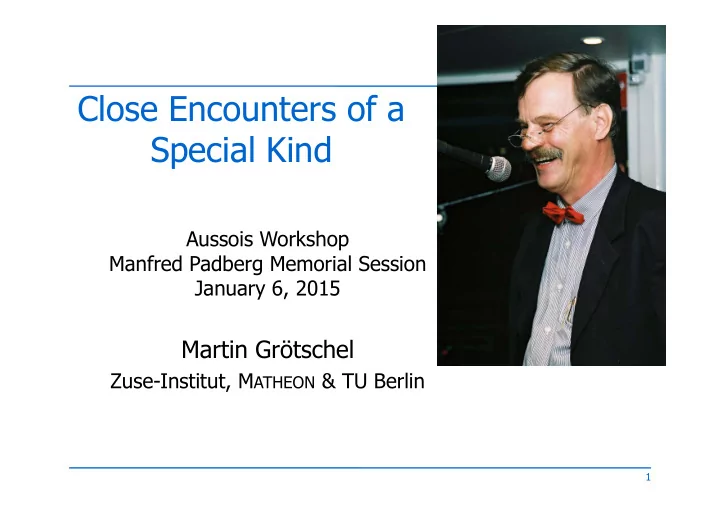
Close Encounters of a Special Kind
Aussois Workshop Manfred Padberg Memorial Session January 6, 2015
Martin Grötschel
Zuse-Institut, MATHEON & TU Berlin
1
Close Encounters of a Special Kind Aussois Workshop Manfred - - PowerPoint PPT Presentation
Close Encounters of a Special Kind Aussois Workshop Manfred Padberg Memorial Session January 6, 2015 Martin Grtschel Zuse-Institut, M ATHEON & TU Berlin 1 Contents 1. Introduction 2. Brief CV 3. My first encounter with Manfred:
1
combinatorics and lifestyle
Martin Grötschel 2
combinatorics and lifestyle
Martin Grötschel 3
Martin Grötschel 4
combinatorics and lifestyle
Martin Grötschel 5
and doctorate (1971) under the supervision of Egon Balas in
Management, Berlin, Germany
York University
Martin Grötschel 6
Brussels
Martin Grötschel 7
and branch-and-cut. Ann. Oper. Res. 139, 321-352 (2005).
Martin Grötschel 8
Society of America (ORSA).
Programming Society and the Society of Industrial and Applied Mathematicians (SIAM).
Award (Germany).
Martin Grötschel 9
Martin Grötschel 10
combinatorics and lifestyle
Martin Grötschel 11
Martin Grötschel 12
Copied last week from Google Street View
My (first) office
Martin Grötschel 13
Copied last week from Google Street View
Manfred’s
his office
What is that?
Martin Grötschel 14
Walk into his office What is the dimension of the travelling salesman polytope?
Martin Grötschel 15
Mykerinos Chephren Cheops bent pyramide of Snofru
Martin Grötschel 16
Martin Grötschel 17
Martin Grötschel 18
(1) - x2 <= 0 (2) - x1 - x2 <=-1 (3) - x1 + x2 <= 3 (4) + x1 <= 3 (5) + x1 + 2x2 <= 9 (1) (4)
1 1 1 1 1 1 , 3 1 3 1 2 9 A b
Martin Grötschel 19
Just find the right number of affinely independent points in the TSP polytope to determine its dimension!
Martin Grötschel 20
What is that? Nobody reports computational success with cutting planes! They use the wrong cutting planes. Gomory cuts are just bad. We have to find the right cutting planes. And these are the facets of the solution sets. And we have to learn that from polyhedral combinatorics. And that is why the TSP is a good staring point.
Martin Grötschel 21
What is that? Complaints of my girlfriend/wife
Martin Grötschel 22
Martin Grötschel 23
combinatorics and lifestyle
Martin Grötschel 24
Martin Grötschel 25
Summer School on Combinatorial Optimization, Dublin, Ireland
Martin Grötschel 26
Gougane Barra, Munster, Ireland
Martin Grötschel 27
Martin Grötschel 28
at Michele Conforti’s apartment at Washington Square
Martin Grötschel 29
Giovanni Rinaldi, Michele Conforti, Monique Laurent, Ram Rao, Manfred
Martin Grötschel 30
Manfred & Karla Hoffman
Martin Grötschel 31
Goethe, Faust 1: Scene Auerbachs Keller in Leipzig Auerbachs Keller in Leipzig Zeche lustiger Gesellen. Frosch Will keiner trinken? keiner lachen? Ich will euch lehren Gesichter machen! Ihr seid ja heut wie nasses Stroh, Und brennt sonst immer lichterloh. Brander Das liegt an dir; du bringst ja nichts herbei Nicht eine Dummheit, keine Sauerei. Frosch (giesst ihm ein Glas Wein über den Kopf) Da hast du beides! Brander Doppelt Schwein! Frosch Ihr wollt es ja, man soll es sein!
Martin Grötschel 32
Martin Grötschel 33
Martin Grötschel 34
Manfred loved to play the piano.
combinatorics and lifestyle
Martin Grötschel 35
Martin Grötschel 36
There are several very good reasons to speak about Claude Berge in this brief review of Manfred’s life.
interests.
friendship with Manfred I became a friend of Claude as well.
Martin Grötschel 37
There are more personal reasons to speak about Claude Berge in this brief review of Manfred’s life.
Claude in 1980 in Paris. Suzy is here today.
long time friend of Suzy and Manfred, is here today as well.
Martin Grötschel 38
Claude Berge came from an highly educated and influential
was President of France from 1895 to 1899. In addition to being an outstanding mathematician, one of the pioneers of graph and hypergraph theory, he was also a
(Ouvroir de Littérature Potentielle)
Martin Grötschel 39
Martin Grötschel 40
In 1994 Berge wrote a 'mathematical' murder mystery for Oulipo. In this short story Who killed the Duke of Densmore (1995), the Duke
Holmes and Watson are summoned to solve the case. Watson is sent by Holmes to the Duke's castle but, on his return, the information he conveys to Holmes is very muddled. Holmes uses the information that Watson gives him to construct a graph. He then applies a theorem of György Hajós to the graph which produces the name of the murderer.
Martin Grötschel 41
Martin Grötschel 42
Martin Grötschel 43
Martin Grötschel, My Favorite Theorem: Characterizations of Perfect Graphs, OPTIMA, 62 (1999) 2-5
Martin Grötschel 44
Claude, Manfred and I had many discussions about the complexity
perfect graph conjecture, etc. Finally, most of the issues could be settled. None of the solutions was “straightforward”. Stability, clique, cloring, clique covering, recognition:
consequences in combinatorial optimization. Combinatorica, 1 (1981) 169-197 Strong perfect graph conjecture (Berge(1961)):
perfect graph theorem, Annals of Mathematics 164 (2006) 51–229
Martin Grötschel 45
Martin Grötschel 46
20.2 Speech of Claude Berge, Read at the Workshop in Honor of Manfred Padberg, Berlin, October 13, 2001 Since Manfred is an old friend, I am extremely sorry for not being fit enough (physically, that is: the brain still ticks over occasionally) to present this speech myself as my tribute to him on his birthday. I suspect that for some of you, the fact that another person will be reading this out may be somewhat preferable. My own English has been distorted by various exposures to pidgin English in Papua New Guinea or in Irian Jaya . . . , and, in addition, laced with an unshakable, though devastatingly seductive, French accent.
Martin Grötschel 47
Martin Grötschel 48
Claude: Where is this mask from? MG: Chichicastenango Claude: No, that is from Guatemala. MG: But Chichicastenango is in Guatemala. Claude: Really? MG: Yes, and I bought my mask there!
Martin Grötschel 49
A Singha from the corner of a Batak long house
Martin Grötschel 50
Acquired from Claude Berge, hanging on the wall in my apartment Photo from the Metropolitan Museum, New York
combinatorics and lifestyle
Martin Grötschel 51
Martin Grötschel 52
Given n „cities“ and „distances“ between them. Find a tour (roundtrip) through all cities visiting every city exactly once such that the sum of all distances travelled is as small as possible. (TSP) The TSP is called symmetric (STSP) if, for every pair of cities i and j, the distance from i to j is the same as the one from j to i, otherwise the problem is called aysmmetric (ATSP).
Grötschel, Martin; Padberg, Manfred, On the symmetric travelling salesman problem I: inequalities. Math. Program. 16, 265-280 (1979). Grötschel, Martin; Padberg, Manfred, On the symmetric travelling salesman problem II: lifting theorems and facets. Math. Program. 16, 281-302 (1979). Grötschel, Martin; Padberg, Manfred, Ulysses 2000: In Search of Optimal Solutions to Hard Combinatorial Problems. Zuse Institute Berlin, SC 93-34, 1993 ..., Le stanze del TSP, AIROnews, VI:3 (2001) 6-9 ..., Die optimierte Odyssee. Spektrum der Wissenschaft, 4 (1999) 76- 85 ..., The Optimized Odyssey. ...
Martin Grötschel 53
n! = (n factorial)
Martin Grötschel 54
A Laurence Wolsey quote:
Padberg & Rao: The diameter of the asymmetric travelling salesman polytope is two. The symmetric case is still not settled.
Martin Grötschel 55
Martin Grötschel 56
120 Städte 7140 Variable 1975/1977/1980
Martin Grötschel 57
666 cities 221,445 variables 1987/1991
http://www.zib.de/groetschel/pubnew/paper/groetschelholland1991.pdf
The Padberg-Rinaldi shock
length of optimal tour: 294 358
Martin Grötschel 58
Martin Grötschel 59
Martin Grötschel, Lászlo Lovász,Alexander Schrijver Geometric Algorithms and Combinatorial Optimization, Springer, 1988
Padberg, Manfred, Linear optimization and extensions (Algorithms and Combinatorics, Vol. 12), Springer-Verlag, Berlin, 1995
Martin Grötschel 60
combinatorics and lifestyle
Martin Grötschel 61
Martin Grötschel 62
In 1983 the path-breaking paper of H.P. Crowder, E.L. Johnson, and M.W. Padberg. Solving large-scale zero-one linear programming problems. Operations Research, 31:803–834, 1983.
for knapsack polytopes dating from 1974 could be put to use in a general code. They formalized the separation problem for cover inequalities for 0/1-knapsack sets as a 0/1-knapsack problem, solved this knapsack problem by a greedy heuristic to find a good cover C, and then sequentially lifted the cover inequality to make it into facet. Manfred pursued this work over several years in many other areas. Quote from L. Wolsey’s Chapter 2 of the Festschrift
Martin Grötschel 63
Martin Grötschel 64
The Impact of Manfred Padberg and His Work
Series: MPS-SIAM Series on Optimization (No. 4), 2004
beautiful and very influential computational study in which the MPSX commercial code was modified for pure 0/1-problems, adding cutting planes and clever preprocessing techniques. The resulting PIPEX code was used to solve a collection of previously unsolved, real-world MIPs.
theoretical and computational results on the TSP by Grötschel (see, for example, Grötschel [18]), Padberg and Rinaldi [24], and
solving hard integer programs (IPs) arising in the context of combinatorial optimization.
Martin Grötschel 65
Martin Grötschel 66
Martin Grötschel 67
Courtesy Bob Bixby
Martin Grötschel 68
Courtesy Bob Bixby
Martin Grötschel 69
combinatorics and lifestyle
Martin Grötschel 70
Martin Grötschel 71
Martin Grötschel 72
Martin Grötschel 73
combinatorics and lifestyle
Martin Grötschel 74
Martin Grötschel 75
Martin Grötschel 76
Martin Grötschel 77
Martin Grötschel 78
Martin Grötschel 79
Martin Grötschel 80
Martin Grötschel 81
Martin Grötschel 82
Quote from Manfred: Never mind “sharp” cuts, only the sharpest one is good enough. Go for facets!
One may bump into Manfred here, there, and everywhere, Berlin, Bonn, Lausanne, New York, Tampa, Hawaii, Grenoble, Paris, but do not interpret his work on the Traveling Salesman Problem in the context of his own peregrinations. If you meet him on the beach of Saint-Tropez, he will be very likely working on a portable, without a look to the sea or to a group of attractive ladies! My personal opinion is that Manfred Padberg is a perfect specimen of a new type of man,
after Homo Erectus, Neanderthals, Cro-Magnons, Homo Sapiens, we are confronting a new breed of Homo Mathematicus? This is the question we have to answer today! Happy birthday, Manfred! Claude
Martin Grötschel 83
From an e-mail I wrote to all contributers to the Padberg Festschrift on September 28, 2006:
The trouble started with an e-mail containing the following piece of text: "After reviewing the scope of your manuscript, I would like to request that we remove the after dinner speeches from Appendix VII (and adjust the Preface and Table of Contents accordingly). I don't think they add much to the book and what seemed funny when spoken will not seem funny in print. I hope you don't mind making this
be a fine tribute to Padberg.„
Quoted from an e-mail by Alexa B. Epstein of July 7, 2003
Martin Grötschel 84
I did not understand what was going on and after lots of e-mails with many people working at SIAM and others it turned out that the person wanting to remove the dinner speeches thought that a sentence in Claude Berge's dinner speech was politically incorrect. You can find the sentence
is "If you meet him on the beach of Saint-Tropez, he will be very likely working on a portable, without a look to the sea
Nobody in my European environment could figure out what is wrong with the sentence, but some more sensitive Americans immediately spotted that one should not use "attractive ladies".
Martin Grötschel 85
We keep Balas's speech, which has by far the most content,... We also keep Berge's speech, as a sort of memorial to him,... Kuhn's speech has to go. There is no way to edit it to make it acceptable. As it is it is practically libellous. I can't imagine that Kuhn would actually want this printed - how would he feel, as 3rd President of SIAM, about a lawsuit being filed by NYU against SIAM?...
Martin Grötschel 86
Being a polite gentleman and former SIAM president Harold Kuhn rephrased a few words to satisfy the SIAM person and president. Harold, in an e-mail to me,joked that, in the future, he may be forced to have to write JOKE!!! on the margin to make some people aware that something is supposed to be funny.
Martin Grötschel 87
We keep Balas's speech, which has by far the most content,... We also keep Berge's speech, as a sort of memorial to him,... Kuhn's speech has to go. There is no way to edit it to make it acceptable. As it is it is practically libellous. I can't imagine that Kuhn would actually want this printed - how would he feel, as 3rd President of SIAM, about a lawsuit being filed by NYU against SIAM?...
Martin Grötschel 88
But I did not give in concerning Claude's contribution and threatened to withdraw the book if SIAM insists on changing the words in the last article a famous mathematician has written before his death. (Claude had died in the meantime.) I had always in mind to write a satiric article about the whole story entitled "Big sister is watching you", or something like that, but it seems that humor is not a universal concept.
Martin Grötschel 89
Claude Berge on “languages” and “history” Manfred himself is a master of Italian, French, English, and, naturally,
presence of colleagues talking about subjects that bore him: a useful method for changing the subject that I wish I could emulate. One of his subjects, for which he is unpeacheable, is the age of most of our
great): the tomb of his father, Pepin, is in Saint Denis, near Paris, but if a rash interlocutor thinks that Charlemagne was more French than German, such an imprudent conviction may generate hours of harsh
Martin Grötschel 90
combinatorics and lifestyle
Martin Grötschel 91
and their liftings, and on vertex adjacency on the set partitioning polytopes, paved the way toward the wider us of polyhedral methods in solving integer programs. His characterization of perfect 0/1 matrices reinforced the already existing ties between graph theory and 0-1/programming.
Martin Grötschel 92
One of the basic discoveries of the early 1980’s was the theoretical usefulness of the ellipsoid method in combinatorial optimization. The polynomial time equivalence of optimization and separation was independently shown by three different groups of researchers: Manfred Padberg and M.R. Rao formed on these groups.
Martin Grötschel 93
approach known as branch-and-cut. Employing the travelling salesman problem as the main test bed, Padberg and Rinaldi successfully demonstrated that if cutting planes generated at various nodes of a search tree can be lifted so as to be valid everywhere, then interspersing them with branch and bound yields a procedure that vastly amplifies the power of either branch and bound or cutting planes themselves. This work had and continues to have a lasting influence.
Martin Grötschel 94
computational testing in the best tradition of Operations Research and the Management Sciences. In his joint work with Crowder and Johnson, as well as in subsequent work with others, Padberg set an example of how to formulate and handle efficiently very large scale practical 0/1 programs with important applications to industry.
Martin Grötschel 95
Martin Grötschel 96
This statement reflects both Manfred’s youth in difficult post– World War II times and his pedagogical relation with his students and coworkers. Some have called it very demanding indeed. And those who could stand it benefitted a lot.
Es geht um die Sache!
Martin Grötschel 97
Martin Grötschel 98
Martin Grötschel 99
Let’s remember Manfred this way!
100
101