Clothing, Insulation, Clothing can keep you cool in very hot places - - PDF document

clothing insulation
SMART_READER_LITE
LIVE PREVIEW

Clothing, Insulation, Clothing can keep you cool in very hot places - - PDF document

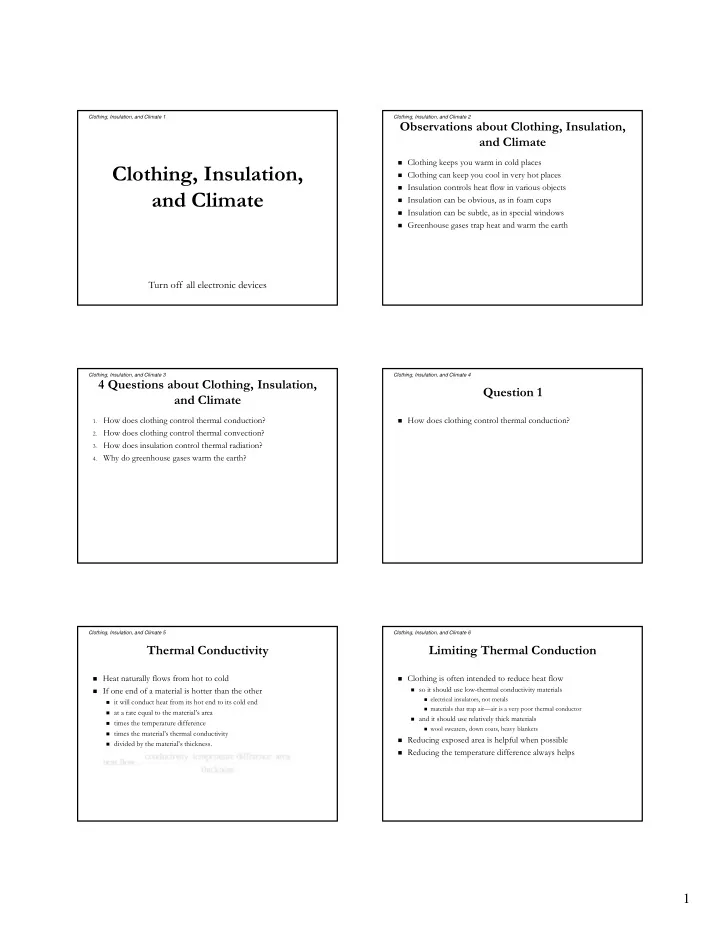
Clothing, Insulation, and Climate 1 Clothing, Insulation, and Climate 2 Observations about Clothing, Insulation, and Climate Clothing keeps you warm in cold places Clothing, Insulation, Clothing can keep you cool in very hot places


slide-1
SLIDE 1

1

Clothing, Insulation, and Climate 1

Clothing, Insulation, and Climate

Turn off all electronic devices

Clothing, Insulation, and Climate 2

Observations about Clothing, Insulation, and Climate

 Clothing keeps you warm in cold places  Clothing can keep you cool in very hot places  Insulation controls heat flow in various objects  Insulation can be obvious, as in foam cups  Insulation can be subtle, as in special windows  Greenhouse gases trap heat and warm the earth

Clothing, Insulation, and Climate 3

4 Questions about Clothing, Insulation, and Climate

  • 1. How does clothing control thermal conduction?
  • 2. How does clothing control thermal convection?
  • 3. How does insulation control thermal radiation?
  • 4. Why do greenhouse gases warm the earth?

Clothing, Insulation, and Climate 4

Question 1

 How does clothing control thermal conduction?

Clothing, Insulation, and Climate 5

Thermal Conductivity

 Heat naturally flows from hot to cold  If one end of a material is hotter than the other

 it will conduct heat from its hot end to its cold end  at a rate equal to the material’s area  times the temperature difference  times the material’s thermal conductivity  divided by the material’s thickness. Clothing, Insulation, and Climate 6

Limiting Thermal Conduction

 Clothing is often intended to reduce heat flow

 so it should use low-thermal conductivity materials  electrical insulators, not metals  materials that trap air—air is a very poor thermal conductor  and it should use relatively thick materials  wool sweaters, down coats, heavy blankets

 Reducing exposed area is helpful when possible  Reducing the temperature difference always helps

slide-2
SLIDE 2

2

Clothing, Insulation, and Climate 7

Question 2

 How does clothing control thermal convection?

Clothing, Insulation, and Climate 8

Natural Convection

 Heat naturally flows from hot to cold  If one region of a fluid is hotter than the other

 those regions will also have different densities  and buoyancy may cause the fluid to circulate.

 The rate of heat flow depends on

 the heat capacity and mobility of the fluid  how quickly heat flows into or out of the fluid  how well buoyancy circulates fluid from hot to cold Clothing, Insulation, and Climate 9

Forced Convection

 Buoyancy isn’t always effective at moving fluids

 It fails when the hotter fluid is above the colder fluid  It fails when fluids experience large drag forces  It fails in certain awkward geometries

 Stirring the fluid enhances heat flow

 Wind leads to faster heat transfer (wind chill)  Moving through air or water speeds heat transfer Clothing, Insulation, and Climate 10

Limiting Thermal Convection

 Clothing can reduce convective heat flow by

 preventing fluids from circulating  reducing temperature differences in the fluid

 The most effective clothing is thick and fluffy

 The fluffiness traps air so that it can’t convect  The thickness allows the surface temperature to drop to that of your

surroundings so that there is no external convection

 A wind breaker minimizes forced convection

Clothing, Insulation, and Climate 11

Question 3

 How does insulation control thermal radiation?

Clothing, Insulation, and Climate 12

Thermal Radiation

 Materials all emit thermal radiation because

 they contain electric charges  and thermal energy causes those charges accelerate.  Accelerating charges emit electromagnetic waves

 Hotter temperatures yield shorter wavelengths

slide-3
SLIDE 3

3

Clothing, Insulation, and Climate 13

Black Body Spectrum (Part 1)

 A surface’s efficiency at absorbing and emitting thermal radiation

is measured by its emissivity

 1 for a perfect emitter-absorber (black)  0 for a nonemitter-nonabsorber (white, clear, shiny)

 The spectrum and intensity of a black surface’s thermal radiation

depend only on its temperature

Clothing, Insulation, and Climate 14

Black Body Spectrum (Part 2)

 The black body spectrum of the sun is white light  Objects hotter than about 500 °C glow visibly  But even your skin emits

invisible thermal radiation

Clothing, Insulation, and Climate 15

Radiative Heat Transfer

 Your skin radiates heat at a rate given by the Stefan-Boltzmann

law:

where temperature is an absolute temperature.

 Because of the 4th power, thermal radiation is extremely sensitive

to temperature.

 Black or gray objects with different temperatures

can exchange heat via thermal radiation

Clothing, Insulation, and Climate 16

Limiting Thermal Radiation (Part 1)

 Insulation can reduce radiative heat flow by

 having surfaces with low emissivities  reducing temperature differences between surfaces

 Emissivity depends on temperature

 You can see high-temperature emissivity  black surfaces have high-temperature emissivities near 1  white, clear, shiny surfaces values near 0  You can’t see low-temperature emissivity  most materials have low-temperature emissivities near 1  conducting (metallic) surfaces can have values near 0 Clothing, Insulation, and Climate 17

Limiting Thermal Radiation (Part 2)

 To reduce radiative heat flow

 use conducting, low-emissivity surfaces  allow exterior surfaces to reach ambient temperature Clothing, Insulation, and Climate 18

Question 4

Q: Why do greenhouse gases warm the earth? A: By increasing altitude of earth’s radiating surface

 Earth receives thermal radiation from the sun  Earth emits thermal radiation into space

 The atmosphere contributes to that thermal radiation  Effective radiating surface is 5 km above sea level

 Balance requires Earth’s radiating surface is -18 °C  Greenhouse gases increase altitude of that surface

slide-4
SLIDE 4

4

Clothing, Insulation, and Climate 19

Effects of the Atmosphere

 Atmosphere has a temperature gradient

 air expands and cools is its altitude increases  air temperature decreases 6.6 °C per km of altitude

 Atmosphere’s average temperature

 at 5 km is -18 °C  at sea level is 15 °C Clothing, Insulation, and Climate 20

Effects of Greenhouse Gases

 Greenhouse gases “darken” the atmosphere

 Low-temperature emissivity of atmosphere increases  Effective radiating surface moves to higher altitude  Average temperature at sea level increases

 Increasing greenhouse gases cause global warming  Greenhouse gases include

 water, carbon dioxide, nitrogen oxides, and methane  but not nitrogen or oxygen; they’re transparent to IR

 Limiting greenhouse gases is critical to our future

Clothing, Insulation, and Climate 21

Summary about Clothing, Insulation, and Climate

 Clothing and insulation limit heat transfer  They use materials with low thermal conductivities  They introduce drag to impede convection  They use low emissivities to reduce radiation  Greenhouse gases affect Earth’s thermal radiation  Those gases raise Earth’s surface temperature