Cluster Diffuse Radio Emissions Kaustuv Basu Argelander Institute - - PowerPoint PPT Presentation

cluster diffuse radio emissions
SMART_READER_LITE
LIVE PREVIEW

Cluster Diffuse Radio Emissions Kaustuv Basu Argelander Institute - - PowerPoint PPT Presentation

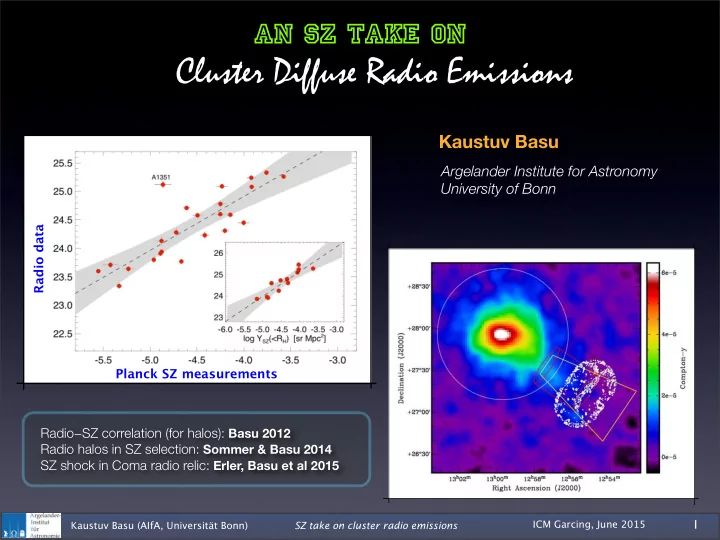
An SZ take on Cluster Diffuse Radio Emissions Kaustuv Basu Argelander Institute for Astronomy University of Bonn Radio data Planck SZ measurements Radio SZ correlation (for halos): Basu 2012 Radio halos in SZ selection: Sommer & Basu


slide-1
SLIDE 1

Kaustuv Basu (AIfA, Universität Bonn) ICM Garcing, June 2015 SZ take on cluster radio emissions

Planck SZ measurements Radio data 1

Cluster Diffuse Radio Emissions

Argelander Institute for Astronomy University of Bonn

Kaustuv Basu

An SZ take on

Radio−SZ correlation (for halos): Basu 2012 Radio halos in SZ selection: Sommer & Basu 2014 SZ shock in Coma radio relic: Erler, Basu et al 2015

slide-2
SLIDE 2

Kaustuv Basu (AIfA, Universität Bonn) ICM Garcing, June 2015 SZ take on cluster radio emissions

An SZ tale of two phenomena

2

Radio Halos: Radio Relics:

  • Radio-SZ correlation for the giant radio halos in galaxy clusters
  • A first attempt at measuring radio halo statistics from SZ selection
  • Significant difgerence between SZ and X-ray selection: possible causes

and implications for cosmology

  • Radio relics in the cluster outskirts: theoretical and observational

connection to cluster merger shocks

  • A first measurement of pressure discontinuity at a radio relic position

from the SZ efgect (also first SZ shock near cluster virial radius)

  • SZ contamination in GHz-frequency observation of radio relics: caution

for observers and challenge for theorists

slide-3
SLIDE 3

Kaustuv Basu (AIfA, Universität Bonn) ICM Garcing, June 2015 SZ take on cluster radio emissions

ICM-based cluster surveys

3

Planck cluster catalog 2015 Planck collaboration 2015 SPT

slide-4
SLIDE 4

Kaustuv Basu (AIfA, Universität Bonn) ICM Garcing, June 2015 SZ take on cluster radio emissions

“Where are they (in the radio)”?

4

?

~1000 clusters ~1500 clusters ~2000 clusters ~100000 clusters

slide-5
SLIDE 5

Kaustuv Basu (AIfA, Universität Bonn) ICM Garcing, June 2015 SZ take on cluster radio emissions

The complex radio cluster

5

PLCKG287.0 (Bonafede et al. 2014)

All contour plots from Giovannini et al. (2009)

slide-6
SLIDE 6

Kaustuv Basu (AIfA, Universität Bonn) ICM Garcing, June 2015 SZ take on cluster radio emissions

Diffuse radio emission in clusters

6

Gallery taken from Feretti et al. (2012) Radio halos: L1.4 GHz ~ 1024-25 W/Hz

  • Mpc scale difguse sources near

cluster centers

  • Low surface brightness and

generally not polarized

  • Mostly steep spectrum (α ~ 1.2)
  • Morphology roughly similar to

X-ray or SZ emission, no severe projection bias Radio relics: L1.4 GHz ~ 1023-25 W/Hz

  • Mpc scale elongated sources

near cluster periphery

  • Higher surface brightness and

polarized

  • Also steep spectrum (α ~ 1.2)
  • Morphology resembles shock

fronts, subject to projection bias Color → X-ray

Both terrible misnomers!

slide-7
SLIDE 7

Kaustuv Basu (AIfA, Universität Bonn) ICM Garcing, June 2015 SZ take on cluster radio emissions

The radio halo “problem”

7

Radio halos imply GeV energy electrons filling up cluster volume (~ Mpc3). But CRe lifetimes are much shorter (~ 108 years) than cluster dynamic timescales.

tH tmerg.

(Fig. from Brunetti & Jones 2014)

Radio halo in Bullet cluster (Liang et al. 2000)

Some in-situ acceleration is necessary for the CRe

slide-8
SLIDE 8

Kaustuv Basu (AIfA, Universität Bonn) ICM Garcing, June 2015 SZ take on cluster radio emissions

The “current wisdom” for radio halos

8

Primary models (or re-acceleration models):

electrons are accelerated in difgusive shocks via turbulence induced by cluster mergers, through ineffjcient Fermi-I process

Secondary models (or hadronic models):

e-/e+ are produced from collision between thermal ions and cosmic ray protons, the latter having significantly longer lifetimes

There is a strong bi-modality

~ 8% ~ 30%

They are rare ~40 known halos

Original competing models for radio halo origin

Cassano et al. (2010) Brunetti et al. (2007)

More complex hybrid models

slide-9
SLIDE 9

Kaustuv Basu (AIfA, Universität Bonn) ICM Garcing, June 2015 SZ take on cluster radio emissions

An “SZ take” on this issue

9

slide-10
SLIDE 10

Kaustuv Basu (AIfA, Universität Bonn) ICM Garcing, June 2015 SZ take on cluster radio emissions

Radio - SZ Correlation

10

Basu (2012)

The cluster SZ signal and radio halo power are correlated (as expected from known X-ray correlation) The correlation becomes tighter (and roughly linear) when the SZ signal is scaled to within the radio halo radius

slide-11
SLIDE 11

Kaustuv Basu (AIfA, Universität Bonn) ICM Garcing, June 2015 SZ take on cluster radio emissions

11

Radio-SZ morphological connection

Radio-SZ morphological comparison can provide crucial test for the theory of radio halo origin From very simplified theoretical estimates Hadronic model with secondary creation of CR electrons: Primary models with turbulent re-acceleration

  • f CR electrons:

Planck collaboration result for Coma (2013)

slide-12
SLIDE 12

Kaustuv Basu (AIfA, Universität Bonn) ICM Garcing, June 2015 SZ take on cluster radio emissions

Reduced bi-modality in SZ

12

Basu (2012)

We found from a posteriori selection

  • f radio halo clusters, taken from

the Planck catalog, that the bi- modality is weak in the radio-SZ correlation. But this is not enough: we need statistics from a priori SZ selection!

Cassano et al. (2013) PSZ data and X-ray selection

slide-13
SLIDE 13

Kaustuv Basu (AIfA, Universität Bonn) ICM Garcing, June 2015 SZ take on cluster radio emissions

Planck 2013 (PSZ) cluster catalog

13

PSZ clusters (Planck coll. 2013)

Sommer & Basu (2014)

Two mass selections: 1) z-dependent mass-cut similar to the Planck COSMO sample, and 2) a constant mass-cut of M500 > 8×10¹⁴ M☉ Similar to the SZ, a complete X-ray selected sample is obtained based on the REFLEX+eBCS+MACS catalogs We then analyze 1.4 GHz radio survey data from the NVSS (Condon et al. 1998) to look for difguse radio emission at cluster centers

PSZ and REFLEX+eBCS+MACS

slide-14
SLIDE 14

Kaustuv Basu (AIfA, Universität Bonn) ICM Garcing, June 2015 SZ take on cluster radio emissions

Filtering NVSS 1.4 GHz maps

14

Before filtering After filtering

  • FIltering and modeling biases are

controlled through extensive set of simulations & null tests

  • Enhanced confusion due to the

faint AGN and starburst population is modeled from their luminosity function and corrected Flux comparison with Giovannini et al. (2009)

slide-15
SLIDE 15

Kaustuv Basu (AIfA, Universität Bonn) ICM Garcing, June 2015 SZ take on cluster radio emissions

Noisy detections & regression analysis

15

Most of our cluster radio halos from NVSS are non-

  • detections. We do not stack

maps, but rather assign individual radio power to each cluster. We aimed to find the mass correlation of radio power, as traced by LX or YSZ, and determine the “radio ofg” fraction that do not belong to this power-law scaling.

We developed a regression method that takes into account errors in both direction, intrinsic scatter, non- detections and a dropout fraction (i.e. zero population). Model parameters are found through a Markov Chain.

slide-16
SLIDE 16

Kaustuv Basu (AIfA, Universität Bonn) ICM Garcing, June 2015 SZ take on cluster radio emissions

Results for the z-dependent mass-cut

16

Sommer & Basu 2014

We fit simultaneously for an “on-correlation” population and a “zero” population for both SZ and X-ray sub-samples The “on-correlation” populations give consistent mass scaling, with large scatter

But the zero-populations are significantly different!

Planck-SZ(V) X-ray(V)

slide-17
SLIDE 17

Kaustuv Basu (AIfA, Universität Bonn) ICM Garcing, June 2015 SZ take on cluster radio emissions

Results for the z-dependent mass-cut

16

Sommer & Basu 2014

We fit simultaneously for an “on-correlation” population and a “zero” population for both SZ and X-ray sub-samples The “on-correlation” populations give consistent mass scaling, with large scatter

But the zero-populations are significantly different!

Planck-SZ(V) X-ray(V)

X-ray dropout 70 ± 10 % SZ dropout 29 ± 12 %

slide-18
SLIDE 18

Kaustuv Basu (AIfA, Universität Bonn) ICM Garcing, June 2015 SZ take on cluster radio emissions

Results for M500 > 8×10¹⁴ M☉ mass-cut

17

Planck-SZ(C) X-ray(C)

The difgerence in the radio “ofg-state” fraction between SZ and X-ray selection is marginally more prominent when constant mass-cuts are used. The dropout fraction in X-ray sub-samples are all consistent with previous measurements (~70%), e.g. GMRT survey (Venturi et al. 2008), WENSS (Rudnick & Lemmerman 2009), etc. Sommer & Basu 2014

slide-19
SLIDE 19

Kaustuv Basu (AIfA, Universität Bonn) ICM Garcing, June 2015 SZ take on cluster radio emissions

Results for M500 > 8×10¹⁴ M☉ mass-cut

17

Planck-SZ(C) X-ray(C)

The difgerence in the radio “ofg-state” fraction between SZ and X-ray selection is marginally more prominent when constant mass-cuts are used. The dropout fraction in X-ray sub-samples are all consistent with previous measurements (~70%), e.g. GMRT survey (Venturi et al. 2008), WENSS (Rudnick & Lemmerman 2009), etc. Sommer & Basu 2014 X-ray dropout 71 ± 10 % SZ dropout 18 ± 11 %

slide-20
SLIDE 20

Kaustuv Basu (AIfA, Universität Bonn) ICM Garcing, June 2015 SZ take on cluster radio emissions

In progress: Radio follow-up of Planck clusters

18

Ongoing program since 2013 to follow up Planck clusters with the VLA 1 Mpc

A 2390 Cool-core cluster at z=0.23 A 2261 Cool-core cluster at z=0.22

Images: Martin Sommer (preliminary)

1 Mpc 1 Mpc

Source filtering - I Source filtering - II

Sommer, Basu et al. in prep.

slide-21
SLIDE 21

Kaustuv Basu (AIfA, Universität Bonn) ICM Garcing, June 2015 SZ take on cluster radio emissions

19

Ongoing program since 2013 to follow up Planck clusters with the VLA

Radio halo in CL1821+643 (z=0.30) Bonafede (+Basu) et al., 2014, MNRAS GMRT radio data at 323 MHz

Chandra X-ray image (Russell et al. 2008)

In progress: Radio follow-up of Planck clusters

slide-22
SLIDE 22

Kaustuv Basu (AIfA, Universität Bonn) ICM Garcing, June 2015 SZ take on cluster radio emissions

Number of radio halos in the sky

20

There are over 1800 clusters with M500 > 5×10¹⁴ M☉in the sky, ~1000 below redshift 0.5

Current prediction for 1.4 GHz All-sky, z<0.6 (Cassano et al. 2012) Factor ~5-10 up!

750 ± 100 radio halos at z<0.5

slide-23
SLIDE 23

Kaustuv Basu (AIfA, Universität Bonn) ICM Garcing, June 2015 SZ take on cluster radio emissions

SZ/X-ray selection difference

21

Planck XMM validation (intermediate results I, 2012) Radio halo count is suggesting 40±15% difgerence between SZ/X-ray selections. Realistic?

(Krause et al. 2012)

Change in the SZ signal during cluster merger process

What is causing the difference between SZ and X-ray selection?

slide-24
SLIDE 24

Kaustuv Basu (AIfA, Universität Bonn) ICM Garcing, June 2015 SZ take on cluster radio emissions

Selection difference: Cool-Core bias in X-rays

22

X-ray brightness of cool-core cluster Abell 2029 X-ray brightness of radio halo cluster Abell 2319

Million & Allen (2009) Relaxed, cool-core clusters are a minority, but they are

  • ver represented in X-ray flux limited samples

These systems generally do not host giant radio halos ➜ producing a strong bi-modal distribution in X-rays

slide-25
SLIDE 25

Kaustuv Basu (AIfA, Universität Bonn) ICM Garcing, June 2015 SZ take on cluster radio emissions

Selection difference: Merger Scenarios

23

N-body hydro simulation results from Poole et al. (2007)

Sommer & Basu (2014)

SZ X-ray

virial crossing 1st core crossing 2nd core crossing looks relaxed

Final equilibrium state

slide-26
SLIDE 26

Kaustuv Basu (AIfA, Universität Bonn) ICM Garcing, June 2015 SZ take on cluster radio emissions

Merger rate with radio halo counts

24

.. this will be extremely easy to check with the upcoming SKA pathfinders

ASKAP MeerKAT SZ selection X-ray selection

Available radio survey data (NVSS) is not deep enough to test the mass- and redshift- dependence of the radio halo fraction, but..

slide-27
SLIDE 27

Kaustuv Basu (AIfA, Universität Bonn) ICM Garcing, June 2015 SZ take on cluster radio emissions

Cosmology from the merger rate

25

Fakhouri et al. (2010) Millenium + Millenium II sims (fixed σ8=0.9 cosmology) Roughly 90% of the high mass halos experience at least a 10:1 merger event since z = 0.5

M200 >1014 M☉

Merger rate brings extra cosmological information!

(Sasaki 1994)

slide-28
SLIDE 28

Kaustuv Basu (AIfA, Universität Bonn) ICM Garcing, June 2015 SZ take on cluster radio emissions

26

Now to cluster outskirts...

slide-29
SLIDE 29

Kaustuv Basu (AIfA, Universität Bonn) ICM Garcing, June 2015 SZ take on cluster radio emissions

27

SZ take on radio relics: Modeling shocks in the cluster outskirts

slide-30
SLIDE 30

Kaustuv Basu (AIfA, Universität Bonn) ICM Garcing, June 2015 SZ take on cluster radio emissions

Radio relics

28

Radio relics: L1.4 GHz ~ 1023-25 W/Hz

  • Extended (up to ~ 1 Mpc) difguse

radio sources at the periphery of clusters

  • Irregular morphology
  • High degree of polarization
  • Steep spectrum (α ~ 1.2)
  • No optical counterpart
  • Morphology resembles shock fronts,

found only in disturbed clusters Abell 3667 (Röttgering et al. 1997) Color: X-ray, contours: radio

slide-31
SLIDE 31

Kaustuv Basu (AIfA, Universität Bonn) ICM Garcing, June 2015 SZ take on cluster radio emissions

Connection to merger shocks

29

Radio relics are thought to be associated to cluster merger shocks. The shock fronts accelerate electrons (and also protons) with the Fermi-I mechanism, ans also compresses the magnetic fields. Those GeV electrons spiraling in the magnetic fields give rise to the synchrotron emission.

  • Merger shocks have low Mach numbers (M ~2−4), so acceleration effjciency will be low
  • Simulations predict many shock fronts, but only a few relics are known. Also, most of

the relics do not have a detected shock feature. Vazza et al. (2012) Mach number CR flux Gas thermal energy

slide-32
SLIDE 32

Kaustuv Basu (AIfA, Universität Bonn) ICM Garcing, June 2015 SZ take on cluster radio emissions

Shocks with X-rays at relics

30

From X-ray one can determine shocks through density and pressure jumps Density jump is not very sensitive to Mach number change, and more afgected by projection biases. It can also just show a contact discontinuity (cold front). Temperature at pre-shock regions diffjcult to determine, not to mention for high redshift objects! Akamatsu et al. (2013) Simionescu et al. (2013)

slide-33
SLIDE 33

Kaustuv Basu (AIfA, Universität Bonn) ICM Garcing, June 2015 SZ take on cluster radio emissions

Cluster shocks in SZ (not at relics)

31

SZ shock in MACS0744 (Korngut et al. 2011) R ≤ R500 shocks in the Coma cluster (Planck collaboration 2013)

slide-34
SLIDE 34

Kaustuv Basu (AIfA, Universität Bonn) ICM Garcing, June 2015 SZ take on cluster radio emissions

Coma relic with the Planck SZ data

32

Erler, Basu et al. (2015), MNRAS, 447, 2497

We used new 2.4 GHz radio data for the coma relic, and extracted

  • ur own y-map from the Planck 2013 public data release

Coma relic has already been analyzed in X-rays: Akamatsu et al. (2013), Ogrean & Brüggen (2013)

slide-35
SLIDE 35

Kaustuv Basu (AIfA, Universität Bonn) ICM Garcing, June 2015 SZ take on cluster radio emissions

Pressure jump at the Coma relic

33

Erler, Basu et al. (2015)

The low-significance shock

  • bserved at the relic position

is attempted to fit with three alternative models. A shock model, with pressure jump at the relic position, provides the best fit and compatibility with other data. y-maps extracted by a constrained ILC method, excellent agreement with the Planck profiles published for Coma.

slide-36
SLIDE 36

Kaustuv Basu (AIfA, Universität Bonn) ICM Garcing, June 2015 SZ take on cluster radio emissions

Results for Coma relic shock

34

SZ data favors a jump close the the relic without any radio prior, at 79+10-9 arcmin (radio relic at 75 arcmin) Corresponding pressure ratio at the relic is 8.8+6.1-3.4 Pressure radio and jump location are uncorrelated

This is the first “detection” of a pressure discontinuity at a radio relic with the SZ

  • efgect. This also happens to be the first SZ shock feature detected near a

cluster’s virial radius.

With the latest 2015 Planck data release, we have Mach number M = 3.4±0.5 (pressure ratio P2/P1 = 14.3±4.5)

Erler, Basu et al. (2015)

slide-37
SLIDE 37

Kaustuv Basu (AIfA, Universität Bonn) ICM Garcing, June 2015 SZ take on cluster radio emissions

Relics at high-z

35

Cluster MACS J1752.0+4440 at z = 0.37 (Bonafede et al. 2012) Observed with IRAM GISMO bolometer array (analysis in progress) Measuring cluster merger shocks through cosmic time!

slide-38
SLIDE 38

Kaustuv Basu (AIfA, Universität Bonn) ICM Garcing, June 2015 SZ take on cluster radio emissions

Summary

36

Radio halo SZ connection: Radio relic SZ connection: We obtained the first evidence for a cluster merger shock at a radio relic

position from the SZ efgect, analyzing Planck data for the Coma cluster.

SZ method is particularly suitable for radio relics in the cluster outskirts,

and for going to high redshifts.

We made a first demonstration for the radio-SZ correlation for the giant

radio halos in galaxy clusters, and also attempted to provide some statistics for radio halos in the SZ selection.

The radio halo fraction in SZ (i.e. mass) selection is large (60%-80%), and

the bi-modal division is weak.

Counting radio halos can potentially provide new ways of constraining

cosmology by measuring the cluster merger fraction.

slide-39
SLIDE 39

Kaustuv Basu (AIfA, Universität Bonn) ICM Garcing, June 2015 SZ take on cluster radio emissions

37