Coal seam gas and research in Australia: Title page with text an - - PowerPoint PPT Presentation

coal seam gas and research in australia
SMART_READER_LITE
LIVE PREVIEW

Coal seam gas and research in Australia: Title page with text an - - PowerPoint PPT Presentation

Coal seam gas and research in Australia: Title page with text an introduction & overview reversed over full page image Presentation to Community Consultative Committee, Narrabri Gas Project Reversed subhead goes here Date goes here


slide-1
SLIDE 1

Title page with text
 reversed over full page image

Reversed subhead goes here Date goes here
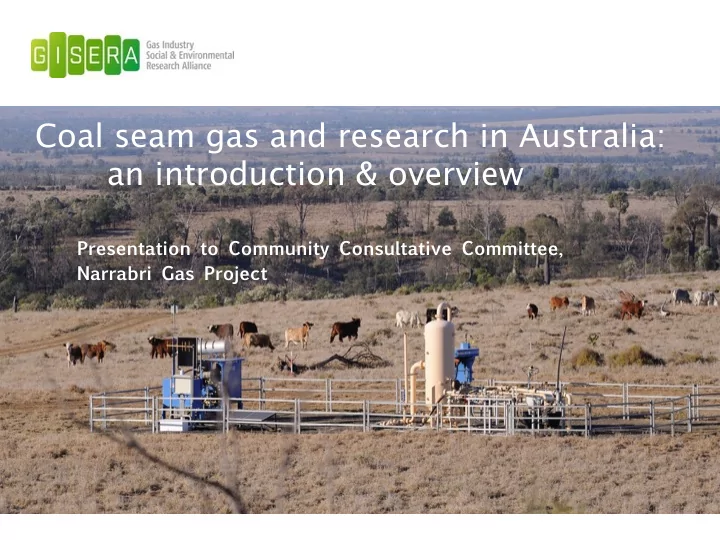
Coal seam gas and research in Australia: an introduction & overview

Presentation to Community Consultative Committee, Narrabri Gas Project

slide-2
SLIDE 2

1.

Gas, as at May 2016

2.

Energy demand

3.

Energy supply and competing fuel sources

4.

Forward curves 2040, 2050, 2060

5.

Climate change

2

Gas, the great energy transition?

slide-3
SLIDE 3

Gas use

homes commercial buildings generating power manufacturing

  • il & gas sector

vehicles

slide-4
SLIDE 4
  • Presents opportunities and challenges
  • Opportunities:
  • Infrastructure development (roads, wells, water resources)
  • Revenue and farm income (rent)
  • Economic development (towns, services)
  • Environmental protection/rehabilitation
  • Challenges:
  • Landscape fragmentation/alienation/degradation
  • Aquifer/alluvium connectivity/drawdown/subsidence
  • Chemical contamination from drilling, hydraulic fracturing, flowback, spills
  • Resource sector economic cycles
  • Not evenly distributed across landscapes and through time
  • Uncertainty creates tension and public discontent
  • Need to maximize benefits and minimize challenges

4

Coal Seam Gas (CSG) - an opportunity & a challenge

slide-5
SLIDE 5

GISERA’s research portfolio

  • Agriculture: identifying landscape/

development configurations that maximise co-benefits

  • Water: understanding risks associated

with extraction & use of groundwater

  • Biodiversity: understanding &

minimising impacts of development on regional ecological function

  • Marine: understanding vulnerable

components of the marine ecosystem to minimise or offset impacts

  • Socio-economic: informing &

supporting change to enhance regional & community benefit

  • Greenhouse footprint: identifying

sources and profiling the region

slide-6
SLIDE 6

GISERA NSW

Narrabri & Macarthur regions

slide-7
SLIDE 7

GISERA objectives

  • Seeks to develop
  • Science: Predict and solve challenges & opportunities
  • Integrated, regional, systems-based research
  • Provide communities evidence based knowledge
  • Informed debate
  • Underpin decisions: Maximize benefits & minimize costs
  • Outcomes
  • New knowledge & reduced uncertainties for relevant

stakeholders

  • Foster collaboration by communities, industry, government,

universities

  • Synthesize data & knowledge at a regional scale
  • Provide non-exclusive opportunities (win-win)
slide-8
SLIDE 8

GISERA governance

  • Research Advisory Committee
  • Contains 2/8 (industry/other) members
  • Contains 4/5 (party/independents)
  • Identifies, develops, approves, stop

projects

  • Ensures research priorities are

independent

  • Ensure research is transparent
  • Oversees conduct
  • Internal documentation completely

visible

  • Science reports publicly available
  • CSIRO peer-review process
  • Research Management Committee
  • Composition: CSIRO, APLNG, QGC
  • Oversees day-to-day operations
  • Financial governance
  • Milestone sign-off

www.gisera.org.au

slide-9
SLIDE 9

NSW Research Advisory Committee

Alliance Director: Dr Damian Barrett: GISERA Director and Research Director Unconventional Gas, Energy Business Unit (CSIRO) CSIRO: Dr Peter Wallbrink: Research Director - Basin Management Outcomes, Land and Water (CSIRO) Amir Aryana: Reservoir Engineering Group Leader, Onshore Gas Program, Energy Business Unit (CSIRO Industry: Armon Hicks: Manager ENSW Public Affairs (Santos) Aaron Clifton: NSW Environment Manager, Gas Operations (AGL) Independents: Jock Laurie: NSW Land and Water Commissioner Jack Warnock: Lower Namoi Cotton Growers Association Ken Flower: General Manager, North West Local Land Services Phillip Wright: DPI Chief Scientist Prof Alison Sheridan: Head of School, UNE Business School

9

slide-10
SLIDE 10

GISERA independence

GISERA purpose-built to ensure that:

  • identification of research priorities
  • selection...
  • conduct...
  • reporting of research projects

is independent of gas interests

  • Only the Research Advisory Committee (4/5 party/independent

members) can develop, approve or stop projects

  • All reports publicly available following CSIRO peer-review
  • All ‘internal’ documentation publicly available at gisera.org.au
slide-11
SLIDE 11

11

NSW RRAC QLD RRAC National Research Management Committee National Advisory Committee GISERA Director P5 P6

Individual Projects Regional Research Advisory Committees (RRAC)

National GISERA Model

P4 P3 P1 P2

Strategic Priorities and Performance Project Approval

National Research Management Committee (NRMC)

slide-12
SLIDE 12

12

National GISERA total budget

Contributor Nature of Contributio n Amount (excluding GST) GST Payable Amount (including GST) CSIRO In-kind $1,500,000 N/A $1,500,000 NSW State Government NSW Department of Trade and Investment Cash $1,500,000 N/A $1,500,000 Federal Government Department of Industry and Science Cash $1,500,000 N/A $1,500,000 Industry Partners Australia Pacific LNG Pty Limited Cash $450,000 $45,000 $495,000 QGC Pty Limited Cash $450,000 $45,000 $495,000 Origin Energy Resources Limited Cash $450,000 $45,000 $495,000 Santos Limited Cash $450,000 $45,000 $495,000 AGL Energy Limited Cash $450,000 $45,000 $495,000 TOTAL CONTRIBUTIONS $6,750,000 $225,000 $6,975,000

slide-13
SLIDE 13

Greenhouse footprint G.1 Methane seepage fluxes, Surat Basin G.1 Methane seepage fluxes (enhancement), Surat Basin G.2 Whole of life cycle GHG assessment of exploitation of Surat Basin gas reserve: global benefits and risks Groundwater W.1 Geo-chemical response to reinjection W.2 Re-injection of CSG water (clogging) W.3 High performance groundwater modelling (feasibility of largescale injection schemes) W.4 Geochemical baseline monitoring (groundwater flow systems) W.5 HCs in groundwater, Surat & Bowen Basins (defunct) Marine M.1 Towards an integrated study of the Gladstone Marine System Agricultural land L.1 Preserving agricultural productivity L.2 Shared space L.3 Gas farm design L.4 Making tracks, treading carefully L.5 Ag land Without a trace L.6 Telling the Story (a communications project) socioeconomics S.1 Monitoring Regional Transition S.2 Community Functioning and well being S.3 Economic assessment and forecasting S.5 Understanding Community Aspirations S.6 Community functioning and wellbeing survey 2 Terrestrial biodiversity B.1 Threat identification B.2 Fire Ecology B.3 Habitat selection by two focal species B.4 Translocation research project for Rutidosis lanata (an offsets projects)

13

Queensland projects

slide-14
SLIDE 14

Greenhouse footprint

profiling molecules from satellite to microscopic inspections

slide-15
SLIDE 15

Methane seeps and fugitive emissions

15

Methane is a significant GHG To quantify industry methane emissions necessary to know seeps Bespoke research program to locate, identify, quantify and monitor seeps CSIRO research program on fugitives Early research suggest well-head emissions are low compared to US

slide-16
SLIDE 16

identifying and quantifying methane sources

16

Gas Plant 1 Cattle Feedlot Gas Plant 2 Water Treatment Ponds 2 km Wind Direction

Plume 1 Plume 2 Plume 3 Plume 4 Plume 5

Max Peak ~2ppm

slide-17
SLIDE 17

Cattle Feedlot

17

Cattle; Peak ~1.9 ppm Feedlot; Peak ~2.5 ppm

  • 1 km downwind
  • 25,000 cattle
  • >4,000 L min-1
  • 1,500 t y-1
slide-18
SLIDE 18

Abandoned Boreholes

18

Wind 1-3 m s-1 100 m

Localised emission

No obvious source Gas seeping from ground Nearest CSG well > 2.5 km away

Traversed to estimate flux

Up to 18 ppm CH4 ~50 L min-1 (17 t y-1)

slide-19
SLIDE 19

Lots of Borehole Sources

19

Chinchilla Miles Gas Plants

slide-20
SLIDE 20

Water

produced water re-injection

slide-21
SLIDE 21

TASK 3: HYDROGEOLOGICAL AND HYDROCHEMICAL DATA COMPILATION AND PROCESSING 


▪ Determine if there are

within-, or inter-aquifer gradients linked to aquifer connectivity or geological heterogeneity within aquifers

▪ Refine existing, or

develop alternative, conceptual models of groundwater recharge and aquifer connectivity.

21

slide-22
SLIDE 22

Re-injection of CSG water

22

Groundwater model of Walloon Coal Measures in Surat Basin, Qld

CSG associated water – ‘waste’ Requires treatment and ‘beneficial use’ CSG water – a significant resource ~ ¼ SW/GW allocations in Condamine Reinjection offers significant benefits Where does reinjected water flow to? How does it react with aquifer water? Does it connect with other aquifers?

slide-23
SLIDE 23

Agricultural land management

Coexistence of CSG & agriculture

X

slide-24
SLIDE 24

24

Look at soil quality Inside vs Outside the compaction zone

slide-25
SLIDE 25

RGB image

slide-26
SLIDE 26

Digital surface model (DSM)

slide-27
SLIDE 27

Ground elevation model (GEM)

slide-28
SLIDE 28

Water accumulation model – flow paths

slide-29
SLIDE 29

Terrestrial biodiversity

priority threats and management

slide-30
SLIDE 30

Terrestrial biodiversity


  • 1. Cost-effective threat management strategies to protect

imperilled species

  • 2. The sensitivity of plants and animals to changes in fire

regimes

  • 3. Habitat selection by two focal species: golden-tailed gecko,

glossy black-cockatoo

  • 4. Ensuring biodiversity offset success: the right kind of seed

for a rare daisy

30

slide-31
SLIDE 31

Marine environment

Turtles and seagrass management

slide-32
SLIDE 32

GISERA Marine Project Components

  • 1. Habitat quality – water column properties and

seagrass distribution

  • 2. Modelling – Hydrodynamic / Biogeochemical

model of Port Curtis; predicting water quality and seagrass growth

  • 3. Turtle behaviour – habitat use and risk

modelling

32

slide-33
SLIDE 33

Socioeconomic impacts and opportunities

community resilience and wellbeing

slide-34
SLIDE 34

Bucking global trend in rural decline?

34

slide-35
SLIDE 35

Regional economics

35

  • Construction phase (2008 – 2014)
  • Family income +15% in CSG region
  • ~30% higher ‘non-mining’ employment

growth

  • ~100 mining/gas jobs generated per SLA
  • 1400 new jobs for residents 2006-2011
  • Excludes FIFO/DIDO in work camps
  • 600 directly in resources sector
  • 800 in other sectors
  • Job growth from CSG:
  • Construction and professional

services

  • Jobs shift: Agriculture/non-

agriculture

  • Operational phase TBD (2015 onwards)
  • GISERA economic modelling and advising

business strategies to maximise

  • pportunities
slide-36
SLIDE 36

1 2 3 4 5

Satisfaction

Services & facilities Community spirit Community cohesion Social interaction Personal safety Environmental quality Built environment Community participation Community trust Income sufficiency Roads Health Decision making and citizen voice Environmental management Employment and business opportunities

Importance for predicting 
 community wellbeing

slide-37
SLIDE 37

Acceptance: most people either tolerate or accepted CSG in 2014

Percentage of participants

12.5 25 37.5 50

Attitude towards CSG

Reject Tolerate Accept Approve Embrace Dalby Chinchilla Miles Tara

slide-38
SLIDE 38

Out of Town v in Town

Percentage of participants

10 20 30 40

Attitude toward CSG

Reject Tolerate Accept Approve Embrace

Out of town In town

2014

slide-39
SLIDE 39

People feel more positive about CSG when

  • They are being listened to
  • Can have a say
  • Trust is high
  • The environment is being managed well for the

future

  • There are employment and business opportunities
  • The community is planning and learning

39

slide-40
SLIDE 40

Adapting to change

When people feel their communities are adapting well to change

  • they are more accepting of and positive towards

CSG

  • they are more positive about their future

40

slide-41
SLIDE 41

Communication and engagement

connection, proximity, performance

slide-42
SLIDE 42

Areas of significant community concern

Extensive community engagement suggests most consistent concern about:

  • negotiation process
  • property value
  • dust, traffic, ‘strangers’
  • compensation
  • long-term groundwater impacts
  • just another fossil fuel (ghg)
  • fraccing chemicals
  • food security
slide-43
SLIDE 43

Thank you

Thank you