Code of Governance for Charities and Institutions of a Public - - PowerPoint PPT Presentation

code of governance for charities and institutions of a
SMART_READER_LITE
LIVE PREVIEW

Code of Governance for Charities and Institutions of a Public - - PowerPoint PPT Presentation

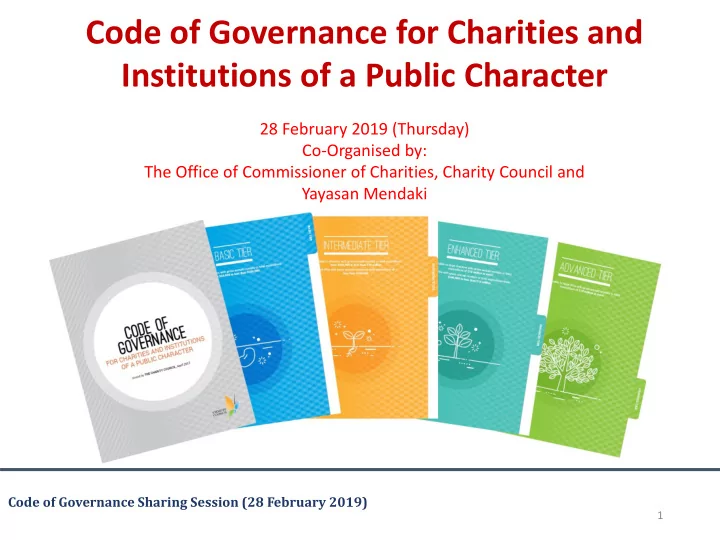
Code of Governance for Charities and Institutions of a Public Character 28 February 2019 (Thursday) Co-Organised by: The Office of Commissioner of Charities, Charity Council and Yayasan Mendaki Code of Governance Sharing Session (28 February


slide-1
SLIDE 1

Code of Governance for Charities and Institutions of a Public Character

1

28 February 2019 (Thursday) Co-Organised by: The Office of Commissioner of Charities, Charity Council and Yayasan Mendaki

Code of Governance Sharing Session (28 February 2019)

slide-2
SLIDE 2

Why a Code of Governance?

2

  • Guidance for charities/Board.

Encourage transparency and accountability

  • Promote support for charities

from the public

slide-3
SLIDE 3

Basic Intermediate Enhanced

Charit ity Tie iered Guid idelines

3

Intermediate Enhanced Advanced

slide-4
SLIDE 4

Key Governance Areas for Discussion

4

slide-5
SLIDE 5

Fundraising Practices

5

General Principle

The charity should ensure that its fundraising activities are transparent and ethical. It should account to its donors on what, how and when the funds would be used. The charity should also be prudent in engaging third party fundraisers.

slide-6
SLIDE 6

[Basic: This applies to all charities with gross annual receipts (GAR)

  • r total expenditure (TE) of $50k and above, and all IPCs]

7.1.1 The charity should ensure that its fundraising activities will preserve the integrity and transparency of the charity.

Conduct of Fundraising

6

slide-7
SLIDE 7

Accountability to Donors

7

7.2.1 The charity should ensure that donors receive accurate and ethical advice about the charity, and the intended use, value and tax implications

  • f donations.

7.2.2 All collections received (solicited or unsolicited) should be properly accounted for and promptly deposited. 7.2.3 All donations-in-kind received should be properly recorded and accounted for by the charity. 7.2.4 Charities should respect donors’ confidentiality. They should not disclose the identity of donors or share information on donors without prior permission from the donors.

[Basic: This applies to all charities with gross annual receipts (GAR)

  • r total expenditure (TE) of $50k and above, and all IPCs]
slide-8
SLIDE 8

Use of Third Party Fundraisers

8

7.3.1 The charity should exercise due care in engaging third party

  • fundraisers. It should take into account how the public may view its

use of third party fundraisers. The use of a third party fundraiser, its rationale and fee arrangements should be approved by the Board and disclosed to potential donors. 7.3.2 Fundraising targets should be set based on the charity’s needs and disclosed to donors. [Basic: This applies to all charities with gross annual receipts (GAR)

  • r total expenditure (TE) of $50k and above, and all IPCs]
slide-9
SLIDE 9

9

Illustration: ABC Charity Fundraising Event Through this fundraising event, we aim to create awareness for xxx and we hope to encourage at least 500 participants to join in our cause and to raise $xx. All funds raised at the event will go to our beneficiaries.

Date 25th July 2019 Time 11am – 7pm Venue VivoCity, Central Court, Level 1

Use of Third Party Fundraisers

slide-10
SLIDE 10

Other Notable Areas

10

Board Governance – Board Committee [Intermediate: This applies to all charities with gross annual receipts (GAR)

  • r total expenditure (TE) of $500k to less than $10 million, and all IPCs]

1.2.1 There should be written terms of reference which clearly set out the authority and duties of the Board and each of its Board committees. The Board should have committees (or designated Board members) to

  • versee the areas relevant to the charity (e.g. Fundraising).

Financial Management and Internal Controls – Operational Controls [Basic: This applies to all charities with gross annual receipts (GAR) or total expenditure (TE) of $50k and above, and all IPCs] 6.1.3 The Board should ensure that reviews are conducted regularly on the charity’s internal controls, processes, key programmes and events (e.g. fundraising).

slide-11
SLIDE 11

11

Code of Practice for Online Charitable Fund-Raising Appeals

a) Put in place processes to ensure user information is kept safe; b) Ensure transparency of funds raised; c) Person conducting the appeals on the platform should complete a declaration of compliance with requirements under the Charities Act; d) Put in place processes for early fraud and mismanagement detection and to ensure legitimacy of appeals; e) Make available the descriptions of the risks related to donations made via such platforms; f) Evaluate risks associated with Money Laundering and Terrorist Financing and have in place processes to address such risks; g) Liaise closely with the Commissioner of Charities and co-operate on the conduct

  • f periodic audits and reviews of the processes.

Platforms subscribe to the Code

  • 1. Giving.sg
  • 2. Give Asia
  • 3. Simply Giving
  • 4. Ray of Hope Initiative Limited
slide-12
SLIDE 12

12

Visibility Guide for Charities

slide-13
SLIDE 13

13

Guide on Safer Giving

https://youtu.be/6cZDqWNOBzs

slide-14
SLIDE 14

Conflict of f In Interest

14

General Principle Board members and staff should act in the best interests of the

  • charity. Clear policies and procedures should be set and measures

be taken to declare, prevent and address conflict of interest1.

1A situation where a Board member, staff, or other person with an existing or

potential financial or other material interest that might impair his or her independence or objectivity in the discharge of responsibilities and duties to the charity.

slide-15
SLIDE 15

15

2.1 The charity should set in place documented procedures for Board members and staff to declare actual or potential conflicts of interest to the Board at the earliest opportunity. 2.2 Board member or staff should not be involved in setting his/her own remuneration. [Basic: This applies to all charities with gross annual receipts (GAR) or total expenditure (TE) of $50k and above, and all IPCs]

slide-16
SLIDE 16

Members* hiring a friend/ relative as an employee or vendor Members* buying

  • r selling goods or

services from/ to a family business for which others might compete Members* having personal relationship where there is an immediate reporting relationship Members* volunteering and/

  • r having

memberships in

  • ther charities

Members* receiving goods or services as beneficiaries.

Source : Social Service Institute

Examples of Conflict of Interest

* A member refers to a board member, management member, staff member or volunteer member.

16

2.3 There should be special procedures to deal with the conflict of interest when Board members have any interest:

  • In business transactions or contracts that the charity may enter into;
  • In other organisations that the charity has dealing with/is considering entering into

joint ventures with;

  • As the charity’s suppliers, service users, beneficiaries or staff
slide-17
SLIDE 17

17

2.4 Where a conflict of interest arises at a Board meeting, the Board member concerned should not vote on the matter nor participate in

  • discussions. He/she should recuse from the meeting. The reason for

how a final decision is made should be recorded in the minutes of the meeting. 2.5 Any appointment of staff who is a close member of the family of the current Board members or staff should undergo the established human resource procedures for recruitment, performance evaluation and remuneration. Board members or staff should make a declaration

  • f such relationships and not influence decisions made during these

procedures. [Basic: This applies to all charities with gross annual receipts (GAR) or total expenditure (TE) of $50k and above, and all IPCs]

slide-18
SLIDE 18

18

Case Study – Employment of a Family Member

  • A charity identifies a need for an administrative support officer to assist the
  • rganisation in the disbursement of funds. The Chief Executive Officer (CEO)

works with the Director of Human Resource to determine a job description and remuneration for the position.

  • The Chief Executive Officer of the charity has a daughter who is looking for a
  • job. The CEO did not mention that his daughter could be a potential applicant.
  • When the role is advertised and his daughter applies, the CEO reports his

Conflict of Interest (COI) to the leadership team and removes himself from the interview selection panel.

  • When the panel recommends his daughter as the preferred candidate, his

daughter accepted the offer.

Adapted from: https://www.education.vic.gov.au/hrweb/Documents/Conflict-of-Interest-COI-Quick-Guide-and-Case-Studies.pdf

slide-19
SLIDE 19

19

Areas with Conflict of Interest

  • From the onset, the CEO has a potential COI knowing that his daughter was

likely to apply. By not disclosing this until after he had finalised the job description and remuneration, he may be seen as influencing the job description to suit his daughter’s qualification and availability, rather than the needs of the charity. This perception creates risk for the CEO’s reputation and could lead to discontent amongst the staff.

  • Once his daughter applied, the CEO took steps to address the COI by reporting

it to the leadership team and removed himself from the interview panel. However, since all the members of the panel are his subordinates, the situation could still create a perception of a COI.

  • Even if the panel felt that they could be impartial in assessing the quality of the

applicants, people might suspect that the panel were influenced to recommend the CEO’s daughter for the position.

slide-20
SLIDE 20

20

Areas to improve on

  • The CEO should disclosed his daughter’s interest to the leadership team earlier

when determining the job description and remuneration. Considerations should be given to whether is was necessary for the CEO to step aside from this process.

  • With the appointment of the CEO’s daughter for the job, his personal

relationship might create an actual or perceived COI whenever he has to make decisions which could affect his daughter’s duties, progression in the

  • rganisation, etc. The organisation should put in place processes to manage
  • ngoing COI issues to ensure that the CEO does not make decisions relating to

the progression, remuneration or the management of complaints about his daughter.

  • The CEO should update his Declaration of Private Interest form and the
  • rganisation should have a policy to deal with the recruitment of family

members in the organisation.

slide-21
SLIDE 21

21

  • Assess the process for current or future risks of COI
  • Disclose any actual, potential or perceived COI as early as possible and take

necessary steps to avoid undue influence.

  • Think about perception of COI as well as actual COI and take sufficient steps

to address the risks

  • Record all decisions made, even decisions not to take any action

Adapted from: https://www.education.vic.gov.au/hrweb/workm/pages/Conflict-of-Interest.aspx

Measures

slide-22
SLIDE 22

Managing Conflict of f In Interest

Decla laratio ion of f In Interests

The declaration of interests should be updated at least annually, or when any changes occur In situations where members are unsure what to declare or whether/ when the declaration needs to be updated, they are strongly encouraged to make a declaration or seek advice from the Board

Source : Social Service Institute, “Conflict of Interest Policy and Operating Procedures”

22

slide-23
SLIDE 23

Confli lict of In Interest Polic licy & Operating Procedures

By Social Service Institute (SSI) Available on:

www.charitycouncil.org.sg

  • Resources For You > Guides and

Templates

www.charities.gov.sg

  • Resources > Publications > Sample

Templates for Charities and IPCs

23

slide-24
SLIDE 24

Sample COI Declaration Form

ABC Charity ABC Charity ABC Charity ABC Charity ABC Charity 24

slide-25
SLIDE 25

Regulatory ry Requirements

25

slide-26
SLIDE 26

26

Key Regulatory Submissions

Submit changes within 14 days of the change Seek COC’s approval for the proposed amendments Submit financial statements, annual report and GEC within 6 months from close of Financial Year (FY) p

Changes to Board Composition Amendments to Governing Instruments Annual Submissions

slide-27
SLIDE 27

27

Online Financial Summary Financial Statements Annual Report GEC

Applicable if charity is required to be externally audited Audited Income / expenditure > $500k Independent Examiner Income / expenditure ≤ $500k Tiered according to annual income / expenditure

Note: Annual submissions requirements vary across charities.

6 months

Close of FY e.g. 31 Dec Due Date e.g. 30 Jun

Annual Submissions

slide-28
SLIDE 28

Available Resources

28

slide-29
SLIDE 29

Consultation Clinics by the Chartered Secretaries In Institute of Singapore

29

Date(s) Time Friday, 22 February 6pm – 8pm Friday, 8 March 2pm – 5pm Friday, 26 April 6pm – 8pm Friday, 31 May 6pm – 8pm Friday, 28 June 6pm – 8pm Friday, 26 July 6pm – 8pm Friday, 30 August 6pm – 8pm Friday, 27 September 6pm – 8pm Friday, 25 October 6pm – 8pm Friday, 29 November 6pm – 8pm

Registration: https://www.123formbuilder.com/form-4501634/

slide-30
SLIDE 30
  • VWOs-Charities Capability Fund
  • Charity Council Website > Resources for You > Guides

and Templates

  • Charity Transparency Framework
  • Visibility Guide
  • Email: Charity_Council_Sec@mccy.gov.sg

30

slide-31
SLIDE 31

31

For enquiries on the Code of Governance, please contact us at charity_council_sec@mccy.gov.sg