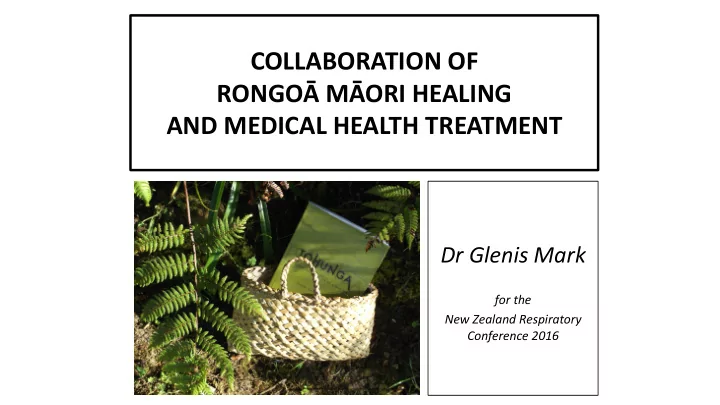
COLLABORATION OF RONGO MORI HEALING AND MEDICAL HEALTH TREATMENT - - PowerPoint PPT Presentation
COLLABORATION OF RONGO MORI HEALING AND MEDICAL HEALTH TREATMENT Dr Glenis Mark for the New Zealand Respiratory Conference 2016 OVERVIEW Definition of rongo Mori Review the literature on collaboration Healers views on
OVERVIEW
- Definition of rongoā Māori
- Review the literature on collaboration
- Healers views on collaboration
- Patients’ views on collaboration
- Is collaboration even possible?
- Future research
- Points of discussion for respiratory
BASIC DEFINITIONS IN THE RESEARCH
RONGOĀ RĀKAU Plants and herbal remedies MIRIMIRI/ROMIROMI Massage/Deep tissue manipulation WAIRUA Spiritual beliefs and practices Multiple plant dosing for multiple conditions (Sporle, 1994) Te Oomai Reia - ancient art of Māori healing (O’Connor, 2008) Understanding matakite (spiritual gifts) (Ngata, 2014) Definition of mirimiri and romiromi (Mark, 2008) Wairua healing practices (Macleod, 1999; Mark, 2012) Relationship between wairua and Māori well- being (Valentine, 2009)
COLLABORATION RESEARCH
- Rongoā should be provided through Māori health providers
(Jones, 2000)
- A trial pilot should be conducted to put collaborative
framework into practice (Stewart et al, 2014)
HEALERS’ VIEWS ON COLLABORATION
| What are the underlying values, beliefs and foundations
- f rongoā Māori healing?
| Seventeen rongoā Māori healers | Narrative interviews | Rourou framework for analysis
|
HEALERS’ VIEWS
- Support
For me, I believe the future of health is where you have a clinical doctor with all that scientific and academic area with healer or tohunga working together side by-side.
- Ambivalent
… there’s a huge change that needs to happen … which won’t, because the way the health system is set up at the moment.
- Conflicting
Actually, doesn’t belong, no it doesn’t actually belong in public health system. It actually belongs back with our people
PATIENTS’ VIEWS ON COLLABORATION
| What do you think about healers and doctors working
together? | Thirty patients of rongoā and medical treatment | Cultural adaptations to photovoice | Thematic analysis of participants’ talk
PATIENTS’ VIEWS ON COLLABORATION
- Rongoā Māori can integrate, complement and work hand-in-hand
with primary health care and patients show a strong desire for integration to happen
- It would be highly beneficial for healers and doctors to work
together and share knowledge, however, participants do not believe that doctors would be able to accept or embrace rongoā Māori healing or healers
- Participants believed that it would be best if patients were treated
by doctors separately to being treated by healers, but that doctors and healers could collaborate at a later stage
IS COLLABORATION POSSIBLE?
WESTERN MEDICINE RONGOĀ MĀORI Focus on pathology and curing disease Focus on influencing the health and healing
- f the person and their whanau
Reductionist: Diseases are biological and treatment should produce measurable
- utcomes
Complex: Diseases do not have a simple explanation, and outcomes are not always measurable Adversarial medicine: “How can I destroy the disease? Bigger picture: "What can the disease teach the patient? Is there a message or story in the disease?" Investigate medicine with a "divide-and- conquer" strategy, looking for microscopic cause Looks at the causes and effects of disease in the physical, emotional, environmental, social, and spiritual realms Intellect is primary. Medical practice is based on scientific theory Intuition is primary. Healing is based on spiritual guidance gained from ancestors, the environment and nature Physician is an authority Healer is the channel for the healing and advisor from the ancestors Fosters dependence on medication, technology, etc. Empowers patients to help them take charge of their own health Health history focuses on patient and family: "Did your mother have cancer?" Health history includes the environment: "Have you offended any tapu on any whenua?" Intervention should result in rapid cure or management of disease Intervention should result in the patient feeling better in their mind, body and spirit
Adapted from: Cohen (2003)
SIMILARITIES
- Treatment for illness (sometimes prevention)
- Diagnosis
- Variety of methods used to treat the patient
- Advice given to the patient
DIFFERENCES
- Underlying philosophy
- Cultural value based
- Validating research
- Doctor suspicion of rongoā
Māori
FUTURE RESEARCH
- Continue to unpack the issues for doctors: Survey of medical
professionals attitude to rongoā Māori – WDHB
- Put collaboration into practice: Information gathering on
collaboration framework and pilot intervention
RELEVANCE TO RESPIRATORY
- Consideration of alternative treatments for asthma and
respiratory illness
- Giving patients different health treatment options and/or past
and current rongoā use
- Exploration of collaboration between doctors and healers for
asthma and respiratory patients
- Potential for collaborative and holistic health treatment for
patients, healers and doctors
REFERENCES
Jones, R. (2000). Rongoa Maori and Primary Health Care (Unpublished master’s thesis). University of Auckland, Auckland. Mark, G. (2008). Conceptualising mind, body, spirit interconnections: perspectives of Māori and non- Māori healers (Unpublished master’s thesis). Massey University, Auckland, New Zealand. Mark, G. (2012). Rongoā Māori (Traditional Māori healing) through the eyes of Māori healers: Sharing the Healing while Keeping the Tapu (Unpublished doctoral dissertation). Massey University, Auckland, New Zealand. Mcleod, M. K. (1999). E iti noa na te aroha: a qualitative exploration into the realms of Maori healing (Unpublished master’s thesis). University of Waikato, Hamilton. Ngata, R. (2014). Understanding Matakite: A Kaupapa Māori study on the impact of matakite/intuitive experiences on wellbeing (Unpublished doctoral dissertation). Massey University, Palmerston North, New Zealand. O’Connor, T. (2007). Governing bodies: A Māori healing tradition in a bicultural state (Unpublished doctoral dissertation). University of Auckland: Auckland, New Zealand. Sporle, A. (1994). Recording Maori Healing Practices. Te Maori News, 3(20), 14. Stewart, A., Hudson, M., Brown, B., Mark, G., Timutimu, T. and Harré-Hindmarsh,J. (2014). Developing a collaborative approach to health service delivery involving rongoā practitioners and medical clinicians in te Tairāwhiti. Gisborne: New Zealand. Valentine, H. (2009). Kia Ngāwari ki te awatea: The relationship between Maori and well-being: a psychological perspective (Unpublished doctoral thesis. Palmerston North: Massey University.