Colorados Created in response to: Unsuccessful experience with - - PDF document

colorado s
SMART_READER_LITE
LIVE PREVIEW

Colorados Created in response to: Unsuccessful experience with - - PDF document

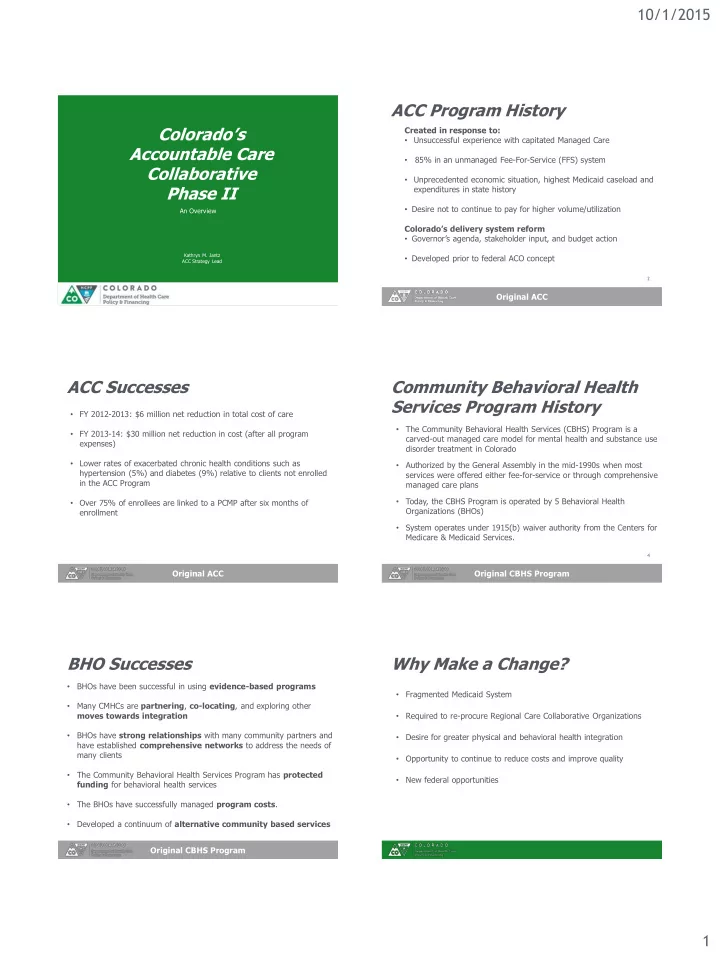
10/1/2015 ACC Program History Colorados Created in response to: Unsuccessful experience with capitated Managed Care Accountable Care 85% in an unmanaged Fee-For-Service (FFS) system Collaborative Unprecedented economic


slide-1
SLIDE 1

10/1/2015 1

Colorado’s Accountable Care Collaborative Phase II

An Overview

Kathryn M. Jantz ACC Strategy Lead

Created in response to:

  • Unsuccessful experience with capitated Managed Care
  • 85% in an unmanaged Fee-For-Service (FFS) system
  • Unprecedented economic situation, highest Medicaid caseload and

expenditures in state history

  • Desire not to continue to pay for higher volume/utilization

Colorado’s delivery system reform

  • Governor’s agenda, stakeholder input, and budget action
  • Developed prior to federal ACO concept

2

ACC Program History

Original ACC

  • FY 2012-2013: $6 million net reduction in total cost of care
  • FY 2013-14: $30 million net reduction in cost (after all program

expenses)

  • Lower rates of exacerbated chronic health conditions such as

hypertension (5%) and diabetes (9%) relative to clients not enrolled in the ACC Program

  • Over 75% of enrollees are linked to a PCMP after six months of

enrollment

ACC Successes

Original ACC

  • The Community Behavioral Health Services (CBHS) Program is a

carved-out managed care model for mental health and substance use disorder treatment in Colorado

  • Authorized by the General Assembly in the mid-1990s when most

services were offered either fee-for-service or through comprehensive managed care plans

  • Today, the CBHS Program is operated by 5 Behavioral Health

Organizations (BHOs)

  • System operates under 1915(b) waiver authority from the Centers for

Medicare & Medicaid Services.

4

Community Behavioral Health Services Program History

Original CBHS Program

BHO Successes

Original CBHS Program

  • BHOs have been successful in using evidence-based programs
  • Many CMHCs are partnering, co-locating, and exploring other

moves towards integration

  • BHOs have strong relationships with many community partners and

have established comprehensive networks to address the needs of many clients

  • The Community Behavioral Health Services Program has protected

funding for behavioral health services

  • The BHOs have successfully managed program costs.
  • Developed a continuum of alternative community based services

Why Make a Change?

  • Fragmented Medicaid System
  • Required to re-procure Regional Care Collaborative Organizations
  • Desire for greater physical and behavioral health integration
  • Opportunity to continue to reduce costs and improve quality
  • New federal opportunities
slide-2
SLIDE 2

10/1/2015 2

Designing ACC Phase II

GOAL:

To optimize health for those served by Medicaid through accountability for value and client experience at every level of the system and at every life stage

This is the impact we want to see in Colorado.

Phase II: Guiding Principles

  • 1. Person- and family-centeredness
  • 2. Accountability at every level
  • 3. Outcomes-focused and value-based

Phase II: Outcomes Phase II: Outcomes Phase II: Outcomes Phase II: Outcomes

slide-3
SLIDE 3

10/1/2015 3

Statewide Data and Analytics Contractor (SDAC) Primary Care Medical Providers (PCMPs) Regional Care Collaborative Organizations (RCCOs)

13

Current ACC: Program Structure

Original ACC

  • Client
  • Health Neighborhood
  • Regional Accountable Entity (RAE)
  • The Department (HCPF)

14

Phase II: Levels of Accountability

15

Phase II: Clients

FY14-15 YTD Average Prenatal Adults 65 and Over Individuals Under 65 with Disabilities Adults Children & Foster Care Number of Clients 16,646 69,862 80,641 475,463 515,872 Percentage 1.43% 6.02% 6.94% 40.95% 44.43%

  • Onboarding
  • Client engagement
  • Client incentives

16

Phase II: Clients

  • Approximately 550 PCMPs
  • PCMPs serve as Medical Homes
  • Member/family centered
  • Whole-person oriented
  • Promotes client self-

management

  • Care provided in a culturally

and linguistically sensitive manner

Current: Primary Care Medical Provider (PCMP) Role

Original ACC Health Team

  • Behavioral Health Providers
  • Primary Care Medical Providers
  • LTSS Case Management Agencies
  • Certain specialists

Phase II: Health Neighborhood

slide-4
SLIDE 4

10/1/2015 4

Health Team

  • Team-based client care
  • Provide care coordination
  • Utilize non-traditional health workers
  • Promote integrated care within practices

Phase II: Health Neighborhood

Broader Health Neighborhood

  • Specialists
  • Hospitals
  • Other medical providers
  • Non-medical providers

Phase II: Health Neighborhood

Broader Health Neighborhood

  • Provider compact
  • Electronic consultation and other telehealth
  • Hospital engagement and other incentives

Phase II: Health Neighborhood

  • Achieve financial and health
  • utcomes
  • Ensure a Medical Home level of

care for every Member

  • Network Development/Management
  • Provider Support
  • Medical Management and Care

Coordination

  • Accountability/Reporting

Current: RCCO Role

Original ACC

  • Provide comprehensive behavioral health benefit
  • Manage provider networks
  • Operate authorization processes
  • Pay providers
  • Perform audits and quality functions
  • Care coordination
  • Accountability and reporting to the State

Current: BHO Role

Original CBHS Program

  • Unified administration of physical health and behavioral health
  • Onboard clients
  • Contract, support, and oversee network
  • Develop a broad health neighborhood
  • Convene Community
  • Manage systems of care for special populations
  • Make value-based payment to Health Team

24

Phase II: Regional Accountable Entity

slide-5
SLIDE 5

10/1/2015 5

25

ACC Phase II: RAE Map

  • Administer benefit package
  • Enrollment into the RAEs
  • Cross-program and cross-agency alignment

Phase II: The Department (HCPF)

There will need to be infrastructure investments at every level of

  • accountability. These fall into three domains:
  • 1. Payment
  • 2. Health Information Technology
  • 3. Sound Administration

Phase II: Program Infrastructure Current: ACC PMPM Payments

  • RCCO PMPM: Payment is reduced for clients unattributed longer

than 6 months

  • PCMP PMPM: Enhanced Primary Care Standards
  • FFS reimbursement for Medical Services

28

Original ACC Capitated managed-care payment. BHO is responsible for the claim when:

  • The client is enrolled in the BHO
  • The client has a BHO-covered diagnosis
  • The service in question is covered by the BHO contract
  • The service is medically necessary for the covered condition

29

Current: BHO Payment

Original CBHS Program

  • PMPM to RAE: RAE makes value-based payments to Health Team

providers

  • Leverage new functionality for hospital payments
  • Exploring aligned alternative payment methodologies for FQHCs

and CMHCs

  • Value based payment formula
  • Payments to support integration
  • Outpatient professional capitation

Phase II: Payment

slide-6
SLIDE 6

10/1/2015 6

KPI & Payment Evolution (2011-2015)

ACC Goal: Improve care, lower cost, and improve client & provider experience.

*Calculation: [All funds saved from reducing RCCO PMPM by $0.50] + [funds retained from tiered payments for unattributed members] – [Amount paid for enhanced PCMP standards]

2011-2012 2012-2013 2013-2014 2014-2015

 ER visits  Well-child check (ages 3-9)  Post-partum follow-up visit  30-day follow-up care post IP discharge  ER visits  30-day readmissions  High cost imaging  ER visits  30-day readmissions  High cost imaging  Well child check (ages 0-21)  ER visits  30-day readmissions  High cost imaging Payment to RCCOs:  ~$9 PMPM (attributed members)  ~$6 PMPM (unattributed members)  Up to $1 KPI incentive  30-day follow-up care post IP discharge funds* Payments to PCMPs:  $3 PMPM (all members)  Up to $1 KPI incentive  $0.50 PMPM (all members) for Enhanced PCMP Standards Payment to RCCOs:  ~$9.50 PMPM (all members) Payments to PCMPs:  $3 PMPM (all members) Payment to RCCOs:  ~$9.50 PMPM (all members)  Up to $1 KPI incentive Payments to PCMPs:  $3 PMPM (all members)  Up to $1 KPI incentive Payment to RCCOs:  ~$9.50 PMPM (all members)  Up to $1 KPI incentive Payments to PCMPs:  $3 PMPM (all members)  Up to $1 KPI incentive

Current: Pay for Performance

Original ACC

Phase II: Pay-for-Performance

  • Key Performance Indicators
  • Competitive Pool
  • Shared Savings
  • Data Repository
  • Data Analytics & Reporting
  • Web Portal & Access
  • Accountability & Continuous

Improvement

Current: Statewide Data Analytics Contractor Role

Original ACC

  • Data, analytics, HIT
  • Enhanced Provider Portal
  • Additional analytics
  • New data sources
  • Focus on Health Information Exchange
  • Care coordination tool

Phase II: Health Information Technology Phase II: Sound Administration

  • Program oversight
  • Program maximization

36

  • Spring-Summer 2014: Stakeholder meetings across Colorado
  • Fall 2014: Request for Information (RFI) published
  • Winter-Spring 2016: Drafting RFP and developing federal waiver

authority

  • Winter-Spring 2016: Draft RFP released
  • Summer 2016: RFP published
  • 2017: New ACC (RAE) contracts begin

Phase II: Request for Proposals

(RFP) Timeline

slide-7
SLIDE 7

10/1/2015 7

37

  • October 21, 2015: ACC Phase II: Overview and Client Engagement
  • November 10, 2015: Open Forum
  • November 18, 2015: Program Improvement Advisory Committee Retreat
  • December 16, 2015: Health Team Support & Payment
  • January 12, 2016: Open Forum
  • January 20, 2016: Advisory Structure and Stakeholder Engagement
  • February 17, 2016: Care Coordination Strategy

Opportunities to Get Involved

Thank You

Kathryn Jantz ACC Strategy Lead Department of Health Care Policy & Financing Kathryn.Jantz@state.co.us RCCORFP@state.co.us