Combinatory Categorial Grammar The effort to develop natural - - PowerPoint PPT Presentation

combinatory categorial grammar
SMART_READER_LITE
LIVE PREVIEW

Combinatory Categorial Grammar The effort to develop natural - - PowerPoint PPT Presentation

Combinatory Categorial Grammar Goal Mildly-context sensitive grammar framework, with provable polynomial parseability To present the intuitions behind Combinatory Categorial Grammar as a framework for relating the structure of a linguistic


slide-1
SLIDE 1

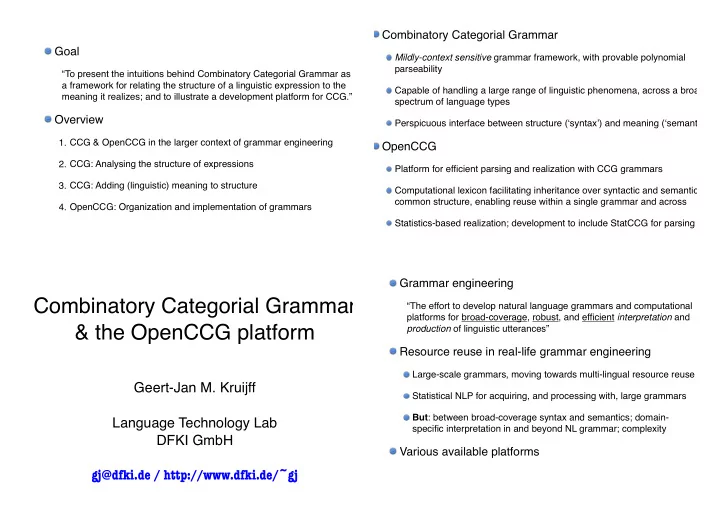
Combinatory Categorial Grammar & the OpenCCG platform

Geert-Jan M. Kruijff Language Technology Lab DFKI GmbH gj@dfki.de / http://www.dfki.de/~gj

Goal

“To present the intuitions behind Combinatory Categorial Grammar as a framework for relating the structure of a linguistic expression to the meaning it realizes; and to illustrate a development platform for CCG.”

Overview

  • 1. CCG & OpenCCG in the larger context of grammar engineering
  • 2. CCG: Analysing the structure of expressions
  • 3. CCG: Adding (linguistic) meaning to structure
  • 4. OpenCCG: Organization and implementation of grammars

Grammar engineering

“The effort to develop natural language grammars and computational platforms for broad-coverage, robust, and efficient interpretation and production of linguistic utterances”

Resource reuse in real-life grammar engineering

Large-scale grammars, moving towards multi-lingual resource reuse Statistical NLP for acquiring, and processing with, large grammars But: between broad-coverage syntax and semantics; domain- specific interpretation in and beyond NL grammar; complexity

Various available platforms Combinatory Categorial Grammar

Mildly-context sensitive grammar framework, with provable polynomial parseability Capable of handling a large range of linguistic phenomena, across a broad spectrum of language types Perspicuous interface between structure (syntax) and meaning (semantics

OpenCCG

Platform for efficient parsing and realization with CCG grammars Computational lexicon facilitating inheritance over syntactic and semantic common structure, enabling reuse within a single grammar and across Statistics-based realization; development to include StatCCG for parsing

slide-2
SLIDE 2

Part 1 A combinatory categorial approach to analysing the structure of expressions

Formal systems

... usually talk about structured objects, the resources ... to collections of which they apply operations ... in order to determine some global properties of these collections

Resource sensitivity governs the way in which a system can use its resources:

How often resources can be used, When they can be assembled into more complex resources, How they can be modified

Structured objects are linguistic signs

Monostratal, multi-level representation

Grammatical composition is resource sensitive

Signs can usually be used only once (no arbitrary copying, wasting) Signs cannot be arbitrarily combined or arranged (linearization, dependency) Control over when operations defining grammatical composition can be applied makes it possible to avoid a collapse to “anything goes”

In the lexicon, words are assigned categories

A category specifies the grammatical use (syntactic behavior) of the word A category can be atomic, or a function using “slashes” \ (left) and / (right) Functional categories are written “result first”: RES |ARG1 ... |ARGn

Examples

Nouns: N Adjectives: N / N Determiners: NP / N Transitive verbs: (S \ NP) / NP, also written as S \ NP / NP

slide-3
SLIDE 3

Basic rules of combination

Forward application (>): X/Y Y ⇒ X Backward application (<): Y X\Y ⇒ X

Example derivation

Ed np saw (s\np)/np Ann np > s\np s <

CCG adds further rules, based on the combinators of Curry & Feys combinatory logic

Forward type raising (>T): X ⇒ Y/(Y\X) Forward harmonic composition (>B): X/Y Y/Z ⇒ X/Z

These rules induce associativity:

Ed np saw (s\np)/np Ann np >B s/np s > >T s/(s\np) (s\np)/np s/(s\np) s/np

Associativity in the structure of language

Associativity introduces “flexible constituency”, non-associativity strict domains Evidence of associativity can be found in extraction, coordination, the interaction of intonational structure and syntactic structure, ...

Example derivation

team that Brazil defeated n n\n/(s/np) np (s\np)/np

>T

s/(s\np)

>B

s/np n\n

>

n

<

Permutation-inducing rules based on the composition combinator B

Forward crossed composition (>Bx): X/Y Y\Z ⇒ X\Z Backward crossed composition (<Bx): Y/Z X\Y ⇒ X/Z <Bx needed for e.g. heavy-NP shift:

<Bx (s\np)/np s\np > s < Ed np his old friend from Skye np saw (s\np)/np briefly (s\np)\(s\np) (s\np)\(s\np) (s\np)/np

slide-4
SLIDE 4

Crossed composition allows for ungrammatical permutations:

a nice in Edinburgh pub np/n n1/n2 n3\n4 n n3/n2

<B >

n3 np

>

English-specific instantiation of <B:

  • English backward crossing composition <B:
  • Y/Z X\Y B X/Z where X=Y=s\$

n1\n4

>B <

n1 np

>

English-specific ban on >B: The grammar

  • f English does not contain forward crossed

composition.

np/n a nice n1/n2 in Edinburgh n3\n4 pub n

Modal control over access to combinators

Modal marking m on connectives: \m and /m Combinators are defined for particular modalized connectives only Hierarchy over modals to inherit combinator accessibility (behavior)

Lexically specified derivational control

The lexicon completely determines structure building

If a modalized connective, controlling the applicability of a rule, is absent from the lexicon, then the rule can never be applied No more need for ad hoc constraints on rule applicability

Universal set of combinator rules: Combinators as formal universals

  • Application (non-associative)
  • Harm. composition (associative)
  • Cross. composition (assoc

All behaviors

The modalities restrict the upper limit, i.e. the strongest rule(s) that can be applied. If a category contains modalities that are stronger than required for a rule, these modalities can be carried over in the result (”no power loss”).

Controlled through ★ All modes inherit from ★, i.e. all have access to application

(>) X /★Y Y ⇒ X (<) Y X \★Y ⇒ X

the np/★n red n/★n car n > n np <

slide-5
SLIDE 5

Harmonic composition

Controlled through , i.e. accessible to but not to ★ (>B) X/Y Y/Z ⇒B X/Z (<B) Y\Z X\Y ⇒B X\Z

Examples

A/B B/C ⇒B A/C ● ⊆ , observe that we remain with ● (not A/ A/B B/★C ⇒ / B A/?C ★ ⊆ / , hence the rule is not applicable

  • Anna

np Manny np marry (s\np)/np might (s\np)/(s\np)

>B

(s\np)/ np s\ np

>

s

<

Observe:

  • ⊆ , so we can keep ●

a nice in Edinburgh pub np/n n1/n2 n3\n4 n n3/n2

<B >

n3 np

>

English-specific instantiation of <B:

  • English backward crossing composition <B:
  • Y/Z X\Y B X/Z where X=Y=s\$

a nice in Edinburgh pub np/n n1/n2 n3\★n4 n

<B

X

  • No need to ban >B

*man that John knew [that, s/s] [saw Ann, s\np] Complementizer “that” gets B mode , which makes B inapplicable n1\n4

>B <

n1 np

>

English-specific ban on >B: The grammar

  • f English does not contain forward crossed

composition.

np/n a nice n1/n2 in Edinburgh n3\n4 pub n a np/n nice in Edinburgh n1/n2 n3\★n4 pub n

>B

X

slide-6
SLIDE 6

Category (not a rule) for coordination

[and, (X\★X)/★X]: * man that [sleeps, s \ np] [and he talks, s\★s] Coordinator “and” gets most restrictive modes, to make B inapplicable

<B

X

  • man

that sleeps and he talks s\np (s\s)/s np s\np

<

s s\s

>

s\np

<B

Simplified coordination rule (for “conjoining like categories”)

X CONJ X’ X” (<>) man that sleeps and s\ np (s\★s)/★s he np talks s\ np

>

s\★s

<

s

Combinatory analysis

Governed by Principle of Adjacency: String-based, not logic-based Building structures using combinatory rules

Multi-modal combinatory analysis

Applicability of combinatory rules is controlled through modalized slashes Control is thus fully lexicalized, the rule component is universal “The ability to speak does not make you intelligent.”

Qui-Gon Jinn to Obi-Wan Kenobi, talking about Jar Jar Binks Star Wars Episode 1: The Phantom Menace

Part 2 Relating the structure of an expression to the meaning(s) it realizes

Modeling the complexity of meaning

Relational structure: relations indicate how parts contribute to the overall meaning of the construction (interpretative import) Ontological richness: differentiation through ontological sorting of propositions

Linguistic meaning

Meaning as far as linguistically realized (no inference, limited resolution) Information structure: “Pragmatization of semantics”

slide-7
SLIDE 7

“Kathy reads a book in the park”

Kathy :person book :object read :event park :region

locative patient actor

Event: Temporal dimension: Present Spatial dimension: ? Causal dimension: ? Event: Temporal dimension: Present Spatial dimension: Park Causal dimension: ? Interpretative import

  • f Locative

Modal logic with a twist

Model theory: states, and accessibility relations between states However, no reference to states in the language

Hybrid logic adds state-reference

A nominal refers uniquely to a state in the model: @ Nominals are first class citizens in the language @n3!p means we have to evaluate at w3, not at w0 We can unify references: @n m means the nominals n and m refer to the same state in the model

w0 w1 w3

R R’ R’ p p q

n3

Reflection of ontological richness through nominals

Nominals can be assigned ontological sorts Ontological sort of the state the nominal refers to Model represents the interpretation of an ontology

Richness through one ontology, or multiple ontologies?

Multiple ontologies require multiple, linked model theories A nominal, through its sort, has reflections in different models An ontology as looking glass on a particular aspect of meaning Model of temporal dimension (e.g. branching time)

... ... ... ...

M

  • d

e l

  • f

s p a t i a l d i m e n s i

  • n

Loc Model of causal dimension

n:event p:region

slide-8
SLIDE 8

@{r:event} read & @r <Actor>k & @{k:person} Kathy & @r <Patient>b & @{b:object} Book & @r <Locative>p & @{p:region} Park

Kathy :person book :object read :event park :region

locative patient actor read kathy book park <Actor> <Patient> <Locative> r k b p

Syntax/semantics-interface

Basic idea follows older proposals by Zeevat (1988), Hoffman (1995), ... Co-index an argument in the meaning with the category that provides it

Constraints only get triggered through when an index on a category gets unified

Derivation over categories is the only source for triggering constraints

read

(S:h \ NP: a) / NP: b @h read & @h<ACT>a & @h<PAT>b

Ed

NP:e @e Ed

reads

(S:r \ NP: a) / NP:b @r read & @r<ACT>a & @r<PAT>b

Mad

NP:m @m Mad (S:r \ NP: a) @r read & @r<ACT>a & @r<PAT>m & @m Mad S:r @r read & @r<ACT>e & @e Ed & <PAT>m & @m Mad

> <

Arguments and adjuncts have different behavior

The way the meaning of an argument contributes to that of the head is specified by the head Adjuncts use a specification that enables them to insert their meaning into that of the head they modify, extending the meaning of the head

Adjunct meaning

No longer do adjuncts act like “predicates”: yesterday(read(j,c)), we

  • btain (retain) a proper relational structure

yesterday

S:h \• S: h @h p & @h <TWH>(y & yesterday)

slide-9
SLIDE 9

yesterda

S:h \• S: @h p & @h<TWH>(y &

Ed

NP:e @e Ed

read

(S:r \ NP: a) / NP:b @r read & @r<ACT>a & @r<PAT>b

Mad

NP:m @m Mad (S:r \ NP: a) @r read & @r<ACT>a & @r<PAT>(m & Mad) S:r @r read & @r<ACT>(e & Ed) & <PAT>(m & Mad)

> <

S:r @r read & @r<ACT>(e & Ed) & <PAT>(m & Mad) & @r<TWH>(y & y)

"Creative minds have always been known to survive any kind of bad training." Anna Freud ... Just in case you star wondering about the joy of XSL transforms

Word part-of-speech (POS) form, stem class (=ontol. sort) macros Lexical family unique id POS closed/open family category lf: lex. meaning str. unique id category type id’d feature str. fs: index variable Atomic cats

inheritance

Complex cats unique id categories, slashes

inheritance inher

Logical forms unique id indexed hlds str. family membership

syn/sem iface based on co-indexation

Word part-of-speech (POS) form, stem class (=ontol. sort) macros Lexical family unique id POS closed/open family category lf: lex. meaning str. unique id category type id’d feature str. fs: index variable Atomic cats Complex cats unique id categories, slashes Logical forms unique id indexed hlds str. cats.xsl dict.xsl

slide-10
SLIDE 10

“ball”: noun,

category n, @b:phys-obj(ball)

“red”: adjective,

category n /* n, @x:phys-obj <Property> (r:color ^ red)

“the”: determiner,

category np /* n @x:phys-obj(<Delimitation>unique ^ <Quantification>specific_singular

Create an atomic category of type n

<xsl:variable name="n.1.X.default"> <atomcat type="n"> <fs id="1"> <feat attr="num"><featvar name="NUM"/></feat> <feat attr="pers"><featvar name="PERS"/></feat> <feat attr="case"><featvar name="CASE"/></feat> <feat attr="index"><lf><nomvar name="X"/></lf></feat> </fs> </atomcat> </xsl:variable>

Note:

Feature structure has an id; this must be unique in a complex category! The feature structure also specifies X as the index variable (nominal) to be used in a lexical family to access the meaning of this noun

Lexical meaning for a noun

<xsl:variable name="X.Default"> <lf> <satop nomvar="X"> <prop name="[*DEFAULT*]"/> </satop> </lf> </xsl:variable>

Note:

The nominal variable X needs to be co-indexed with the index on a category, for this meaning to be accessible “[*DEFAULT*]” means using the word stem as proposition

Setting up the lexical family

<xsl:template name="add-n-families"> <family name="n.default" pos="N" closed="false"> <entry name="default"> <xsl:call-template name="extend"> <xsl:with-param name="elt" select="xalan:nodeset($n.1.X.default)/*"/> <xsl:with-param name="ext" select="$X.Default"/> </xsl:call-template> </entry> </family> </xsl:template>

Note:

Make sure that the family is specified within the add-n-families template

slide-11
SLIDE 11

Imports:

<xsl:import href="./n.xsl"/> <xsl:output indent="yes" xalan2:indent-amount="2"/> <xsl:strip-space elements="*"/>

Call the template to add the noun families

<xsl:call-template name="add-n-families"/>

Note:

The provided lexicon-base.xsl file specifies where to put the above

Specifying the entry for the word “ball”

<entry stem="ball" pos="N" class="thing"> <word form="ball" macros="@num.sg"/> <word form="balls" macros="@num.pl"/> </entry>

How about those macros?

<macro name="@num.sg">

<fs id="1" attr="num" val="sg"/> </macro> <macro name="@num.pl"> <fs id="1" attr="num" val="pl"/> </macro>

Note: these macros only apply to feature structures with id 1!

Building the resources

Use [ comsys-build ] in the grammar directory to build the resources

Testing

Use [ tccg ] to load the grammar into OpenCCG Type in “ball” at the prompt and see what happens! Use [ testbed.xml ] for test suite; use [ ccg-test ] to do regression tests

the resulting noun inherits the features from the argument <xsl:variable name="n.from-1.default">

<atomcat type="n"> <fs inheritsFrom="1"/> </atomcat> </xsl:variable>

a feature specified in the above fs overwrites the original fs material

complex category structure

<xsl:variable name="adj.from-1.default"> <complexcat> <xsl:copy-of select="$n.from-1.default"/> <slash dir="/" mode="*"/> <xsl:copy-of select="$n.1.X.default"/> </complexcat> </xsl:variable>

slide-12
SLIDE 12

The meaning of the adjective is added as property of the

  • bject, realized by the noun the adjective modifies

<xsl:variable name="P.default.X"> <lf> <satop nomvar="X"> <diamond mode="Property"> <nomvar name="P"/> <prop name="[*DEFAULT*]"/> </diamond> </satop> </lf> </xsl:variable>

Note:

the X is the index of the object (interface specified in the n category)

Basic family for adjectives

<family name="adj.property.default" pos="ADJ"> <entry name="adj.property"> <xsl:call-template name="extend"> <xsl:with-param name="elt" select="xalan:nodeset($adj.from-1.default)/*"/> <xsl:with-param name="ext" select="$P.default.T"/> </xsl:call-template> </entry> </family>

Lexical entry for the word “red”

<entry stem="red" pos="ADJ" class="color"> <word form="red" macros=""/> <member-of family="adj.property.default"/> </entry>

the resulting np inherits features from the n argument, and adds a “form” feature with value “definite” (for the)

<xsl:variable name="np.from-1.definite">

<atomcat type="np"> <fs inheritsFrom="1"> <feat attr="form" val="definite"/> </fs> </atomcat> </xsl:variable>

complex category structure

<xsl:variable name="det.from-1.def.sg"> <complexcat> <xsl:copy-of select="$np.from-1.definite"/> <slash dir="/" mode="*"/> <xsl:copy-of select="$n.1.X.default"/> </complexcat> </xsl:variable>

the lexical meaning of the (definite) determiner specifies unique delimitation, about a specific singular object

<xsl:variable name="D.DELIM.UNQ.QUANT.SPECSING.X"> <lf> <satop nomvar="X"> <diamond mode="Delimitation"><prop name="unique"/></diamond> <diamond mode="Quantification"><prop name="specific_singular"/></diamond> </satop> </lf> </xsl:variable>

Note:

the X is the index of the object (interface specified in the n category)

slide-13
SLIDE 13

Lexical family

<family name="determiner.definite" pos="DET" indexRel="Delimitation" closed="true"> <entry name="n.sg"> <xsl:call-template name="extend"> <xsl:with-param name="elt" select="xalan:nodeset($det.from-1.def.sg)/*"/> <xsl:with-param name="ext" select="$D.DELIM.UNQ.QUANT.SPECSING.X"/> </xsl:call-template> </entry> </family>

the family is closed - it should only be applicable to definite determiners the feature indexRel directs the realizer to the Delimitation feature, there being no propositional content for the determiner

Lexical entry for “the”

<entry stem="the" pos="DET"> <word form="the" macros=""/> <member-of family="determiner.definite"/> </entry>

After building, tccg can parse “the red ball”

tccg> the red ball 1 parse found. Parse: np{case=CASE, form=definite, index=T_4:thing, num=sg, pers=PERS} : @b1:thing(ball ^ <Delimitation>unique ^ <Quantification>specific_singular ^ <Property>(r1:color ^ red))

Add the following line to testbed.xml, and run ccg-test

<item numOfParses="1" string="the red ball"/>