Community-based mangrove management in Giao An commune, Giao Thuy - - PowerPoint PPT Presentation

community based mangrove management
SMART_READER_LITE
LIVE PREVIEW

Community-based mangrove management in Giao An commune, Giao Thuy - - PowerPoint PPT Presentation

Community-based mangrove management in Giao An commune, Giao Thuy district, Nam Dinh province, Viet Nam Presenter : Vo Thi Thu Supervisor : Prof. Misa Masuda Contents 1. Introduction to Community-based forest management 2. Objectives of the


slide-1
SLIDE 1

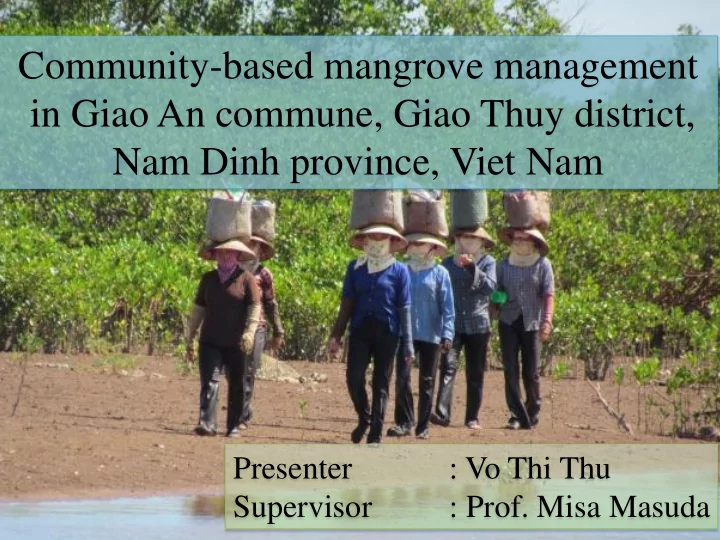
Community-based mangrove management in Giao An commune, Giao Thuy district, Nam Dinh province, Viet Nam

Presenter : Vo Thi Thu Supervisor : Prof. Misa Masuda

slide-2
SLIDE 2

Contents

  • 1. Introduction to Community-based forest management
  • 2. Objectives of the study
  • 3. Research site
  • 4. Methods
  • 5. Tentative results
  • 6. Future work
slide-3
SLIDE 3

Community-based Forest Management (CBFM) Arnold (1992) defined CBFM as “an umbrella term denoting a wide range

  • f activities which link rural people with forest and trees, and the

products and benefits to be derived from them” The Regional Community Forestry Training Center for Asia and Pacific (RECOFTC) defined CBFM as a forest management method which involves the governance and local community in managing forest resource for commercial and non-commercial purpose. Pomeroy (1992):CBFM strives to make maximum use of local knowledge and expertise in developing management and strategies. Agrawal and Gibson (1999) showed that communities to be successful and sustainable alternatives to state and private management of resources. Soontornwong (2006) proved contribution of CBFM in livelihood improvement in community mangrove management in Thailand

slide-4
SLIDE 4

Country Initation period Level achieved Salient features of the program

Philippines Originally in 1957, but

  • n

national scale in 1990 Moderate CBFM was taken as a component of the comprehensive coastal management comprising all coastal resources Thailand 1980s High Achievements of grass-root communities have made the state agencies to modify the legislation and support initiatives accordingly as well as allocate financial assistance for them India 1990s Moderate Protective duties and usufructs are shared by both commune and state-run forestry development South Africa 1990s Low CBFM, in its true sense, was implemented in the post- apartheid period. Source: Datta, D., etc (2012), Status of implement CBFM in different countries , Journal of Environmental Management 107, 84-95.

Status of implementation of CBFM in different countries

slide-5
SLIDE 5

11.7 9.31 12.09 13.39 5 10 15 1976 1995 2003 2010 Millions (ha) Year

Changes in forest area Historical changes in forest management bodies in Viet Nam Forest management by the state 70% of forests belonged to the State Forest Enterprises (SFEs) Forest land allocation policy Individual households became legal

  • wners of forests

Land Law 2003 Forest Protection Law 2004 Communities as legal owners of forests

slide-6
SLIDE 6

Percentage to the total forest area by forest management bodies (MARD, 2010)

 State actors: 66%

 Forest Management Board (FMBs)  People’s committee  State enterprises  Army units

 Households: 26%  Communities: 2%  Private actors: 1%  Others: 5% Forests currently controlled by people’s committee will be allocated to communities.

Current forest ownership

33% 16% 15% 26% 10%

FMBs People's committee State Enterprise Households Others Total: 13.39 millions ha

slide-7
SLIDE 7

11.7 9.31 12.09 13.39 5 10 15 1976 1995 2003 2010 Millions (ha) Year

Changes in forest area Historical changes in forest management bodies in Viet Nam

Forest management by the state 70% of forests belonged to the State Forest Enterprises (SFEs) 40 CBFMs in production forests Forest land allocation policy Individual households became legal

  • wners of forests

 Land Law 2003  Forest Protection Law 2004 Communities as legal owners of forests 2 CBFMs in protection forests

CBFM: community-based forest management

2013

slide-8
SLIDE 8

Objectives and methods

OBJECTIVES  Evaluate applicability of CBFM to protection forests, particularly to mangrove forests.

 Clarify characteristics of livelihoods in mangrove forests.  Compare the policy and practices.  Compare perceptions of stakeholders.

METHODS  Focus on one of the two CBFMs in protection forests.

 Bach Ma National Park  Xuan Thuy National Park

 Secondary data collection at MoNRE, National Park, GA commune  Household survey at a commune selected from those surrounding the mangrove forest.

slide-9
SLIDE 9

Map of Xuan Thuy Nation Park (XTNP, 2008)

Research site: Xuan Thuy National Park (XTNP)

GA commune  Area: 15,100 ha Core zone: 7,100 ha Buffer zone: 8,000 ha Mangrove forest: 3,200 ha  Largest mangrove distribution is in Giao An commune  CBFM has been introduced to GA commune since 2010

slide-10
SLIDE 10

 Xuan Thuy National Park  GA commune Community Forest Management Board (5 members)

Structure of CBFM in Giao An commune

Patrol group (5 members) Members (52HHs) GA commune: 126 HHs in research village 72 HHs were randomly selected, of which 38 HHs belonged to CBFM

slide-11
SLIDE 11

Rights Obligation

  • Conduct plan and rules of mangrove

management and resources ultilization (time of harvesting, amount …)

  • Freely collectors: Do not use collecting

equipments which can cause harm to mangrove and ecosystem

  • Collect resources within mangrove

forest sustainably

  • Shrimp pond owners: do not expand

shrimp pond illegally, do not cut down mangrove in shrimp pond, contribute money to support for patrol group activities

  • Patrol group can make record of rule

violating and reports to local authority

  • r national park
  • Patrol group: go on patrol to protect

mangrove forest, organize meeting every month and reports to the community forest management board

  • Members of management board and

patrol group can receive supporting

  • money. Members of CBFM do not have

pay for the annual renting area

Rights and Obligation of members in CBFM

slide-12
SLIDE 12

Dang Livelihoods in mangrove environment

slide-13
SLIDE 13

Choi: watching hut in clam, fish and oyster farms Inside of a choi Free collectors of shells.

slide-14
SLIDE 14

488 585 1,024 1,317 1,463 1,756 2,107 2,220 2,732 3,512 4,878 1000 2000 3000 4000 5000 6000

Rice planting Livestock Others Freely collecting Choi protecting Work outside village Dang, Day, Lo Aquatic resource trading Oyster farming Clam farming Shirmp farming

USD

Result

Utilization of the land could gain larger income. Shrimp farming is more forest destructive than the

  • thers.

Average annual net income by major source of income (June 2012 – May 2013) Profits derived from aquatic resources can be categorized to: Direct ones (dang, day, lo, and free collection), and Indirect

  • nes

(trading and labor)

slide-15
SLIDE 15

66.7 20.8 12.5

Very important Important Significant

Number of HHs Percentage(%) Very important 48 66.7 Important 15 20.8 Significant 9 12.5 Donnot know Total 72 100

Function of mangrove :  72 HHs (100%): Protect from storm  58 HHs (80.5%): Protect and improve livelihoods  34 HHs (47.2%): Provide habitats for migratory birds  14 HHs (19.4%): Others

Awareness of local people about mangrove

Result

slide-16
SLIDE 16

Number of HHs Percentage (%) Catch female aquatic with egg 72 100 Catch small-sized aquatic 61 84.7 Catch died aquatic 22 30.5 Catch mature aquatic 72 100

Awareness of local people on aquatic resources protection

Result

100% 84.70% 30.50% 100%

0% 10% 20% 30% 40% 50% 60% 70% 80% 90% 100% Catch female aquatic with egg Catch small-sized aquatic Catch died aquatic Catch mature aquatic

slide-17
SLIDE 17

Future works LITERATURE SURVEY  Analysis of the policies and regulations related to:

 CBFM  Shirmp farming

 Original design of the CBFM in XTNP HOUSEHOLD SURVEY  Analysis of the dependency on the mangrove forest  Comparison of awareness among the stakeholders that have different interests in mangrove ecosystem protection Compare between policies and practices in CBFM in XTNP Applicability to other mangrove forests and other forest types

slide-18
SLIDE 18