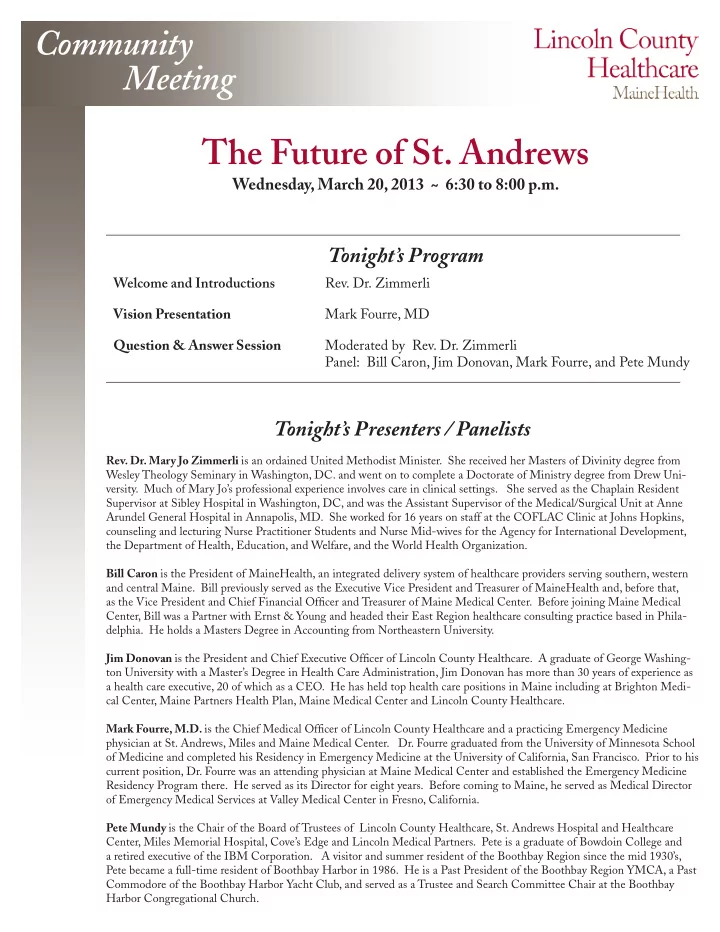
Community Meeting The Future of St. Andrews Wednesday, March 20, - - PDF document

community meeting the future of st andrews
SMART_READER_LITE
LIVE PREVIEW

Community Meeting The Future of St. Andrews Wednesday, March 20, - - PDF document

Community Meeting The Future of St. Andrews Wednesday, March 20, 2013 ~ 6:30 to 8:00 p.m. Tonights Program Welcome and Introductions Rev. Dr. Zimmerli Vision Presentation Mark Fourre, MD Question & Answer Session Moderated by Rev.


slide-1
SLIDE 1

Community Meeting The Future of St. Andrews

Wednesday, March 20, 2013 ~ 6:30 to 8:00 p.m.

  • Rev. Dr. Mary Jo Zimmerli is an ordained United Methodist Minister. She received her Masters of Divinity degree from

Wesley Theology Seminary in Washington, DC. and went on to complete a Doctorate of Ministry degree from Drew Uni-

  • versity. Much of Mary Jo’s professional experience involves care in clinical settings. She served as the Chaplain Resident

Supervisor at Sibley Hospital in Washington, DC, and was the Assistant Supervisor of the Medical/Surgical Unit at Anne Arundel General Hospital in Annapolis, MD. She worked for 16 years on staff at the COFLAC Clinic at Johns Hopkins, counseling and lecturing Nurse Practitioner Students and Nurse Mid-wives for the Agency for International Development, the Department of Health, Education, and Welfare, and the World Health Organization. Bill Caron is the President of MaineHealth, an integrated delivery system of healthcare providers serving southern, western and central Maine. Bill previously served as the Executive Vice President and Treasurer of MaineHealth and, before that, as the Vice President and Chief Financial Offjcer and Treasurer of Maine Medical Center. Before joining Maine Medical Center, Bill was a Partner with Ernst & Young and headed their East Region healthcare consulting practice based in Phila-

  • delphia. He holds a Masters Degree in Accounting from Northeastern University.

Jim Donovan is the President and Chief Executive Offjcer of Lincoln County Healthcare. A graduate of George Washing- ton University with a Master’s Degree in Health Care Administration, Jim Donovan has more than 30 years of experience as a health care executive, 20 of which as a CEO. He has held top health care positions in Maine including at Brighton Medi- cal Center, Maine Partners Health Plan, Maine Medical Center and Lincoln County Healthcare. Mark Fourre, M.D. is the Chief Medical Offjcer of Lincoln County Healthcare and a practicing Emergency Medicine physician at St. Andrews, Miles and Maine Medical Center. Dr. Fourre graduated from the University of Minnesota School

  • f Medicine and completed his Residency in Emergency Medicine at the University of California, San Francisco. Prior to his

current position, Dr. Fourre was an attending physician at Maine Medical Center and established the Emergency Medicine Residency Program there. He served as its Director for eight years. Before coming to Maine, he served as Medical Director

  • f Emergency Medical Services at Valley Medical Center in Fresno, California.

Pete Mundy is the Chair of the Board of Trustees of Lincoln County Healthcare, St. Andrews Hospital and Healthcare Center, Miles Memorial Hospital, Cove’s Edge and Lincoln Medical Partners. Pete is a graduate of Bowdoin College and a retired executive of the IBM Corporation. A visitor and summer resident of the Boothbay Region since the mid 1930’s, Pete became a full-time resident of Boothbay Harbor in 1986. He is a Past President of the Boothbay Region YMCA, a Past Commodore of the Boothbay Harbor Yacht Club, and served as a Trustee and Search Committee Chair at the Boothbay Harbor Congregational Church.

Tonight’s Presenters / Panelists Tonight’s Program

Welcome and Introductions

  • Rev. Dr. Zimmerli

Vision Presentation Mark Fourre, MD Question & Answer Session Moderated by Rev. Dr. Zimmerli Panel: Bill Caron, Jim Donovan, Mark Fourre, and Pete Mundy

slide-2
SLIDE 2

Important Questions & Answers about Changes at St. Andrews

  • 1. Why are you closing St. Andrews? St. Andrews is not closing. If the exact same patients who used St. An-

drews Hospital last year come back next year with the exact same medical needs, 94% would be treated on the St. Andrews Campus.

  • 2. Why are these times so challenging for the small health care providers? Small health care providers must

provide the highest quality of care by keeping up with changing standards of care; remain competitive in salaries and benefjts for physicians and clinical staff; keep up-to-date as possible with expensive technology; and reduce their charges to compete with bigger organizations that have the benefjt of economies of scale.

  • 3. Why did St. Andrews choose to join MaineHealth? The Board of Trustees of St. Andrews realized in 1996

that in order to maintain a core group of services for the Boothbay Region and be better able to respond to a rap- idly changing healthcare environment, it was necessary to join a system that could signifjcantly improve purchas- ing power, provide clinical and professional expertise, and have the resources to signifjcantly improve the health of

  • ur communities.
  • 4. Why did St. Andrews choose to become a partner in creating Lincoln County Healthcare? Partnering with

Miles Memorial to form Lincoln County Healthcare was done for many of the same reasons St. Andrews joined MaineHealth - to provide the highest quality care AND maximize effjciency. In today’s challenging health care environment, we must pool our resources instead of competing with one another.

  • 5. Who owns St. Andrews? This is not an easy or simple question to answer. It’s like asking who owns the

YMCA, the United Way or the Red Cross. As a private, not-for-profjt organization, St. Andrews is not owned as one might usually think of ownership (like a small business, or retail shop). For example, no one can sell St. Andrews or its assets and keep the money for themselves. The important question to ask is…”who is responsible for St. Andrews?” The answer to that question is easy and simple: all of St. Andrews assets are controlled by the Board of Trustees, who must use these assets to fulfjll the organization’s mission.

  • 6. What is St. Andrews Mission? To ensure access to high-quality, patient-centered and affordable care for the

residents of the Boothbay Region.

  • 7. Why doesn’t the public have a say in decisions that affect the health care in our region? As a practical

matter, the public infmuences what services are available locally by choosing where they have their needs met. In the last few decades, more and more community members have chosen to get their healthcare needs met off the peninsula, and this has led to an unsustainable loss of volume and a resulting decrease in services available at St.

  • Andrews. As a private, not-for-profjt organization, decisions about St. Andrews are made by the local, volunteer

Board of Trustees. The Boothbay Region is represented on the Board by individuals and physicians who live in the Boothbay Region. Many of these volunteers have literally spent years learning the complexities of health care systems and fjnance. Their decisions are based on that knowledge and are made on behalf of (and in the best interest of) their communities.

  • 8. Won’t the physicians who serve on your board either make decisions solely for their own benefjt or do what

they’re told by the administrators? The physicians who serve on the Board have a responsibility to make deci- sions they feel are in the best interests of our patients, residents, their families and the community. They take this responsibility very seriously.

  • 9. Why won’t you allow the public to decide who serves on your Board of Trustees? Like the YMCA or the

Botanical Gardens, St. Andrews is a private, not-for-profjt organization whose Trustee selection is not subject to a public vote. Because health care is an incredibly complex endeavor, our Governance Committee (which is comprised of Trustees) chooses potential candidates for our Board based on the knowledge that the candidates are willing, capable and have the time to dedicate to the responsibilities of board membership.

slide-3
SLIDE 3
  • 10. Why did you reduce patient volume by eliminat-

ing services at St. Andrews? This question puts the cart before the horse. In reality, volume declined before services were eliminated. In many cases, services were eliminated by specialty providers from other organiza- tions because of low volume, not because of anything St. Andrews did or didn’t do. In each and every case, the lack of suffjcient patient volume preceded the decision to stop providing the service.

  • 11. Why did you make these changes? The decision

was made in light of the many challenges we face (see above). The lack of patient volume and the quality issues that develop as a result necessitates a change in

  • perations. Low patient volume is a serious challenge to

patient safety and quality of care, and is very fjnancially challenging in light of coming changes in the health care environment.

  • 12. Why did you choose to convert the Emergency

Department to an urgent care center? In short, this decision was made to improve the safety and quality of

  • care. Approximately 80% of those receiving care at the
  • St. Andrews ED could receive the same care at an urgent care center. Those having more complicated conditions

are better off being seen at an emergency room where inpatient care, emergency surgery and an ICU is available. This decision also makes care more affordable. Since the vast majority of individuals who come to the St. An- drews ED need urgent care, we can substantially reduce our prices by providing their care through an urgent care

  • center. The businesses in this region who insure their employees, and individuals who pay for their own health

care, desperately need lower prices and more affordable care. The chief barrier for many in accessing health care is no longer geography, it is affordability. This decision was also about sustainability. St. Andrews will not survive if its volume can’t support safe, quality and affordable care. We must see volume stabilize and grow in the coming years.

  • 13. According to some, St. Andrews will actually lose money (the Medicare Critical Access Hospital Subsidy)

by closing its E.D. Is this true? This is only one piece of the larger fjnancial picture and this subsidy does not make the Hospital viable. St. Andrews would lose more money going forward because even with this subsidy, the low volume drives losses most years. The service changes at St. Andrews have taken the loss of the subsidy into consideration in designing the vision for the future. Having said this, the subsidy has been important to us and we are searching for ways to mitigate the loss of this federal funding.

This chart shows increases levels of complexity in Urgent/Emergent Care and how the charges differ depending on where a patient is treated. While there are 5 levels of care, most patients who are treated in an urgent care setting are either level 2 or level 3.

slide-4
SLIDE 4
  • 14. According to some, the St. Andrews administration is misleading the public about its fjnances. Isn’t there

approximately $6 million that isn’t accounted for? Since 2001, St. Andrews has had operating losses totaling $7,144,029. Even after properly accounting for non-operating revenues: the Critical Access Hospital subsidy, all charitable donations (including capital campaign donations), community support and investment returns, the 12-year accumulated loss was $1,935,855. What’s more, during this twelve year period, only fjve of the 12 years resulted in a positive bottom line when including all revenues. The “missing” $6 million isn’t missing at all. About 10 years ago, St. Andrews spent $6.5 million in a major renovation of our campus. This money was generously do- nated by people and businesses in our community. Like all charitable organizations, we do not treat donations the same as money which patients pay for services. St. Andrews fjnancial statements are prepared in accordance with Generally Accepted Accounting Principles, as are all hospitals, and audited annually by an independent audit fjrm.

  • 15. How could individuals who live in this area consciously choose to close the ED at St. Andrews? Our Trust-

ees chose to convert the ED to an urgent care center when they no longer believed we were capable of delivering the high-quality, patient-centered, and affordable care our community deserves. While a very diffjcult decision, the Trustees made the right decision for the future of healthcare services in the Boothbay Region.

  • 16. By making this decision, haven’t you created fjnancial hardship for the Boothbay Region Ambulance Ser-

vice (BRAS) and the communities that support it? St. Andrews and Lincoln County Healthcare are committed to partnering with BRAS in any way we can to help develop the best possible EMS system for the region. To date, we have provided training for BRAS and fjnancial support to the towns ($250,000) to help during this transition.

  • 17. Why don’t you simply use the $250,000 to keep the ED open at St. Andrews? The St. Andrews organiza-

tion as it stands today is unsustainable from a volume (the core issue), quality and fjnancial perspective. What’s needed is a fundamental change in our vision and in our approach to providing care. That’s why we have devel-

  • ped an outpatient model of care that is clinically and administratively integrated with Lincoln County Health-

care and with the other MaineHealth facilities.

  • 18. Can’t you use the upcoming MaineCare settlement funds to keep things the way they are? Once again, an

infusion of cash will not sustain St. Andrews when the core issue is low patient volume. Besides, in this particular settlement, the state doesn’t owe money to St. Andrews. St. Andrews actually owes money to the state.

  • 19. What’s to keep you from closing the other services you provide on the St. Andrews campus and in the

Boothbay Region? We are committed to providing the health care services the people of the Boothbay Region need and use. Suffjcient patient volume is imperative to maintain a high level of quality and fjnancial sustainabil-

  • ity. So long as enough people choose to use the services provided on the St. Andrews Campus, we will continue

to provide them.

  • 20. Do you have any plans for new services at St. Andrews? We are working with the State of Maine to license

the current beds at St. Andrews to provide rehabilitation care. This program would, in effect, continue the level of care that is provided there today. Another possibility is a community pharmacy directly linked to our primary care services at the Family Care Center.

  • 21. How will you fjnance your new vision for health care in the Boothbay Region and in Lincoln County? Our

future is very challenging. We are taking steps to maximize our effjciency and quality in our day-to-day opera-

  • tions. We are also reviewing our corporate structure and considering changes to it that will allow us to continue
  • ur mission today and into the future.