
SLIDE 1
Community Solar Energy
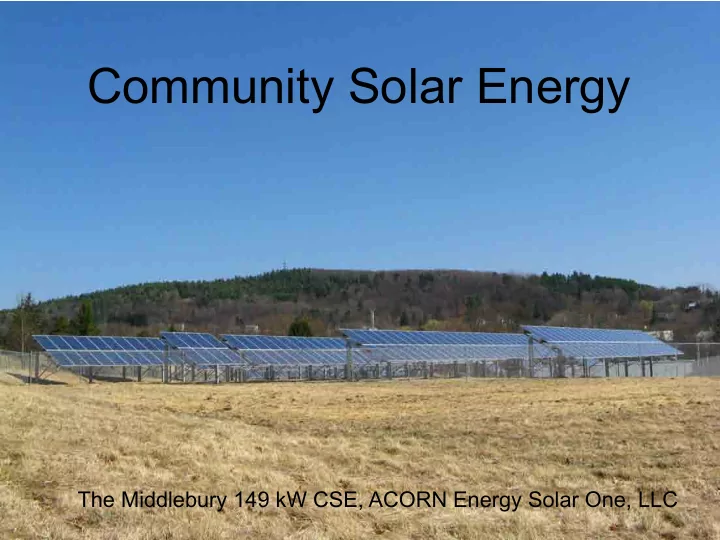
The Middlebury 149 kW CSE, ACORN Energy Solar One, LLC
Community Solar Energy The Middlebury 149 kW CSE, ACORN Energy Solar - - PowerPoint PPT Presentation
Community Solar Energy The Middlebury 149 kW CSE, ACORN Energy Solar One, LLC Efficiency and Renewables Deep Energy Retrofits are not practical for most people 30% gain from Home Performance with Energy Star ($7500 avg), means 70% of
The Middlebury 149 kW CSE, ACORN Energy Solar One, LLC
16” thick Larsen truss walls, 26 years off grid. both energy reduction and energy production
the next 10 years in the SPEED program, with a goal that 20% of the state's electricity in 2017 be a new SPEED resource
Standard (Section 8004) based on SPEED resources 2005-2012
increasing by 4% per year to 75% by 2032
it has a large Biosystems loss, and there are many environmental and FERC regulations
heat, and best use is CHP
widely available using small to large, distributed facilities
Map of Wind Resources in Hartland Small area qualifies as category 1
health spas, gained wider popularity after W.W.2, and is now used to reduce lighting loads
sunspaces to highly insulated buildings with special glazing
water heating to a minimum
An Upper Valley resident who had solar panels on his barn for charging his car
Cobb Hill 2.7 kW community array
small municipal buildings
(PAREI, Mt Holly)
Energy is not part of our mindset yet, and groups will support members
property ownership ($500 Solar Shingles in CA, Brewster Solar Garden's 28 panels for 5 years for $5000 will return you $6400 of electricity)
found 22% of residential and 65% of commercial cool climate buildings were acceptable. 2/3's of roof sites need a better location.
regulations become more extensive at 150 kW and up
expensive above that
(above 94%) to increase generation
expedite financing
(CSE)
(CSE)
(CSE/sub)
(sub)
(sub)
(CSE/sub)
On a cloudless day, the solar energy falling on Hartland is equal to the output
uprate to 620 MW).
events, and 15 site visits, and found a dozen people who were interested in forming a CSE group at a commitment equal to a residential PV system ($10,000-15,000). Many more would be interested if the amount were smaller
interested around the $1000-2500 level
threshold (around $1200, some at $600)
credits, payback, structure, to be concerns. A CSE would help these issues.
from a CSE solar array, especially if they don't have a good on site location. Many are not aware of the incentives.
(7W versus 15W CFL)
(Electric bill)
Maps like this one, and Redbook data, are in kWh per square meter per day. For our purposes, since the Standard Test Condition for solar panels is 1000 watts/m2, we can divide out the terms, and the data becomes hours per day. This allows us to multiply the nominal kW rating of the solar panels by these hours to get the kWh output per day.
NREL Solar Resource Map, annual
Measure the N-S length and E-W width of your site, and do a shading analysis using the SSA. Then you can calculate how many hours of sunlight, how many panels will fit, how much electricity they will make, and a general cost.
less than one unshaded acre. This will serve about two dozen homes (which can vary from 1,000 to 12,000 kWh per year)
and have year round repair access
at the pole top on a cross bar)
for use of the land
the solar access of various sites
Would anyone like to help develop a spreadsheet that skips the chart sketching step?
15 degrees
from horizontal
array along with the azimuth and tilt into PV Watts, to correct the output. (There is less than 2% loss up to these limits.)
are for residential.
These incentives, in combination with a reduction in peak demand on Time Of Use rates, (solar is a peaking source), can make Solar really attractive for a business
(How are you getting paid for the electricity generated?)
Which members get the tax incentives?
loan
that are at a 36 degree angle from horizontal. Fixed racks at that angle with two average panels (63”x2) high will cover 8.5' of ground, and allowing 6” of vertical misalignment between rows and a 20 degree winter sun, on level ground the aisles need to be 18.5'
your area by 27' to find the number of rows
would be 10.5' tall, so each linear foot of row will produce 135 watts. Multiply the east/west length of your rows in feet by 135 watts, and divide by 1000, to find the output in kW.
shading measurement calculation, to find the annual kWh output
(“GMP Coffee Roasters 2008 100kW was $7/w, now would be $3.25”
premises
and need to monetize them to pay expenses
for income is discouraged, GMP is the only utility that has cash payment option in their rates.
businesses, who can use tax incentives
$0.30/kWh for 15-25 years, makes financing much easier
than $0.30 in 20 years)
year for 10 years allotment (2.5 MW to utilities, 7.5 other)
need to monetize them to pay expenses, assume value to be $0.20/kWh. Loan may depend
income is discouraged. GMP is the only utility that has a cash payment (at their option) in their rates.
who can use tax incentives
was oversubscribed in 2 minutes
$0.271/kWh for 10-25 years, makes financing much easier (note- kWh may be higher than $0.271 in 20 years)
allotment over the next 10 years
metering group members, tax investors, 3'rd party investors, lease companies
LLC, L3C in Vermont, Leasing Agreement w/ tax equity+SSA
and kWh allocation from a major owner to the group after a designated depreciation period (generally after 5 years for the MACRS incentive) and a specified return is achieved
designed to allocate tax benefits and kWh credits to members. Vermont Law School and Powersmith Farm suggest a Multilateral Licensing Agreement.
“shares” or “stock” (example- Calif SMUD “Solar Shingles”), it has to be a subscription or service (example- magazine subscription, or Brewster Solar Garden's “kWh output of 28 panels for 5 years for $5000”).
Exemption”) there is a substantial registration process that will cost a few hundred thousand dollars.
until 2016
1603 cash grant in lieu of tax credit were not renewed, which is bad for municipalities and other nonprofit (tax exempt) organizations
appetite to use these incentives, but there is one more restriction- most of the members will not be “materially participating” in the
the tax credits only to income generated by other “passive activities”
and there may be local taxes up to half again that amount
Market”, technically the only entity you can have a “Power Purchase Agreement” with is your utility, Solar Service Agreements may be ok
group member to achieve a certain return to make involvement viable, the allocation of kWh credits can be adjusted
lines, contact the utility early if your preliminary study looks like you have a good site. A smaller (under 100 kW) array may be possible on single phase lines
A 3% annual increase means that the “Solar Adder” will rise from the current average of $0.146/kWh to the $0.20 threshold in 11 years.
in only 2 of Solar Hartland's 24 site visits. In general they were $200 to $1200 more expensive for the same kWh output
and late sun, not common in the Upper Valley
50' spacing, only 36% to 73% (25' or 0' margin) as many panels would fit on two recently measured 149 kW array sites, compared to fixed racks
The author's 1 kW tracker he built 14 years ago
Scale, Business and SPEED programs
and loans. They also have a loan guarantee program (short form NA- >$200k, long form 80 hours), however this may help a CSE loan application only a little because lenders have solar specific criteria
arrays in their view. Using a well known installation company will reduce due diligence fees and make your loan approval more likely
CO, HI, NJ, MA, MD, NY and PA. (It's possible to walk into Home Depot and get a system from SolarCity, or Lowes from Sungevity, in some of these states.) In Vermont the only lease available is tied to a tracker package (All Earth Renewables), and the only other dealer financing is like a credit card- 16.79% (Alteris/Real Goods)
Basic Price- $600,000 Cost of Financing- 6%for5yrs, thenfloat Due Diligence- $1200 Legal (LLC, permits)-$5,000 to $25,000 Permitting- $250 Power Line Extension-$15-20/ft,new3ph Maintenance- $800/yr @ 3% inflation Administrator- $3000/yr @ 3% inf. Income tax/workmans comp ? Inverter Replacement- $30,000 @yr20 Insurance- $1200/yr @ 3% inflation Property Tax $4/kW+local, about$900/yr Emergency Repairs- assume $300/yr Land Lease- (ag use taxes on 1 acre) $100/yr or kWh credits? Decommissioning- wide range - to + Panel Degradation 0.5% per year Membership Subscriptions $300,000 Federal Investment Tax Credit $168,000 Federal MACRS depreciation 14%+12% Vermont Business Tax Credit $43,200 Vermont Small Scale $36,000 Value of kWh $35,400/yr to year 11, 3% Solar Adder $53,543 REC's go to Utility for their state quota Fair Market Value? (decommissioning) Equipment lifespan 30 years (my 20yr old panels still produce 125%) Land arrangement 30 to 40 yrs or longer, (if price of kWh has risen more than panel loss, then keep running array) Disclaimer! This budget is a work in progress, with many vague amounts! The value of Solar Installations are deeply discounted by lenders in other states. The allowable loan amount will be based on about 65% of the net present value
will specify the components, run their own prediction of output, and return a price
budget
file the CPG and assist with incentive forms
Administrator monitoring output, filing yearly reports and taxes, making GNM and legal updates, and the group also maintains the facility
Brown, www.mrve.net
www.acornenergycoop.com
linda.c.gray@gmail.com
interested
(In order of preference, first 5 are recommended) A Guide to Community Solar:Utility, Private, and Non-Profit Project Development, U.S. Dept of Energy, Solar America Communities, 2010, Very good overall view Community Solar Power, Obstacles and Opportunities, John Farrel, 2011, New Rules Project, Good case studies Solar Photovoltaic Financing: Residential Sector Deployment, Jason Coughlin, Karlynn Cory, NREL, 2009, General financing models Financing Non-Residential Photovoltaic Projects: Options and Implications, Mark Bolinger, LBNL, 2009, Good detailed analysis, see also 2011 followup wind report Vermont Group Net Metering Information and Guidelines, Michael Dworkin, Dan Ingold, 2010, State specific info, “Multilateral Licensing Agreement” not LLC Solar PV Project Financing: Regulatory and Legislative Challenges for Third Party PPA System Owners, Kathryn Kollins, Speer, Cory, NREL, 2010, Leasing+SSA's Vermont Utilities Electric Service Requirements Manual, reduce Utility Rep's time Photovoltaics Business Models, L. Frantzis, S. Graham, R. Katofsky, H. Sawyer, NREL, Navigant, 2008, Distributed ownership, 3'rd parties, and utilities Solar Powering Your Community: A Guide for Local Governments, US DOE Solar America Communities, 2011, Very comprehensive guide Lex Helius, The Law of Solar Energy, A Guide to Business and Legal Issues, Stoel Rives Law Firm, 2011, Detailed guide covering many states legal rules Tracking the Sun III, The Installed Cost of Photovoltaics in the US 1998-2009, Barbose, Darghouth, Wiser, LBNL, 2010, Good analysis, dated figures The Solarize Guidebook: A Community Guide to Collective Purchasing of Residential PV Systems, US DOE, 2011, Focused more on buying groups, NW
Pomerleau 1MW array, Vergennes
Karl Kemnitzer, www.solarhartland.org
This presentation was made using 100% solar power