
SLIDE 1
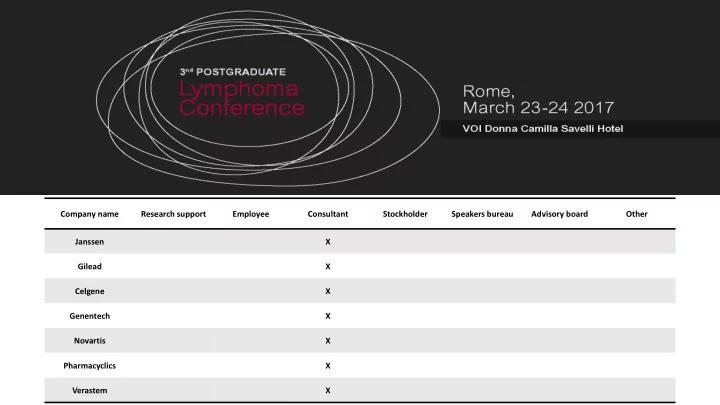
Company name Research support Employee Consultant Stockholder Speakers bureau Advisory board Other Janssen X Gilead X Celgene X Genentech X Novartis X Pharmacyclics X Verastem X
Company name Research support Employee Consultant Stockholder - - PowerPoint PPT Presentation
Company name Research support Employee Consultant Stockholder Speakers bureau Advisory board Other Janssen X Gilead X Celgene X Genentech X Novartis X Pharmacyclics X Verastem X Palbociclib in Previously Treated Mantle Cell
Company name Research support Employee Consultant Stockholder Speakers bureau Advisory board Other Janssen X Gilead X Celgene X Genentech X Novartis X Pharmacyclics X Verastem X
March 26, 2017 pem9019@med.cornell.edu
Turner, N. C. et al. Nat. Rev. Clin. Oncol..2016.26 Veronica Fernàndez et al. JCO 2005;23:6364-6369
Turner, N. C. et al. (2016) Treating cancer with selective CDK4/6 inhibitors
The Lancet Oncology 2015 16, 25-35DOI: (10.1016/S1470-2045(14)71159-3)
Leonard J P et al. Blood 2012;119:4597-4607
Leonard J P et al. Blood 2012;119:4597-4607
Leonard J P et al. Blood 2012;119:4597-4607
N=19 Level 1 N=6 Level 2 N=3 Level 3 N=7 Level 4 N=3 Median age (range) 64
61 75 64 71 Sex M:F 11:8 3:3 2:1 6:1 2:1 Prior therapies (range) 2 (1-7) 2.5 (1-7) 3 (2-5) 4 (1-7) 1 (1-2) Prior bortezo mib
1 3 1 2 LDH ULN=192 209 190 224 225 130 WBC x 109 4.8 4.8 6.9 4.8 4.3 ECOG 0-1 18 5 3 7 3 2 1 1 MIPI low 6 2 1 2 1 Int. 11 4 7 2 high 2 2
Di Liberto, Huang, et al, unpublished Chiron et al, Cancer Discovery, 2014
Figure courtesy of Selina Chen-Kiang
DLT (cycle 1)
Grade 3 or 4 non-heme tox., N/V/D > grade 3 >48h Grade 4 ANC > 7 days, or ANC < 750 cells/mL with fever or sepsis Grade 4 plts >5 days or grade >3 with bleeding
Patients seen D1, 2, 8, 14 during cycle 1, then on D1 of each cycle Response evaluated after cycle 3, cycle 6, then every 6 cycles
CR confirmed by PET/CT, BMBx (if involved), endoscopy (if involved)
Treatment continues until progression or unacceptable toxicity
Dose level # of DLT DLT 1 0/3
0/3
1/6 Grade 4 platelets > 5 days 4* 0/6
2/5 Grade 3 rash (n=2)
# - Median time to CR was 3 cycles $ - 3 PR are CR by PET with residual microscopic marrow/GI involvement.
* - Two NE patients stopped treatment due to adverse events (platelets). * - Three NE patients are currently receiving ongoing treatment and have not yet been assessed for response.
Ki67 (n=13) < 50% 6/8 (75%) > 50% 3/5 (60%) Response to prior therapy (n=18) Refractory 2/6 (33%) Responder 10/12 (83%) Number of prior therapies (n=21) < 4 11/18 (61%) > 4 2/3 (67%) MIPI (n=21) Low 5/7 (71%) Intermediate 5/8 (62.5%) High 3/6 (50%)