Comparative Analysis of Islamic Banking Supervision and Regulation - - PDF document

comparative analysis of islamic banking supervision and
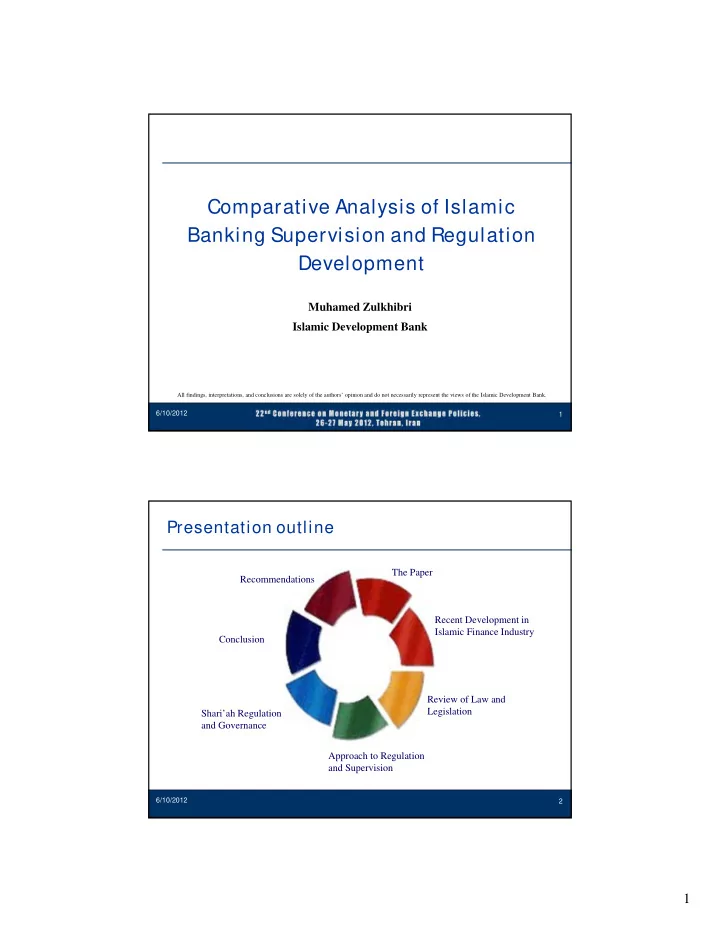
SMART_READER_LITE
LIVE PREVIEW

Comparative Analysis of Islamic Banking Supervision and Regulation - - PDF document

Comparative Analysis of Islamic Banking Supervision and Regulation Development Muhamed Zulkhibri Islamic Development Bank All findings, interpretations, and conclusions are solely of the authors opinion and do not necessarily represent the


slide-1
SLIDE 1

1

6/10/2012 1

Comparative Analysis of Islamic Banking Supervision and Regulation Development

Muhamed Zulkhibri Islamic Development Bank

All findings, interpretations, and conclusions are solely of the authors’ opinion and do not necessarily represent the views of the Islamic Development Bank.

6/10/2012 2

Presentation outline

Inflation Cost push inflation Cost push inflation Inflation

The Paper Recent Development in Islamic Finance Industry Review of Law and Legislation Approach to Regulation and Supervision Shari’ah Regulation and Governance Conclusion Recommendations

slide-2
SLIDE 2

2

6/10/2012 3

The paper

Motivation:

Rapid development but lack of coherent legal framework Lack of uniformity in specific forms of Islamic principles Difficult to generalize Islamic banking in practice

Objective:

Review the legal and regulatory framework Compare the legal and regulatory framework Focus on 11 IDB member and 2 non-member countries

6/10/2012 4 6/10/2012 4

Recent Developments

slide-3
SLIDE 3

3

6/10/2012 5

Rapid development in Islamic financial industry

Source: Bank Negara Malaysia, IFSB-IDB-IRTI, various 6/10/2012 6

Total assets of the industry has exceeded US$800 billion

Table 2. Islamic finance by country* (Banking, takaful, fund & other assets, US$bn)

  • f which

Number 2009 Banks Takaful Inv.firms Others

  • f firms

Iran 314.9 310.92 3.67 0.31

  • 22

S.Arabia 138.2 136.01 2.2

  • 0.03

25 Malaysia 102.6 96.69 3.8

  • 2.15

39 UAE 85.6 84.18 1.4 0.03 0.01 22 Kuwait 69.1 56.32 0.14 12.63

  • 37

Bahrain 44.9 42.71 0.42 1.73

  • 34

Qatar 34.7 32.4 0.4 1.87 0.01 18 Turkey 22.6 22.56

  • 4

UK 19.0 18.95

  • 22

Bangladesh 9.4 9.17 0.15 0.05

  • 16

Sudan 9.3 9.06 0.2

  • Egypt

7.2 7.21 0.01

  • 3

Indonesia 7.2 6.84 0.38

  • 26

Pakistan 6.2 6.2

  • 23

Syria 5.5 5.53

  • 3

Jordan 5.0 4.8 0.08 0.16

  • 10

Brunei 3.3 3.31

  • 6

Other countries 10.3 9.46 0.49 0.06 0.3 38 Total 895.0 862.32 13.34 16.84 2.5 348 *Includes only those firms submitting data to the Banker's survey Source: The Banker, 2010

slide-4
SLIDE 4

4

6/10/2012 7

How do Islamic financial infrastructure keep-up with the development pace?

6/10/2012 Source: Khan , T (2009) 8

However, there are gaps remained in Islamic financial architecture development

Areas of Standards Key Agency( s) in the I nternational Financial Architecture Corresponding Agency( s) in I slam ic Finance

  • 1. Accounting

International Accounting Standards Board (IASB), International Federation of Accountants (IFAC), Committee on Banking Supervision (BCBS) AAOIFI

  • 2. Anti-Money Laundering /

Combating the Financing of Terrorism Financial Action Task Force (FATF) Auditing International Federation of Accountants (IFAC) AAOIFI

  • 3. Banking

Committee IFSB

  • 4. Corporate Governance

OECD, Basel Committee, World Bank AAOIFI and IFSB

  • 5. Data Dissemination

IMF

  • 6. Fiscal Transparency

IMF

  • 7. Insolvency and Creditor

Rights Systems World Bank, United Nations Commission on International Trade Law (UNCITRAL), International Bar Association (IBA) Not yet addressed but especially critical for Islamic financing as it is based on risk sharing

  • 8. Insurance Regulation

International Association of Insurance Supervisors (IAIS) Not yet addressed but within the mandate of IFSB

  • 9. Monetary & Financial

Transparency Policies IMF

  • 10. Payments Systems

Committee on Payment and Settlements Systems (CPSS)

  • 11. Securities Market Regulation

International Organization of Securities Commissions (IOSCO) Not yet addressed but within the mandate of IFSB

slide-5
SLIDE 5

5

6/10/2012 9

Product development - slow pace of innovation

 Great need to continue to innovate for further growth  Shortage of product in the area of risk and liquidity management  Sufficient (short- and medium-term maturities), but not for maturities at the extreme  Lack of national/international supporting commercial framework  Application of derivatives, hedging and securitization remained controversial

Figure 3. Sukuk Global Issuance (US$bil) Sources: Zawya Sukuk Monitor, Islamic Financial Information Service, 2011

6/10/2012 10

Lack of comprehensive development

Cross Border and Global Development National Development

Institutional Development Legal, Regulation and Shar’iah Knowledge, Education and Expert Product and Market

Supporting key initiatives of legal and regulatory framework are key to robust development

slide-6
SLIDE 6

6

A Review of Law and Legislation

6/10/2012 12

Islamic banking laws and structure varies across jurisdictions

Countries whose constitution requires the banking system to be fully Islamic: Iran, Sudan, Pakistan (1985-2001) Countries having specific enabling Islamic banking legislation: Malaysia, Brunei, Indonesia Countries that has no specific enabling legislation but have specific regulation and/or provisions under general financial market regulation for Islamic finance: UAE, Saudi Arabia, Kuwait, Pakistan (since 2001), Jordan, Bahrain, Singapore, UK. Islamic Window to Islamic Subsidiary Badr, Emirates Islamic Bank, First Gulf Bank, RHB Islamic Bank, ABN AMRO, HSBC Amanah, AFFIN Islamic, Arab Banking Corporation Conventional Banks to Islamic Banks Bank Aljazira, Sharjah Islamic Bank, Dubai Bank, Kuwait International Bank, Bank Muamalat, Meezan Bank, Kauthar Bank New Islamic Banks NOOR Islamic Bank, Albaraka Banking Group, Alinma Bank, Kuwait Finance House, The Bank of Khyber, Asian Finance Bank ISLAMIC BANKING STRUCTURE Pure Banking System Dual Banking System Parallel Banking System Table 5. Overview of Type of Islamic Banking System and Banks ISLAMIC BANKING SYSTEM

Specific Law Using law as conventional banks

Law & Legislation

Specific Rules Using rules as conventional banks

Prudential Framework

slide-7
SLIDE 7

7

6/10/2012 13

Variation in law and regulations

Malaysia Iran Bahrain

  • S. Arabia

Pakistan Turkey Indonesia Sudan Kuwait UAE Jordan S’pore U.Kingdom Type of Islamic Financial System Dual Pure Parallel Parallel Pure Parallel Dual Pure Parallel Parallel Parallel Parallel Parallel Specific enabling legislation for banking Yes No No No No No No Yes No No No No No Specific provisions for Islamic banking under general legislation Yes Yes Yes Yes Yes Yes Yes Yes Yes Yes Yes No No Specific regulation for Islamic banking Yes Yes Yes No Yes No Yes Yes Yes Yes Yes Yes Yes Specific provision for Islamic banking under general regulation Yes No Yes No No No Yes Yes No No Yes No No Specific enabling legislation for capital market No No No No No No No No No No No No No Specific provisions for Islamic capital market under general legislation Yes No No No No No Yes Yes No No Yes No No Specific regulation for Islamic capital market Yes No Yes No No No Yes Yes No No Yes No No Specific provision for Islamic capital market under general regulation Yes No No No Yes No Yes Yes No No Yes No No General legislation and regulation applicability and enforceability Yes Yes Yes Yes Yes Yes Yes Yes Yes Yes Yes Yes Yes Shari’ah Authority in Central Bank or Financial Institutions SAC/SC CoG NSB/SSC No SB/SA No SSB HSSB SSB HSA/SSA SB SA SA Applicable Shari’ah Standards (Final Authority) SAC CoG NSB No SB No NSB SB SSB NSB SB No No Applicable Accounting Standards National AAOIFI# National AAOIFI AAOIFI IFRS IFRS AAOIFI# National National AAOIFI# AAOIFI IFRS IFRS AAOIFI IFRS National Tax Rules Yes Yes Yes Yes Yes Yes Yes Yes Yes Yes Yes Yes Yes Regulatory and Supervision Authority Bank Negara Malaysia Central Bank of Iran Bahrain Monetary Authority

  • S. Arabia

Monetary Authority State Bank

  • f Pakistan

Central Bank of Turkey Bank Indonesia Bank of Sudan Central Bank of Kuwait DFIC, Central Bank of UAE Central Bank of Jordan Monetary Authority Singapore Financial Services Authority Note: 1/ See Appendix 1 for details of the legislations and regulatory frameworks. SAC is stand for Shari’ah Advisory Council; SC is stand for Shari’ah Committee; HSA is stand for Higher Shariah Authority; SB is stand for Shari’ah Board; SA is stand for Shari’ah Advisor; SSC is stand for Shari’ah Supervisory Committee; SSA is stand for Supervision Shari’ah Authority; HSSB is stand for Higher Shari’ah Supervisory Board; CoG is stand for Council of Guardian; NA is stand for Not Applicable; AAOIFI stands for Accounting and Auditing Organisation for Islamic Financial Institutions; IFRS stands for International Financial Reporting Standards; # indicates authority has issued guidelines. Rules/Regulations IDB Member Countries Non-Member Countries

6/10/2012 14

Implications: Need to have a clear and specific legislative mandate

  • Legal framework contain provisions relating to licensing and permissible

modes of financing

  • Clear provision for enterprise to call themselves Islamic banks, collect deposits

and carry-out banking practices on the basis of Islamic principles

  • Clear legislative power and enforceability to address compliance of Islamic

principles i.e Civil court vs. Shari’ah court

  • Resolve conflict between Islamic laws and common/civil laws
  • A clear and specific point of reference with respect to different fatwas

i.e Shari’ah board

  • Integrating

ruling within the conventional banking framework and accommodating Shari’ah reference in conventional legal documents

  • Need to develop uniform prudential and best practices standards that are

tailored to the specific characteristics

slide-8
SLIDE 8

8

6/10/2012 15

Approach to Regulation and Supervision

6/10/2012 16

Islamic bank - different from conventional?

 Significant deviation of

the structure of assets

 Choice and application

  • f accounting policies

 Practice and principles -

the status of investment accounts (PSIA)

 Governance rights

granted to investment account holders.

Table 8. Two Windows Balance Sheet of Islamic Financial Instjtutjons Liabilities Assets The mix of contracts on the liability side A wider variety of assets and financing mixes. Products can be either PLS based, or based on mark- up pricing Demand deposit: Guaranteed but no return at all, the purpose is amanah (safekeeping) Equity based PLS of Mudarabah and Musharakah, holding of equity

  • f companies

Investment deposit (PSI account): Not guaranteed, no fixed return Sales based assets through Murabahah, Ijarah, Salam and Istis'na Quasi-equity nature of investment deposit (account) due to PLS system Murabahah trade financing Shareholders’ equity Fee-based services Reserves: Profit equalization reserves, investment risk reserves Presence

  • f

risk sharing and absence of interest

slide-9
SLIDE 9

9

6/10/2012 17

Stylised facts about Islamic banking regulation

Single regulatory framework applies to both conventional and Islamic banks Some follow the national and international accounting standards: IAS and AAOIFI Some follow IFSB for prudential, regulatory and disclosure standards Central banks are their main regulators and supervisors Safety net arrangement implementing Islamic deposit insurance Lack of cross border cooperation between different authorities

6/10/2012 18

E mergence of Islamic Deposit Insurance

Table 9. Islamic Deposit Insurance in the IDB Member Countries Malaysia Iran Bahrain

  • S. Arabia

Pakistan Turkey Indonesia Sudan Kuwait UAE Jordan S’pore U.Kingdom Year of establishment 2005 not available 1993 not available Implementing 2005 2005 1996 2008 2010 2000 2006 2001 Governance Structure government-

  • wned

deposit insurer with specific legislation implicit scheme government-

  • wned entity

without specific legislation implicit scheme not available government-

  • wned

entity without specific legislation government-

  • wned entity

without specific legislation government-

  • wned

deposit insurer with specific legislation central bank with specific legislation implicit scheme government-

  • wned entity

with specific legislation government-

  • wned

entity without specific legislation privately-

  • wned entity

with specific legislation Mandatory membership  not available  not available not available    not available not available × × × Separation of Islamic premiums from non-Islamic premiums  not available not available not available not available × × not available not available not available not available × × Management of fund according to Shariah principles  not available not available not available not available × ×  not available not available not available × × Similar coverage limit for Islamic and conventional deposits  not available × not available not available   not available not available  not available × × Similar premium rates for Islamic and conventional deposits  not available  not available not available   not available not available  not available   Coverage limit MYR 60,000 (USD 17,150) not available 75% up to a maximum of BHD 15,000 (USD 39,800) not available not available TRY 50,000 (USD 30,000) IDR 100 million (USD 10,000) SDG 4,000 (USD 2,000) for investment and SDG 3,000 (USD 1,500) for current 100% not available JOD 50,000 (USD 14,085) SGD 20,000 (USD 14,000) GBP 35000 (USD 56,000) Source: Central bank websites, International Association of Deposit Insurers Features IDB Member Countries Non-Member Countries
slide-10
SLIDE 10

10

6/10/2012 19

National regulatory framework and international best practices

National Regulation

6/10/2012 20

Shari’ah Regulation and Governance

slide-11
SLIDE 11

11

6/10/2012 21

Stylised facts on Shari’ah regulation and governance

Exposed to “Shari’ah arbitrage” - seek to find the opinion that suits their objectives Different institutions have different governance models to measure and monitor compliance AAOIFI established a standard requiring Islamic financial services to have its own Shari’ah supervisory board Shari’ah boards exist in all individual Islamic banks with some Shari’ah scholars sit on the SSBs of more than one financial institution The backbone of Islamic finance and need for a standardized Shari’ah regulation and supervisory framework

6/10/2012 22

Regulating Shari’ah Governance

Independent central Shari’ah council commands public confidence and promote harmonisation and uniformity

  • f Shari’ah interpretations

Table 10. Regulatjon and Governance of Shari'ah Advisor/Board Country Reference Term Composition Decision Making Appointment/ Dismissal Fit/Proper Criteria Higher Authority Restriction

  • n Sholars

Islamic Rating External Shari'ah Audit Malaysia   × ×     × Iran   ×    × × × Bahrain  × ×   × × × ×

  • S. Arabia

  ×    × × × Pakistan   ×     ×  Turkey   ×    × × × Indonesia  × ×    × × × Sudan   ×    × × × Kuwait    × ×  × × × UAE   ×  ×  × × × Jordan     × × × × × Singapore × × × × × × × × × U.Kingdom × × × × × × × × ×

Source: Adapted from Wafik Grais and Matueo Pellegrini (2006), official country websites and central bank annual reports

slide-12
SLIDE 12

12

6/10/2012 23

Need for a structured Shari’ah compliance process

1) Inception & Conceptualization

  • f Islamic

Instrument 2) Structuring the Product according to Shari’ah 3) Legal Documentation 4) Execution and Implementation

  • f Islamic

Instrument 5) Audit and Review 6) Restructuring (if needed) 7) Recovery mechanisms & dispute resolution

Source: Adawiyah (2007)

External and internal audit Drafting the compliance manual

6/10/2012 24

Lessons Learned

slide-13
SLIDE 13

13

6/10/2012 25

Lessons Learned

Rapid development, small global share, diverse stages of maturity Over-dependence on trade and commodity financing instruments Reluctant to indulge in PLS instruments (PLS has been marginalised) Gap between ideal model and practical implementation and gap between applicable law and Shari’ah principles Policies and tools for regulation are based on conventional business models Absence of standardisation of ununified Islamic governance model Lack of Shari’ah consensus hampering innovation and creating loopholes Standardisation will not be achieved in near and absolute term

6/10/2012 26

Recommendations

slide-14
SLIDE 14

14

6/10/2012 27

What is there for us?

Designing appropriate legal framework for Islamic financial institutions – conform to Shari’ah principles Implementing the AAOFI, IFSB and Basel III legal and regulatory standards Centralizing Shari’ah council/committee, supervisor and verdicts Setting-up Shari’ah compliance audit framework and audit programme Focus on cluster or regional harmonisation and gradually moving towards greater harmonisation

6/10/2012 28

Further Questions

Future sustainability – New business model, bank bail-out? Shari’ah-compliant or Shari’ah-based Additional values – social/ethical/moral issues Different economic outcome? Discipline and governance

slide-15
SLIDE 15

15

6/10/2012 29

Thank You

6/10/2012 30

Applicable law related to Islamic Finance

Table 6. Applicable Laws and Legislations for Islamic Banking Country Malaysia Islamic Banking Act, 1983 Central Bank of Malaysia Act 2009 Banking and Financial Institution, 1989 (S.32; S.124) Government Funding Act, 1983 Development Financial Act, 2002 (S. 129) Takaful Act 1984 Iran Usury-Free Banking Operations Law, 1983 Bahrain Central Bank of Bahrain, 2006 Central Bank of Bahrain, Rulebook, Manama, 2010: Section CA-3 Decree No.64, 2006

  • S. Arabia

Saudi Arabia Banking Law, 1966: Article 10.1 Saudi Arabian Banking Law, 1966 Pakistan Banking and Financial Services Ordinance, 1984 Banking Control Department Circular No. 13, 1984 Modaraba Companies and Modarabas Ordinance, 1980 Modaraba Companies and Modaraba Rules, 1981 Banking and Financial Services Ordinance, 1984 Banking Tribunals Ordinance, 1984 Banking Companies Ordinance 1962 (S.32 (1), 2002) Presidential order to the local Council of Islamic Ideology, 1977 Turkey Decree No. 18112, dated 22/7/1983 Decree No. 70 for the establishment of banks Decree No. 83/7506 dated 16/12/1983 for the establishment of Special Finance Houses in Turkey Indonesia Banking Act No.21, 2008 Banking Act No. 23, 1999 (amended Act 3, 2004) Banking Act No. 72, 1992 Banking Act No. 7, 1992 (amended Act 10, 1998) Laws and Legislations Country Sudan Comprehensive Peace Agreement (CPA) Banking Business Regulation Act, 1991 Central Bank of Sudan Act 2002 (amended in 2006) Kuwait Central Bank of Kuwait Law No. 32 1968: Section 10 Central Bank of Kuwait Law No. 33 1968 (amended 2003) Central Bank of Kuwait Law, Article 86 Central Bank of Kuwait Law, Article 93 UAE Dubai Islamic Finance Centre Islamic Finance Law Federal Law No.5, 1985 Federal Law No.6, 1985 Federal Law No. 10, 1980 Dubai Law No. 9, 2004 Jordan Banking Law No. 28, 2000 Singapore MAS Notice 640 MAS Notice 613 MAS Notice 626 MAS Notice 637 MAS Notice 612 Banking Act (S. 29) Banking Act (S.33) U.Kingdom Financial Services and Markets Act 1999 Finance Acts 2007 Finance Acts 2006 Finance Acts 2005 Finance Acts 2003 Source: Official country websites and central bank annual reports Laws and Legislations