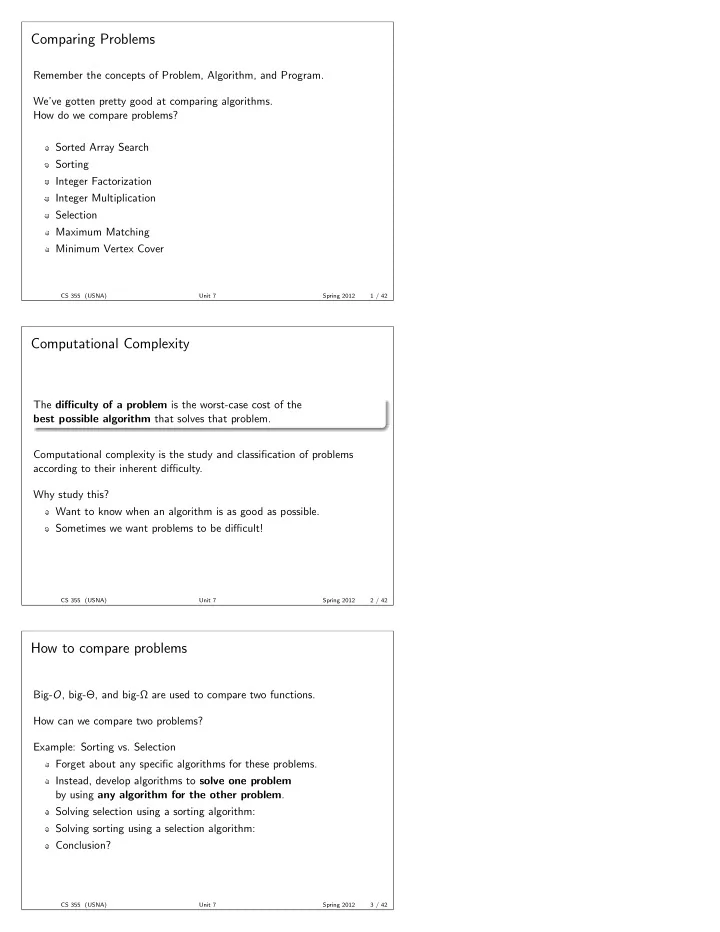
Comparing Problems Remember the concepts of Problem, Algorithm, and - - PDF document

comparing problems
SMART_READER_LITE
LIVE PREVIEW

Comparing Problems Remember the concepts of Problem, Algorithm, and - - PDF document

Comparing Problems Remember the concepts of Problem, Algorithm, and Program. Weve gotten pretty good at comparing algorithms. How do we compare problems? Sorted Array Search Sorting Integer Factorization Integer Multiplication Selection


slide-1
SLIDE 1

Comparing Problems

Remember the concepts of Problem, Algorithm, and Program. We’ve gotten pretty good at comparing algorithms. How do we compare problems? Sorted Array Search Sorting Integer Factorization Integer Multiplication Selection Maximum Matching Minimum Vertex Cover

CS 355 (USNA) Unit 7 Spring 2012 1 / 42

Computational Complexity

The difficulty of a problem is the worst-case cost of the best possible algorithm that solves that problem. Computational complexity is the study and classification of problems according to their inherent difficulty. Why study this? Want to know when an algorithm is as good as possible. Sometimes we want problems to be difficult!

CS 355 (USNA) Unit 7 Spring 2012 2 / 42

How to compare problems

Big-O, big-Θ, and big-Ω are used to compare two functions. How can we compare two problems? Example: Sorting vs. Selection Forget about any specific algorithms for these problems. Instead, develop algorithms to solve one problem by using any algorithm for the other problem. Solving selection using a sorting algorithm: Solving sorting using a selection algorithm: Conclusion?

CS 355 (USNA) Unit 7 Spring 2012 3 / 42

slide-2
SLIDE 2

Defining tractable and intractable

Cobham-Edmonds thesis: A problem is tractable only if it can be solved in polynomial time. What can we say about intractable problems? Maybe they’re undecidable (e.g., the halting problem) Maybe they just seem impossible (e.g., regexp equivalence) But not always! (e.g., integer factorization) Million-dollar question: Can any problems be verified quickly but not solved quickly?

CS 355 (USNA) Unit 7 Spring 2012 4 / 42

Fair comparisons: Machine models

Proving lower bounds on problems requires a careful model of computation. Candidates: Turing machine Clock cycles on your phone MIPS instructions “Primitive operations”

Theorem

These models are all polynomial-time equivalent.

CS 355 (USNA) Unit 7 Spring 2012 5 / 42

Fair comparisons: Bit-length

Input size is our measure of difficulty (n). It must be measured the same between different problems! Past examples: Factorization Θ(√n) vs. HeapSort Θ(n log n) Karatsuba’s Θ(n1.59) vs. Strassen’s Θ(n2.81) Dijkstra’s Θ(n2) vs Dijkstra’s Θ((n + m) log n) Only measure for this unit: length in bits of the input

CS 355 (USNA) Unit 7 Spring 2012 6 / 42

slide-3
SLIDE 3

Fair comparisons: Decision problems

What about the size of the output? We’ll consider only:

Definition: Decision Problems

Problems whose output is YES or NO Is this a big restriction? Selection EI Scheduling Integer factorization Minimum vertex cover

CS 355 (USNA) Unit 7 Spring 2012 7 / 42

Decision problem comparison

Compare regular factorization with decision problem version:

1 Given instance (N, k) of decision problem,

use computational version to solve it:

2 Given instance N of computational problem,

use decision problem to solve it:

CS 355 (USNA) Unit 7 Spring 2012 8 / 42

Formal Problem Definitions

Page 1

SHORTPATH(G,k)

Input: Graph G = (V , E), integer k Output: Does G have a path of length at most k? Input size and encoding:

LONGPATH(G,k)

Input: Graph G = (V , E), integer k Output: Does G have a path of length at least k? Input size and encoding:

CS 355 (USNA) Unit 7 Spring 2012 9 / 42

slide-4
SLIDE 4

Formal Problem Definitions

Page 2

FACT(N,k)

Input: Integers N and k Output: Does N have a prime factor less than k? Input size and encoding:

VC(G,k)

Input: Graph G = (V , E), integer k Output: Does G have a vertex cover with at most k nodes? Input size and encoding:

CS 355 (USNA) Unit 7 Spring 2012 10 / 42

Our first complexity class

Complexity theory is all about classifying problems based on difficulty.

Definition

The complexity class P consists of all decision problems that can be solved by an algorithm whose worst-case cost is O(nk), for some constant k, and where n is the bit-length of the input instance. This is the “polynomial-time” class. Can you name some members?

CS 355 (USNA) Unit 7 Spring 2012 11 / 42

Certificates

A certificate for a decision problem is some kind of digital “proof” that the answer is YES. The certificate is usually what the output would be from the “computational version”. Examples (informally): Integer factorization Minimum vertex cover Shortest path Longest path

CS 355 (USNA) Unit 7 Spring 2012 12 / 42

slide-5
SLIDE 5

Nice properties of P

When we just worry about polynomial-time, we can be really lazy in analysis! Polynomial-time is closed under: Addition: nk + nℓ ∈ O(nmax(k,ℓ)) In terms of algorithms: one after the other. Multiplication: nk · nℓ ∈ O(nk+ℓ) In terms of algorithms: calls within loops. Composition: nk ◦ nℓ ∈ O(nkℓ) In terms of algorithms: replace every primitive op. with a function call

CS 355 (USNA) Unit 7 Spring 2012 13 / 42

Verifiers

A verifier is an algorithm that takes:

1 Problem instance (input) for some decision problem 2 An alleged certificate that the answer is YES

and returns YES iff the certificate is legit. Principle comes from “guess-and-check” algorithms: Finding the answer is tough, but checking the answer is easy. We can write fast verifiers for hard problems!

CS 355 (USNA) Unit 7 Spring 2012 14 / 42

Our second complexity class

Definition

The complexity class NP consists of all decision problems that have can be verified in polynomial-time in the bit-size of the original problem input. Steps for an NP-proof:

1 Define a notion of certificate 2 Prove that certificates have length O(nk) for some constant k 3 Come up with a verifier algorithm 4 Prove that the algorithm runs in time O(nk)

for some (other) constant k

CS 355 (USNA) Unit 7 Spring 2012 15 / 42

slide-6
SLIDE 6

VC is in NP

VC(G,k): “Does G have a vertex cover with at most k vertices?”

1 Certificate: 2 Certificate size: 3 Verifier algorithm: 4 Algorithm cost: CS 355 (USNA) Unit 7 Spring 2012 16 / 42

FACT is in NP

FACT(N,k): “Does N have a prime factor less than k?”

1 Certificate: 2 Certificate size: 3 Verifier algorithm: 4 Algorithm cost: CS 355 (USNA) Unit 7 Spring 2012 17 / 42

How to get rich

The BIG question is: Does P equal NP? The Clay Institute offers $1,000,000 for a proof either way. What you would need to prove P = NP: What you would need to prove P = NP: In a nutshell: Is guess-and-check ever the best algorithm?

CS 355 (USNA) Unit 7 Spring 2012 18 / 42

slide-7
SLIDE 7

Alternate meaning of NP

Meaning of the name NP: “Non-deterministic polynomial time” Non-deterministic Turing machine Turing machine with (possibly) multiple transitions for the same current state and current tape symbol Like a computer program with “guesses” Connection to randomness? Why is this equivalent to our definition with certificates and verifiers?

CS 355 (USNA) Unit 7 Spring 2012 19 / 42

Reductions

Recall that a reduction from problem A to problem B is a way of solving problem A using any algorithm for problem A. Then we know that A is not more difficult than B. Formally, a reduction from A to B:

1 Takes an instance of problem A as input 2 Uses this to create m instances of problem B 3 Uses the solutions to those m problem B’s to recover the solution for

the original problem A

CS 355 (USNA) Unit 7 Spring 2012 20 / 42

Example Linear-Time Reduction

Two problems: MMUL(A,B): Compute the product of matrices A and B MSQR(A,B): Compute the matrix square A2 Show that the inherent difficulty of MMUL and MSQR is the same.

CS 355 (USNA) Unit 7 Spring 2012 21 / 42

slide-8
SLIDE 8

Polynomial-Time Reduction

Ingredients for analyzing a reduction: (All will be functions of n, the input size for problem A) Number (m) of problem B instances created Maximum bit-size of a problem B instance Amount of extra work to do the actual reduction. Polynomial-time reduction: all three ingredients are O(nk) (Often m = 1, sometimes called a “strong reduction”.) We write A ≤P B, meaning “A is polynomial-time reducible to B”.

CS 355 (USNA) Unit 7 Spring 2012 22 / 42

Formal Problem Definitions

Page 3

Minimum Hitting Set: HITSET(L,k)

Input: List L of sets S1, S2, . . . , Sm, integer k. Output: Is there a set H with size at most k such that every Si ∩ H is not empty? Input size and encoding:

HAMCYCLE(G)

Input: Graph G = (V , E) Output: Does G have a cycle that touches every vertex? Input size and encoding:

CS 355 (USNA) Unit 7 Spring 2012 23 / 42

VC reduces to HITSET

CS 355 (USNA) Unit 7 Spring 2012 24 / 42

slide-9
SLIDE 9

HAMCYCLE reduces to LONGPATH

CS 355 (USNA) Unit 7 Spring 2012 25 / 42

Completeness

Definition

A problem B is NP-hard if A ≤P B for every problem A ∈ NP. Informally: NP-hard means “at least as difficult as every problem in NP”

Definition

A problem B is NP-complete if B is NP-hard and B ∈ NP. What is the hardest problem in NP?

CS 355 (USNA) Unit 7 Spring 2012 26 / 42

An easy NP-hard proof

Theorem: The halting problem is NP-hard. Proof:

CS 355 (USNA) Unit 7 Spring 2012 27 / 42

slide-10
SLIDE 10

Formal Problem Definitions

Page 4

Circuit Satisfiability: CIRCUIT-SAT(C)

Input: Boolean circuit C with AND, OR, and NOT gates, m inputs, and one output. Output: Is there a setting of the m inputs that makes the output true? Input size and encoding:

3-SAT(F)

Input: Boolean formula F in “conjunctive normal form” (product of sums), with three literals (terms) in every sum (clause): F = (x1 ∨ ¬x2 ∨ x3) ∧ (¬x2 ∨ x4 ∨ x5) ∧ (x1 ∨ x2 ∨ ¬x4) ∧ · · · Output: Can we assign T/F to the xi’s to make the formula true? Input size and encoding:

CS 355 (USNA) Unit 7 Spring 2012 28 / 42

Modeling programs as circuits

Remember this simple model of a computer? Current state Combinational circuit Next state State contains PC, registers, program, memory Size is linear in input size and program runtime Combinational is a circuit (AND, OR, and NOT gates) for ALUs, MUXes, control, shifts, adders, etc. Size is polynomial in size of state.

Lemma

Any decision problem with a polynomial-time algorithm can be simulated by a polynomial-size boolean circuit.

CS 355 (USNA) Unit 7 Spring 2012 29 / 42

CIRCUIT-SAT is NP-hard

CS 355 (USNA) Unit 7 Spring 2012 30 / 42

slide-11
SLIDE 11

NP-Completeness

Theorem

CIRCUIT-SAT is NP-complete. Proof: All that’s left is to show CIRCUIT-SAT ∈ NP. We only have to do this kind of proof once (why?) Will this help us prove P = NP?

CS 355 (USNA) Unit 7 Spring 2012 31 / 42

3-SAT

We want to reduce CIRCUIT-SAT to 3-SAT. Idea: Every wire in the circuit becomes a variable. Gate Formula x y z (¬x∨¬y∨z)∧(x∨¬z)∧(y∨¬z) x y z (x ∨y ∨¬z)∧(¬x ∨z)∧(¬y ∨z) x z (x ∨ z) ∧ (¬x ∨ ¬z) What do these clauses ensure? What other clause do we need to add?

CS 355 (USNA) Unit 7 Spring 2012 32 / 42

VC

Reduce 3-SAT to VC.

CS 355 (USNA) Unit 7 Spring 2012 33 / 42

slide-12
SLIDE 12

Properties of NP-Complete Problems

There are many known NP-complete problems. We have seen: LONGPATH, VC, HITSET, HAMCYCLE, CIRCUIT-SAT, 3-SAT. What’s needed to prove a new problem is NP-complete: Note: All have one-sided verifiers (can’t verify NO answer!) What about FACT?

CS 355 (USNA) Unit 7 Spring 2012 34 / 42

Frontiers of Complexity Theory

Big open questions: Does P = NP? (Probably not) Is FACT NP-complete? (Probably not) Is FACT in P? (Hopefully not!) Do true one-way functions exist? (Not if P = NP) Can quantum computers solve NP-hard problems? (Probably not) Where does randomness fit in?

CS 355 (USNA) Unit 7 Spring 2012 35 / 42

Traveling Salesman Problem

TSP Definition

Input: Graph G = (V , E) Output: The shortest cycle that includes every vertex exactly once, or FAIL if none exist. Classic NP-hard problem Many important applications The worst-case is hard — so what can we do?

CS 355 (USNA) Unit 7 Spring 2012 36 / 42

slide-13
SLIDE 13

MSTs and TSP

Theorem: Length of TSP tour is at least the size of a MST. b d a e c 2 2 2 5 4 5 4 5 b d a e c 2 2 2 5 4 5 4 5

CS 355 (USNA) Unit 7 Spring 2012 37 / 42

Branch and Bound

How to compute the optimal TSP?

1 Pick a starting vertex 2 Explore every path, depth-first 3 Return the least-length Hamiltonian cycle

This is really slow (of course!) Branch and bound idea: Define a quick lower bound on remaining subproblem (MST!) Stop exploring when the lower bound exceeds the best-so-far

CS 355 (USNA) Unit 7 Spring 2012 38 / 42

Simplified TSP

Solving the TSP is really hard; some special cases are a bit easier: Metric TSP Edge lengths “obey the triangle inequality”: w(a, b) + w(b, c) ≥ w(a, c)∀a, b, c ∈ V What does this mean about the graph? Euclidean TSP Graph can be drawn on a 2-dimensional map. Edge weights are just distances! (Sub-case of Metric TSP)

CS 355 (USNA) Unit 7 Spring 2012 39 / 42

slide-14
SLIDE 14

Approximating Metric TSP

Idea: Turn any MST into a TSP tour. b d a e c 2 2 2 5 4 5 4 5 How good is the approximation?

CS 355 (USNA) Unit 7 Spring 2012 40 / 42

Greedy TSP

Greedy strategies: Nearest neighbor Smallest “good” edge b d a e c 2 2 2 5 4 5 4 5 b d a e c 2 2 2 5 4 5 4 5

CS 355 (USNA) Unit 7 Spring 2012 41 / 42

Local Refinement

Idea: Take any greedy solution, then make it better. 2-OPT refinement: Take a cycle with (a, b) and (c, d) Replace with (a, c) and (b, d) b d a e c 2 2 2 5 4 5 4 5

CS 355 (USNA) Unit 7 Spring 2012 42 / 42