Compiling with Optimizations Compilers usually have options to - - PowerPoint PPT Presentation

compiling with optimizations
SMART_READER_LITE
LIVE PREVIEW

Compiling with Optimizations Compilers usually have options to - - PowerPoint PPT Presentation

13.1 13.2 Compiling with Optimizations Compilers usually have options to apply optimization Example: gcc/g++ -O n -O0 : ____ optimization (the default); generates unoptimized code but has the CS356 Unit 13 __________ compilation


slide-1
SLIDE 1

13.1

CS356 Unit 13

Performance

13.2

Compiling with Optimizations

  • Compilers usually have options to apply optimization
  • Example: gcc/g++ -On

– -O0: ____ optimization (the default); generates unoptimized code but has the __________ compilation time. – -O1: ___________ optimization; optimizes reasonably well but does not degrade compilation time significantly. – -O2: ____ optimization; generates highly optimized code and has the slowest compilation time. – -O3: Full optimization as in -O2; also uses more aggressive automatic _______

  • f subprograms within a unit and attempts to vectorize loops.

– -Os: Optimize space usage (code and data) of resulting program.

  • However, there are still many things the programmer can do to help

https://gcc.gnu.org/onlinedocs/gnat_ugn/Optimization-Levels.html 13.3

Profiling

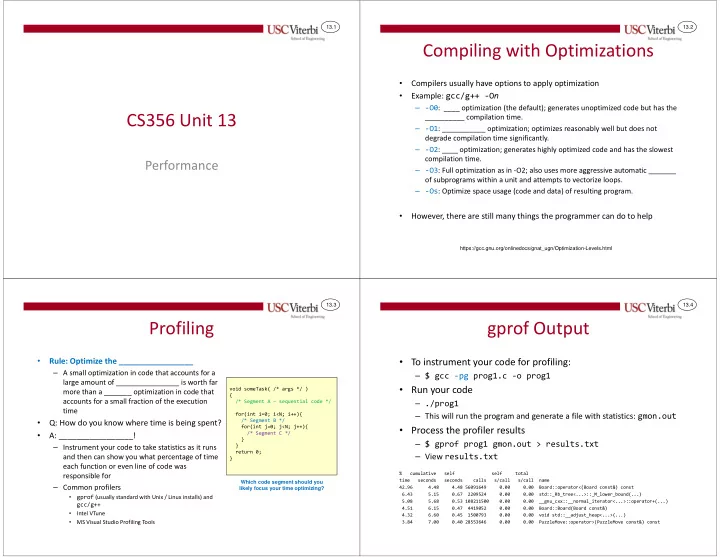
  • Rule: Optimize the _________________

– A small optimization in code that accounts for a large amount of ________________ is worth far more than a _______ optimization in code that accounts for a small fraction of the execution time

  • Q: How do you know where time is being spent?
  • A: _________________!

– Instrument your code to take statistics as it runs and then can show you what percentage of time each function or even line of code was responsible for – Common profilers

  • gprof (usually standard with Unix / Linux installs) and

gcc/g++

  • Intel VTune
  • MS Visual Studio Profiling Tools

void someTask( /* args */ ) { /* Segment A – sequential code */ for(int i=0; i<N; i++){ /* Segment B */ for(int j=0; j<N; j++){ /* Segment C */ } } return 0; } Which code segment should you likely focus your time optimizing? 13.4

gprof Output

  • To instrument your code for profiling:

– $ gcc -pg prog1.c -o prog1

  • Run your code

– ./prog1 – This will run the program and generate a file with statistics: gmon.out

  • Process the profiler results

– $ gprof prog1 gmon.out > results.txt – View results.txt

% cumulative self self total time seconds seconds calls s/call s/call name 42.96 4.48 4.48 56091649 0.00 0.00 Board::operator<(Board const&) const 6.43 5.15 0.67 2209524 0.00 0.00 std::_Rb_tree<...>::_M_lower_bound(...) 5.08 5.68 0.53 108211500 0.00 0.00 __gnu_cxx::__normal_iterator<...>::operator+(...) 4.51 6.15 0.47 4419052 0.00 0.00 Board::Board(Board const&) 4.32 6.60 0.45 1500793 0.00 0.00 void std::__adjust_heap<...>(...) 3.84 7.00 0.40 28553646 0.00 0.00 PuzzleMove::operator>(PuzzleMove const&) const

slide-2
SLIDE 2

13.5

OPTIMIZATION BLOCKERS

13.6

Reducing Function Calls

  • Consider the "original" code to the

right

  • Can we optimize by converting the
  • riginal code to the proposed
  • ptimized code?

– _____!

  • Functions may have _____________

– What if ____________________ in the function

#include <stdio.h> int x=0; int f1() { /* Produces & returns an int */ ____________________; } int main() { int y = f1() + f1() + f1() + f1(); printf("%d\n", y); return 0; } #include <iostream> using namespace std; ... int main() { int y = 4*f(); cout << y << endl; return 0; } Proposed Optimization Original Code 13.7

Function Inlining

  • Inlining is the process of _________________ the function code

into each location where it is called

  • This avoids the ________________ of a function call at the cost
  • f greater ________________________

– Note: Compiling with optimization levels above -O0 allow the compiler to auto-inline functions of its choice (usually small functions)

int x=0; int f1() { /* Produces & returns an int */ return ____; } int main() { int y = f1() + f1() + f1() + f1(); printf("%d\n", y); return 0; } int x=0; int f1() { /* Produces & returns an int */ return ____; } int main() { int y = ++x + ++x + ++x + ++x; printf("%d\n", y); return 0; } 13.8

Inlining

int x=0; int f1() { /* Produces & returns an int */ return ++x; } int main() { int y = f1() + f1() + f1() + f1(); printf("%d\n", y); return 0; } int x=0; int f1() { /* Produces & returns an int */ return ++x; } int main() { int y = f1() + f1() + f1() + f1(); printf("%d\n", y); return 0; } main: ... movl x(%rip), %edx # %edx = x leal 4(%rdx), %eax # %eax = 4+x movl %eax, x(%rip) # x = 4+x leal 6(%rdx,%rdx,2), %edx # %edx=3x+6 addl %eax, %edx # %edx=4x+10 main: ... movl $0, %eax call f1 movl %eax, %ebx movl $0, %eax call f1 addl %eax, %ebx movl $0, %eax call f1 addl %eax, %ebx movl $0, %eax call f1 leal (%rbx,%rax), %edx

g++ -O1 … g++ -O2 …

slide-3
SLIDE 3

13.9

Inlining

int f1(vector<int>& v1) { int total = 0; for(int i=0; i < v1.size(); i++){ total += v1[i]; } return total; } _Z2f1RSt6vectorIiSaIiEE: .LFB509: .cfi_startproc movq (%rdi), %rsi movq 8(%rdi), %rax subq %rsi, %rax sarq $2, %rax movq %rax, %rdi testq %rax, %rax je .L4 movl $0, %ecx movl $0, %edx movl $0, %eax .L3: addl (%rsi,%rcx,4), %eax addl $1, %edx movslq %edx, %rcx cmpq %rdi, %rcx jb .L3 rep ret .L4: movl $0, %eax ret

Notice there is no call to vector's _______

  • function. Compiling with optimization levels
  • O0 would cause it to NOT inline the call

g++ -O1 …

13.10

Limits of Inlining

  • Inlining can only be done when the definition of the function

is in the same __________________________

– Recall the compiler only sees the code in the current translation unit (file) and so won't see the ______________ of f1() in lib.c to be able to inline it

int x=0; int f1() { /* Produces & returns an int */ return ++x; } extern int x; int f1(); int main() { int y = f1() + f1() + f1() + f1(); printf("%d\n", y); return 0; }

prog1.c lib1.c prog1.o lib1.o

13.11

C++ Templates and Inlining

  • Since .h files are #include'd, any functions defined in the .h file can

then be inlined

  • This is one reason templates offer some advantage in C++ is

because their definition is ALWAYS available

template<typename T> class vec { public: ... int size() const; private: int size_; }; template <typename T> int vec<T>::size() const { return size_; } #include "vec.h" int main() { vec<int> myvec; for(int i=0; i < myvec.size(); i++){ ... } ... }

prog1.c vec.h

13.12

Memory Aliasing

  • Consider twiddle1 and its

function to return x + 2y

  • Now suppose we have

pointers as arguments

– We could write twiddle2a (to try to do what twiddle1 did) – Is it equivalent to twiddle1? – Is twiddle2b equivalent to twiddle2a?

  • _______!

– _____ if xp and yp _________ the same value.

int twiddle1(long x, long y) { x += y; x += y; return x; // x + 2*y } // Now with pointers int twiddle2a(long* xp, long* yp) { *xp += *yp; *xp += *yp; return *xp; } int twiddle2b(long* xp, long* yp) { *xp += 2 * (*yp); return *xp; } int ans = 0; void f1(long x, long y) { ans = twiddle1(x,y); ans += twiddle2a(&x,&y); ans += twiddle2b(&x,&y); }

slide-4
SLIDE 4

13.13

Memory Aliasing

  • The compiler must play it safe and

generate code that would work if both pointers contain the same address (i.e. reference the same variable)…we call this memory aliasing

int twiddle1(long x, long y) { x += y; x += y; return x; // x + 2*y } // Now with pointers int twiddle2a(long* xp, long* yp) { *xp += *yp; *xp += *yp; return *xp; } int twiddle2b(long* xp, long* yp) { *xp += 2 * (*yp); return *xp; } int ans = 0; void f1(long x, long y) { ans = twiddle1(x,y); ans += twiddle2a(&x,&y); ans += twiddle2b(&x,&y); } // Notice the compiler optimized // to perform x + 2*y twiddle1: leaq (%rdi,%rsi,2), %rax ret // But here it left it as two // separate adds twiddle2a: movq (%rsi), %rax addq (%rdi), %rax movq %rax, (%rdi) addq (%rsi), %rax movq %rax, (%rdi) ret 13.14

Memory Aliasing

  • Aliasing may also affect inlining

– -O1 does not inline twiddle2a – Running -O3 does end up inlining twiddle2a

int twiddle1(long x, long y) { x += y; x += y; return x; // x + 2*y } // Now with pointers int twiddle2a(long* xp, long* yp) { *xp += *yp; *xp += *yp; return *xp; } int twiddle2b(long* xp, long* yp) { *xp += 2 * (*yp); return *xp; } int ans = 0; void f1(long x, long y) { ans = twiddle1(x,y); ans += twiddle2a(&x,&y); ans += twiddle2b(&x,&y); } f1: subq $16, %rsp movq %rdi, 8(%rsp) movq %rsi, (%rsp) leaq (%rdi,%rsi,2), %rax movl %eax, ans(%rip) movq %rsp, %rsi leaq 8(%rsp), %rdi call twiddle2a movq 8(%rsp), %rdx movq (%rsp), %rcx leaq (%rdx,%rcx,2), %rdx addl ans(%rip), %eax addl %edx, %eax movl %eax, ans(%rip) addq $16, %rsp ret

Inlined Not Inlined Inlined gcc -O1 …

13.15

MAXIMIZING PERFORMANCE

13.16

Overview

  • We have seen our processors have great capability to

perform many operations in parallel

  • How can we write our code in such a way as to take

advantage of those capabilities?

  • Are there limits on how much performance we can

achieve and how would we know if we are hitting those limits?

  • Let's first understand our hardware capabilities
slide-5
SLIDE 5

13.17

Latency and Throughput (Issue Time)

  • Int. ALU,
  • Addr. Calc.

Front End

Int ADD x4 FP ADD IMUL FPMUL x2 IADD Queue FADD Queue IMUL Queue FPMUL Queue Issue Unit FADD S1 FADD S2 FADD S3 IMUL S1 IMUL S2 IMUL S3 IADD S1 FMUL S1 FMUL S2 FMUL S3 FMUL S4 FMUL S5

FP/INT DIV Pipeline Stages of Each Functional Unit

  • Latency: clock cycles (pipeline stages) in the pipeline of that unit
  • Some units are ________________ (ex. Int and FP Divider) which means

we ___________ overlap operations

– Must wait for one to _____________ we start the next

Functional Unit

Latency

(Required stalls cycles between dependent [RAW] instrucs.)

Issue Time (Reciprocal throughput)

(Cycles between 2 independent instructions requiring the same FU)

Int ADD Int MUL FP ADD FP Mul. FP Div.

3-15 3-15

Latency and Issue times for Intel's Haswell architecture 13.18

Combine1 (Base)

  • Base implementation of

combining elements of an array/vector

  • Use MACROS to be able to

easily switch between adding and multiplying

  • Use typedefs to be able to

switch types: int or float

  • Attempt to measure clock

cyles per element (CPE)

– Total clock cycles / array size

#define OP + #define IDENT 0 #ifndef FP typedef int DTYPE; #else typedef double DTYPE; #endif void combine1(struct vec* v1, DTYPE* tot) { DTYPE* data = v1->dat; *tot = IDENT; for(unsigned i = 0; i < get_size(v1); i++) { *tot = *tot OP data[i]; } }

combine1.c (Base)

Function Method Int (+) Int (*) FP (+) FP (*) combine1 Base 10.12 10.12 10.17 11.14

Performance (CPE = Clocks Per Element)

struct vec { DTYPE* dat; unsigned size; }; 13.19

Combine2 (Code Motion)

  • No need to repeat call to

get_size() each call

  • Code Motion

– Move code __________ the loop

#define OP + #define IDENT 0 #ifndef FP typedef int DTYPE; #else typedef double DTYPE; #endif void combine2(struct vec* v1, DTYPE* tot) { DTYPE* data = v1->dat; *tot = IDENT; unsigned size = get_size(v1); for(unsigned i = 0; i < size; i++) { *tot = *tot OP data[i]; } }

combine2.c (Move get_size)

Function Method Int (+) Int (*) FP (+) FP (*) combine1 Base 10.12 10.12 10.17 11.14 Combine2 Move get_size 7.02 9.03 9.02 11.03 13.20

Combine4 (Use temporary)

  • Use a temporary accumulator

variable

  • Avoid combine2's memory

_______________ of *dest in each loop iterations

  • Why didn't the compiler infer

this optimization in combine 1

  • r 2?

– _________________! – What if ___________ to one of the vector elements – Ex. [2 3 5] and tot _____________

#define OP + #define IDENT 0 #ifndef FP typedef int DTYPE; #else typedef double DTYPE; #endif void combine4(struct vec* v1, DTYPE* tot) { *tot = IDENT; unsigned size = get_size(v1); DTYPE* data = v1->dat; DTYPE acc = IDENT; for(unsigned i = 0; i < size; i++){ acc = acc OP data[i]; } *tot = acc; }

combine4.c (Temp. accumumulator)

Function Method Int (+) Int (*) FP (+) FP (*) combine2 Move get_size 7.02 9.03 9.02 11.03 combine4 Temp acc. 1.27 3.01 3.01 5.01

slide-6
SLIDE 6

13.21

Combine4 vs. Combine2

  • Why didn't the compiler infer this optimization in combine 1 or 2?

– Memory aliasing! – What if tot points to one of the vector elements – Ex. [2 3 5] and tot points to 5 – Combine2: [2 3 1] => [2 3 __] => [2 3 __] => [2 3 __] – Combine4: [2 3 5], 1 => [2 3 5], 2 => [2 3 5], 6 => [2 3 5], 30

void combine4(struct vec* v1, DTYPE* tot) { *tot = IDENT; unsigned size = get_size(v1); DTYPE* data = v1->dat; DTYPE acc = IDENT; for(unsigned i = 0; i < size; i++){ acc = acc OP data[i]; } *tot = acc; }

combine4.c

void combine2(struct vec* v1, DTYPE* tot) { DTYPE* data = v1->dat; *tot = IDENT; unsigned size = get_size(v1); for(unsigned i = 0; i < size; i++) { *tot = *tot OP data[i]; } }

combine2.c

2 3 5

tot 13.22

Combine4 Dataflow

void combine4(struct vec* v1, DTYPE* tot) { *tot = IDENT; unsigned size = get_size(v1); DTYPE* data = v1->dat; DTYPE acc = IDENT; for(unsigned i = 0; i < size; i++){ acc = acc OP data[i]; } *tot = acc; } .L3: mulsd (%rdx), %xmm0 addq $8, %rdx cmpq %rax, %rdx jne .L3 .L3: ld (%rdx), %xmm1 mulsd %xmm1, %xmm0 addq $8, %rdx cmpq %rax, %rdx jne .L3

LD MUL (OP) ADD CMP JMP i=0 i=1 i=2 LD MUL (OP) ADD CMP JMP LD MUL (OP) ADD CMP n iters

3 3 1 1 1 3 3 1 1 1 3 3 1 1

Add/Multiplies (OP) will be on the critical path

Instruc. Latency Critical path delay 13.23

Combine5 (Loop Unrolling)

  • Can we use loop unrolling to

try to shorten the critical path

  • For the code to the right we

see little improvement

  • Let's look at the dataflow

graph

void combine5(struct vec* v1, DTYPE* tot) { *tot = IDENT; unsigned size = get_size(v1); DTYPE* data = v1->dat; DTYPE acc = IDENT; unsigned limit = size-1; unsigned i; for(i = 0; i < limit; i+=2){ acc = (acc OP data[i]) OP data[i+1]; } for( ; i < size; i++){ acc = acc OP data[i]; } *tot = acc; }

combine5.c (Unrolled 2x w/ 1 accumulators)

Function Method Int (+) Int (*) FP (+) FP (*) combine4 Temp acc. 1.27 3.01 3.01 5.01 combine5 Unrolled 2x1 1.01 3.01 3.01 5.01 Ideal Latency:1/Throughput 1 : 0.5 3 : 1 3 : 1 5 : 0.5 2x1 = Times Unrolled x # Accumulators 13.24

Combine5 Dataflow

void combine5(struct vec* v1, DTYPE* tot) { *tot = IDENT; unsigned size = get_size(v1); DTYPE* data = v1->dat; DTYPE acc = IDENT; unsigned limit = size-1; unsigned i; for(i = 0; i < limit; i+=2){ acc = (acc OP data[i]) OP data[i+1]; } for( ; i < size; i++){ acc = acc OP data[i]; } *tot = acc; } .L3: ld (%rcx), %xmm1 mulsd %xmm1, %xmm0 ld 8(%rcx), %xmm2 mulsd %xmm2, %xmm0 addl $16, %rcx cmpl %edx, %edi ja .L3

LD MUL (OP) ADD CMP JMP i=0 i=2 i=4 LD MUL (OP) ADD CMP JMP LD MUL (OP) ADD CMP LD MUL (OP) LD LD n/2 iters MUL (OP)

Still n multiplies on critical path

slide-7
SLIDE 7

13.25

Combine6 (Loop Unrolling)

  • We want to shorten the

critical path so we can use _______________________

void combine6(struct vec* v1, DTYPE* tot) { *tot = IDENT; unsigned size = get_size(v1); DTYPE* data = v1->dat; DTYPE acc0 = IDENT; DTYPE acc1 = IDENT; unsigned limit = size-1; unsigned i; for(i = 0; i < limit; i+=2){ acc0 = acc0 OP data[i]; acc1 = acc1 OP data[i+1]; } for( ; i < size; i++){ acc0 = acc0 OP data[i]; } *tot = acc0 OP acc1; }

combine6.c (Unrolled 2x w/ 2 accumulators)

Function Method Int (+) Int (*) FP (+) FP (*) combine4 Temp acc. 1.27 3.01 3.01 5.01 combine6 Unrolled 2x2 0.81 1.51 1.51 2.51 Ideal Latency:1/Throughput 1 : 0.5 3 : 1 3 : 1 5 : 0.5 2x2 = Times Unrolled x # Accumulators 13.26

Combine6 Dataflow

void combine6(struct vec* v1, DTYPE* tot) { *tot = IDENT; unsigned size = get_size(v1); DTYPE* data = v1->dat; DTYPE acc0 = IDENT; DTYPE acc1 = IDENT; unsigned limit = size-1; unsigned i; for(i = 0; i < limit; i+=2){ acc0 = acc0 OP data[i]; acc1 = acc1 OP data[i+1]; } for( ; i < size; i++){ acc0 = acc0 OP data[i]; } *tot = acc0 OP acc1; } .L3: ld (%rcx), %xmm2 mulsd %xmm2, %xmm0 ld 8(%rcx), %xmm3 mulsd %xmm3, %xmm1 addl $16, %rcx cmpl %edx, %edi ja .L3

LD MUL (OP) ADD CMP JMP i=0 i=2 i=4 LD MUL (OP) ADD CMP JMP LD MUL (OP) ADD CMP LD MUL (OP) LD MUL (OP) LD MUL (OP) n/2 iters

Critical path shortened to n/2 multiplies.

13.27

Combine5 vs. Combine7

void combine7(struct vec* restrict v1, DTYPE* restrict tot) { *tot = IDENT; unsigned size = get_size(v1); DTYPE* data = v1->dat; DTYPE acc = IDENT; unsigned limit = size-1; unsigned i; for(i = 0; i < limit; i+=2){ acc = acc OP (data[i] OP data[i+1]); } for( ; i < size; i++){ acc = acc OP data[i]; } *tot = acc; }

combine7.c (Unrolled 2x w/ 1A Accumulator)

Function Method Int (+) Int (*) FP (+) FP (*) combine5 Unrolled 2x1 1.01 3.01 3.01 5.01 combine7 Unrolled 2x1A 1.01 1.51 1.51 2.51 void combine5(struct vec* v1, DTYPE* tot) { *tot = IDENT; unsigned size = get_size(v1); DTYPE* data = v1->dat; DTYPE acc = IDENT; unsigned limit = size-1; unsigned i; for(i = 0; i < limit; i+=2){ acc = (acc OP data[i]) OP data[i+1]; } for( ; i < size; i++){ acc = acc OP data[i]; } *tot = acc; }

combine5.c (Unrolled 2x w/ 1 Accumulator)

  • Why do the following perform so differently?

13.28

Combine7 Dataflow

void combine7(struct vec* restrict v1, DTYPE* restrict tot) { *tot = IDENT; unsigned size = get_size(v1); DTYPE* data = v1->dat; DTYPE acc = IDENT; unsigned limit = size-1; unsigned i; for(i = 0; i < limit; i+=2){ acc = acc OP (data[i] OP data[i+1]); } for( ; i < size; i++){ acc = acc OP data[i]; } *tot = acc; } .L3: ld (%rcx), %xmm1 ld 8(%rcx), %xmm2 mulsd %xmm2, %xmm1 mulsd %xmm1, %xmm0 addl $16, %rcx cmpl %edx, %edi ja .L3

LD MUL (OP) ADD CMP JMP i=0 i=2 i=4 LD MUL (OP) ADD CMP JMP LD MUL (OP) ADD CMP LD MUL (OP) LD MUL (OP) LD MUL (OP) n/2 iters

Critical path shortened to n/2 multiplies.

slide-8
SLIDE 8

13.29

Combine8 (Loop Unrolling)

  • Further unrolling can also

help achieve near-ideal (maximum) throughput

void combine8(struct vec* restrict v1, DTYPE* restrict tot) { *tot = IDENT; unsigned size = get_size(v1); DTYPE* data = v1->dat; DTYPE acc = IDENT; unsigned limit = size-9; unsigned i; for(i = 0; i < limit; i+=10){ acc = acc OP ((data[i] OP data[i+1]) OP (data[i+2] OP data[i+3]) OP ... (data[i+8] OP data[i+9])); } for( ; i < size; i++){ acc = acc OP data[i]; } *tot = acc; }

combine8.c (Unrolled 10x w/ 10 accumulators)

Function Method Int (+) Int (*) FP (+) FP (*) combine8 Unroll 10x10 0.55 1.00 1.01 0.52 Ideal Latency:1/Throughput 1 : 0.5 3 : 1 3 : 1 5 : 0.5 13.30

Summary

  • Compiler can perform some optimizations and

even some unrolling, especially at higher levels of optimization (i.e. gcc/g++ -O3)

  • Use a profiler to find the bottleneck
  • Some manual transformations can help

– Explicit unrolling – Code motion (factoring code out of a loop) – Avoid memory aliasing

13.31

SIMD

Vector units

13.32

Introductory Example for SIMD

  • An image is just a 2D array of pixel values
  • Pixel color represented as a numbers

– E.g. 0 = black, 255 = white

Image taken from the photo "Robin Jeffers at Ton House" (1927) by Edward Weston

64 64 64 128 192 192 192 192 128 64

Individual Pixels

slide-9
SLIDE 9

13.33

Graphics Operations

  • Brightness

– Each pixel value is increased/decreased by a constant amount – Pnew = Pold ______

  • B > 0 = brighter
  • B < 0 = less bright
  • Contrast

– Each pixel value is multiplied by a constant amount – Pnew = _______ Pold

  • C > 1 = more contrast
  • 0 < C < 1 = less contrast
  • Same operations performed on

all pixels

+ Brightness Original

  • Brightness
  • Contrast

+ Contrast

13.34

Scalar Operations

  • Typical processors use

instructions that perform an

  • peration on a single (aka

scalar) data value:

  • Scalar: _ instruc. = _ data result

– movq (%rdi), %rax – addq %rdx, %rax

  • Referred to as ______ operation

– Single Instruction, Single Data

void combine4(struct vec* v1, DTYPE* tot) { *tot = IDENT; unsigned size = get_size(v1); DTYPE* data = v1->dat; DTYPE acc = IDENT; for(unsigned i = 0; i < size; i++){ acc = acc OP data[i]; } *tot = acc; } .L3: mulsd (%rdx), %xmm0 addq $8, %rdx cmpq %rax, %rdx jne .L3 Front End

Int ADD x4 FP ADD IMUL FPMUL x2 IADD Queue FADD Queue IMUL Queue FPMUL Queue Issue Unit 1:1 ratio of instruction to data results

13.35

Vector/SIMD Operations

  • Modern processors now include additional hardware that

perform the same operation on multiple data items (a.k.a. ____________) using a single instruction

– Referred to as SIMD (Single Instruction, _________ Data) operation or vector or ______________ operations

  • Updated hardware capabilities include:

– Processor adds vector registers which can each hold 128-, 256-, or even 512-bits of data – The 128-, 256-, or 512-bit data can be then interpreted as a _________ set of ___, ____, or ____-data items and in a single instruction perform an operation on all of the packed data items. – Example instruction: paddw (%rdi),%xmm0 where paddd (_________ _________) reads 128-bits of data (from cache) which is really ____ 32- bit dwords and adds it to another ____ 32-bit dwords in the 128-bit %xmm0 register

13.36

Vector Instructions

  • Vector load / store

– MOVDQA (Move Double Quad Word Aligned) reads a 128-bit chunk from memory to 128-bit vector register – movdqa (%rdi), %xmm1

  • Vector operations (packed) [e.g. paddb $5, %xmm0]

– PADDB = (16) 8-bit values – PADDW = (8) 16-bit values – PADDD = (4) 32-bit values

A[0]

8-bits

A[1] … A[15]

8-bits 8-bits

A[0] A[7] …

16-bits 16-bits

A[0]

32-bits

A[3]

32-bits

… Data configurations +

8-bits

+ … +

8-bits 8-bits

+ + …

16-bits 16-bits

+

32-bits

+

32-bits

… ALU configurations PADDB PADDW PADDD %xmm0 %xmm0 %xmm0

slide-10
SLIDE 10

13.37

Vector Operations

  • paddd %xmm0, %xmm1

v0[0] v0[1] v0[2] v0[3]

32-bits 32-bits 32-bits 32-bits

v1[0] v1[1] v1[2] v1[3]

32-bits 32-bits 32-bits 32-bits

+ + + +

v2[0] v2[1] v2[2] v2[3]

128-bit adder configured for (4) 32-bit additions

13.38

More Vector Instructions

// Loop unrolled 4 times for(i=0; i < MAX; i+=4){ A[i] = A[i] + 5; A[i+1] = A[i+1] + 5; A[i+2] = A[i+2] + 5; A[i+3] = A[i+3] + 5; } # %rdi = A # %esi = n = # of iterations L1: ld 0(%rdi),%r9 add $5,%r9 st %r9,0(%rdi) ld 4(%rdi),%r9 add $5,%r9 st %r9,4(%rdi) ld 8(%rdi),%r9 add $5,%r9 st %r9,8(%rdi) ld 12(%rdi),%r9 add $5,%r9 st %r9,12(%rdi) add $16,%rdi add $-4,%esi jne $0,%esi,L1

Unrolled Scalar Code

# %rdi = A # %esi = n = # of iterations .align 16 .LC1: .long 5,5,5,5 ... f1: movdqa .LC1(%rip), %xmm0 L1: movdqa (%rdi), %xmm1 ____________________ movdqa %xmm1,(%rdi) add $16,%rdi addi $-4,%esi jne $0,%esi,L1 void f1(int* A, int n) { for( ; n != 0; n--, A++) *A += 5; }

Original “scalar” code Vectorized / SIMD Code (Could unroll this if desired)

13.39

Vector Processing Examples

  • Intel

– SSE,SSE2,SSE3 – Streaming SIMD Extensions

  • 128-bit vectors & registers (%xmm0-%xmm15)
  • Support for (16) 8-bit, (8) 16-bit, or (4) 32-bit integers or (4) single- and (2) double-

precision FP ops

– AVX – Advanced Vector Extensions

  • _______-bit vectors (%_______0-%_______15)
  • Support for (___) 8-bit, (__) 16-bit, or (__) 32-bit integers or (8) single- and (4)

double-precision FP ops

  • ARM SVE (Scalable Vector Extensions)

Function Method Int (+) Int (*) FP (+) FP (*) combine8 Scalar 10x10 0.54 1.01 1.01 0.52 Ideal ScalarLatency:1/Throughput 1 : 0.5 3 : 1 3 : 1 5 : 0.5 SIMD Vector 8x8 0.05 0.24 .25 0.16 13.40

Enabling Vectorization

  • To enable vectorization:

– Use at least -O3 with gcc/g++ – Need to ensure memory _________

  • f arrays
  • Chunks of 16-bytes needs to start on

an address that is a multiple of ____

– Avoid ___________________

  • restrict keyword can help
  • g++ options

– -fopt-info-vec

  • See report of what loops were vectorized

– -march=native

  • use native processor's capabilities

$ gcc -O3 -march=native -fopt-info-vec -S simd1.c simd1.c:13:3: note: loop vectorized // simd1.c void vec2(int* restrict A, unsigned n) { A = (int*) __builtin_assume_aligned(A,32); for(unsigned i = 0; i < n; i++){ A[i] += 5; } }

Reference: http://hpac.rwth-aachen.de/teaching/sem-accg-16/slides/08.Schmitz-GGC_Autovec.pdf

slide-11
SLIDE 11

13.41

Parallel Processing Paradigms

  • SISD = Single Instruction, Single Data

– Uniprocessor

  • SIMD = Single Instruction, Multiple Data/Thread

– Multimedia/Vector Instruction Extensions, Graphics Processor Units (GPU’s)

  • _______ = Multiple Instruction, Multiple Data

– Typical ___________________ processing system

CU ALU MEM CU ALU MEM ALU ALU MEM MEM CU ALU

Shared MU

ALU ALU CU CU

  • Instruc. Stream

Data Stream

SISD SIMD/SIMT _______ MEM MEM MEM

13.42

SIMT Example: NVIDIA Tesla GPU

H&P, CO&D 4th Ed. Chapter 7 — Multicores, Multiprocessors, and Clusters — 42

Streaming multiprocessor 8 × Streaming processors

8 processing elements execute the same instruction stream but

  • perate on

separate data partitions

Lock-Step Execution