Complete redesign of a PDZ domain YJ. Sun, T. Hou, E. Fuentes; - - PowerPoint PPT Presentation

complete redesign of a pdz domain yj sun t hou e fuentes
SMART_READER_LITE
LIVE PREVIEW

Complete redesign of a PDZ domain YJ. Sun, T. Hou, E. Fuentes; - - PowerPoint PPT Presentation

Computational design of proteins and enzymes with a physics-based approach Laboratoire de Biochimie, Ecole Polytechnique, Institut Polytechnique de Paris V. Opuu, N. Panel, F . Villa, T. Gaillard, D. Mignon & T. Simonson Complete


slide-1
SLIDE 1
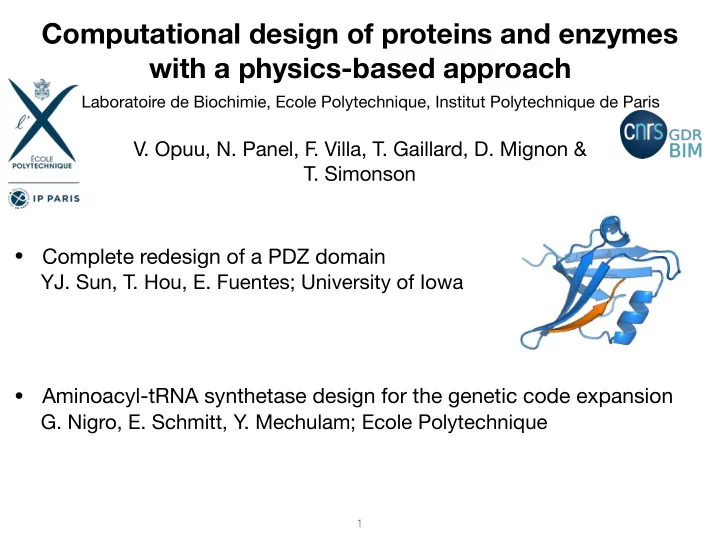
  • Complete redesign of a PDZ domain
  • Aminoacyl-tRNA synthetase design for the genetic code expansion

Laboratoire de Biochimie, Ecole Polytechnique, Institut Polytechnique de Paris

  • V. Opuu, N. Panel, F

. Villa, T. Gaillard, D. Mignon &

  • T. Simonson

Computational design of proteins and enzymes with a physics-based approach

  • 1
  • YJ. Sun, T. Hou, E. Fuentes; University of Iowa
  • G. Nigro, E. Schmitt, Y. Mechulam; Ecole Polytechnique
slide-2
SLIDE 2

Complete redesign of a PDZ domain

  • Domain length: 83 aas
  • Establish protein-protein interactions
  • Mutate positions in a Monte Carlo exploration
  • Proline, glycine, backbone, and 13 ligand binding positions

not allowed to mutate

  • All 61 others mutate freely: 1076 possible sequences
  • 2
slide-3
SLIDE 3

Computational framework

Experimental backbone structure Rotamer library

Change a rotamer or type

Monte Carlo moves

  • 3

Physics based energy function Proteus software (https:proteus.polytechnique.fr)

E = EMM + EGB + ESA

Empirical unfolded state ∑

aa

Euf

aa(typeaa)

Replica Exchange MC sampling

slide-4
SLIDE 4

Designed sequences ressemble natural PDZ sequences

Core positions: Proteus vs Pfam

Pfam Proteus

104 sequences were obtained 37% mean identity

Frequency Similarity

  • 4

Pfam Designed

slide-5
SLIDE 5

3 sequences chosen for experimental testing All 3 shown to fold correctly

CD spectra

First protein redesign with a physics based energy function

Opuu, Sun, Hou, Panel, Fuentes, Simonson, under review, JACS

  • 5

1D-NMR

(B)

Tiam1 PDZ FDB 1350 FDB 1555 FDB 1669

10.0 9.5 9.0 8.5 8.0 7.5 7.0 6.5 6.0 10.0 9.5 9.0 8.5 8.0 7.5 7.0 6.5 6.0

δ1H(ppm) δ1H(ppm)

Temperature wavelength

Fluorometry

molar ellipticity Normalized RFU

Thermal denaturation upshifted by peptide binding

slide-6
SLIDE 6

Methionyl-tRNA synthetase design for genetic code expansion

Methionine Azidonorleucine Selenomethionine β-Methionine Phosphinic acid Homocysteine

Met + AMP MetRS tRNA Met

Aminocylated tRNA

  • 6
slide-7
SLIDE 7

Design for affinity or catalysis is very difficult

  • Large combinatorial space
  • Simultaneous optimization directions: stability, affinity, catalysis
  • Need to optimize bound/unbound difference:

both positive and negative design

  • Existing methods are heuristic or very expensive:
  • ptimize the bound state energy (Rosetta)

exhaustive enumeration of states (Osprey)

  • 7
slide-8
SLIDE 8

A rigorous method to sample by affinity: adaptive importance sampling

1) Adaptatively flatten the free energy landscape of the apo state

+bias

2) Simulate holo state with the same bias: bias "subtracts out" the apo free energy

Natural population Flattened population

Flattened landscape

Sequences populated according to their binding free energy

Villa, Panel, Chen, Simonson 2018; Bhattacherjee & Wallin 2013

  • 8
slide-9
SLIDE 9

As a test: redesign MetRS for Anl binding

Anl

L260 L301 S13

21 experimental variants 3 variable positions Azidonorleucine (Protein labeling)

Anl

  • 9

5 of 6 most active variants are among the top 100 predictions

(Tanrikulu et al, 2009)

slide-10
SLIDE 10

I297 A256 L13

2nd test: redesign MetRS for Met binding

MetAMP

  • 10
  • 5 active variants among top 40 predictions
  • Computed affinities in good agreement with experiment:
  • 21 experimental variants
  • 3 variable positions

0.9 kcal/mol mean error, 0.75 correlation

slide-11
SLIDE 11

1) Flatten the landscape of the substrate complex 2) Sample the transition state complex, including the bias

Adaptive importance sampling allows us to design for catalysis

PPi Met AMP Sequences populated according to their activation free energy

  • 11
slide-12
SLIDE 12

MetRS redesigned for catalytic power

Experimental (kcal/mol) Computational (kcal/mol)

  • 12

kT × ln ( kcat KM )

  • 21 experimental values
  • 13 among top predictions
  • Excellent agreement for
  • 0.8 correlation, 1.1 kcal/mol mean error

kcat/KM

Opuu, Nigro, Villa, Gaillard, Schmitt, Mechulam, Simonson, accepted, Plos Comp. Bio.

WT

  • −7

−6 −5 −4 −3 −2 −1 −5 −4 −3 −2 −1 1

slide-13
SLIDE 13

Design MetRS for β-Met activity

  • 13
  • 3 positions allowed to mutate (more underway)
  • Good agreement for
  • 4 variants discovered with improved selectivity

kcat/KM

sequence

β-Methionine

Relative β-Met activity x 103

4.5 10−5

WT LAC SAC CAC MAC

1 2 3 4 5 6 7 8 9 10

x 200

slide-14
SLIDE 14
  • First whole-protein redesign with a physics-based energy function
  • First design of an enzyme for catalytic power
  • good agreement with experiment
  • predicted variants have improved β-Met selectivity
  • Computing group:

Alexandrine Daniel, Thomas Gaillard, Vaitea Opuu, David Mignon, Nicolas Panel, Francesco Villa, Thomas Simonson

Summary & Acknowledgements

  • PDZ collaborators:

Ernesto Fuentes, Titus Hou Young Joo Sun

  • MetRS collaborators:

Giuliano Nigro, Christine Lazennec- Schurdevin, Yves Mechulam, Emmanuelle Schmitt