
SLIDE 1
AUTOMATED REASONING SLIDES 9 to 11 (Appendix A2): RELATIONS between RESOLUTION and TABLEAU Completeness of Resolution via tableaux A useful notation (chain notation) Relation of ME with linear resolution The UNIFY - AT - END tableau development Parallel Model Elimination
KB-AR - 09 A2ai
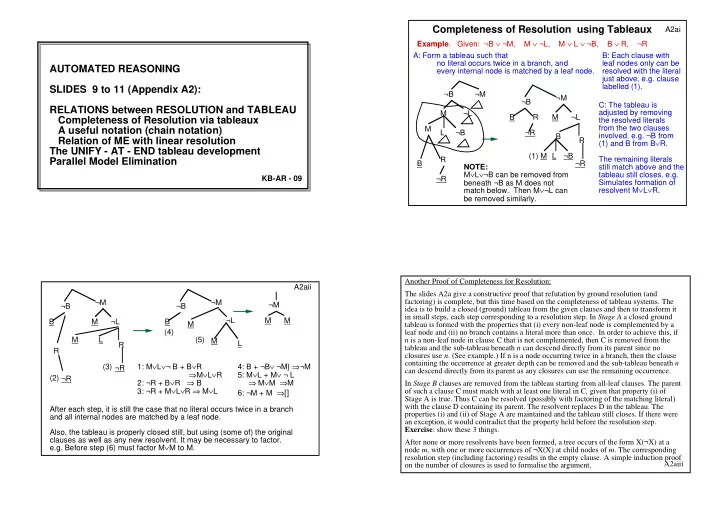
- Example. Given: ¬B ∨ ¬M, M ∨ ¬L, M ∨ L ∨ ¬B, B ∨ R, ¬R
A: Form a tableau such that no literal occurs twice in a branch, and every internal node is matched by a leaf node. B: Each clause with leaf nodes only can be resolved with the literal just above. e.g. clause labelled (1). ¬B ¬M B R M ¬L ¬R B R M L ¬B ¬R (1) C: The tableau is adjusted by removing the resolved literals from the two clauses
- involved. e.g. ¬B from
(1) and B from B∨R. The remaining literals still match above and the tableau still closes. e.g. Simulates formation of resolvent M∨L∨R. NOTE: M∨L∨¬B can be removed from beneath ¬B as M does not match below. Then M∨¬L can be removed similarly. ¬B ¬M M ¬L M L ¬B B R ¬R
Completeness of Resolution using Tableaux
A2aii ¬B ¬M B M M (4) ¬L L (5) ¬M M M 1: M∨L∨¬ B + B∨R ⇒M∨L∨R 2: ¬R + B∨R ⇒ B 3: ¬R + M∨L∨R ⇒ M∨L 4: B + ¬B∨ ¬M} ⇒¬M 5: M∨L + M∨ ¬ L ⇒ M∨M ⇒M 6: ¬M + M ⇒[] After each step, it is still the case that no literal occurs twice in a branch and all internal nodes are matched by a leaf node. Also, the tableau is properly closed still, but using (some of) the original clauses as well as any new resolvent. It may be necessary to factor. e.g. Before step (6) must factor M∨M to M. ¬B ¬M B M ¬L R ¬R M L (3) R ¬R (2) A2aiii Another Proof of Completeness for Resolution: The slides A2a give a constructive proof that refutation by ground resolution (and factoring) is complete, but this time based on the completeness of tableau systems. The idea is to build a closed (ground) tableau from the given clauses and then to transform it in small steps, each step corresponding to a resolution step. In Stage A a closed ground tableau is formed with the properties that (i) every non-leaf node is complemented by a leaf node and (ii) no branch contains a literal more than once. In order to achieve this, if n is a non-leaf node in clause C that is not complemented, then C is removed from the tableau and the sub-tableau beneath n can descend directly from its parent since no closures use n. (See example.) If n is a node occurring twice in a branch, then the clause containing the occurrence at greater depth can be removed and the sub-tableau beneath n can descend directly from its parent as any closures can use the remaining occurrence. In Stage B clauses are removed from the tableau starting from all-leaf clauses. The parent
- f such a clause C must match with at least one literal in C, given that property (i) of
Stage A is true. Thus C can be resolved (possibly with factoring of the matching literal) with the clause D containing its parent. The resolvent replaces D in the tableau. The properties (i) and (ii) of Stage A are maintained and the tableau still closes. If there were an exception, it would contradict that the property held before the resolution step. Exercise: show these 3 things. After none or more resolvents have been formed, a tree occurs of the form X(¬X) at a node m, with one or more occurrences of ¬X(X) at child nodes of m. The corresponding resolution step (including factoring) results in the empty clause. A simple induction proof
- n the number of closures is used to formalise the argument.