Complexities of Federal Preemption Strategies for Exercising Local - - PowerPoint PPT Presentation

complexities of federal preemption
SMART_READER_LITE
LIVE PREVIEW

Complexities of Federal Preemption Strategies for Exercising Local - - PowerPoint PPT Presentation

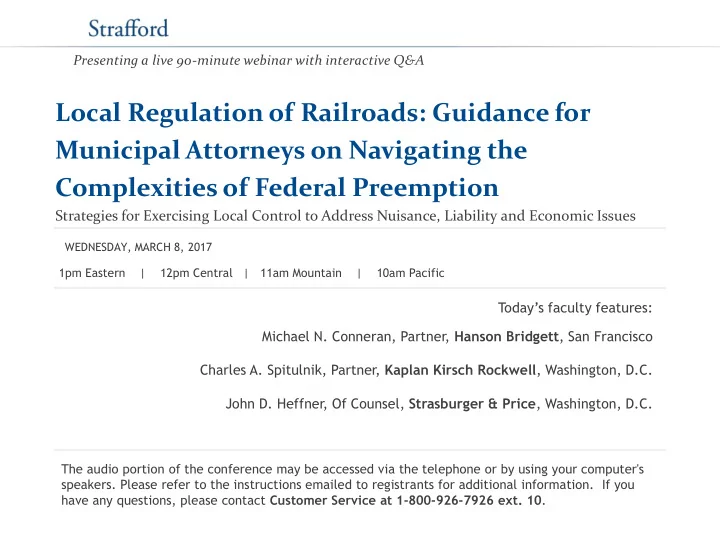
Presenting a live 90-minute webinar with interactive Q&A Local Regulation of Railroads: Guidance for Municipal Attorneys on Navigating the Complexities of Federal Preemption Strategies for Exercising Local Control to Address Nuisance,


slide-1
SLIDE 1

The audio portion of the conference may be accessed via the telephone or by using your computer's

  • speakers. Please refer to the instructions emailed to registrants for additional information. If you

have any questions, please contact Customer Service at 1-800-926-7926 ext. 10.

Presenting a live 90-minute webinar with interactive Q&A

Local Regulation of Railroads: Guidance for Municipal Attorneys on Navigating the Complexities of Federal Preemption

Strategies for Exercising Local Control to Address Nuisance, Liability and Economic Issues

Today’s faculty features:

1pm Eastern | 12pm Central | 11am Mountain | 10am Pacific WEDNESDAY, MARCH 8, 2017

​ Michael N. Conneran, Partner, Hanson Bridgett, San Francisco Charles A. Spitulnik, Partner, Kaplan Kirsch Rockwell, Washington, D.C. John D. Heffner , Of Counsel, Strasburger & Price, Washington, D.C.

slide-2
SLIDE 2

Tips for Optimal Quality

Sound Quality If you are listening via your computer speakers, please note that the quality

  • f your sound will vary depending on the speed and quality of your internet

connection. If the sound quality is not satisfactory, you may listen via the phone: dial 1-866-871-8924 and enter your PIN when prompted. Otherwise, please send us a chat or e-mail sound@straffordpub.com immediately so we can address the problem. If you dialed in and have any difficulties during the call, press *0 for assistance. Viewing Quality To maximize your screen, press the F11 key on your keyboard. To exit full screen, press the F11 key again.

FOR LIVE EVENT ONLY

slide-3
SLIDE 3

Continuing Education Credits

In order for us to process your continuing education credit, you must confirm your participation in this webinar by completing and submitting the Attendance Affirmation/Evaluation after the webinar. A link to the Attendance Affirmation/Evaluation will be in the thank you email that you will receive immediately following the program. For additional information about continuing education, call us at 1-800-926-7926

  • ext. 35.

FOR LIVE EVENT ONLY

slide-4
SLIDE 4

Program Materials

If you have not printed the conference materials for this program, please complete the following steps:

  • Click on the ^ symbol next to “Conference Materials” in the middle of the left-

hand column on your screen.

  • Click on the tab labeled “Handouts” that appears, and there you will see a

PDF of the slides for today's program.

  • Double click on the PDF and a separate page will open.
  • Print the slides by clicking on the printer icon.

FOR LIVE EVENT ONLY

slide-5
SLIDE 5

Local Regulation of Railroads: Guidance for Municipal Attorneys on Navigating the Complexities of Federal Preemption

Strafford Live Webinar

March 8, 2017

Michael Conneran, Partner Charles Spitulnik, Partner John Heffner, Of Counsel

slide-6
SLIDE 6

THE BASICS

  • Surface Transportation Board
  • Federal Railroad Administration
  • Labor Issues
  • The Courts - FELA

6

slide-7
SLIDE 7

Interstate Commerce Act of 1887

Imposed regulation of railroads:

  • Prohibited discrimination among shippers
  • Required publication of rates

7

slide-8
SLIDE 8

Deregulation – 1976-1995

Combatting “the disappearing railroad blues,” Congress enacted new laws aimed at making railroads solvent:

  • 4R Act (1976) – Fewer controls on rates
  • Staggers Rail Act of 1980– More deregulation,

allows railroads to share tracks

  • Interstate Commerce Commission Termination

Act (ICCTA) of 1995

8

slide-9
SLIDE 9

ICCTA of 1995

  • Abolished Interstate Commerce Commission

(ICC)

  • Established Surface Transportation Board (STB)

under the U.S. Department of Transportation

  • Now independent based on recent legislative

changes

  • More limited control of rail operations by federal

agency

9

slide-10
SLIDE 10

STB

10

slide-11
SLIDE 11

The STB

  • Jurisdiction: Interstate Commerce
  • Rail (all), Water (some), Motor Carrier (some)
  • … “exclusive and plenary”
  • Commerce – rates; sales, leases and use

agreements; abandonments

11

slide-12
SLIDE 12

Other Agencies

  • Federal Railroad Administration (FRA) – Safety

Agency that regulates tracks, vehicles, speeds, and conducts safety inspections

  • State Public Utilities Commission (PUC)

12

slide-13
SLIDE 13

Basics for Federal Jurisdiction

  • Commerce Clause – Art. I, §8, Cl. 3
  • Supremacy Clause – Art. VI, Cl. 2

13

slide-14
SLIDE 14
  • PREEMPTION –
  • 49 U.S.C. 10501
  • 49 U.S.C. 11321

14

slide-15
SLIDE 15

Federal Pre-Emption

  • Remember the key words: “exclusive and

plenary”

  • Chicago and North Western Transportation

Company v. Kalo Brick and Tile Co. (1991) 450 U.S. 311:

“The ICA is among the most pervasive and comprehensive of federal regulatory schemes . . . . Since the turn of the century, we have frequently invalidated attempts by the States to impose on common carriers obligations that are plainly inconsistent with the plenary authority of the [ICC] . . .”

15

slide-16
SLIDE 16

Federal Pre-Emption

  • Chicago and North Western Transportation

Company v. Kalo Brick and Tile Co. (1991) 450 U.S. 311:

“[There] can be no divided authority over interstate commerce, and . . . the acts of Congress on that subject are supreme and exclusive. [Citation.] Consequently, state efforts to regulate commerce must fall when they conflict with or interfere with federal authority over the same activity.” (Id. at 318-9.)

16

slide-17
SLIDE 17

It’s all about safety

  • 49 U.S.C. §20106:
  • National Uniformity of Regulation
  • Preemption of State Law

17

slide-18
SLIDE 18

49 CFR Part 209, Appendix A

  • Joint Use of Rail Lines
  • “Connection” of “electric interurban rail

system” to interstate rail system

18

slide-19
SLIDE 19

What is an Interstate Carrier?

  • Active
  • Discontinued
  • Abandoned (not the same as easement

abandonment)

  • Rails to Trails (“Railbanking”)– Grantwood

Village v. Missouri Pacific Railroad Company

  • Railroads that look wholly Intrastate
  • Tourist railroads, plant railroads not included (not

point-to-point)

19

slide-20
SLIDE 20

Railway Labor: Also a World Unto Itself

  • Railway Labor Act, National Mediation Board
  • Railroad Retirement/Railroad Unemployment

Insurance

  • LABOR PROTECTION
  • STB
  • Collective Bargaining
  • Transit Industry
  • FELA

20

slide-21
SLIDE 21

City of Auburn v Surface Transportation Board, 154 F.3d 1025 (9th Cir. 1998)

Auburn: Cities file legal challenges to the re-opening of Stampede Pass line

  • 229 miles through the Cascades
  • Auburn at Western terminus – near Seattle N/S line

21

slide-22
SLIDE 22

City of Auburn v Surface Transportation Board, 154 F.3d 1025 (9th Cir. 1998)

BNSF sought STB approval to reacquire line it had sold to short line operator and segment it used

  • nly for local traffic
  • STB prepared Environmental Assessment (EA)

under National Environmental Policy Act (NEPA)

22

slide-23
SLIDE 23

City of Auburn v Surface Transportation Board, 154 F.3d 1025 (9th Cir. 1998)

City challenged STB decision that found that: i. Local environment permitting laws were preempted by ICCTA ii. STB’s reliance on Environmental Assessment (i.e. finding that no Environmental Impact Statement (EIS) needed to be prepared)

23

slide-24
SLIDE 24

City of Auburn v Surface Transportation Board, 154 F.3d 1025 (9th Cir. 1998)

City of Auburn contentions on appeal to 9th Circuit:

  • City claims no express preemption of local

regulation: – Says Congress meant to preempt economic regulation, not “essential local police power required to protect the health or safety of citizens.”

24

slide-25
SLIDE 25

City of Auburn v Surface Transportation Board, 154 F.3d 1025 (9th Cir. 1998)

Court rejects City’s position--opinion notes long history of judicial recognition that rail operations need to be regulated at the federal, not local, level

25

slide-26
SLIDE 26

City of Auburn v Surface Transportation Board, 154 F.3d 1025 (9th Cir. 1998)

Auburn court cited Chicago and North Western Transportation Company v. Kalo Brick and Tile Company:

  • Interstate Commerce Act (ICA) is “among the

most persuasive and comprehensive federal regulatory schemes” (450 U.S. 311,318)

26

slide-27
SLIDE 27

City of Auburn v Surface Transportation Board, 154 F.3d 1025 (9th Cir. 1998)

Does legislative history of ICCTA help city? No!

  • 1. 49 U.S.C. §10501(b)(2): STB will have

exclusive jurisdiction over “the construction, acquisition, operation, abandonment, or discontinuance of spur, industrial, team, switching, or side tracks, or facilities . . . .”

  • 2. Remedies are exclusive and preempt local law

27

slide-28
SLIDE 28

City of Auburn v Surface Transportation Board, 154 F.3d 1025 (9th Cir. 1998)

Auburn court noted that STB also has exclusive authority over rail line mergers and acquisitions and stated:

  • “[A] rail carrier participating in that approved or

exempted transaction is exempt from . . . all

  • ther law, including state and municipal law…”

28

slide-29
SLIDE 29

City of Auburn v Surface Transportation Board, 154 F.3d 1025 (9th Cir. 1998)

Also rejected City’s NEPA challenge, finding the Environmental Assessment was adequate and the preparation of an Environmental Impact Statement was not required.

29

slide-30
SLIDE 30

Who Can Claim Preemption?

  • The activity must constitute transportation by an STB-

licensed rail carrier. Tri-State Brick and Stone Petition for Declaratory Order, FD 34824 (STB served Dec. 11, 2007).

  • By rail carriers and nonoperating owners of rail lines.

New York City Economic Development Corporation - Petition for Declaratory Order, FD 34429 (STB-served July 15, 2004).

  • And operating in interstate commerce subject to STB

jurisdiction.

30

slide-31
SLIDE 31

Who Can Claim Preemption?

  • For anything directly regulated by STB or FRA

such as industry entry or exit, rates and service, mergers, track and equipment standards, crew qualifications, operating practices, and so forth. The railroad must be providing common carrier transportation including a common carrier providing service to a customer under a rate contract.

31

slide-32
SLIDE 32

Does Not Cover

  • Tenants of railroad landowners, Florida East Coast Ry. v. City
  • f Palm Beach, 110 F. Supp.2d 1367 (S.D. Fla. 2000).
  • Rail customers, SEA-3, Inc.-Petition for Declaratory Order, FD

35853 (STB-served March 17, 2015); Hi-Tech Transportation v.

NJ, 382 F.3d 295 (3d Cir. 2004).

  • Landowners crossed by a common carrier rail line, JGB

Properties, LLC-Petition for Declaratory Order, FD 35817 (STB-served May 22, 2015).

32

slide-33
SLIDE 33

Does Not Cover

  • Noncommon carrier activities of railroads. New England

Transrail, LLC, d/b/a Wilmington and Woburn Terminal Railway Construction, FD 34797 (STB-served July 10, 2007) (activities must be “integrally related” to transportation).

  • Car storage.
  • Intrastate passenger service outside the national
  • network. Peninsula Corridor Joint Powers Board-Petition

for Declaratory Order, FD 35929 (STB-served July 2, 2015).

33

slide-34
SLIDE 34

Does Not Cover

  • Solid Waste, contaminated dirt, and construction

and demolition debris (“C&D”) unless moving in

  • riginal sealed containers.

34

slide-35
SLIDE 35

The Lautenberg Amendment

35

slide-36
SLIDE 36

Lautenberg Amendment

“Micro short line railroad”

36

slide-37
SLIDE 37

The Lautenberg Amendment, 49 U.S.C. 10908-9

Legislative reaction to NYS&W v. Jackson, 500 F.3d 238 (2007) (generally holding that local environmental and permitting laws do not to apply to Susquehanna Railroad’s waste transfer facility. But the Third Circuit remanded the case to the lower court for its failure to identify specifically which regulations were preempted).

37

slide-38
SLIDE 38

The Lautenberg Amendment

Addressed abuses from operators of waste transfer facilities seeking to establish themselves as short line railroads to avoid state and local permitting requirements.

38

slide-39
SLIDE 39

The Lautenberg Amendment

49 CFR 1155

Solid Waste Rail Transfer Facilities Allowed STB to license transfer facilities but eliminated preemption except for licensed facilities and for cargo transported in original sealed

  • containers. Rule is so complex that no one has

applied for a license.

39

slide-40
SLIDE 40

Transloading facility

40

slide-41
SLIDE 41

Transloading activities

  • A facility for transferring cargo between modes.
  • No preemption unless conducted by railroad itself or

railroad’s agent under its complete control.

  • Compare, The City of Alexandria, Virginia-Petition for

Declaratory Order , FD 35157 (STB-served Feb. 17, 2009 (transloader acted as an agent of the railroad and pursuant to its directions) with Town of Babylon and Pinelawn Cemetery – Petition for Declaratory Order, FD 35057 (STB-served Feb. 1, 2008) (transload provider was totally independent of the railroad). Same result as Hi-Tech.

41

slide-42
SLIDE 42

Construction, acquisition, operation, or abandonment of railroad lines and facilities

Distinguish between “lines of railroad,” “exempt spurs,” and “private track.”

  • “Line of railroad” provides through rail service as part of

the national network. A fact-specific inquiry. Does the track “invade” new territory? Requires STB approval under 49 U.S.C. §§10901-2, or 10903.

  • Preemption applies

42

slide-43
SLIDE 43

Construction, acquisition, operation, or abandonment of railroad lines and facilities “Exempt spur,” track typically used for switching, servicing, or storing of railroad equipment. The STB employs a “use test” for making that

  • determination. Exempt from STB entry and exit

licensing under 49 U.S.C. §10906. Preemption applies.

43

slide-44
SLIDE 44

Construction, acquisition, operation, or abandonment of railroad lines and facilities A “private track,” track outside STB jurisdiction. Typically track inside a shipper’s plant or facility. Subject to local regulation but FRA safety regulation can apply. No preemption. Subject to all local laws.

44

slide-45
SLIDE 45

Construction, acquisition, operation, or abandonment of railroad lines and facilities

  • STB construction authority required for new lines but not

for exempt spurs. 49 U.S.C. §10901, §10906.

  • Improvements” and “ancillary” facilities may be built

without STB approval and enjoy preemption because they form an “integral part” of the railroad's interstate

  • perations. Union Pacific Petition for Declaratory Order,

FD 33611 (STB served Aug. 21, 1998); Friends of the Aquifer, City of Hauser, ID¸ FD 33966 (STB-served Aug. 10, 2001); City of Auburn v. United States, 154 F.3d 1025 (9th Cir. ).

45

slide-46
SLIDE 46

Construction, acquisition, operation, or abandonment of railroad lines and facilities

  • Party building or acquiring its first line must get STB approval

regardless of whether the line would otherwise constitute a line or a spur. Effingham Railroad Company–Petition for Declaratory Order–Construction at Effingham, IL, 2 S.T.B. 606 (1997). Pre-filing activity not exempt. Preemption applies

  • nce approved but cannot build until approved. Suffolk and

Southern Rail Road-Lease and Operation Exemption, FD 35036 (STB-served Aug. 27, 2008); DesertXpress Enterprises, LLC-Petition for Declaratory Order, FD 34914 (STB-served June 27, 2007).

  • Local requirements cannot be burdensome or discriminatory
  • r intended to delay a project forever.

46

slide-47
SLIDE 47

Operations and maintenance

  • State and local economic and environmental regulation
  • forbidden. States cannot regulate matters expressly left

to the STB such as licensing, rates and service, mergers, etc.

  • State regulation of station closures preempted. CSX v.

Georgia Public Service Comm’n, 944 F. Supp. 1573 (N.D. GA. 1996).

  • Local governments cannot dictate how railroads can

route traffic including hazardous materials. CSX Transp., Inc.—Pet. for Declaratory Order, FD 34662 (STB served

  • Mar. 14, 2005).

47

slide-48
SLIDE 48

Operations and maintenance

  • Local governments cannot enact or apply land use or

zoning regulations which forbid or limit the railroad’s use

  • f its facilities. Borough of Riverdale Petition for

Declaratory Order, FD 33466 (STB-served Sept. 10, 1999).

  • Boston And Maine Corporation Petition for Declaratory

Order, FD 35749 (STB-served July 19, 2013).

  • Local government cannot regulate railroad noise
  • emissions. Petition of Norfolk Southern Railway

Company for Expedited Declaratory Order, FD 35949 (STB-served Feb. 25, 2016).

48

slide-49
SLIDE 49

Operations and maintenance

  • Local government cannot require pre-construction

building permits for rail facilities. Green Mountain R.R. v. Vermont, 404 F.3d 643 (2d Cir. 2005).

  • Railroad operations block public access to local
  • business. Not a ground for suing railroad for loss of
  • business. Freiberg v. KCS, 267 F.3d 439 (5th Cir. 2001).

49

slide-50
SLIDE 50

Operations and maintenance

 Railroad maintenance practices  Regulated by FRA under Federal Rail Safety Act.  Brush cutting and noxious weed spraying  Tie replacement and disposal of old railroad ties  Property damage/flooding cases due to improper maintenance

  • There are a many decisions on the subject of track and

right of way maintenance and they go both ways.

50

slide-51
SLIDE 51

Condemnation of Rail Lines

How many of you remember the ads for Colgate toothpaste with its Gardol shield?

51

slide-52
SLIDE 52

Condemnation of Rail Lines

Just like Colgate toothpaste with Gardol allegedly put a protective shield around your teeth to prevent decay, federal preemption insulates interstate rail lines from state and local laws including condemnation powers.

52

slide-53
SLIDE 53

Condemnation of Rail Lines

So how do you remove that protective shield? It depends. (A) If the condemned rights do not interfere with the target carrier’s ability to provide rail service including right of way maintenance and possible expansion needs, you can take the right of way. But to test that, you will need to seek a declaratory ruling from the STB and the railroad will likely challenge your petition.

53

slide-54
SLIDE 54

Condemnation of Rail Lines

Examples of successful condemnations:

  • Easement for road crossing and subsurface utilities. Maumee

& Western Railroad Corporation And RMW Ventures, LLC- Petition For Declaratory Order, FD 34354 (STB-served March 3, 2004).

  • Easement for underground sewer line. Eastern Alabama

Railway, LLC-Petition for Declaratory Order, FD 35583 (STB- served Feb. 22, 2012).

54

slide-55
SLIDE 55

Condemnation of Rail Lines

Examples of unsuccessful condemnations:

  • A 20’ wide five block long easement along right of way for a

pedestrian/bike trail and storm drainage improvements. City of Lincoln Petition for Declaratory Relief, FD34425 (STB-served

  • Dec. 8, 2003).
  • A parcel of railroad property for use as a public park in

Birmingham, AL. Norfolk Southern Railway Company Petition for A Declaratory Order, FD 35196 (STB-served March 1, 2010).

55

slide-56
SLIDE 56

Condemnation of Rail Lines

What About:

  • Condemnation of operating rights over rail freight line for

passenger service?

  • Use of adjoining right of way for high voltage electric

lines where railroad claims electrical interference?

56

slide-57
SLIDE 57

Condemnation of Rail Lines

(B) But what if your condemnation could interfere with the railroad’s operations, how do you remove the “protective shield”

  • f preemption? Then you seek an “adverse abandonment” of

the rail line, which my colleague Chuck Spitulnik will explain.

57

slide-58
SLIDE 58

Condemnation of Rail Lines

So what’s the standard? Maumee & Western teaches us: “Routine, non-conflicting uses, such as non-exclusive easements for at-grade road crossings, wire crossings, sewer crossings, etc., are not preempted so long as they would not impede rail operations or pose undue safety risks.”

58

slide-59
SLIDE 59

So what rights does that leave state

  • r local officials?

Key precedent to review: Joint Pet. for Declaratory Order—Bos. & Me. Corp. (Town

  • f Ayer), FD 33971 (STB served May 1, 2001),

City of Auburn v. STB, 154 F.3d 1025, 1029-31 (9th Cir. 1998) Village of Ridgefield Park v. NYS&W RR, 750 A.2d 57 (NJ 2000).

59

slide-60
SLIDE 60

So what rights does that leave state

  • r local officials?
  • Railroads to notify
  • Railroads to meet
  • Railroads to share site plans
  • Railroads to provide information to local officials
  • Railroads to provide test results from testing or

monitoring

  • Railroads to provide emergency access
  • Railroads to use “best management” practices

60

slide-61
SLIDE 61

Options for state or local officials:

  • State and local government can use their “police powers”

to protect public health and safety but state or local actions must not be discriminatory.

  • Railroads can be required to meet with local officials and

interested parties, share site plans, etc.

  • Permissible are reasonable compliance with codes

involving fire, electrical, plumbing, and safety but must not be subjective or unduly delay projects. And the requirements must be readily available and easy to understand.

61

slide-62
SLIDE 62

Options for state or local officials:

  • State or local agencies can enforce prior railroad

commitments to abide by governmental requirements. Town of Woodbridge v. Consolidated Rail Corporation, FD 42053 (STB-served March 23, 2001).

  • Property rights disputes belong in local or state courts.

Allegheny Railroad Company Petition for Declaratory Order, FD 35388 (STB-served April 25, 2011).

  • Once a line is fully abandoned it is subject to state and

local law including as to damage caused by salvage. Buddy and Holly Hatcher-Petition for Declaratory Order, FD 35581 (STB-served Sept. 21, 2012).

62

slide-63
SLIDE 63

Options for state or local officials

Federal environmental laws are not preempted unless applied unreasonably. Where there are overlapping Federal statutes, they are to be harmonized, with each statute given effect to the extent possible. This includes Federal environmental statutory programs that are implemented in part by the states, including the Clean Air Act, the Clean Water Act, and the Solid Waste Disposal Act as amended by Resource Conservation and Recovery Act, and the regulation of railroad safety under the Federal Rail Safety Act

63

slide-64
SLIDE 64

Franchises

  • Union Pacific Railroad Company - Petition for Declaratory

Order, STB Finance Docket No. 34090 (Decided: November 7, 2001): “[E]ven assuming that the City's interpretation of the Franchise Agreement is correct, its enforcement of the Franchise Agreement is no less an attempt to regulate the abandonment of an interstate line of railroad than if the City promulgated laws for the same purpose.”

  • New Orleans Terminal, 366 F.2d at 163-64,
  • Des Moines v. Chicago & N.W. R. Co., 264 F.2d 454, 457-60

(8th Cir. 1959),

64

slide-65
SLIDE 65

Crossings

  • People v. Burlington Northern Santa Fe Railroad

(2012) 209 Cal.App.4th

State rule regulating blockage of grade crossings found to be preempted

  • Not a preemption issue exclusively but a serious

concern that merits some discussion

65

slide-66
SLIDE 66

Stop that train?

  • At 55 mph, a train can take one mile to stop
  • Safety focus must be on controlling cars and

trucks

66

slide-67
SLIDE 67

Crossing Signals— Not Always Enough!

  • 50% of collisions occur at

signalized intersections

– Source: Operation Lifesaver

67

slide-68
SLIDE 68

Sound the horn!

  • Locomotive engineers rely on horns for safety
  • Horns are noisy but the best safety device

available

68

slide-69
SLIDE 69

The Horn Problem

  • Horns are loud (>96 db)
  • Horns are sounded about ¼ mile from

crossing (=15 second warning @ 60mph)

69

slide-70
SLIDE 70

Localities React to Noisy Horns

  • Citizens press for action
  • Localities attempt to ban train horns
  • Railroads object on safety/liability grounds;

turn to federal agencies for help

70

slide-71
SLIDE 71

Federal Law Controls Local Attempts to Limit Noisy Horns

  • Federal law is supreme regarding regulation of

interstate commerce

  • Federal law is plenary with regard to railroad
  • perations
  • “What part of ‘plenary’ don’t you understand?”

71

slide-72
SLIDE 72

Congress Acts: PL 103-440 49 USC §20153

  • 1994 statute requires DOT to issue regulations

requiring that train horns be sounded at public crossings

  • Allows FRA to grant exemptions via rulemaking

process

  • Regulations will pre-empt non-compliant local

bans

  • Final Rule Codified at 49 CFR §222 and §229

72

slide-73
SLIDE 73

Who can establish quiet zones?

  • “Public Authorities” = agencies “responsible for

traffic control or law enforcement” (i.e. cities, counties etc.)

  • Not railroads, nor the state PUC

73

slide-74
SLIDE 74

What can be done?

  • Localities can now declare quiet zones under

the conditions specified in the FRA rule

74

slide-75
SLIDE 75

Basic Requirements

  • Must be at least ½ mile long
  • All crossings in zone must have:

– Flashing lights – Crossing gates – Signs re: absence of horns – Power out indicators – Constant warning time devices (if practical)

75

slide-76
SLIDE 76

FRA Approval Requirements

  • No FRA approval is required if:

– Supplemental Safety Measures (SSM’s) are in place at each x-ing – SSM’s include:

  • 4 quadrant gates
  • 2 quadrant gates with median strip
  • One way traffic with gates

76

slide-77
SLIDE 77

Four Quadrant Gates

77

slide-78
SLIDE 78

Alternate Safety Measures

  • Require prior FRA approval
  • Allows use of measures that don’t qualify as SSM’s
  • OK to use “corridor approach” to average risks within

quiet zone

  • Education/enforcement program (including photo

enforcement)

78

slide-79
SLIDE 79

Issues for Cities and Counties

  • Who pays for intersection improvements?

– Federal rule is silent on this point – If you want a quiet zone, must you pay for it? (Answer: probably!)

  • Potential sources of funding:

– Assessment Districts – Developer Mitigation Fees – Grants – Bond Proceeds – Sales or Other Taxes

79

slide-80
SLIDE 80

Railroad Concerns

  • Railroads focused of freight

movement

  • Railroads have other capital priorities

for their $$$

  • Liability issues are of concern

80

slide-81
SLIDE 81

Addressing Liability

  • Text of rule is silent on liability
  • Federal law preempts certain state law actions,

such as: – Actions based on creation of quiet zones – Actions for failure to sound horn

  • FRA declined to require localities to indemnify

RR’s

  • RR’s may demand indemnity in exchange for

making improvements (no prohibition in rule)

81

slide-82
SLIDE 82

A Final Topic—Railroad Liability Issues

82

slide-83
SLIDE 83

Liability Allocation

  • Liability allocation with railroads is a major challenge for

any transaction with a railroad. The larger the railroad, the greater the challenge.

  • The normal rule for freight railroads with more or less

equal bargaining power is :

– “My people, my freight, my equipment, my problem… your people, your freight, your equipment, your problem.”

83

slide-84
SLIDE 84

Railroad Liability Allocation

  • But railroads have a different mindset for allocating liabilities

with non-railroad parties, including rail customers, public agencies working with railroads on projects, and passenger service operators. Thus the liability allocation theory for parties with unequal bargaining power is what is commonly called “but for liability:”

  • The customer, the agency, or the passenger carrier is

responsible for any accident or injury regardless of cause and must indemnify the railroad absent the railroad’s gross negligence, intentional acts, or statutory violations

84

slide-85
SLIDE 85

More information:

mconneran@hansonbridgett.com: (415) 995-5042 cspitulnik@kaplankirsch.com (202) 955-5600 John.Heffner@strasberger.com (202) 742-8607

slide-86
SLIDE 86