Composting for Emergency Disposal of Poultry and Livestock - - PowerPoint PPT Presentation

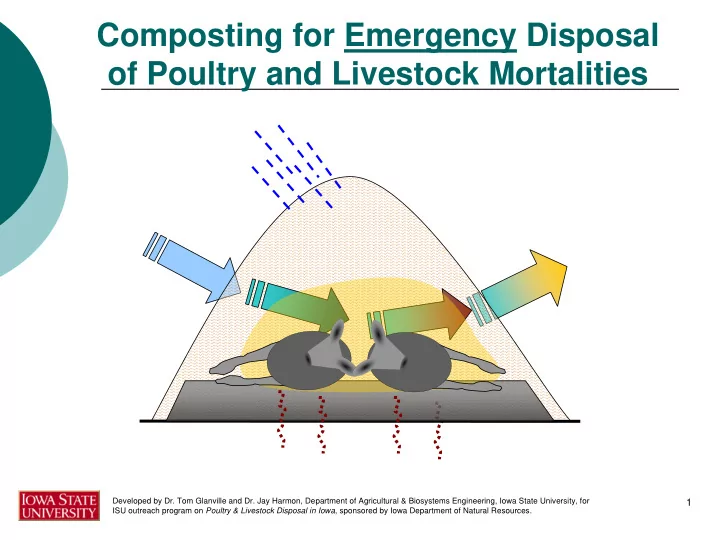
composting for emergency disposal of poultry and
SMART_READER_LITE
LIVE PREVIEW

Composting for Emergency Disposal of Poultry and Livestock - - PowerPoint PPT Presentation

Composting for Emergency Disposal of Poultry and Livestock Mortalities Developed by Dr. Tom Glanville and Dr. Jay Harmon, Department of Agricultural & Biosystems Engineering, Iowa State University, for 1 ISU outreach program on Poultry &


slide-1
SLIDE 1

1

Developed by Dr. Tom Glanville and Dr. Jay Harmon, Department of Agricultural & Biosystems Engineering, Iowa State University, for ISU outreach program on Poultry & Livestock Disposal in Iowa, sponsored by Iowa Department of Natural Resources.

Composting for Emergency Disposal

  • f Poultry and Livestock Mortalities
slide-2
SLIDE 2

2

Developed by Dr. Tom Glanville and Dr. Jay Harmon, Department of Agricultural & Biosystems Engineering, Iowa State University, for ISU outreach program on Poultry & Livestock Disposal in Iowa, sponsored by Iowa Department of Natural Resources.

Learning Objectives

Emergency disposal scenarios that favor use of

composting

Which composting system works best for

emergency disposal?

Construction procedures & recommended cover

materials for emergency composting

Rules of thumb for sizing emergency composting

system and estimating cover material quantities

slide-3
SLIDE 3

3

Developed by Dr. Tom Glanville and Dr. Jay Harmon, Department of Agricultural & Biosystems Engineering, Iowa State University, for ISU outreach program on Poultry & Livestock Disposal in Iowa, sponsored by Iowa Department of Natural Resources.

Mortality Disposal Concerns in Iowa

Iowa has some of the largest

poultry and livestock populations in the U.S.

# 1 in swine …

. population ~ 15,000,000 head

# 1 in laying hens … ~ 55,000,000 birds # 7 in cattle & calves … ~ 3,800,000

head

slide-4
SLIDE 4

4

Developed by Dr. Tom Glanville and Dr. Jay Harmon, Department of Agricultural & Biosystems Engineering, Iowa State University, for ISU outreach program on Poultry & Livestock Disposal in Iowa, sponsored by Iowa Department of Natural Resources.

Mortality Disposal Concerns in Iowa

Large scale death losses happen!

Fire Ventilation failure Heat stress Less frequent but MORE serious

Contagious disease outbreaks

2001 foot-and-mouth disease outbreak in Great Britain

required disposal of nearly 6,000,000 animals

2004 avian influenza outbreak in Canada

Agro-terrorism – a new concern

slide-5
SLIDE 5

5

Developed by Dr. Tom Glanville and Dr. Jay Harmon, Department of Agricultural & Biosystems Engineering, Iowa State University, for ISU outreach program on Poultry & Livestock Disposal in Iowa, sponsored by Iowa Department of Natural Resources.

Emergency Disposal Concerns

Rendering

Only 5 major plants in Iowa

Will there be sufficient rendering capacity to

handle regional scale emergencies caused by heat stress or disease?

Are rendering firms willing to handle

emergency losses if caused by a disease (such as avian influenza) that is transmissible to humans?

Cost & biosecurity risks associated with

transport of diseased carcasses to rendering plants?

slide-6
SLIDE 6

6

Developed by Dr. Tom Glanville and Dr. Jay Harmon, Department of Agricultural & Biosystems Engineering, Iowa State University, for ISU outreach program on Poultry & Livestock Disposal in Iowa, sponsored by Iowa Department of Natural Resources.

Emergency Disposal Concerns

Incineration

Requires high-temperature / high-

capacity equipment to avoid serious air pollution … . open pyre incineration is not permitted by Iowa DNR

Takes time to locate and transport

portable incinerators

Requires large amounts of fuel Cost & biosecurity risks associated with

transport of diseased carcasses to central incinerator locations

slide-7
SLIDE 7

7

Developed by Dr. Tom Glanville and Dr. Jay Harmon, Department of Agricultural & Biosystems Engineering, Iowa State University, for ISU outreach program on Poultry & Livestock Disposal in Iowa, sponsored by Iowa Department of Natural Resources.

On-farm burial

Poses groundwater pollution concerns

Approximately 22 lbs of nitrogen and 8 lbs of

phosphorus in every 1,000 lbs of carcasses

Nitrogen loading rates imposed by high

density emergency burial practices can exceed 20,000 lbs/ acre

30-40% of Iowa has shallow bedrock or

shallow water table

Emergency Disposal Concerns

slide-8
SLIDE 8

8

Developed by Dr. Tom Glanville and Dr. Jay Harmon, Department of Agricultural & Biosystems Engineering, Iowa State University, for ISU outreach program on Poultry & Livestock Disposal in Iowa, sponsored by Iowa Department of Natural Resources.

Landfills

At present, no consistent policy on

acceptance of mortalities … . some will… some won’t

Cost & biosecurity risks associated with

transport of diseased carcasses to central location

Emergency Disposal Concerns

slide-9
SLIDE 9

9

Developed by Dr. Tom Glanville and Dr. Jay Harmon, Department of Agricultural & Biosystems Engineering, Iowa State University, for ISU outreach program on Poultry & Livestock Disposal in Iowa, sponsored by Iowa Department of Natural Resources.

Consider Composting for Emergency Disposal

When:

Rendering plants are too far away or rendering plant

capacity is likely to be exceeded

High-temperature high-capacity incinerators & large

quantities of fuel are not readily available

Shallow groundwater or bedrock, or frozen soil, make

burial unwise or impractical

Landfills are too far away or will not accept mortalities Animal death is caused by contagious disease …

. transport to off-farm disposal sites may increase bio- security risks

slide-10
SLIDE 10

10

Developed by Dr. Tom Glanville and Dr. Jay Harmon, Department of Agricultural & Biosystems Engineering, Iowa State University, for ISU outreach program on Poultry & Livestock Disposal in Iowa, sponsored by Iowa Department of Natural Resources.

Immediate carcass containment …

. reduces air pollution and disease transmission potential

Produces heat that kills pathogens…

.has been used for many years in poultry and swine industries without reported incidents of disease transmission

Can be done on the farm using common farm

equipment and agricultural products (cornstalks, silage, straw)

Easier than burial when ground is frozen More environmentally friendly than burial, keeps

potential water pollutants above or near surface of ground … . further from groundwater resources

What Does On-farm Emergency Composting Offer?

slide-11
SLIDE 11

11

Developed by Dr. Tom Glanville and Dr. Jay Harmon, Department of Agricultural & Biosystems Engineering, Iowa State University, for ISU outreach program on Poultry & Livestock Disposal in Iowa, sponsored by Iowa Department of Natural Resources.

History of Emergency Mortality Composting

Examples of successful use of composting

for emergency disposal

Massive poultry losses caused by flooding in

Missouri (1993), and heat wave in Iowa (1996)

Iowa Dept. of Natural Resources sanctioned

use of composting for swine losses caused by barn fire in north central Iowa in 2003

Canadian Food Inspection Agency used

composting during avian influenza outbreak in British Columbia in 2004

slide-12
SLIDE 12

12

Developed by Dr. Tom Glanville and Dr. Jay Harmon, Department of Agricultural & Biosystems Engineering, Iowa State University, for ISU outreach program on Poultry & Livestock Disposal in Iowa, sponsored by Iowa Department of Natural Resources.

Bin vs Windrow Composting Systems

  • Roofed bin systems … are

recommended for routine disposal of small/ medium sized species in Iowa

  • Roof prevents excessive moisture
  • Walls limit rodent & insect access
  • Requires less cover material than
  • pen piles
  • BUT bin systems are NOT well

suited for emergency disposal

  • Typically sized for average daily

loss rates … . NOT for loss of whole herd or flock

  • Would take too long to construct

in an emergency

  • Expensive for large species

NOTE: For more info on bin composting

systems see companion presentation in this series …. “Composting for routine disposal of poultry and livestock mortalities”

slide-13
SLIDE 13

13

Developed by Dr. Tom Glanville and Dr. Jay Harmon, Department of Agricultural & Biosystems Engineering, Iowa State University, for ISU outreach program on Poultry & Livestock Disposal in Iowa, sponsored by Iowa Department of Natural Resources.

Windrow Composting Systems

Well suited for emergency disposal

Can be sized to fit varying quantities and sizes of

carcasses

Can be constructed quickly using on-farm

equipment and materials

Low capital and operating cost

slide-14
SLIDE 14

14

Developed by Dr. Tom Glanville and Dr. Jay Harmon, Department of Agricultural & Biosystems Engineering, Iowa State University, for ISU outreach program on Poultry & Livestock Disposal in Iowa, sponsored by Iowa Department of Natural Resources.

Windrow Composting Procedures

Step 1 - Lay down 18-24 inch thick absorptive base

layer

Retains contaminated leachate caused by:

Heavy precipitation Water in carcasses

Each 1,000 lbs of carcasses contains ~ 600 lbs of water!

Note: white leachate capture troughs are for research purposes …. not normally included in on-farm mortality composting

slide-15
SLIDE 15

15

Developed by Dr. Tom Glanville and Dr. Jay Harmon, Department of Agricultural & Biosystems Engineering, Iowa State University, for ISU outreach program on Poultry & Livestock Disposal in Iowa, sponsored by Iowa Department of Natural Resources.

Step 2 – place carcasses on base

Windrow Composting Procedures

NOTE: use of pallet fork on loader facilitates placement of large carcasses without damaging base layer

slide-16
SLIDE 16

16

Developed by Dr. Tom Glanville and Dr. Jay Harmon, Department of Agricultural & Biosystems Engineering, Iowa State University, for ISU outreach program on Poultry & Livestock Disposal in Iowa, sponsored by Iowa Department of Natural Resources.

16-18 ft. max base width

cover material base material

7- 8 ft

Carcass Placement

For Large Carcasses (e.g. cattle or horses)

Single layer recommended

Stacking large carcasses can cause:

Excessive pile settling …

. carcass exposures … .. need for frequent addition of cover material

Leachate release …

.. every 1,000 lbs of carcasses contains ~ 600 lbs of water

Minimum 18-inch cover to retain heat, absorb odor, & absorb excess precipitation. Minimum 24-inch base layer to absorb leachate.

slide-17
SLIDE 17

17

Developed by Dr. Tom Glanville and Dr. Jay Harmon, Department of Agricultural & Biosystems Engineering, Iowa State University, for ISU outreach program on Poultry & Livestock Disposal in Iowa, sponsored by Iowa Department of Natural Resources.

Carcass Placement

For Small carcasses (swine, sheep, calves, poultry)

Limited stacking of small carcasses is OK

Less settling due to smaller size & distributed weight Greater opportunity to retain water from carcasses

Place 3-6 inches of cover material between carcasses in the

same layer

Use 6-9 inches of cover material between layers

Minimum 24-inch base layer to absorb leachate.

cover material base material

Minimum 18-inch cover to retain heat, absorb odor, & absorb excess precipitation.

7-8 ft. 16-18 ft. max base width

slide-18
SLIDE 18

18

Developed by Dr. Tom Glanville and Dr. Jay Harmon, Department of Agricultural & Biosystems Engineering, Iowa State University, for ISU outreach program on Poultry & Livestock Disposal in Iowa, sponsored by Iowa Department of Natural Resources.

Step 3 - Cover carcasses with 18-24 inches

  • f envelope material

Retains heat and moisture …

. both are essential for bacterial activity

Absorbs excess precipitation Absorbs and retains odorous gases

Windrow Composting Procedures

NOTE: grey tubing shown in photos above is for research purposes….not normally used in routine practice.

slide-19
SLIDE 19

19

Developed by Dr. Tom Glanville and Dr. Jay Harmon, Department of Agricultural & Biosystems Engineering, Iowa State University, for ISU outreach program on Poultry & Livestock Disposal in Iowa, sponsored by Iowa Department of Natural Resources.

Expect substantial settling, particularly

during warm seasons

Can lead to pile cracking … need for occasional

repair … stockpile extra cover material for this purpose

day 45 – 4 ft pile height day 1 – 7 ft pile height

Windrow Composting Procedures

slide-20
SLIDE 20

20

Developed by Dr. Tom Glanville and Dr. Jay Harmon, Department of Agricultural & Biosystems Engineering, Iowa State University, for ISU outreach program on Poultry & Livestock Disposal in Iowa, sponsored by Iowa Department of Natural Resources.

What about windrow turning?

Pros

Speeds up decay by introducing oxygen and

redistributing moisture and nutrients

Helps insure that all materials in pile are exposed to

high heat

Cons

Chills the pile if done during cold weather … dries

the pile if done during hot/ dry weather

Releases serious odors if done too soon Requires additional material to re-cover un-

decomposed materials … prevent fly problems

Releases pathogens if done before pathogens are

inactivated

Time consuming

Windrow Composting Procedures

slide-21
SLIDE 21

21

Developed by Dr. Tom Glanville and Dr. Jay Harmon, Department of Agricultural & Biosystems Engineering, Iowa State University, for ISU outreach program on Poultry & Livestock Disposal in Iowa, sponsored by Iowa Department of Natural Resources.

Is frequent turning essential?

No… most on-farm mortality compost is turned only

  • nce … some not at all

If death is caused by disease … turning not

recommended until carcasses are fully decayed

During 3-year study by Iowa State University …

. 54 tons of 1,000-lb cattle carcasses were composted in unturned windrows

If begun during cold weather – complete soft tissue

decomposition occurred in 10 to 12 months

If begun during warm weather – 4 to 6 months Smaller carcasses will decay more quickly

Windrow Composting Procedures

slide-22
SLIDE 22

22

Developed by Dr. Tom Glanville and Dr. Jay Harmon, Department of Agricultural & Biosystems Engineering, Iowa State University, for ISU outreach program on Poultry & Livestock Disposal in Iowa, sponsored by Iowa Department of Natural Resources.

How does composting work without turning?

Use of porous (air-permeable) and adsorbent envelope

materials is the key!

Allows diffusion of oxygen into windrow Temporarily absorbs excess moisture Permits evaporation of excess moisture Lets decay gases escape

water vapor, decay gases

  • xygen entry

Windrow Composting Procedures

slide-23
SLIDE 23

23

Developed by Dr. Tom Glanville and Dr. Jay Harmon, Department of Agricultural & Biosystems Engineering, Iowa State University, for ISU outreach program on Poultry & Livestock Disposal in Iowa, sponsored by Iowa Department of Natural Resources.

During 3-year study sponsored by Iowa DNR, three

materials were tested in emergency windrows.

Corn silage Ground cornstalks Ground straw or hay All worked reasonably well for both base layer and

cover material

Corn silage considered best for disease-related

emergencies

Produces high temperatures quickly & sustains them Best potential to kill pathogens quickly

Ground cornstalks or ground straw

Produces heat more slowly, temperatures lower than

silage

Well suited for non-disease emergencies

Fire, flood, ventilation failures

Envelope Materials

(Base & Cover)
slide-24
SLIDE 24

24

Developed by Dr. Tom Glanville and Dr. Jay Harmon, Department of Agricultural & Biosystems Engineering, Iowa State University, for ISU outreach program on Poultry & Livestock Disposal in Iowa, sponsored by Iowa Department of Natural Resources.

NOTE: Use of un-ground cornstalks in the cattle m ortality com posting w indrow show n above ( left) led to bridging, poor heat retention, serious dow nw ind

  • dor, & heavy fly infestation ( center and far right)

(photos courtesy of Dan Olson, Iowa DNR)

Grinding of coarse cover materials is essential!

slide-25
SLIDE 25

25

Developed by Dr. Tom Glanville and Dr. Jay Harmon, Department of Agricultural & Biosystems Engineering, Iowa State University, for ISU outreach program on Poultry & Livestock Disposal in Iowa, sponsored by Iowa Department of Natural Resources.

Cover/Base Material Quantities

Requires about 12 cubic yards of loose cover/ base

material per 1,000 lbs of large carcasses

Estimate cover material tonnage using:

Corn silage - 3.2 tons / 1,000 lbs of carcasses Ground cornstalks - 1.4 tons / 1,000 lbs of carcasses Ground straw - 1 ton / 1,000 lbs of carcasses

NOTE: Cover material quantities for emergency

windrow composting are substantial

Cover materials should be stockpiled (or pre-contracted

for quick accessibility) if composting is included in your emergency disposal plan

slide-26
SLIDE 26

26

Developed by Dr. Tom Glanville and Dr. Jay Harmon, Department of Agricultural & Biosystems Engineering, Iowa State University, for ISU outreach program on Poultry & Livestock Disposal in Iowa, sponsored by Iowa Department of Natural Resources.

Rules of Thumb for Emergency Windrow Systems

  • W indrow base w idth
  • Less than 2 0 ft …. for acceptable
  • xygen penetration into core of pile
  • W ider piles not recom m ended … core

area m ay not receive sufficient oxygen for good com posting

  • xygen entry

less than 20 ft

slide-27
SLIDE 27

27

Developed by Dr. Tom Glanville and Dr. Jay Harmon, Department of Agricultural & Biosystems Engineering, Iowa State University, for ISU outreach program on Poultry & Livestock Disposal in Iowa, sponsored by Iowa Department of Natural Resources.

Rules of Thumb for Emergency Windrow Systems

Carcass loading density

For mature cattle or similar large species

Two 1,000-lb carcasses (1 ton total) per every 8-ft

length of windrow

For smaller carcasses

No more than 1 ton per each 8 ft of windrow length

Examples

4-500 lb sows or calves 8-250 lb pigs

To estimate windrow length

length (ft) = number of mature (1,000 lb) cattle X 4

  • r

length (ft) = lbs of small carcasses / 250

slide-28
SLIDE 28

28

Developed by Dr. Tom Glanville and Dr. Jay Harmon, Department of Agricultural & Biosystems Engineering, Iowa State University, for ISU outreach program on Poultry & Livestock Disposal in Iowa, sponsored by Iowa Department of Natural Resources.

Rules of Thumb for Emergency Windrow Systems

To make construction, maintenance, and tear

down easier

Space parallel windrows 2-3 loader lengths

apart

Loader Length (LL)

3 X LL composting windrows

slide-29
SLIDE 29

29

Developed by Dr. Tom Glanville and Dr. Jay Harmon, Department of Agricultural & Biosystems Engineering, Iowa State University, for ISU outreach program on Poultry & Livestock Disposal in Iowa, sponsored by Iowa Department of Natural Resources.

Land application is most common end-use

Cattle mortality compost contains large bones that may not break

down quickly

May interfere with tillage or planting Use of spreader with hammer mill-type discharge (shown above) helps

to break them up

Compost Use

slide-30
SLIDE 30

30

Developed by Dr. Tom Glanville and Dr. Jay Harmon, Department of Agricultural & Biosystems Engineering, Iowa State University, for ISU outreach program on Poultry & Livestock Disposal in Iowa, sponsored by Iowa Department of Natural Resources.

  • Iowa rules allow mortality compost to be applied to cropland or

pastureland without a permit

  • Application to other types of land requires IDNR approval
  • Nutrient content typically low

Often less than 1% total N and total P Varies with type and amount of cover material used with carcasses Test before applying, follow acceptable nutrient management plan

Compost Use

slide-31
SLIDE 31

31

Developed by Dr. Tom Glanville and Dr. Jay Harmon, Department of Agricultural & Biosystems Engineering, Iowa State University, for ISU outreach program on Poultry & Livestock Disposal in Iowa, sponsored by Iowa Department of Natural Resources.

Most Common Cause of Composting Problems ?

Skimping on cover materials …

. leads to:

inadequate water retention …

. pile saturation

low temperatures …

. inadequate “insulation”

carcass exposures …

.biosecurity concerns

  • dor releases

For more info on diagnosing and solving composting

problems see companion presentation in this series … . “Troubleshooting Mortality Composting”

slide-32
SLIDE 32

32

Developed by Dr. Tom Glanville and Dr. Jay Harmon, Department of Agricultural & Biosystems Engineering, Iowa State University, for ISU outreach program on Poultry & Livestock Disposal in Iowa, sponsored by Iowa Department of Natural Resources.

Review

Three scenarios favoring use of composting for emergency livestock mortality disposal? 1. 2. 3.

slide-33
SLIDE 33

33

Developed by Dr. Tom Glanville and Dr. Jay Harmon, Department of Agricultural & Biosystems Engineering, Iowa State University, for ISU outreach program on Poultry & Livestock Disposal in Iowa, sponsored by Iowa Department of Natural Resources.

Review

Three scenarios favoring use of composting for emergency livestock mortality disposal?

  • 1. Rendering plant too far away, or

inadequate rendering capacity

  • 2. Burial ill-advised due to shallow water

table

  • 3. Biosecurity concerns associated with off-

farm transport of diseased carcasses

slide-34
SLIDE 34

34

Developed by Dr. Tom Glanville and Dr. Jay Harmon, Department of Agricultural & Biosystems Engineering, Iowa State University, for ISU outreach program on Poultry & Livestock Disposal in Iowa, sponsored by Iowa Department of Natural Resources.

Review

True or False? Bin composting systems designed for routine disposal typically have sufficient capacity to handle whole- herd emergency disposal. ___ True ___ False

slide-35
SLIDE 35

35

Developed by Dr. Tom Glanville and Dr. Jay Harmon, Department of Agricultural & Biosystems Engineering, Iowa State University, for ISU outreach program on Poultry & Livestock Disposal in Iowa, sponsored by Iowa Department of Natural Resources.

Review

True or False? Bin composting systems designed for routine disposal typically have sufficient capacity to handle whole- herd emergency disposal. ___ True _X_ False

slide-36
SLIDE 36

36

Developed by Dr. Tom Glanville and Dr. Jay Harmon, Department of Agricultural & Biosystems Engineering, Iowa State University, for ISU outreach program on Poultry & Livestock Disposal in Iowa, sponsored by Iowa Department of Natural Resources.

Review

Three practical cover materials that have performed adequately during emergency mortality composting tests in Iowa ? 1. 2. 3.

slide-37
SLIDE 37

37

Developed by Dr. Tom Glanville and Dr. Jay Harmon, Department of Agricultural & Biosystems Engineering, Iowa State University, for ISU outreach program on Poultry & Livestock Disposal in Iowa, sponsored by Iowa Department of Natural Resources.

Review

Three practical cover materials that have performed adequately during emergency mortality composting tests in Iowa ?

  • 1. Corn silage
  • 2. Whole cornstalks
  • 3. Ground straw
slide-38
SLIDE 38

38

Developed by Dr. Tom Glanville and Dr. Jay Harmon, Department of Agricultural & Biosystems Engineering, Iowa State University, for ISU outreach program on Poultry & Livestock Disposal in Iowa, sponsored by Iowa Department of Natural Resources.

Review

Three practical cover materials that have performed adequately during emergency mortality composting tests in Iowa ?

  • 1. Corn silage
  • 2. Oops! Whole GROUND cornstalks
  • 3. Ground straw
slide-39
SLIDE 39

39

Developed by Dr. Tom Glanville and Dr. Jay Harmon, Department of Agricultural & Biosystems Engineering, Iowa State University, for ISU outreach program on Poultry & Livestock Disposal in Iowa, sponsored by Iowa Department of Natural Resources.

Review

Problem:

  • Accidental spillage of poison into a cattle feed

mixture

  • Resulted in death of 100 feeder cattle weighing an

average of 1,000 lbs each

  • Space limitations near feedlot require that windrows

are no longer than 100 ft.

Estimate:

  • Length and number of windrows
  • Volume and tonnage of envelope material if ground

cornstalks are used

slide-40
SLIDE 40

40

Developed by Dr. Tom Glanville and Dr. Jay Harmon, Department of Agricultural & Biosystems Engineering, Iowa State University, for ISU outreach program on Poultry & Livestock Disposal in Iowa, sponsored by Iowa Department of Natural Resources.

Review

Problem: Total mass of losses = 100 cattle X 1,000 lbs = 100,000 lbs Windrow length (ft) = 4 X number of Mature Cattle = 400 ft. Number of windrows = total length / individual length = 400 / 100 = 4 windrows Volume of loose envelope material = 12 cu yds / 1000 lbs of carcasses = 12 X 100 = 1200 cubic yards Tons of ground corn stalks = 1.4 tons per 1,000 lbs of carcasses = 1.4 tons X 100 = 140 tons ground stalks

slide-41
SLIDE 41

41

Developed by Dr. Tom Glanville and Dr. Jay Harmon, Department of Agricultural & Biosystems Engineering, Iowa State University, for ISU outreach program on Poultry & Livestock Disposal in Iowa, sponsored by Iowa Department of Natural Resources.

Developm ent of this educational presentation has been funded in part by the I ow a Agricultural Experim ent Station, I ow a State University Extension, and by the I ow a Departm ent of Natural Resources through a grant from the U.S. Environm ental Protection Agency under the Federal Nonpoint Source Managem ent Program , Section 3 1 9 of the Clean W ater Act.

Technical review of this presentation was provided by: Kathleen A. Lee, Senior Environmental Specialist, Emergency Response and Homeland Security Unit, Iowa Department of Natural Resources; Alex Moon, Environmental Program Supervisor, Energy & Waste Management Bureau, Iowa Department of Natural Resources; and Kapil Arora, Field Specialist – Agricultural Engineering, University Extension, Iowa State University.

revised February 2008