Compressive Wireless Pulse Sensing CTS 2015 Internet of Things - - PowerPoint PPT Presentation

compressive wireless pulse sensing
SMART_READER_LITE
LIVE PREVIEW

Compressive Wireless Pulse Sensing CTS 2015 Internet of Things - - PowerPoint PPT Presentation

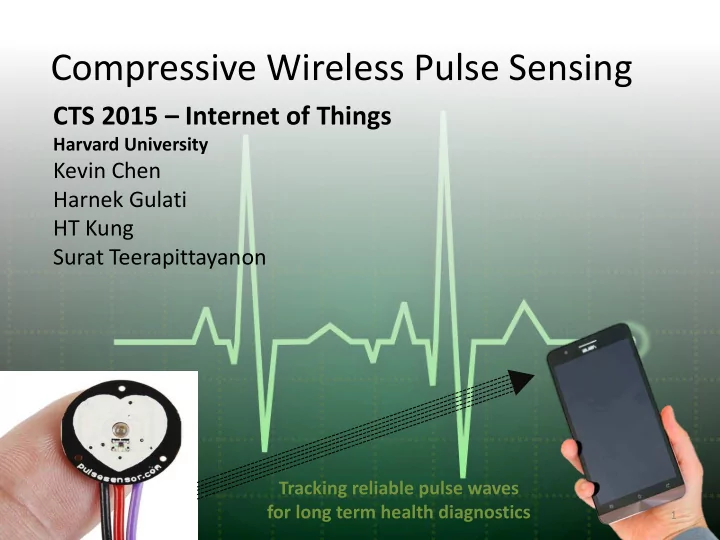
Compressive Wireless Pulse Sensing CTS 2015 Internet of Things Harvard University Kevin Chen Harnek Gulati HT Kung Surat Teerapittayanon Tracking reliable pulse waves for long term health diagnostics 1 Motivation Classification of


slide-1
SLIDE 1

Compressive Wireless Pulse Sensing

CTS 2015 – Internet of Things

Harvard University

Kevin Chen Harnek Gulati HT Kung Surat Teerapittayanon

1

Tracking reliable pulse waves for long term health diagnostics
slide-2
SLIDE 2

Classification of Heart Health Motivation

Classification of heart conditions derived from heart rate over time

[1] Peng, Chung-Kang. "Toward a General Principle of Health and Disease." Toward a General Principle of Health and Disease. Harvard Medical School, Cambridge. 26 Mar. 2015. Lecture.

slide-3
SLIDE 3

Diagnostics based on pulse Motivation

Time (Minutes)

Heart Rate

Apnea Apnea

Blood Volume Time (Seconds)

  • Wrist
  • Finger

Sleep apnea diagnosis based on changes in heart rate Blood pressure calibration from phase change of PPG signals in two locations

3

Time (Minutes)

slide-4
SLIDE 4

Message

With the recent availability of low-power wireless chips, for the first time, we can monitor pulse waves over a long period of time for applications such as measuring heartrate

  • variability. However, we are still limited by the

power budget available on wearables. In this paper, we will show how we can use compressive sensing to reduce power consumption.

4

slide-5
SLIDE 5

Power Consumption of Wearables Problem to Solve

Battery consumption of wearables restricts its ability to continuously monitor pulse wave

2 4 6 8 10 12 Garmin Forerunner Mio Alpha Mio Link Apple Watch

Battery life of heartrate watches

Lifetime (hours) 5

With new low-power wireless chips like BLE and additional power-saving compressive sensing techniques of this paper, it is now feasible for battery- powered wearables to monitor pulse wave continuously for days or even weeks.

slide-6
SLIDE 6

Signal Acquisition

Overview of System

Tracking reliable pulse waves for long term health diagnostics

6

slide-7
SLIDE 7

Video Demo of Pulse Wave Reconstruction

7

slide-8
SLIDE 8

Outline of Presentation

  • 1. Signal Acquisition

– Compressive sensing for pulse waves

  • 2. Wireless Data Transmission

– Forward error correction by interleaving and randomization – Adaptations in response to channel quality

  • 3. Signal Recovery

– Reconstruction of pulse wave through sparse coding – Noise removal

8

slide-9
SLIDE 9

Part One: Signal Acquisition

Compressive sensing for pulse waves

9

slide-10
SLIDE 10

=

y S x Sensing Matrix

Compressive sensing formulation

  • 1. Compression by linear projection

=

x D Dictionary

  • 3. Reconstruction of x

z

Givens Obtain Trained Given

=

y z D S Dictionary Sensing Matrix

  • 2. Finding sparse representation of x

Trained Givens Solve

8

slide-11
SLIDE 11

Uniform subsampling to reduce sensor wake-up time

=

y

1 1 1 1

U

subsampling

x

The measurements y is a linear projection of x

11

We use uniform subsampling as the sensing matrix Obtain

slide-12
SLIDE 12

Finding the sparse representation of x

=

y z D

Dictionary

1 1 1 1

U

Uniform subsampling matrix

subsampling

12

x

Trained Givens

slide-13
SLIDE 13

Reconstructing the signal from sparse representation

13

=

x D Dictionary z

Trained Solved Simple Matrix Multiplication

slide-14
SLIDE 14

Experimental Results

With a dictionary trained on pulse waves, uniform subsampling performs better than classic compressive sensing methods.

Low construction error and very efficient to implement

14

slide-15
SLIDE 15

Wireless Data Transmission

— Forward error correction by interleaving and randomization — Adaptations in response to channel quality

15

slide-16
SLIDE 16

Naïve transmission scheme

Putting a whole signal segment in one packet is not ideal, because there is no way to recover information without resending

#1 #2 #3 #p

#4

Batch of packets

A whole segment of signal is lost

16

slide-17
SLIDE 17

Packet interleaving

By interleaving packets, we can recover the information

  • f lost packet from neighboring received packets.

#1 #2 #3 #p

#4

Batch of packets

1 3 segment 1 Packet 1 Packet 3 Packet n 2 4 6 5

n

n+1 n+3

2n

segment 2 segment 3 segment p

17

slide-18
SLIDE 18

Problems with burst packet loss

However, consecutive packet loss still results in consecutive sample loss in each segment

#1 #2 #3 #p

#4

Batch of packets

1 3 segment 1 Packet 1 Packet 3 Packet n 2 4 6 5

n

n+1 n+3

2n

segment 2 segment 3 segment p

18

slide-19
SLIDE 19

Randomizing packet sending order

We can avoid consecutive sample loss by sending packets in randomized order

#1 #2 #3 #p

#4

Randomized sending order

#10 #3 #1 #21

#2

1st Pkt Sent 2nd Pkt Sent 3rd Pkt Sent p-th Pkt Sent 4th Pkt Sent

Batch of packets

19

slide-20
SLIDE 20

=

y z D

Dictionary

1 1 1 1

U

Uniform subsampling matrix

Reconstruction with updated packet transmission scheme

=

w z D

Dictionary

1 1 1 1

U

Uniform subsampling matrix

C

1 1 1 1

Channel matrix

After Before

We can represent the packet interleaving as a projection

20

Matrix that represents how we interleave packets

slide-21
SLIDE 21

Reconstruction error with varying packet loss rates

Channel is good, so we can sample at a very low rate. Channel is bad, but we get loss tolerance by simply increasing sampling rate

21

Transmission rate is adaptive to packet loss

slide-22
SLIDE 22

Signal Recovery

— Reconstruction of pulse wave through sparse coding — Noise Removal

22

slide-23
SLIDE 23

Reconstructing the signal

=

w z D

Dictionary

1 1 1 1

U

Uniform subsampling matrix

C

1 1 1 1

Channel matrix

1. Use sparse coding to recover z

Known Solve

=

x z D

Dictionary

2. Reconstruct x

23

slide-24
SLIDE 24

Cleaning the signal from outliers

There can be outliers caused by movements, sensor voltage change, etc.

24

slide-25
SLIDE 25

Augmenting the dictionary for noise removal

With a little tweak, we can even tolerate corrupted measurements

=

w z CUD

Dictionary

1 1 1 1

Identity matrix

Corrupted measurement

25

slide-26
SLIDE 26

Reconstruction error at different noise levels

We can deal with corrupted samples by increasing sampling rate

26

slide-27
SLIDE 27

Pulse Diagnostics Readily Available Implications of Our Results

Long term health monitoring made possible

Time (Minutes) Heart Rate Apnea Apnea Blood Volume Time (Seconds)

  • Wrist
  • Finger

Sleep Apnea diagnosis based

  • n changes in heart rate

Blood Pressure Calibration from phase change of PPG signals in two locations Classification of heart conditions derived from heart rate over time

27

slide-28
SLIDE 28

Signal Acquisition

With new BLE chips, continuous health monitoring is possible for the first time

Lower wakeup frequency

Summary

28

slide-29
SLIDE 29

Conclusion

Due to the recent availability of pulse sensing chips, and low-power wireless chips, for the first time we can monitor pulse waves over along period for applications such as measuring heartrate variations. But we have a challenge of coping with limited power budget available on

  • wearables. We have shown in this paper that we

can use compressive sensing to reduce power consumption.

29

slide-30
SLIDE 30

Training a dictionary with pulses* (remove?) =

x z D

Dictionary

30

Trained on earlier samples

slide-31
SLIDE 31

31

slide-32
SLIDE 32

Naïve transmission scheme

Putting a whole signal segment in one packet is not ideal, because there is no way to recover information without resending

#1 #2 #3 #p

#4

Batch of packets

A whole segment of signal is lost

32

c

slide-33
SLIDE 33

33

slide-34
SLIDE 34

Compressive Wireless Pulse Sensing

Signal Acquisition Kevin Chen Harnek Gulati HT Kung Surat Teerapittayanon

34