Computer Networks M Group issues and policies Antonio Corradi - - PDF document

computer networks m
SMART_READER_LITE
LIVE PREVIEW

Computer Networks M Group issues and policies Antonio Corradi - - PDF document

University of Bologna Dipartimento di Informatica Scienza e Ingegneria (DISI) Engineering Bologna Campus Class of Computer Networks M Group issues and policies Antonio Corradi Academic year 2015/2016 Groups issues & policies 1


slide-1
SLIDE 1

Class of

Computer Networks M

Antonio Corradi Academic year 2015/2016 Group issues and policies

University of Bologna Dipartimento di Informatica – Scienza e Ingegneria (DISI) Engineering Bologna Campus

Groups issues & policies 1

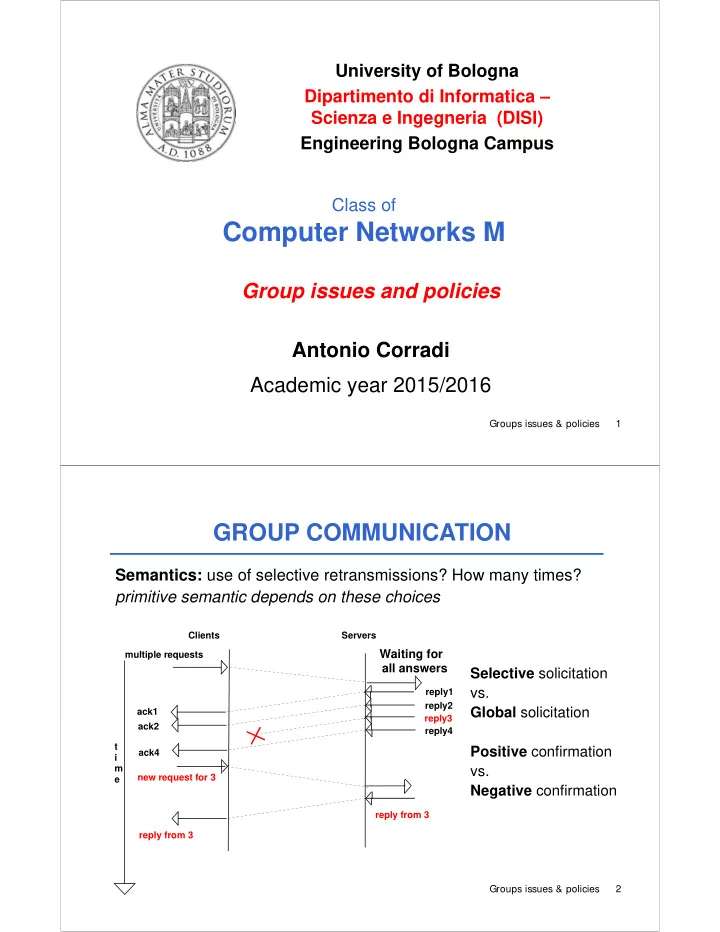
Semantics: use of selective retransmissions? How many times? primitive semantic depends on these choices

GROUP COMMUNICATION

Waiting for

Servers t i m e Clients multiple requests

all answers

ack1 ack2 ack4 new request for 3 reply from 3 reply from 3 reply1 reply2 reply3 reply4

Selective solicitation vs. Global solicitation Positive confirmation vs. Negative confirmation

Groups issues & policies 2

slide-2
SLIDE 2

MULTICAST SEMANTIC The multicast action could make the multiple group sending

  • perations atomic, but they can try to associate a different and

more suitable meaning

GROUP COMMUNICATION

sender R1 R2 R3 R4

Motivations of the interest

  • bject copy location

inside a system

  • fault tolerance
  • use of data replication

and streaming

  • multiple changes on

group entities

Groups issues & policies 3

TWO aspects

  • f

MULTICAST SEMANTICS are intertwined and can be untangled Reliability

group members message reception reliable  guaranteed delivery unreliable 

  • nly 1 attempt (Chorus)

Atomicity

message reception for all group members with possible different ordering for different actions

The two aspects can and must be considered in separation Essential Element We must think not only to the semantics of a single action, but also to message

  • rdering

in a multiple action

  • ccurrence (and consider their synchronization)

GROUP COMMUNICATION

Groups issues & policies 4

slide-3
SLIDE 3

Reliability can be achieved if some occurrences cause no problems – sender crash – receiver crash – message omission Necessity of fault identification and recovery through monitoring of multicast and group actions – check of every ongoing communication – eventual retransmissions – removal of failed components – protocol to re-enter in the group The additional costs for identification and recovery must be considered and they apply in case of failures

RELIABLE MULTICAST

Groups issues & policies 5

Implementation

  • Dispatch all message to the group members support and

delay before passing them to the applications

timeout and retransmission (who checks the protocol?)

  • How long to wait? problems with efficiency
  • If controller fails?

Quis custodiet ipsos custodes? (Juvenal / Giovenale)

hold-back  the support holds a message until it is sure that all previous others reached the destination in order

In case of dense numbering, a message is delayed until all previous

  • nes appeared (if is the number 3, it must appear after and 2)

negative ack  the support sends an ack only in case of losses, to highlight those events (in selective way)

RELIABLE MULTICAST

Groups issues & policies 6

slide-4
SLIDE 4

The other aspect of ATOMICITY is connected to semantic connected properties with atomicity we focus on the reception order of messages by any alive members of the group

In distributed systems sometimes we are not so interested in

  • btaining a very tight synchronization of copies

No Ordering  the multicast messages coming from any sending process to all receivers can present a different

  • rdering in any copy

The No ordering policy is very nice to support It has no cost and you do not have to synchronize copies in any way and they are free of operating on their own

ATOMICITY VS. NO ORDERING

Groups issues & policies 7

We have many situations in which we want to require some connections between copy scheduling FIFO Ordering  from the same sending process to all receivers for a sequence of successive multicast messages

In case of FIFO ordering, two multicast messages from the same sender reach any group member in the same order For example, m1 and m2 from S1, and m3 and m4 from S2 reach everyone respecting sending order of the two senders many sequences are compatible m1 m2 m3 m4, m1 m3 m2 m4, m1 m3 m4 m2, m3 m4 m1 m2, m3 m1 m2 m4, …

We can use supports that already guarantee FIFO Otherwise we need to achieve it An easy way is message numbering for that specific sender

FIFO ORDERING

Groups issues & policies 8

slide-5
SLIDE 5

Compliance with FIFO ordering guarantees that every message to the group from the same sender (and its requests) are received in the same order in which are sent from the group (only related with same sender multicasts) Compliance with FIFO ordering do not guarantees a feature that we tend to consider considering more than one sender

A sends a news Na B receives the news and sends a response to Nb C receives first Nb then Na (Nb before Na) D receives first Na then Nb (Na before Nb)

We need to consider cause/effect relationships between different (two or more) senders

FIFO ORDERING LIMITATIONS

Groups issues & policies 9

CAUSE-EFFECT

  • rdering

can connect events from different senders process CAUSAL ordering  events that are correlated with a cause-effect relationship

  • utside

the group must be acknowledged by the group and the group must achieve consistency about them (to be delivered to everyone) first the cause than the effect (Cause before Effect)

In case of CAUSAL ordering, two multicast messages in the causal relationship must be considered in the right order from everyone For example, m1 and m2 from S1, and m3 and m4 from S2, and m1 causes m3. So they must reach copies respecting FIFO and CAUSAL

  • rdering. Many sequences are compatible

m1 m2 m3 m4, m1 m3 m2 m4, m1 m3 m4 m2 NOT m3 m1 m4 m2

There are no supports that guarantee CAUSAL ordering How can we guarantee it?

CAUSAL ORDERING

Groups issues & policies 10

slide-6
SLIDE 6

Compliance with CAUSAL

  • rdering

guarantees that messages from different senders in cause-effect relationship are received in the causal order by the group Compliance with CAUSAL ordering for just one sender is similar to FIFO and it is easy to implement Compliance with CAUSAL ordering do not catch real world situations that we tend to take for granted in case of

more then one operations

A requests an action to Na; B requests an action to Nb These actions are not related C receives first Nb and then Na, D receives first Na then Nb

So copies have different internal decisions of scheduling

CAUSAL ORDERING

Groups issues & policies 11

No external relations imposes a scheduling, but the group should act in a coordinated and reasonable way, with all the members the operate in the same order ATOMIC ordering guarantees that all messages are received in the same order by all group members (so related actions can occur in the same order in all copies) Often no predetermined order is likely, but it is necessary to agree on one and it should be the same for all If a copy C decides to receive first Nb then Na, all copies must follow that decision

Nb may ask to compute an interest on a bank account, Na intends to make a withdrawal

Obviously, many different atomic orderings exists that we can consider with group operations

ATOMIC ORDERING

Groups issues & policies 12

slide-7
SLIDE 7

In a distributed environment the introduction and the and enforcing of orderings is costly

(coordination between group entities or numbering support) and tend to enforce it only when necessary Minimum cost: no ordering  each one group member work in a free and independent way

FIFO and CAUSAL ordering ore orderings that we tend to enforce only for some specific events in the system Partial orderings ATOMIC ordering is an ordering that we tend to enforce on every event within the group in the system Total or global ordering

ATOMIC ORDERING

Groups issues & policies 13

Obviously, given a group and a set of events coming from outside, we may have many different atomic orderings

How many? ATOMIC orderings Among many atomic orderings, some of them can follow

CAUSAL and FIFO ordering, some only FIFO, some only CAUSAL, and some of other none of them

Costs for atomic orderings can be very different

ATOMIC ORDERING

A B

Groups issues & policies 14

slide-8
SLIDE 8

FIFO multicast with ordering only from the same sender messages from the same sender arrive with sender and ordering number and are delivered in that order (only for the same sender) CAUSAL multicast with causal ordering (logic) messages arrive and are delivered to the group in order to respect the relationship if the event A causes the event B Lamport ordering ATOMIC multicast requires the same order (any order) for all messages to the group members ATOMIC multicast imposes a total or global ordering for messages that arrive to the group and must be delivered with the same order to all correct members of the group We stress that an atomic order does not necessarily subsume the other two or anyone of them: any order can be decided inside the group

MULTICAST ORDERING

Groups issues & policies 15

ATOMIC multicast needs the same order

A simple way to implement it is to have an entry element (a front end) inside the group and it is the one that orders messages while they arrive and imposes an increasing numbers before sending them to all other members of the group

Every member receives messages and must send them in the agreed order to the application layers

Disadvantages of this implementation are

Problems in case of coordinator fault (that defines and rules the policy) Unfair management: the coordinator neighbors or preferred ones can be favored and scheduled always before others (that have made their requests before)

Low cost solution, but very unfair

 mobile coordinator (circulating token) Many other solution even more dynamic (Lamport, ring, etc.)

MULTICAST IMPLEMENTATION

Groups issues & policies 16

slide-9
SLIDE 9

Synchronization means to impose orderings on events, typically …there are Constraints on temporal ordering of some events inside a distributed system It is necessary to provide a consistent view of the system to the entire set of communicating processes

Communication and Synchronization are often correlated, for example:

  • synchronizing sender / receiver of a message
  • check on cooperating activities
  • serialization of access to shared resources
  • N processes in access to a resource (mutually exclusive)

so, ordering on important events must be enforced

SYNCHRONIZATION

Groups issues & policies 17

Synchronization by using PHYSICAL TIME and PHYSICAL CLOCK Unique time can be determined, if we assume that either 1) a unique clock is available on every node or 2) one clock for any node, and all of them perfectly in sync This work assumption is perfectly admissible in concentrated

  • r limited systems, but absolutely not feasible and easy to be

granted in distributed and global environments It has been defined Universal Coordinated Time (UTC) that

is based on the transmission of the value and on local correction Some systems are based on coordination clock

A node verifies the time of all group members, computes the average and distributes it to all as the group time (Berkeley time)

CLOCK SYNCHRONIZATION

Groups issues & policies 18

slide-10
SLIDE 10

NTP - Network Time Protocol introduces a protocol based on UTC and on synchronization to achieve an agreement on clocks NTP tries to overcome possible transmission delay of the common time through statistical filtering policies based on historic behavior of servers

Starts with a higher server hierarchy, where every node transmit time to lower-level neighbors (its subtree) The primary nodes are more accurate and going farther from the root, accuracy decreases, of course The NTP tries to make actions to recover from server fault

The problem that can occur, by using clocks not perfectly in synch, is that an event happened afterwards maybe labeled and considered before an event that precedes it in time (that may produce a wrong time synchronization)

CLOCK SYNCHRONIZATION

Groups issues & policies 19

Synchronization via PHYSICAL TIME clashes with the difficulties of guaranteeing synching of clocks and a high implies a high overhead and also may present errors Precision requires to coordinate continuously the clocks, and it is impossible to avoid conflicts and clock drifting with limited overhead

Typically distributed synchronization is not based on complex algorithms of physical clock agreement but based on different strategies that can restrict the sync requirements and focus only on a subset of global system events

The idea is to work on a subset of events (considering only some interesting events) and to create an agreement only on them The assumption of a limiting focus and a reduced group can limit the

  • verhead and protocol cost

SYNCHRONIZATION

Groups issues & policies 20

slide-11
SLIDE 11

Several Distributed Synchronization Methods

Ordering of logical time of Lamport We can use timestamps (time indicator) to label relevant events and to order them  logical clocks and "happened before“ relationship Token passing LeLann ring strategies We can use authorizations, and the token can pass in a logical ring to order events Events based on priority We can use process priority to order correlated events Used in real-time systems and unfair

SYNCHRONIZATION STRATEGIES

Groups issues & policies 20

Lamport aim at to ordering some events in a distributed system, by excluding physical time

Only some events are considered in the distributed system with a scenario constituted by processes that have their internal history and can exhibit a behavior based on two kinds of events: 1) local: local events 2) remote: interprocess event, generated by sending messages form one process to another process We limit the actions of interest

The ordering must consider only some ‘relevant’ events and aims at creating a simple ordering policy, on which to eventually establish a correct synchronization with adequate costs and not very expensive to implement

LAMPORT RELATIONSHIP

Groups issues & policies 22

slide-12
SLIDE 12

Events ordering for a set of processes that communicate through message passing based

  • n

cause-effect relationship introduced by process actions 1) If a and b are events of the same process and a occurs before b, then a  b (local order) 2) If a is the sending of a message of one process and b the receiving event within another process, then a  b (communication interprocess order) 3) If a  b and b  c, then a  c (transitivity) The relation introduce a partial ordering in systems events and it exists only among some systems events and not available among all events (it is not a total ordering) Two events are concurrent  if not a  b and not b  a

HAPPENED-BEFORE RELATIONSHIP

Groups issues & policies 22

HAPPENED-BEFORE RELATIONSHIP

a1 c1 c2 b3 b1 b2 a2 a3 Pa Pb Pc

a1  a2, a1  a3 a1  b1, a1  b2, a1  b3 c1  c2 c1  b2, c1  b3, c1  a3 Concurrent events a1 c1, a1c2, … a2 b2, a2  b3, …

Groups issues & policies 23

slide-13
SLIDE 13

The happened-before relationship allows to work in a distributed system in which only  is enough for ordering

We do not assume a unique global clock (global time), but allow for a set of local clocks (local time)

We assume also to work in an asynchronous assumption, that considers possible any transmission delay for messages, variable and unlimited, in principle, so higher than any significant possible delay  We may need several ordering strategies, also global

  • r total to synchronize

We want to build a logical time system built on the  relationship that is based on logical clocks and not on physical clocks

HAPPENED-BEFORE RELATIONSHIP 

Groups issues & policies 24

We need to construct a clock system (system timestamp) to assign a simple indicator, a ‘number’, to order events The happened_before relationship is only partial

We define a function TS(i), a logical time-based function (called timestamp) that must assign a value to any relevant event If a  b in the system, than the logical timestamp of events must respect the law TS(a) < TS(b)

If need a clock condition, if we want to infer the global logical clock function LC for system events related to processes Pi Clock condition (Logical Clock - LC) Given a and b, if a  b, than LC(a) < LC(b) NOTE: it is not true that, if LC(a) < LC(b), than a  b

LOGICAL CLOCKS and TIMESTAMP

Groups issues & policies 26

slide-14
SLIDE 14

Any process Pi has a logical clock LCi(c) (an integer counter)

  • C1. For a and b, if a  b inside the same process Pi,

then LCi(a) < LCi(b)

  • C2. For a and b, if a is the sending of a message in the

process Pi and b the reception in the process Pj, then LCi(a) < LCi(b)

  • I1. Every process Pi increments LCi between any two events
  • I2. For a, sending of a message in process Pi, the message

contains a clock as timestamp TS = LCi(a)

  • I3. For b, reception of a message in process Pj, the process

put the logical clock at the greater value between current clock and timestamp LCj = max (TSreceived, LCicurrent) + 1 These rules introduce a partial order relationship

Many events concurrent a b with equal timestamp

LOGICAL CLOCKS and TIMESTAMP

Groups issues & policies 27

WHO DOESN’T RECIVE, DON’T UPDATE

a1 c1 c2 b3 b1 b2 a2 a3 Pa Pb Pc

The  relationship allows to

  • rder events according with

a logical cause-effect relation but the sender has initiative and forces the update the logical clock of the receiver, but not its own… (it is the receiver that has to update clock to sender, with a transmission eventually)

26 25 23 8 27 9 28 10 27 29 30

Groups issues & policies 28

slide-15
SLIDE 15

HAPPENED-BEFORE  PARTIAL

a1 c1 c2 b3 b1 b2 a2 a3 Pa Pb Pc

The  relationship allows to catch cause-effect event

  • rdering

But … it also make you assume an ordering of events even without the  relationship Concurrent events in real world – such as c1 and b1- are considered one after the

  • ther … so in sequence

What is the relationship between the b2 and c2 events (same timestamp)?

6 5 6 8 7 9 10 10 11 11 12

Groups issues & policies 29

Sometimes it is necessary to introduce some total order relationship between all process events in the system These cases are dealt with by a global order relationship  between all system events that is based on logical clock and on the partial ordering of  total order relationship  If a is an event in process Pi and b an event in process Pj, than a  b if and only if R1) LCi(a) < LCj(b) or R2) LCi(a) = LCj(b) and Pi < Pj The total ordering assume that in case of events of the same clock, there is an order between all processes It is possible to use  to define an univocal and simple

  • rdering to create synchronization upon

TOTAL ORDERING and 

Groups issues & policies 30

slide-16
SLIDE 16

The Lamport relationship  is a logical one and it is loosely connected with the real world; it cannot be considered a physical world relationship (it does not respect ‘reasonable’ human behavior) In general who receive messages update its time

Those who do not receive messages may maintain a very low timestamps and are not forced to sync logical clocks (so their timestamps can be very favorable)

Hidden channel problem

If a process can use a external and non mapped channel to communicate (hidden channel), that can lead to a situation that do not respect cause / effect relationship

The effect in real world can have a timestamp more low than cause

Causality problem Two events considered by Lamport in a causal relationship can instead be not related

TOTAL ORDERING and REALITY

Groups issues & policies 31

HAPPENED-BEFORE  TOTAL

a1 c1 c2 b3 b1 b2 a2 a3 Pa Pb Pc The  relationship orders any pair of events it makes possible to consider in sequence two events that are instead concurrent in real world c2 and b2 are managed as in sequence, by considering first process Pb, then Pc 6 5 6 8 7 9 10 10 11 11 12

Groups issues & policies 32

slide-17
SLIDE 17

There are other strategies it is possible also to consider vector logical clocks or Vector Clocks to order events in a process set Processes must maintain a vector of all known clocks of all the processes and use that in communication Every process keep its timestamp and a vector Vi[k] of integers of a dimension of the number of processes A vector clock element Vi[k] contains information on what a process knows about the clocks of the others processes The process Pi in the vector keeps: 1) Vi[i] its timestamp (index i) 2) Vi[k] the timestamp of any other process Pk at its knowledge So the data structure is more complex for processes and also for the protocol to communicate and update the vector

VECTOR CLOCK ORDERING

Groups issues & policies 33

The Vector clock update protocol is based on the steps:

  • 1. Every process Pi increments Vi[i] between two events
  • 2. For  sending of a message to process Pi, the message

contains the whole vector clock at best knowledge of Pi after incrementing its own Vi[i] = Vi[i] + 1

  • 3. For  reception of a message, the process Pj increments

its own Vj[j] = Vj[j] + 1 and updates its vector according to Vj[k] = max (Vj[k], Vi[k]) The receiver obtains information on the logical time of the sender process and also on time that it knows of all others Vectors clocks allow a better information propagation and permits a wider information exchange and diffusion (sometimes matrices are used)

A VECTOR CLOCK PROTOCOL

Groups issues & policies 34

slide-18
SLIDE 18

The logical clock protocol produces updating of clock values at message reception In case of communication  the receiver clock adapts then all successive events are ordered with  The main cons is that events not in the  relationship can be taken as if they were The vector clock protocol instead pays the cost of the propagation

  • f the entire vector and requires to adjustment of the entire vector

at the receiver The vector clock  requires to apply to all dimension of the clock, … so it becomes more significant and the relationship if bi-univocal

With vector clock algorithms

The events in  are recognized to be in cause effect relationship and the events not in that relationship, i.e., concurrent events , are recognized not to be in the  cause-effect sequence

LOGICAL CLOCK vs. VECTOR CLOCK

Groups issues & policies 35

VECTOR CLOCK

a1 c1 c2 b3 b1 b2 a2 a3 Pa Pb Pc

With vector clocks we can identify if two events are in a real cause-effect relationship Not only events in relationship are tagged and ordered, but

  • thers events that are not

cause effects are recognized as such Concurrent events in real world - c1 and b1, a1 and c2,… - are not considered in the cause effect relationship

6,0,0 5,0,0 0,6,0 0,0,8 6,7,0 0,0,9 6,8,9 0,0,10 7,0,10 6,9,9 8,9,10

Groups issues & policies 36

slide-19
SLIDE 19

The simplest synchronization case is the scenario of a set of processes that have to access a resource in a mutually exclusive way

We have to assume that every process must access to the resource for a limited time and release it after usage

OBJECTIVES: Safety

  • only one process at a time can have access to the

resource Liveness - every process that has done a request receives the access after a limited delay Fairness - different requests must be managed by a fair policy Obviously we have many ways to realize it We exclude fixed priorities that are unfair and can cause starvation

SYNCHRONIZATION

Groups issues & policies 37

We can follow an approach based on a Coordinator process

An approach completely centralized considers a unique coordinator process known to all others processes (all participants must not know each others – C/S model, but they know the cooordinator) Every process that intends to access the resource sends the request to the coordinator and after usage, notifies it The coordinator process decides the scheduling of the resource accesses by using its policy to grant mutual exclusion

Obviously the coordinator can decide different policies (FIFO management or others) We assume that the coordinator receives all requests sent and queued in a reliable way (but with any delay)

RESOURCE SYNCHRONIZATION

Groups issues & policies 38

slide-20
SLIDE 20

Protocol of the coordinator

1) a process when it intends to access to the resource sends a request message (request) to the coordinator 2) The coordinator serves its request queue and it is free of deciding the request to reply to (reply). Obviously, it must send

  • nly one reply to one request at a time (typically FIFO).

3) when receiving the reply, the process can use the resource and at the end, must send a release message to the coordinator (release), that can decide to reply to another request, etc., etc.

3 messages for every access to the critical section

There are several disadvantages stemming from the centralized and unique role of the coordinator The case of coordinator fault and of its potential unfairness Differentiated delays in reaching the coordinator

RESOURCE COORDINATOR

Groups issues & policies 39

Lamport proposes a decentralized solution without single failure points A set of N processes that must access to a single resource in mutual exclusion, without assuming any centralized role and trying to grant that requests are served in order (in a fair way)

Participant processes must only examine their request queue Processes exchange messages between each other to obtain synchronization and must use Lamport clock relationship (up to 

relationship) Assumptions:

  • messages between processes must arrive in FIFO order
  • messages can be delayed but not lost
  • the connection between processes is complete and direct

LAMPORT SYNCHRONIZATION

Groups issues & policies 40

slide-21
SLIDE 21

Use of logical clocks and Lamport relationship Every process has a local queue of received messages, in which messages are queued in order of timestamps For every process, the local queue initially contains the message T0:P0, lesser than every clock in the system

Clock is considered a logical time, specified by an integer and with the process identity that owns it Every message has a timestamp that depends

  • n

both components (process and logical clock) and allows fair ordering

A process that decides to access a resource must execute a global coordination protocol Every process must know any other and faults are not expected (N processes in order of index compose a static group)

LAMPORT PROTOCOL

Groups issues & policies 41

Protocol

1) The process Pi sends the request message Tm:Pi to every process (even in its queue) to signal its intention to access to the

resource

2) At message Tm:Pi reception, the process Pj (and already in its

queue) sends a reply with its updated timestamp

3) The process Pi can use the resource if in its local queue:

  • It has the request Tm:Pi ordered before any other request of
  • ther processes ( relationship)
  • It has at least one message coming from any other process

with a timestamp successive to Tm 4) At the release, Pi removes the message from its queue and sends a release message with its timestamp to every process 5) Every process Pj receives the release request and removes the request message from its queue

Mutual Exclusion PROTOCOL

Groups issues & policies 42

slide-22
SLIDE 22

That solution grants that every process that executes the protocol can receive the resource with a limited time delay, if every process respects the constraints

Let us note that the process that requested to access, but waits and enforces a coordination with any other participant Every request message sent requires a response from all others The wait for messages form any other process in the system, allows for the arrival of other possible requests from other processes that may precede the current one and, once arrived, are queued ordered by timestamp Every process queue is ordered, and so a process can pass

  • nly when ‘previous’ requests have been served already

At least (N-1) messages sent and the same number received before entering

RESOURCE SYNCHRONIZATION

Groups issues & policies 43

The synchronization worst case is when all processes want to access the resource at the ‘same’ time

In case two processes make a request, they separately agree on the fact that first to enter is the one with the lower timestamp So there cannot be conflicts

The algorithm occurs without any centralization, but in a completely distributed way For every action on the critical section the number of exchanged messages is (considering a probable broadcast as N-1 messages, unless you can obtain lower cost) Number of messages 3 * (N-1) or N-1 and 2 broadcast We have a high cost due to decentralization Heavy assumptions on the static group and no faults

SYNCHRONIZATION COST

Groups issues & policies 44

slide-23
SLIDE 23

Ricart & Agrawala protocol

1) Process Pi sends the request message Tm:Pi to any process

(even it its queue) to signal its intention to access to the resource

2) At message Tm:Pi reception the process Pj sends

  • an immediate approval reply if does not need the resource or the

requester has a higher priority

  • Delay its reply if is using the resource or it has already asked to

enter and its has a higher priority 3) Process Pi access the resource only if receive N-1 approval messages 4) At release, Process Pi must send approval to all arrived requests 5) The requests are deleted after approval Only one process can have N-1 approval responses and

  • nly a process can access the resource at a time

OTHER M.E. PROTOCOL

Groups issues & policies 45

For every action in the critical section, the number of exchanged messages is (a possible broadcast costs as N-1 messages) Number of messages 2 * (N-1) So, there are N-1 messages from requester and N-1 from everyone else difficult to foresee a coordination at lower cost These algorithms are based on variations of Lamport relationship are completely distributed (no unique manager) fair and free from deadlock and starvation But they may have high costs in terms of exchanged messages for coordination have high costs due to decentralization Heavy assumptions of messages not lost and static group without faults

RA - SYNCHRONIZATION

Groups issues & policies 46

slide-24
SLIDE 24

Distributed implementation of atomic multicast can be less centralized than the obvious one with a unique coordinator CATOCS CAusal & Totally Ordered Communication operations Support based on a by-need dynamic coordination of a set of managers that decide internally the request order The group does not have a unique central manager, but coordinates on need and create a unique vision: it is possible to have a manager selected for every request that negotiate with

  • thers and obtains all the requests to synch with others

Realization not scalable and implementation

  • f

different efficiency (?) or at least efficient only in specific cases

Availability

  • f

a broadcast at a low level can solve many implementation problems and enhance efficiency (we also need a support that grant the assumption of not losing messages, connecting all processes, … etc.)

ATOMIC MULTICAST

Groups issues & policies 47

ISIS appeared in the 1990… for CATOCS

ISIS is system based on groups with active replication and with necessity of a vision with different degrees of coordination of group components The system obtains coordination with many different forms of group multicast (called broacast) Many different multicast forms are available (BCast) FBCast (Fifo BCast) CBCast (Causal BCast) ABCast (Atomic BCast) GBCast (Group BCast) Providing also support to the case of no copy coordination In general, there are no assumptions on group central roles, but any operation need a manager, typically chosen dynamically according to any kind of policy (closeness, … )

ATOMIC MULTICAST - ISIS

Groups issues & policies 48

slide-25
SLIDE 25

ISIS ABCast (Atomic BCast) That CATOCS uses a queue for every corresponding component of the group and Lamport relationship The messages that arrives to any group element are tagged with an initial arriving timestamp and only considered if labeled as final in the right order for Lamport relationship Every arrived message requests a coordination phase of the manager (and hold-back) to determine the final timestamp

The coordinator receives the message:

  • labels it, and sends it to all others (with its timestamp)
  • anyone else labels the answer with its timestamp based on its time

(clock) and sends the answer back with its timestamp

  • labels it as final with the received highest timestamp (is it necessary?)
  • resends the message with the final timestamp to all others to

communicate the final decision

Any in the group has all messages in the same order in its queue Problems: delay and overhead - message cost of 3 * (N-1)

ATOMIC MULTICAST - ISIS

Groups issues & policies 49

ISIS ABCast (Atomic BCast) achieves the total

  • rdering
  • f

messages for a group toward a coherent group vision

The group must reach an internal agreement and that can also not be a compliant vision to external timestamping (not to be respected)

Group members cannot operate on one request until it is sure that the message:

  • has been seen also by everyone else (arrived to anyone)
  • has been ordered with respect to any other message for the

group (arrival order) The group is achieving consistency in operation ordering and, so, atomicity and global order is guaranteed

  • other messages not yet arrived, maybe sent before these, will be

considered only afterwards by the entire group And if we have to guarantee causal multicast? How do we do that? It is more or less complex?

ATOMIC MULTICAST

Groups issues & policies 50

slide-26
SLIDE 26

ISIS CBCast (Causal BCast) also partial ordering

That multicast tends to consider only some external events that are considered to be ordered respectively; all other events can be ordered differently by any group components (limiting costs and coordination)

ABCast tends to impose an order based on timestamping decided inside the receiver group (internal event ordering strategy) CBcast requests a behavior decided outside the receiver group that have to detect a cause-effect relationship by inferring it via timestamps arriving from outside (internal event ordering strategy) The Causal Broadcast assumes a coordination between senders that must update their “logical clock” and send information to receivers (requests are queued in the group with the senders timestamps) Group members must only respect that ordering If a cause would not reach the group before processing the effect? Necessity of undo or error

CAUSAL MULTICAST - ISIS

Groups issues & policies 51

ISIS GBCast (Group BCast) In the real world, the group of processes can dynamically change in cardinality, so it is possible to join or to leave the group for different reasons (possible group inconsistencies and problems) For every concurrent multicast, the message arrive in two states:

  • to every member before group changing
  • to every member after a gropu changing

consistent ordering of any BCast events, either before or after GBCast makes possible to order all Bcasts, so either the message is received only after receiving every previous BCasts still in process (or before, in a consistent way)

GBCast requires a monitoring support for group variation events (insert and extraction, because of fault and reinsertion, triggers one GBCast) Every group member uses of a table for other member memberships to the group, and that table is updated by a GBCast (so all other Bcasts can be aware of it and consistently ordered)

OTHER MULTICAST - ISIS

Groups issues & policies 52

slide-27
SLIDE 27

JGROUPS

Support for reliable multicast and for group concept Designed in Java and with user defined proprieties JGROUPS starts with a transport level, either not connected or connected, and it is also possible to work with JMS (Java Message Service) for message specifications The goal of JGROUPS is group and message delivery

  • rdering: it proposes a reliable implementation, intended as

delivery with message retransmission, with most common different ordering: atomic, FIFO, causal, etc. For the group property, groups are dynamic and managed in membership: every group element benefits from group messages, both from outside that from inside the group Possibility of security, like encryption and other secure support protocols

JGROUPS – RELIABLE MULTICAST

Groups issues & policies 53

To

  • vercome

the problem

  • f
  • ne

central coordinator, the synchronization can be deployed by changing the coordinator without a fixed role, but varying the responsibility The synchronization is associated with a token dynamically passed between N different participants

SYNCHRONIZATION by using TOKEN

1 2 3 4 5 6 7 8 token

The nodes are organized in a logical ring (ON), where every node knows the next

  • ne

(successor and predecessor) Every node acts as the group manager when it owns the token that it must keep for a while, then must pass to the next one The token circulates among the N different participants

Groups issues & policies 54

slide-28
SLIDE 28

A logical RING connects all N participants and the token current

  • wner is the manager of ME

Protocol to access to the resource: who has the token,

  • verifies that it is the expected recipient and
  • uses the token for a time period with a maximum detention

(it manages ME to access resources for all N nodes)

  • addresses it to the following

Only one process at a time can access ME resources, only one process has the token at a time and no conflicts can arise Starvation is not possible, if the token moves in the ring in one direction only Number of messages N for complete token passage The working scheme is typically proactive: the token must circulate even without requests Problem if the token is lost (failure of the node that has it)

RING SYNCHRONIZATION

Groups issues & policies 55

The case of losing the token or having more than one must be avoided (since they are unsafe for ME) In case of failure of the node that has the token, it is necessary to regenerate it Token loss must be prevented (due to fault on manager node) Every node, sending the token in the ring, activates a timeout interval (depending on N and on maximum permanence of token in a node) that is reset at token return

SYNCHRONIZATION in a RING

1 2 3 5 6 7 8 9 token

In case the timeout is triggered, the node starts a recovery procedure to regenerate the token Note that more than one node can start this procedure

Groups issues & policies 56

slide-29
SLIDE 29

Election protocol to decide who must become the manager (by generating a unique new token) based on static priority

  • At timeout, the process creates an election token (ET) with his

name and enter an election state until the token returns

  • If the process receives the normal token before the generated

ET is back, the election is considered useless and terminated (ET destroyed at return)

  • If the process receive an ET from another process, it is

registered on an election list together with identity of process that generated it, and it is passed inside the ring if it has already generated an ET token, verifies the static priority and decides who has highest priority in the election

  • If the process receive its ET, removes it and verify registration

list The process generate a new token, if the it is the node with minimum index (top priority) inside the registration list

ELECTION REQUIREMENT in a RING

Groups issues & policies 57

The RING architecture allows to execute very simple recovery algorithms in case of single fault with limited duration Obviously, any node must execute some local neighbor correctness checks to re-create the ring and overcome failure in case of neighbor failure Any node must also know the further following node

ELECTION in a RING

1 2 3 5 6 7 8 9 token election 3 1 9

In this case, the token can be regenerated from the node with higher priority among the considered ones (here the number 1) The election token become the new token

Groups issues & policies 58

slide-30
SLIDE 30

The election protocols are used any time an agreement among participants must be found without a predefined policy They are typically necessary in case of fault and recovery in a group to obtain distributed and easy agreement on a decision In many cases, it is based on a potential static order of participants BULLY algorithm Every participant Pi that detects necessity of an election (event local to everyone) or a recovery for a management role can do it Three types of messages are considered

  • message Election
  • answer Answer
  • announcement IAmCoordinator

How many phases there are in election protocols?

ELECTION PROTOCOLS

Groups issues & policies 59

1) sends an election message to processes with higher priority (Election) 1’- in case of election message from a lower priority process, sends an answer to block and a new election is started 2) after some time, … Answer coordination messages from superior nodes can arrive

  • if they arrive, the low priority process stops
  • if no message arrives from higher priority

processes, it becomes a coordinator and 3) signals its presence with the message IAmCoordinator to lower priority nodes that are advised

BULLY ELECTION

1 Election 2 I-1 I+1 I Answer IAmCoordinator

Every participant can start the election at any time triggered by some timeout events

Groups issues & policies 60

slide-31
SLIDE 31

Optimist: A distributed system is a collection of independent computers that appears to its users as a single coherent system Pessimist: “You know you have one when the crash of a computer you have never heard of stops you from getting any work done.” (Lamport) Academics like point of view: Clean abstractions, Strong semantics, Things that are formally provable and that are smart Users like point of view: Systems that work (most of the time), Systems that scale well, Consistency not important per se

TWO PERSPECTIVES

Groups issues & policies 61

The idea of granting the maximum of consistency is embodied by the ACID properties typically considered in

  • Concurrent execution of multiple transactions
  • Recovery from failure
  • Atomicity: Either all operations of the transaction are properly

reflected in the database (commit) or none of them are (abort)

  • Consistency: If the database is in a consistent state before

starting a transaction, it must be in a consistent state at the end of the transaction

  • Isolation: Effects of ongoing transactions are not visible to

transactions that executed concurrently Basically “we’ll hide any concurrency”

  • Durability: Once a transaction commits, updates can not be lost or

their effects rolled back

ACID PROPERTIES

Groups issues & policies 62

slide-32
SLIDE 32

A “serial” ACID execution is one where is at most one transaction runs at a time, and it completes via commit or abort before another starts: “serializability” is the “illusion” of a serial execution but with heavy costs The costs of transactional ACID model on replicated data can be surprisingly high in some settings. Let us think to two cases:

  • Embarrassingly easy ones: transactions that do not conflict at all

(like Facebook updates by a single owner to a page that others

  • nly read and never change)
  • Conflict-prone ones: transactions sometimes interfere and

replicas could be left in conflicting states, if no attention is paid to

  • rder the updates. Scalability for this case is terrible

Solutions must involve ad hoc solutions, such as sharding and coding ad-hoc transactions

ACID EXECUTION and COSTS

Groups issues & policies 63

eBay researchers

  • Found that many eBay employees came from

transactional database backgrounds and were used to the transactional style of “thinking”

  • But the resulting applications did not scale well and

performed poorly on their cloud Goal was to guide that kind of programmer to a cloud solution that performs much better and to give new guideline sin designing internal applications

  • BASE is the solution that reflects experience with

real cloud applications and provide a new workflow

  • “Opposite” of ACID

BASE MOTIVATIONS

Groups issues & policies 64

slide-33
SLIDE 33

Brewer’s CAP theorem: “you can’t use transactions at large scale in the cloud” Or in large dimension systems

  • We saw that the real issue is mostly in the highly

scalable and elastic outer tier (“stateless tier”) close to the users and does not impact on the second inner layer

  • In reality, cloud systems use transactions all the time, but

they do so in the “back end”, and they shield that layer as much as they can from users, to avoid overload and not to create bottlenecks

CAP STRATEGY

Groups issues & policies 65

Basically Available: the goal is to provide fest responses BASE start from the fact that in data centers partitioning faults are very rare and are mapped to crash failures by forcing the isolated machines to reboot But we may need rapid responses even when some replicas can’t be contacted on the critical path Basically Available: Fast response even if some replicas are slow or crashed Soft State Service: Runs in first tier

  • cannot store any permanent data
  • restarts in a “clean” state after a crash
  • to maintain data, either replicate it in memory in enough

copies to never lose all in any crash (active copies in memory) or pass it to some other service that keeps “hard state”

BASE PROPERTIES

Groups issues & policies 66

slide-34
SLIDE 34
  • Basically Available: Fast response even if some

replicas are slow or crashed

  • Soft State Service: No durable memory
  • Eventual Consistency: abbreviate return path by

send “optimistic” answers to the external client

  • Could use cached data (without checking for staleness)
  • Could guess at what the outcome of an update will be
  • Might skip locks, hoping that no conflicts will happen

(optimistic approach)

  • Later, if eventually needed, correct any inconsistencies

in an offline cleanup activity

MORE BASE PROPERTIES

Groups issues & policies 67

  • Use transactions, but removing Begin/Commit points
  • Now fragment it into “steps” that can be done in parallel, as

much as possible

  • Ideally each step can be associated with a single event that

triggers that step: usually, delivery of a multicast

  • the transaction Leader stores these events in a MOM “message

queuing middleware” system  Like an email service for programs  Events are delivered by the message queuing system  That provides a kind of ‘all-or-nothing’ behavior

  • Consider sending the reply to the user before finishing the
  • peration
  • Modify the end-user application to mask any asynchronous side-

effects that might be noticeable, by “weaken” the semantics of the operation and coding the application to work properly anyhow

SOME IMPLEMENTATION

Groups issues & policies 68

slide-35
SLIDE 35

Before BASE, the code was often too slow and scaled poorly, so end-user waited a long time for responses With BASE

  • Code itself is more concurrent, hence faster
  • Eliminate locking, with early responses, all make end-

user experience snappy and positive

  • But we do sometimes notice oddities when we look hard

Suppose an eBay auction running fast and furious Does every single bidder necessarily see every bid? And do they see them in the identical order? Clearly, everyone needs to see the winning bid, but slightly different bidding histories shouldn’t hurt much, and if this makes eBay 10x faster, the speed may be worth the slight change in behavior!

BASE EFFECTS

Groups issues & policies 69

ACID

  • Strong consistency for

transactions highest priority

  • Availability less important
  • Pessimistic
  • Rigorous analysis
  • Complex mechanisms

BASE

  • Availability and scaling

highest priorities

  • Weak consistency
  • Optimistic
  • Best effort
  • Simple and fast

ACID vs. BASE

Groups issues & policies 70

slide-36
SLIDE 36

What goals you might want from a large organization support system for sharing data globally Consistency, Availability, Partition tolerance

  • Strong Consistency: all clients see the same view, even

in presence of updates

  • High Availability: all clients can find some replicas of the

data, even in presence of failures

  • Partition-tolerance: the system properties hold even

when the system is partitioned and the work can go on without interruption You can respect only two out of these three properties The choice of which feature to discard determines the nature

  • f your system

ACID + BASE = CAP

Groups issues & policies 71

Providing transactional semantics requires all functioning nodes to be in contact with each other (and no partition is allowed) When a partition occurs, no work can go on and the reconnection must be awaited

  • Examples:
  • Single-site and clustered databases
  • Other cluster-based designs
  • Typical Features:
  • Two-phase commit
  • Cache invalidation protocols
  • Classic DB style

Consistency and Availability

Groups issues & policies 72

slide-37
SLIDE 37

If you neglect consistency, life is much better and easy…. You can work in case of a partition and give answers, then you will grant reconciliation afterwards

  • Examples:
  • DNS
  • Web caches
  • Practical distributed systems for mobile environments

are choosing like that (eBay as the pioneer)

  • Typical Features:
  • Optimistic updating with conflict resolution
  • That is the Internet philosophy
  • TTLs and lease cache management

Partition-Tolerance and Availability

Groups issues & policies 73

  • Strict: updates must happen instantly everywhere
  • A read must return the result of the latest write on that data:

instantaneous propagation are not so realistic

  • Linearizable: updates appear to happen instantaneously at

some point in time

  • Like “Sequential” but operations ordered by a global clock
  • Primarily used for formal verification of concurrent programs
  • Sequential: all updates occur in the same order everywhere

– Every client sees the writes in the same order

  • Order of writes from the same client is preserved
  • Order of writes from different clients may not be preserved

– Equivalent to Atomicity + Consistency + Isolation

  • Eventual consistency: if all updating stops then eventually all

replicas will converge to the identical values

– Equivalent to CAP Atomicity + Consistency + Isolation

SEVERAL CONSISTENCIES

Groups issues & policies 74

slide-38
SLIDE 38

When all updating stops, then eventually all replicas will converge to the identical values Write propagation can be implemented with two steps:

  • All writes eventually propagate to all replicas
  • Writes, when they arrive, are written to a log and applied in

the same order at all replicas (timestamps and “undo-ing”) Update propagation in two phases

  • Epidemic stage: Attempt to spread an update quickly

willing to tolerate incomplete coverage for reduced traffic

  • verhead
  • Correcting omissions: Making sure that all replicas that

weren’t updated during the first stage get the update

EVENTUAL CONSISTENCY

Groups issues & policies 75

In a distributed system it is sometimes necessary to coordinate and support a global state associated with the current situation The state can be successively used to replay the system from a previous point and restart execution in a safe situation The main point is to locally coordinate the event of the single component parts to compose a consistent view, without paying too much for coordinating checkpoint for recovery, distributed garbage collector Let’s assume an asynchronous model with processes

  • n

different nodes that can send messages reciprocally (there are channels with only one-way communication between processes) Processes can execute locally and also exchange messages via channels that must grant that all nodes are reachable by any other

  • ne (no partitioning)

GLOBAL STATE

Groups issues & policies 76

slide-39
SLIDE 39

The global state stems from the private states of any participant process, but also should keep into account exchanged messages (currently exchanged) between different processes The main point is to record the whole needed information to avoid a situation in which you are losing content The snapshot must be taken while processes are running, so it must minimally intrude in the normal execution and be safe Distributed snapshot Compose the needed information in a unique meaningful state, but acquiring it in a distributed scenario with a minimal coordination Recall that we have to grant a safe global vision in a consistent way how to compose every single state? compose meaningful state and potentially consistent excluding meaningless states (also not consistent)

GLOBAL STATES

Groups issues & policies 77

Consistent cuts in a distributed system Non all states are admissible and safe for snapping the shot Consistent cuts (a) represent a safe global state and Inconsistent cuts (b) produce an unreasonable global states

GLOBAL STATES CONSISTENCY

Groups issues & policies 78

slide-40
SLIDE 40

Consistent cuts in distributed system exclude unreasonable

situations from the operation point of view Consistent Cut or Message (a) message m3 from P1 to P2 In case of the m3 message, where we record the sending state in the snapping of P1, and we cannot not record the arrival within the state of the receiving node P3 – the message must be recorded

We have to keep track of that message inside the global state in case

  • f replay (the message is part of the snapshot process, and it is

must be recorded in the input of the receiver)

Inconsistent Cut or Message (b) message m2 from P2 to P3 In case of messages where we record the arrival in the state of the receiver node, but not the sending in the sender node

This type of recording or cut is inconsistent, because it embodies the message in the receiver state, but the message has not recorded in the sender state: in case of replay, the sender will forcedly resend the message that causes the effect of a double reception in the receiver and an unsafe behavior (this event must be avoided)

SAFE GLOBAL STATE

Groups issues & policies 79

Distributed Global Snapshot (one at a time) Local algorithms plaid by nodes to put together a single

  • rganization starting from all participant states (checkpoint) and

the exchanging compatible messages (channels state) OBJECTIVE: propagate a state snapshot wave from processes that individually record the local state; the wave expands to cover the entire system (assumption of complete reachability) Every process is characterized

  • by IN and OUT channels in FIFO mode and enough connections

(every bidirectional channel is separated into two channels)

  • by two states and two colors and marker management messages

white - initial state (before snapshot) red - successive state (doing snapshot or completed) Every process that becomes red makes a local snapshot and sends

  • ne marker message via any OUT channels

Every process that receives the marker becomes red The marker message passes through channels in order, together with all other application messages

GLOBAL STATES VIA SNAPSHOT

Groups issues & policies 80

slide-41
SLIDE 41

Every process organizes state to save in two parts:

  • its local environment (state) to

record as soon as they become red

  • some sets of possible

messages associated to one input channels these messages are recorded until a marker message arrives in the queue A process become red either at a marker reception on an input channel or if it has decided to make a snapshot; after it remains red (stability of the state) A process completes its snapshot after receiving a marker on every input channels (and completes the snapshot)

Distributed Global Snapshot

Groups issues & policies 81

a) The process Q receives a marker and registers its internal state (checkpoint) b) The process Q sends out new markers to output queues and start registering all incoming messages from open input channels The messages are meanwhile processed and consumed c) The process Q receives a marker on a specific input channel (except the one where it arrived first that is already closed) d) The process Q closes the registration for that channel (but messages continue to be served) When a process ends the snapshot on every input channel it has completed the node snapshot (state an all messages saved from input channels)

Distributed Global Snapshot Algorithm

Groups issues & policies 82

slide-42
SLIDE 42

Distributed Global Snapshot Every process can start a snapshot (checkpoint of local state) and send the marker on every out channel The snapshot global state result composed by:

  • local states of every process
  • state of input connection channels

(messages sent by senders and recorded by receiver) For the process state, it is created when a process starts the snapshot or receives a marker

Every process that receives the marker makes the checkpoint of its local state e sends a marker message in any output queue

For the channel state, every incoming message from incoming channels is recorded until that channel gets a marker that signals the end of the information to be recorded for that channel The registration in that channel can then be closed (checkpoint)

STATE as union of LOCAL STATES

Groups issues & policies 83

The global state is composed by:

  • local state of every process
  • state of connection channels (messages sent)
  • bb messages before and rr messages after the snapshot
  • br messages to be recorded in the channel state
  • rb messages not consistent (avoided by the protocol since the

marker will pass beforehand and makes the node red beforehand) Messages as rb are avoided by protocol construction

Distributed Global Snapshot

P Q bb rr br rb

Groups issues & policies 84

slide-43
SLIDE 43

The process P can start a snapshot and request the collaboration of every other process that record their processor states and channel states How it is all recorded and where?

Every process that ends can send the state to the process that started the snapshot or to a defined node P devoted to management collection

About snapshots management At first snapshots are intended as rare events inside the system because of the cost What happen if more snapshot are executed together? How is it possible to execute more snapshots concurrently and distinguish them? Are they compatible and how?

SNAPSHOT MANAGEMENT

Groups issues & policies 85