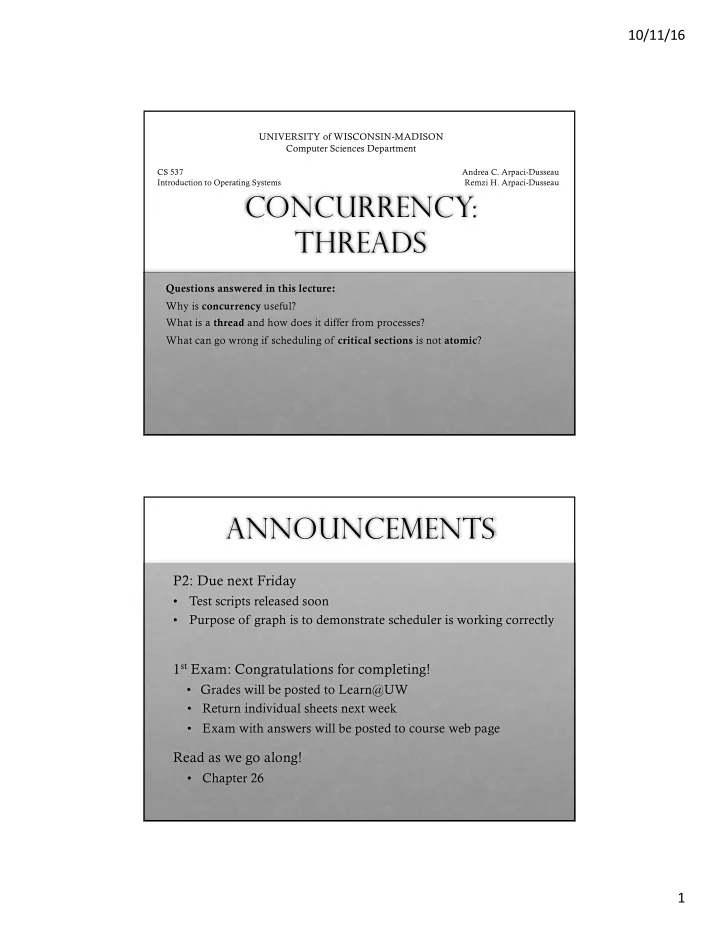
Concurrency: Threads Questions answered in this lecture: Why is - - PDF document

concurrency threads
SMART_READER_LITE
LIVE PREVIEW

Concurrency: Threads Questions answered in this lecture: Why is - - PDF document

10/11/16 UNIVERSITY of WISCONSIN-MADISON Computer Sciences Department CS 537 Andrea C. Arpaci-Dusseau Introduction to Operating Systems Remzi H. Arpaci-Dusseau Concurrency: Threads Questions answered in this lecture: Why is concurrency


slide-1
SLIDE 1

10/11/16 1

Concurrency: Threads

Questions answered in this lecture: Why is concurrency useful? What is a thread and how does it differ from processes? What can go wrong if scheduling of critical sections is not atomic?

UNIVERSITY of WISCONSIN-MADISON Computer Sciences Department

CS 537 Introduction to Operating Systems Andrea C. Arpaci-Dusseau Remzi H. Arpaci-Dusseau

Announcements

P2: Due next Friday

  • Test scripts released soon
  • Purpose of graph is to demonstrate scheduler is working correctly

1st Exam: Congratulations for completing!

  • Grades will be posted to Learn@UW
  • Return individual sheets next week
  • Exam with answers will be posted to course web page

Read as we go along!

  • Chapter 26
slide-2
SLIDE 2

10/11/16 2

Review: Easy Piece 1

Virtualization CPU Memory Context Switch Schedulers Segmentation Paging TLBs Multilevel Swapping Allocation

http://cacm.acm.org/magazines/2012/4/147359-cpu-db-recording-microprocessor-history/fulltext

Motivation for Concurrency

slide-3
SLIDE 3

10/11/16 3

Motivation

CPU Trend: Same speed, but multiple cores Option 0: Run many different applications on one machine Goal: Write applications that fully utilize many cores Option 1: Build applications from many communicating processes

  • Example: Chrome (process per tab)
  • Communicate via pipe() or similar

Pros?

  • Don’t need new abstractions; good for security

Cons?

  • Cumbersome programming
  • High communication overheads
  • Expensive context switching (why expensive?)

CONCURRENCY: Option 2

New abstraction: thread Threads are like processes, except: multiple threads of same process share same address space Approach

  • Divide large task across several cooperative threads
  • Communicate through shared address space
slide-4
SLIDE 4

10/11/16 4

Common Programming Models

Multi-threaded programs tend to be structured as:

  • Producer/consumer

Multiple producer threads create data (or work) that is handled by one of the multiple consumer threads

  • Pipeline

Task is divided into series of subtasks, each of which is handled in series by a different thread

  • Defer work with background thread

One thread performs non-critical work in the background (when CPU idle) CPU 1 CPU 2

running thread 1 running thread 2

RAM What state do threads share?

slide-5
SLIDE 5

10/11/16 5 CPU 1 CPU 2

running thread 1 running thread 2

RAM

PageDir A PageDir B

… Do threads share page directories? What state do threads share?

PTBR PTBR IP IP

Do threads share Instruction Pointers?

CODE HEAP …

Virt Mem (PageDir A) Share code, but each thread may be executing different code at the same time

à Different Instruction Pointers

CPU 1 CPU 2

running thread 1 running thread 2

RAM

PageDir A PageDir B

PTBR PTBR CODE HEAP

Virt Mem (PageDir A)

IP IP SP SP STACK 1 STACK 2

Do threads share stack pointer? threads executing different functions need different stacks

slide-6
SLIDE 6

10/11/16 6

THREAD VS. Process

Multiple threads within a single process share:

  • Process ID (PID)
  • Address space
  • Code (instructions)
  • Most data (heap)
  • Open file descriptors
  • Current working directory
  • User and group id

Each thread has its own

  • Thread ID (TID)
  • Set of registers, including Program counter and Stack pointer
  • Stack for local variables and return addresses

(in same address space)

THREAD API

Variety of thread systems exist

  • POSIX Pthreads

Common thread operations

  • Create
  • Exit
  • Join (instead of wait() for processes)
slide-7
SLIDE 7

10/11/16 7

OS Support: Approach 1

User-level threads: Many-to-one thread mapping

  • Implemented by user-level runtime libraries
  • Create, schedule, synchronize threads at user-level
  • OS is not aware of user-level threads
  • OS thinks each process contains only single thread of control

Advantages

  • Does not require OS support; Portable
  • Can tune scheduling policy to meet application demands
  • Lower overhead thread operations since no system call

Disadvantages?

  • Cannot leverage multiprocessors
  • Entire process blocks when one thread blocks

OS Support: Approach 2

Kernel-level threads: One-to-one thread mapping

  • OS provides each user-level thread with a kernel thread
  • Each kernel thread scheduled independently
  • Thread operations (creation, scheduling, synchronization)

performed by OS

Advantages

  • Each kernel-level thread can run in parallel on a

multiprocessor

  • When one thread blocks, other threads from process can be

scheduled

Disadvantages

  • Higher overhead for thread operations
  • OS must scale well with increasing number of threads
slide-8
SLIDE 8

10/11/16 8

Demo: basic threads

main-thread-0.c

Thread SchedulE #1

0x195 mov 0x9cd4, %eax 0x19a add $0x1, %eax 0x19d mov %eax, 0x9cd4A Thread 1 Thread 2

%eax: ? %rip: 0x195

State: 0x9cd4: 100 %eax: ? %rip = 0x195

process control blocks: T1

%eax: ? %rip: 0x195

balance = balance + 1; balance at 0x9cd4 What is state after instruction 0x195 completes?

Registers are virtualized by OS; Each thread thinks it has own

slide-9
SLIDE 9

10/11/16 9

Thread SchedulE #1

Thread 1 Thread 2

State: 0x9cd4: 100 %eax: 100 %rip = 0x19a

process control blocks: T1

%eax: ? %rip: 0x195 %eax: ? %rip: 0x195

0x195 mov 0x9cd4, %eax 0x19a add $0x1, %eax 0x19d mov %eax, 0x9cd4A

What is state after instruction 0x19a completes?

Thread SchedulE #1

Thread 1 Thread 2

State: 0x9cd4: 100 %eax: 101 %rip = 0x19d

process control blocks: T1

%eax: ? %rip: 0x195 %eax: ? %rip: 0x195

0x195 mov 0x9cd4, %eax 0x19a add $0x1, %eax 0x19d mov %eax, 0x9cd4A

What is state after instruction 0x19d completes?

slide-10
SLIDE 10

10/11/16 10

Thread SchedulE #1

Thread 1 Thread 2

State: 0x9cd4: 101 %eax: 101 %rip = 0x1a2

process control blocks: T1

%eax: ? %rip: 0x195 %eax: ? %rip: 0x195

Thread Context Switch

New contents of PCB and %eax and %rip? 0x195 mov 0x9cd4, %eax 0x19a add $0x1, %eax 0x19d mov %eax, 0x9cd4A

Thread SchedulE #1

Thread 1 Thread 2

State: 0x9cd4: 101 %eax: ? %rip = 0x195

process control blocks: T2

%eax: 101 %rip: 0x1a2 %eax: ? %rip: 0x195

0x195 mov 0x9cd4, %eax 0x19a add $0x1, %eax 0x19d mov %eax, 0x9cd4A

What is state after instruction 0x195 completes?

slide-11
SLIDE 11

10/11/16 11

Thread SchedulE #1

Thread 1 Thread 2

State: 0x9cd4: 101 %eax: 101 %rip = 0x19a

process control blocks: T2

%eax: 101 %rip: 0x1a2 %eax: ? %rip: 0x195

0x195 mov 0x9cd4, %eax 0x19a add $0x1, %eax 0x19d mov %eax, 0x9cd4A

What is state after instruction 0x19a completes?

Thread SchedulE #1

Thread 1 Thread 2

State: 0x9cd4: 101 %eax: 102 %rip = 0x19d

process control blocks: T2

%eax: 101 %rip: 0x1a2 %eax: ? %rip: 0x195

What is state after instruction 0x19d completes?

0x195 mov 0x9cd4, %eax 0x19a add $0x1, %eax 0x19d mov %eax, 0x9cd4A

slide-12
SLIDE 12

10/11/16 12

Thread SchedulE #1

Thread 1 Thread 2

State: 0x9cd4: 102 %eax: 102 %rip = 0x1a2

process control blocks: T2

%eax: 101 %rip: 0x1a2 %eax: ? %rip: 0x195

0x195 mov 0x9cd4, %eax 0x19a add $0x1, %eax 0x19d mov %eax, 0x9cd4A

Desired Result!

Another schedule

slide-13
SLIDE 13

10/11/16 13

Thread SchedulE #2

Thread 1 Thread 2

%eax: ? %rip: 0x195

State: 0x9cd4: 100 %eax: ? %rip = 0x195

process control blocks: T1

%eax: ? %rip: 0x195

0x195 mov 0x9cd4, %eax 0x19a add $0x1, %eax 0x19d mov %eax, 0x9cd4A

Thread SchedulE #2

Thread 1 Thread 2

%eax: ? %rip: 0x195

State: 0x9cd4: 100 %eax: 100 %rip = 0x19a

process control blocks: T1

%eax: ? %rip: 0x195

0x195 mov 0x9cd4, %eax 0x19a add $0x1, %eax 0x19d mov %eax, 0x9cd4A

slide-14
SLIDE 14

10/11/16 14

Thread SchedulE #2

Thread 1 Thread 2

%eax: ? %rip: 0x195

State: 0x9cd4: 100 %eax: 101 %rip = 0x19d

process control blocks: T1

%eax: ? %rip: 0x195

Thread Context Switch

0x195 mov 0x9cd4, %eax 0x19a add $0x1, %eax 0x19d mov %eax, 0x9cd4A

Thread SchedulE #2

Thread 1 Thread 2

%eax: 101 %rip: 0x19d

State: 0x9cd4: 100 %eax: ? %rip = 0x195

process control blocks: T2

%eax: ? %rip: 0x195

0x195 mov 0x9cd4, %eax 0x19a add $0x1, %eax 0x19d mov %eax, 0x9cd4A

slide-15
SLIDE 15

10/11/16 15

Thread SchedulE #2

Thread 1 Thread 2

%eax: 101 %rip: 0x19d

State: 0x9cd4: 100 %eax: 100 %rip = 0x19a

process control blocks: T2

%eax: ? %rip: 0x195

0x195 mov 0x9cd4, %eax 0x19a add $0x1, %eax 0x19d mov %eax, 0x9cd4A

Thread SchedulE #2

Thread 1 Thread 2

%eax: 101 %rip: 0x19d

State: 0x9cd4: 100 %eax: 101 %rip = 0x19d

process control blocks: T2

%eax: ? %rip: 0x195

0x195 mov 0x9cd4, %eax 0x19a add $0x1, %eax 0x19d mov %eax, 0x9cd4A

slide-16
SLIDE 16

10/11/16 16

Thread SchedulE #2

Thread 1 Thread 2

%eax: 101 %rip: 0x19d

State: 0x9cd4: 101 %eax: 101 %rip = 0x1a2

process control blocks: T2

%eax: ? %rip: 0x195

0x195 mov 0x9cd4, %eax 0x19a add $0x1, %eax 0x19d mov %eax, 0x9cd4A

Thread Context Switch

Thread SchedulE #2

Thread 1 Thread 2

%eax: 101 %rip: 0x19d

State: 0x9cd4: 101 %eax: 101 %rip = 0x19d

process control blocks: T1

%eax: 101 %rip: 0x1a2

0x195 mov 0x9cd4, %eax 0x19a add $0x1, %eax 0x19d mov %eax, 0x9cd4A

slide-17
SLIDE 17

10/11/16 17

Thread SchedulE #2

Thread 1 Thread 2

%eax: 101 %rip: 0x1a2

State: 0x9cd4: 101 %eax: 101 %rip = 0x1a2

process control blocks: T1

%eax: 101 %rip: 0x1a2

0x195 mov 0x9cd4, %eax 0x19a add $0x1, %eax 0x19d mov %eax, 0x9cd4A

Thread SchedulE #2

Thread 1 Thread 2

%eax: 101 %rip: 0x1a2

State: 0x9cd4: 101 %eax: 101 %rip = 0x1a2

process control blocks: T1

%eax: 101 %rip: 0x1a2

WRONG Result! Final value of balance is 101

0x195 mov 0x9cd4, %eax 0x19a add $0x1, %eax 0x19d mov %eax, 0x9cd4A

slide-18
SLIDE 18

10/11/16 18

Timeline View

Thread 1 Thread 2 mov 0x123, %eax add %0x1, %eax mov %eax, 0x123 mov 0x123, %eax add %0x2, %eax mov %eax, 0x123

How much is added to shared variable? 3: correct!

Timeline View

Thread 1 Thread 2 mov 0x123, %eax add %0x1, %eax mov 0x123, %eax mov %eax, 0x123 add %0x2, %eax mov %eax, 0x123 How much is added? 2: incorrect!

slide-19
SLIDE 19

10/11/16 19

Timeline View

Thread 1 Thread 2 mov 0x123, %eax mov 0x123, %eax add %0x2, %eax add %0x1, %eax mov %eax, 0x123 mov %eax, 0x123

How much is added? 1: incorrect!

Timeline View

Thread 1 Thread 2 mov 0x123, %eax add %0x2, %eax mov %eax, 0x123 mov 0x123, %eax add %0x1, %eax mov %eax, 0x123

How much is added? 3: correct!

slide-20
SLIDE 20

10/11/16 20

Timeline View

Thread 1 Thread 2 mov 0x123, %eax add %0x2, %eax mov 0x123, %eax add %0x1, %eax mov %eax, 0x123 mov %eax, 0x123

How much is added? 2: incorrect!

Non-Determinism

Concurrency leads to non-deterministic results

  • Not deterministic result: different results even with same inputs
  • Race conditions

Whether bug manifests depends on CPU schedule!

  • Passing tests means little

How to program well for concurrency?

  • Imagine scheduler is malicious
  • Assume scheduler will pick bad ordering at some point…
slide-21
SLIDE 21

10/11/16 21

What do we want?

Want 3 instructions to execute as an uninterruptable group

That is, we want them to be atomic

mov 0x123, %eax add %0x1, %eax mov %eax, 0x123

critical section

More general: Need mutual exclusion for critical sections Ci and Cj

  • if process A is in critical section Ci, process B can’t execute Cj

(okay if other processes do unrelated work) Specific: Any code that modifies “balance” variable

Break

  • What is your spirit animal?
  • Did you have a favorite pet growing up?
  • If you could have any type of pet, what would it be?
slide-22
SLIDE 22

10/11/16 22

Synchronization

Build higher-level synchronization primitives in OS

  • Operations that ensure correct ordering of instructions across threads

Motivation: Build them once and get them right

Monitors Semaphores Condition Variables Locks Loads Stores Test&Set Disable Interrupts

Locks

Goal: Provide mutual exclusion (mutex) Three common operations:

  • Allocate and Initialize()
  • Pthread_mutex_t mylock = PTHREAD_MUTEX_INITIALIZER;
  • Acquire
  • Acquire exclusion access to lock;
  • Wait if lock is not available (some other process in critical section)
  • Spin or block (relinquish CPU) while waiting (implementation later)
  • Pthread_mutex_lock(&mylock);
  • Release
  • Release exclusive access to lock; let another process enter critical section
  • Pthread_mutex_unlock(&mylock);
slide-23
SLIDE 23

10/11/16 23

More Demos

main-thread-1.c main-thread-2.c

Lessons from Demos

Mutex interface is very easy to use Tricky to get best performance; trade-off… Acquiring and releasing locks has significant overhead

  • Implication: Don’t want to do “too often”

Shorter critical sections mean more concurrency

  • Utilize more cores effectively
  • Implication: Put locks around smallest portion of code possible

Extreme scenarios for correctness:

  • Single big lock around all code; poor performance but works!
slide-24
SLIDE 24

10/11/16 24

Conclusions

Concurrency is needed to obtain high performance by utilizing multiple cores Threads are multiple execution streams within a single process

  • r address space

Share PID and address space Separate registers and stack

Context switches within a critical section can lead to non-deterministic bugs (race conditions) Use locks to provide mutual exclusion