Conflict of interest Cell context, mutation and common I am a - - PowerPoint PPT Presentation

conflict of interest
SMART_READER_LITE
LIVE PREVIEW

Conflict of interest Cell context, mutation and common I am a - - PowerPoint PPT Presentation

5/25/2018 Conflict of interest Cell context, mutation and common I am a founder and chief medical officer of carcinomas of the uterus and ovary Contextual Genomics a company offering cancer genomics testing solutions I will not be


slide-1
SLIDE 1

5/25/2018 1

Cell context, mutation and common carcinomas of the uterus and ovary

David G. Huntsman

BC Cancer Agency Vancouver General Hospital University of British Columbia

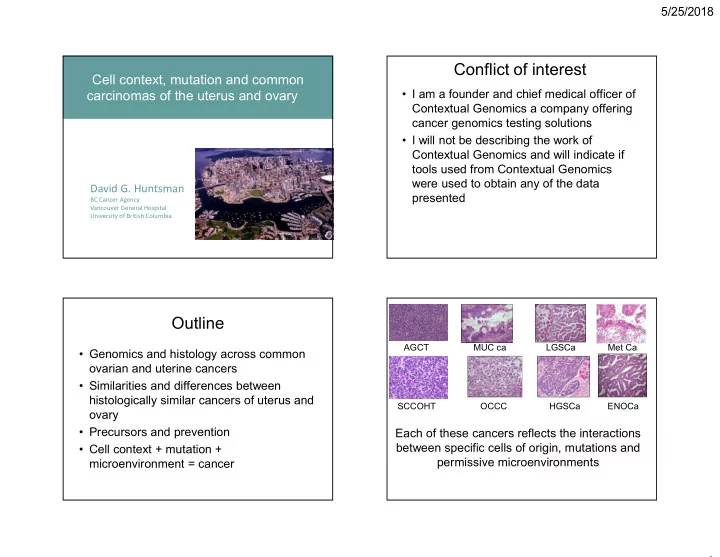
Conflict of interest

  • I am a founder and chief medical officer of

Contextual Genomics a company offering cancer genomics testing solutions

  • I will not be describing the work of

Contextual Genomics and will indicate if tools used from Contextual Genomics were used to obtain any of the data presented

Outline

  • Genomics and histology across common
  • varian and uterine cancers
  • Similarities and differences between

histologically similar cancers of uterus and

  • vary
  • Precursors and prevention
  • Cell context + mutation +

microenvironment = cancer Each of these cancers reflects the interactions between specific cells of origin, mutations and permissive microenvironments

AGCT MUC ca LGSCa Met Ca SCCOHT OCCC HGSCa ENOCa

slide-2
SLIDE 2

5/25/2018 2

Hiking 1350 miles SE from Hobbiton gets you to Mordor

But if Frodo started in Topeka Kansas he would have ended up in Jacksonville

Assessing the problem

SEER Victoria BC

Vaughan et al Nature Reviews Cancer 2012

“with few exceptions, the clinical presentation, treatment, and results of treatment are similar for all (cell) types of tumor”

  • CDM Fletcher ed. In Diagnostic

Histopathology of Tumors (2007)

slide-3
SLIDE 3

5/25/2018 3

Changing Paradigms for Cancer Control

Generic Cancer Control 1990 Stratified Cancer Control 2010 Individualized Cancer Control 2020

Breast cancer Lymphoma Ovarian cancer Pancreatic cancer

Serous Endometrioid Mucinous Clear Cell Transitional Undifferentiated LMP GR 1 GR 2 GR 3

Ovarian carcinoma sub-typing 2000 New classification: freq

These cancers can be classified with 95% accuracy by microscope using WHO 2014 diagnostic criteria Genomics offers a substrata of information to aid treatment decisions

F Kommoss 2002 << F Kommoss 2014 = B Gilks 2014

<<< =

  • 300 cases centrally reviewed in 2002
  • Reviewed again by same pathologist using

2014 WHO criteria : 54% concordance

  • New histotypes showed 98% concordance

with second reviewer and stronger associations with outcome and biomarkers

Impact of histotype changes

slide-4
SLIDE 4

5/25/2018 4

Ovarian cancer outcomes from 2000 Canadian patients

All subtypes treated with platinum/taxane based therapy Primary resistance in non HGSCa is primarily due to cell context and how cell context determines oncogenic

  • pportunity

Le Page et al BMC Cancer 2018

How to define a distinct disease?

  • Different etiology
  • Different precursor lesions
  • Different molecular characteristics
  • Different presentation
  • Different clinical course
  • Different biomarker profiles
  • Different response to therapy

On all counts HGS, mucinous, LGS and endometrioid/CCC are distinct diseases

Changing Paradigms for Cancer Control

Generic Cancer Control 1990 Stratified Cancer Control 2010 Individualized Cancer Control 2020

Breast cancer Lymphoma Ovarian cancer Pancreatic cancer

Endometrial Cancer

  • 4th most common

cancer in women

slide-5
SLIDE 5

5/25/2018 5

This is very different than in ovarian cancer

Endometrial cancer TCGA-2013

TCGA Classifier for Endometrial Cancers reduced to practice

Simple technologies, reproducible

Talhouk, McAlpine Cancer , 2017 Kommoss, McAlpine, Talhouk in press

ProMisE remains a significant prognostic marker for all events even after we account for other known risk factors available at diagnosis: age, bmi, histology, grade, and treatment. Overall Survival Disease Specific Survival Progression Free Survival

Talhouk, McAlpine Cancer , 2017 Kommoss, McAlpine, Talhouk in press

Prognostic Ability of ProMisE

slide-6
SLIDE 6

5/25/2018 6

Genomic Stratification of cancers

  • In ovarian cancer genomic data offers a

substra of information to refine our understanding of subtypes

  • In endometrial cancer genomic data will

replace histotyping

  • In brain and lymphoid cancer integration

has occurred

  • In breast cancer molecular and histologic

analysis are parallel tracks with no integration

  • Chromosomal instability
  • P53 mutations (ubiquitous)
  • BRCA or BRCA associated

High Grade Serous Carcinomas

19 20 21 22 X 1 2 3 4 5 12 13 14 15 16 17 18 6 7 8 9 10 11

A B C D E F

Ahmed et al J path 2010; Press et al BMC Cancer 2008

1 2 3 4 5 12 13 14 15 16 17 18 19 20 21 22 X 6 7 8 9 10 11 1 2 3 4 5 12 13 14 15 16 17 18 19 20 21 22 X 6 7 8 9 10 11 1 2 3 4 5 13 14 15 16 17 18 19 20 21 22 X 6 7 8 9 10 11 12 1 2 3 4 5 12 13 14 15 16 17 18 19 20 21 22 X 6 7 8 9 10 11 19 20 21 22 X 1 2 3 4 5 12 13 14 15 16 17 18 6 7 8 9 10 11

Reproducible expression-based subtypes of HGSC but clinical relevance is unknown

TCGA = The Cancer Genome Atlas. The Cancer Genome Atlas Research Network. Nature 2011;474:609–15; Tothill RW, et al. Clin Cancer Res 2008;14:5198–208. Not prognostic with current therapy; may predict response to future therapies (antiangiogenics)

Low High Gene expression

Tumour/gene groups

Differentiated Immunoreactive Mesenchymal Proliferative

TCGA Tothill et al.

489 tumours 245 tumours 1000 genes

Ribeiro et al. 2014 Frontiers in Oncology

slide-7
SLIDE 7

5/25/2018 7

Nature 2011

Targeting Cyclin E1 in high grade serous cancer <10% of cases have highly level amplification This is mutually exclusive with BRCA mutation

David Bowtell Peter MacCallum Cancer Centre Melbourne Imperial College London d.bowtell@petermac.org

Patch et al, Nature 2015

Targeting the 500lb gorilla

Genetic Deficits in Homologous Recombination are found in 50% of Serous Ovarian Cancer: multiple PARP inhibitor trials ongoing – this is truly exciting

BRCA1 Germline 8% BRCA2 Germline 6% BRCA1 Somatic 3% BRCA2 Somatic 3% BRCA1 Methylation 11% EMSY Amplification 6% PTEN Loss 5% Other HRD 7% CCNE1 Amplification 15% MMR Germline 2% Other 34%

slide-8
SLIDE 8

5/25/2018 8

Iglehart NEJM 2009

PARP inhibition with Olaparib as maintenance therapy for HGSOC

Ledermann et al NEJM April 2014

e

How best to identify potential PARP responders and non responders

Somatic and germline BRCA1 and 2 mutations c.20%



Platinum response 60–65%

50 100 150 200 250 10 100 1000 10000 Time (Days) CA125

TCGA Analysis 51%

TCGA, Nature (2011) 474:609

RAD51 assay 50%

Mukhopadhyay, Cancer Res (2012) 72:5675

Courtesy of Iain McNeish Final efficacy analysis Ariel2: PFS in BRCAmut and LOH-high versus LOH-low patients Swisher et al Lancet Oncology 2017

slide-9
SLIDE 9

5/25/2018 9

Final efficacy analysis NOVA: PFS in gBRCAmut and HRD positive versus HRD negative patients

25 50 75 100 2 4 6 8 10 12 14 16 18 20 22 24 Time Since Randomization (months) Progression–free Survival (%) Niraparib Placebo 25 50 75 100 Progression–free Survival (%) Niraparib Placebo 2 4 6 8 10 12 14 16 18 20 22 24 Time Since Randomization (months) 25 50 75 100 Time Since Randomization (months) Progression–free Survival (%) 2 4 6 8 10 12 14 16 18 20 22 24 Niraparib Placebo

Mirza et al NEJM (2016) ePub 8th Oct 2016

gBRCAmut HRD positive HRD negative HR= 0.27 HR= 0.38 HR= 0.58 gBRCAWT gBRCAWT

We still can not adequately predict lack of response to PARP inhibition

Given the paucity of specific features beyond tp53 mutation and BRCA: Can the genome be the biomarker?

  • Higher level view of cancer genome

enables identification of signatures that point to mutational process

vs

Signatures as well as specific mutations track with cancer types

Signatures of mutational processes in human cancers: Alexandrov et al Nature 2014

Mutational signatures of ovarian cancer histotypes

Yikan Wang et al Nature Genetics 2017

slide-10
SLIDE 10

5/25/2018 10

Unsupervised analysis using genomic landscape features splits HGSCa, CCC and ENOCa into subgroups

Yikan Wang et al Nature Genetics 2017

H-FBI cases are distinct but path for reduction to practice is obscure

Yikan Wang et al Nature Genetics 2017

Are ovarian cancers and uterine cancers the same tumours in different places?

Gounaris et al, J Pathology 2011

Synchronous uterine and ovarian carcinomas

  • Up to 50% of low grade endometrioid carcinomas
  • Most are low grade and T1a
  • Due to excellent prognosis are considered to be separate

primaries

  • Genomic and data molecular studies low resolution and

interpreted as supporting separate primaries

  • Data to be shown non-validated comparisons of somatic

mutations

slide-11
SLIDE 11

5/25/2018 11

SEO_ VAN_ 65 SEO_ TBG_ 22 150 125 SEO_ VAN_ 43 SEO_ VAN_ 22 SEO_ VAN_ 27 SEO_ VAN_ 29 SEO_ VAN_ 14 SEO_ VAN_ 54 SEO_ TBG_ 15 SEO_ VAN_ 58 SEO_ VAN_ 56 SEO_ VAN_ 60 SEO_ TBG_ 31 SEO_ VAN_ 04 SEO_ VAN_ 07 SEO_ VAN_ 08 SEO_ VAN_ 33 SEO_ VAN_ 40

Endometriosis? Ovarian Endometrial

In almost all cases the uterine and ovarian cancers share somatic mutations Anglesio JNCI 2016

Copy number plots showing clonality Data and Conclusions

  • Clonal relationships between the endometrial and
  • varian cancers seen in but one of 20 cases

studies so far (similar data from MSKCC)

  • Analysis of endometriosis and normal

endometrium should inform whether these are metastatic cancers or whether a mutant field defect leads to both uterine cancer and ovarian cancer through endometriosis

  • Are these true metastasis?

Ovarian and uterine carcinomas: siblings or weird cousins

  • Other than P53 serous carcinomas of

uterus and fallopian tube/ovary are molecualarly distinct

  • Endometrioid carcinomas at both sites are

similar and co-occurrences are clonally related

  • What about clear cell carcinomas
slide-12
SLIDE 12

5/25/2018 12

Outcomes: CCOC and CCEC

CCEC

Delaire et al J Path 2017

CCOC

Le Page et al BMC Cancer 2018

Both cancers lack effective medical treatments for non resectable cases They share some molecular features but in no way are identical

  • 32 of 45 cases passed pathology

review and were used

  • 11 (34%), 7 (22%), and 6 (19%)

showed P53 or ARID1a abnormalities or MSI

  • The molecular subtypes of

endometrial cancer seen but at different frequencies than in usual uterine carcinomas

  • If there are no absolute molecular

differences between CCEC and

  • ther endometrial carcinomas could

their distinctions be due to different cells of origin Delaire et al J Path 2017

Ovarian cancer cells of origin : old school

Epithelial (EOC) (90%) Germ Cell (3%-5%) Sex Cord-Stromal (2%-3%) Secondary (Metastatic) (5%)

Figure modified from Gartner, L.P. & Hiatt, J.L. eds. In Color Atlas of Histology. 3rd ed. (2000) Lippincott Williams & Wilkins: Philadelphia, PA.

Challenges to the old model

  • Most “ovarian” cancers have morphologic

and molecular features in common with normal cell populations in the Ovary or Mullerian tract

  • Lack of credible precursor lesions in the
  • vary for high grade serous cancers and

the association of endometriosis with clear cell & endometrioid cancers and not high grade serous cancers

slide-13
SLIDE 13

5/25/2018 13

Origins of ovarian cancer

  • The cellular origins gate and shape oncogenesis and

influence response to therapy

  • The subtypes of ovarian carcinoma are more distinct

subtypes of carcinoma of other organs, perhaps due to their distinct non-ovarian cellular origins Karenzis Nat Rev Can 2016

A fallopian tube origin for high grade serous carcinomas of the ovary

Dubeau, Pick, Crum, Shaw…………

Karst and Drapkin, J. Oncol, 2010

The role of the fallopian tube in ovarian cancer

Retrograde menstruation (inflammation, endometriosis) Infection Irritants (e.g. talc)

Fallopian tube as source Fallopian tube as conduit

Tubal ligation (or salpingectomy) blocks passageway Salpingectomy removes at-risk tissue

Development

  • f high-grade

serous carcinomas And possible LGSCA

Ovulation (tubal inflammation)

Potential to develop endometrioid/clear cell carcinomas

slide-14
SLIDE 14

5/25/2018 14

Recommendation to all gynecologistsin British Columbia

  • 1. Removal of fallopian tube

along with fimbriated end at the time of hysterectomy

  • 2. Perform salpingectomy in

place of tubal ligation

  • 3. Genetic counseling and

BRCA mutation screening in all women with high-grade serous carcinoma Goal: >30% reduction in

  • varian cancer deaths after 20 years

10-20% through salpingectomy at time of hysterectomy 10-20% through salpingectomy instead of tubal ligation 5% through risk-reducing surgery in patients with BRCA mutations Recommendation Changes in Clinical and Surgical Practice

Hysterectomy with OS Hysterectomy alone

post-campaign pre-campaign 2011

37%

2010

59% 41% 54

Figure 1: Hysterectomy without oophorectomy in British Columbia 2012 2014 2008

92% 8% 63% 31% 69% 20% 80% = 5% of women

2008

Bilateral salpingectomy (for sterilization) Tubal ligation = 5% of women 99.6%

post-campaign pre-campaign 2011

67%

2010

89% 11% 55 0.4% 33%

2012

55%

2014

50% 45% 50%

Figure 2: Permanent and irreversible contraception in British Columbia

Population based opportunistic salpingectomy

  • Short term safety demonstrated
  • Retrospective studies have suggested

efficacy

  • Efficacy and long term safety profile need

assessing –will take 5 years in BC

How does this shifting view of cell of origin influence our understanding of other risk factors ?

slide-15
SLIDE 15

5/25/2018 15

Collaborative Group on Epidemiological Studies of Ovarian

  • Cancer. Lancet, 2008

Oral contraceptives and ovarian cancer risk

OCP’s and ovarian cancer

  • Massively protective
  • Mechanism unknown
  • Impact on OC

prevention unknown

Clear cell and endometrioid ovarian carcinoma represent around 20% of cases in North America

Endometriosis Related Ovarian Neoplasms (ERONs)

ENDOMETROID CLEAR CELL

Alterations: ARID1A (~50%) PIK3CA PTEN, KRAS Sometimes MMR-deficient TP53 (~10%) Alterations: PIK3CA ARID1A (~30%) CTNNB1 PPP2R1A, PTEN, KRAS, TP53 Frequent MMR-deficiency

slide-16
SLIDE 16

5/25/2018 16

ARID1a mutations

  • Common in OCCC, Endometrioid of ovary and uterus and

MSI positive gastric cancers

  • Found in cancer types without tp53 mutations
  • Occur in precancerous lesions but may not be initiating

events

  • Not prognostic
  • Apart from association with PIK3Ca mutations no

reproducible evidence that ARID1a mutant ovarian cancers are different from non mutant cases of the same type

  • Specific targeting of ARID1a mutant cancers has been

challenging Activated pathways in OCCC: IL6 is central to OCCC

Anglesio et al 2011. Clin Can Res

IL6  STAT3  HIF1A & HIF2A(EPAS1) (activation of hypoxia-related survival pathways)

Elevated levels: IL6 (Activated) STAT3 (Nuclear) HIF1A HIF2A (EPAS1) Nuclear HIF1a in OCCC

Endometriosis: the main risk factor for CCC and ENOC

  • First described by Sampson in

1925.

What is Endometriosis?

Presence of endometrial-type epithelium and stroma

  • utside the uterus
  • BIPHASIC

Generally regarded as a benign inflammatory condition

  • Affects up to 10% of women of childbearing age
  • Usually associated with pelvic pain
  • Frequently associated with fertility issues
  • Hormone dependent & responsive (frequently treated with

progestins)

  • Macrophages dominate immune infiltrate & elevated levels of “M2”

cytokines (eg. IL6) in peritoneal fluid of affected women

Vercellini Nat Rev Endoc 2014 Bunlun NEJM 2009

slide-17
SLIDE 17

5/25/2018 17

Increased Risk of Cancer for Women with Endometriosis

Endometriosis affect 10% (or more) of women of childbearing age Women with history of endometriosis have 2-4 fold increased risk of developing CCOC and ENOC 2012, 2015

Pearce et al. Epidemiological association between endometriosis and CCOC and ENOC

2013

Sieh et al. Tubal ligation preferentially protects against CCOC and ENOC

2008

Merritt et al. found an increased risk of endometrioid and clear cell ovarian cancer only among women with a history

  • f endometriosis

Pearce et al Lancet Oncology 2012

MET (HGFR) amplification and overexpression in OCCC?

Fig 1 from Yamamoto et al, 2012. Mod Path

In second study by Yamamoto et al. MET

  • verexpression and copy number changes were also

correlated with atypical endometriosis that was synchronous with OCCC Endometriosis Adjacent atypical endometriosis

Regions of endometriosis that are synchronous to OCCC

Features found in OCCC can be found in adjacent endometriosis

H&E IHC CISH

VOA1048

Adjacent Atypical Endometriosis vs. OCCC

67

DAH145 - VOA1048 (in some cases the adjacent atypical endometriosis is essentially cancer

68

1:22408228:CDC42:coding:snvs:DAH145 15:100890253:AC015723.8:coding:snvs:DAH145 19:50840381:NAPSB:coding:snvs:DAH145 20:46386033:SULF2:coding:snvs:DAH145 1:6266355:C1orf188:coding:snvs:DAH145 1:29631897:PTPRU:coding:snvs:DAH145 1:46105922:GPBP1L1:coding:snvs:DAH145 1:89523838:GBP1:coding:snvs:DAH145 1:109197458:C1orf59:coding:snvs:DAH145 1:186324779:TPR:coding:snvs:DAH145 2:211085473:ACADL:coding:snvs:DAH145 2:219602546:TTLL4:coding:snvs:DAH145 3:132172461:DNAJC13:coding:snvs:DAH145 3:149700912:C1orf37:coding:snvs:DAH145 3:184580707:VPS8:coding:snvs:DAH145 4:187629068:FAT1:coding:snvs:DAH145 5:524228:SLC9A3:coding:snvs:DAH145 5:127681270:FBN2:coding:snvs:DAH145 5:140615717:PCDHB18:coding:snvs:DAH145 5:168180893:SLIT3:coding:snvs:DAH145 6:7246723:RREB1:coding:snvs:DAH145 6:74073560:OOEP:coding:snvs:DAH145 7:101944369:AC005088.3−2:coding:snvs:DAH145 8:113301714:CSMD3:coding:snvs:DAH145 9:2718192:KCNV2:coding:snvs:DAH145 9:130270400:LRSAM1:coding:snvs:DAH145 10:95069866:MYOF:coding:snvs:DAH145 10:102566211:PAX2:coding:snvs:DAH145 10:104130515:GBF1:coding:snvs:DAH145 11:45907403:CRY2:coding:snvs:DAH145 11:55135884:OR4A15:coding:snvs:DAH145 11:56143251:OR8U8:coding:snvs:DAH145 11:125853858:CDON:coding:snvs:DAH145 12:6078430:VWF:coding:snvs:DAH145 12:57586646:LRP1:coding:snvs:DAH145 12:101682807:UTP20:coding:snvs:DAH145 12:102053560:MYBPC1:coding:snvs:DAH145 13:23906156:SACS:coding:snvs:DAH145 13:73539509:PIBF1:coding:snvs:DAH145 14:92548659:ATXN3:coding:snvs:DAH145 16:4016933:ADCY9:coding:snvs:DAH145 16:22825976:HS3ST2:coding:snvs:DAH145 16:30980953:SETD1A:coding:snvs:DAH145 17:18226316:SHMT1:coding:snvs:DAH145 17:42284886:UBTF:coding:snvs:DAH145 17:68129103:KCNJ16:coding:snvs:DAH145 17:73499325:KIAA0195:coding:snvs:DAH145 18:9859309:RAB31:coding:snvs:DAH145 19:814453:PTBP1:coding:snvs:DAH145 20:25263878:PYGB:coding:snvs:DAH145 22:24829598:ADORA2A:coding:snvs:DAH145 22:37447918:7SK:coding:snvs:DAH145 22:39884587:MGAT3:coding:snvs:DAH145 X:8764386:FAM9A:coding:snvs:DAH145 X:37026831:FAM47C:coding:snvs:DAH145 X:117043429:Y:RNA:coding:snvs:DAH145 X:117540879:WDR44:coding:snvs:DAH145 X:153187162:ARHGAP4:coding:snvs:DAH145 X:153219079:HCFC1:coding:snvs:DAH145 V O A 1 4 8 . A 1 5 a t y p i c a l e n d
  • m

e t r i

  • s

i s − a d j a c e n t V O A 1 4 8 . A 6 L e f t O v a r y C C C V O A 1 4 8 . B 6 E n d

  • m

e t r i a l P

  • l

y p V O A 1 4 8 . T L e f t O v a r y C C C value SOMATIC UNDETERMINED WILDTYPE

slide-18
SLIDE 18

5/25/2018 18

CCC (3a) AT-E-osis (3b) E-osis (3e) E-osis (3f)

Somatic variants in endometriosis

Anglesio et al. 2015 J Path

Deep infiltrating endometriosis

  • Will other clinically

relevant forms of endometriosis have somatic mutations as have been seen in endometriosis associated with cancer

? Is endometriosis a partially competent neoplasm Anglesio et al NEJM 2017 Deep Infiltrating Endometriosis “Case 2”

NTC CTRL G12V CTRL CASE2 (LCM) Normal Tissue CASE2

Endometriosis

(LCM)

KRAS Double- mutation positive

G12V G12A WT

Anglesio et al NEJM 2017

A8 B3 C2 A8 31.22% A8 B3 C2

Deep Endometriosis Normal epithelium from endocervix and endometrium

A8- Epithelium A8- Stroma NTC CTRL Positive CTRL 68.3% 0.00% 0.45% 31.22% A10 0.28% A5 0.05% B3 9.37% C2 38.57%

Multiple lesions with same KRAS mutation- Is endometriosis itself a neoplasm?

slide-19
SLIDE 19

5/25/2018 19

Deep infiltrating endometriosis: preliminary data

  • Cancer associated mutations present in

epithelium of non cancer associated endometriosis

  • Endometriosis may in some cases be a

partially competent neoplasm

  • Do mutations predict outcomes and does

this indicate new treatment options

  • Across pathology how many other “non-

neoplastic” entities are neoplasms?

If cancer associated mutations are found in deep infiltrating endometriosis: what about other subtypes ?

  • We hypothesized that

incisional endometriosis would be least likely to have clonal mutations

  • 19 cases were

studied by high sensitivity mutation test and IHC for PTEN and ARID1A

Droplet Digital PCR validation of KRAS mutations detected in Incisional EMS

Sample VAF (ddPCR) VAF (CG Assay) VS15-22726 B1 MACRO 2.34 3.22 VS15-22726 B1 LCM 28.7 n/a VS15-22726 B1 LCM: VS15-22726 B1 MACRO: Sample VAF (ddPCR) VAF (CG Assay) TBG-22946 14 MACRO 4.39 4.81 TBG-22946 14 LCM 29.7 n/a

ddPCR assay for KRAS c.35G>T (p. G12V) ddPCR assay for KRAS c.34G>T (p. G12C)

TBG-22946 14 MACRO: TBG-22946 14 LCM:

Regional PTEN IHC loss observed in Incisional EMS

PTEN stain for TBG 16141 111A3 at 4X magnification (left) and 20X magnification (right)

But what about normal endometrium

slide-20
SLIDE 20

5/25/2018 20 Mutation rates in normal endometrium versus endometrial cancer (half cooked data)

0% 10% 20% 30% 40% 50% 60% 70% 80% 90% 100% PTEN PIK3CA KRAS FGFR2 ERBB2

Mutated Cases (%)

endometrial carcinoma (n=248) normal endometrium (n=34)

KRAS is more frequently mutated in normal endometrial epithelium than in carcinoma derived from endometrial epithelium

Mutations in eutopic and ectopic endometrial epithelium: summary

  • Cancer associated mutations are found in

endometriosis with no cancer risk including incisional endometriosis – their clinical relevance is unknown

  • Similar mutations are found in normal endometrium –

the medical relevance is unknown

  • Further clinical and basic research will be required to

understand and use this information

  • Since cancer mutations can be found in non

cancerous tissue screening for cancer by mutation testing of LGT samplings may not work

Endometriosis, CCOC and ENOCa

?

How do two such different cancers arise from the same precursor? How do different cancers arise from the same precursor?

?

Almost all mutations in a cancer may be present in adjacent endometriosis Mutations may be intrinsic to endometriosis and not associated with transformation No mutation is exclusive to CCC or ENOCa

slide-21
SLIDE 21

5/25/2018 21

The opportunity of proteome analysis

Interested in capturing expression, localization, PTMs, variants…how?

DNA ➞ mRNA ➞ Proteome➞ Phenotype

Cancer Pathology: what’s under the hood The sequence-to-phenotype continuum

Selective Pressure

Adaptation

⬇ ⬇ ⬇ ⬇ ⬇

  • DNA mutation
  • Epigenetic

modification

  • Proteome

remodeling

  • Altered

metabolism DNA ➞ mRNA ➞ Proteome➞ Cancer Phenotype

The proteome is largely unpredictable based

  • n measures of DNA and mRNA

The proteome is largely unpredictable based

  • n measures of DNA and mRNA

Gene copy number mRNA Mass Spec

The sequence-to-phenotype continuum in lung cancer

0.31 ±0.07 0.07 ±0.03 0.16 ±0.06

Spearman Correlation

1p 2 3 4 5 6 7 8 9 10 11 12 13 14 15 16 17 18 19 20 21 22 XY

Chromosome

1q

Integrated Omic Array  Genetic Map

Courtesy of Mike Moran

slide-22
SLIDE 22

5/25/2018 22

SP3 Clinical Tumor Proteomics SP3 Clinical Tumor Proteomics

cystathionine gamma lyase Highly enriched in clear cell carcinomas compared to ENOCa and HGSCa Hughes et al Sci Reports 2016

Cytathionine Gamma Lyase

  • cystathionine gamma-lyase (CTH)

– found to be enriched in CCC compared to HGS and ENOC – transulfuration enzyme in the cysteine synthesis pathway

Methionine Homocysteine Cystathionine Cysteine

CBS CTH

Glutathione H2S

CTH Expression in Cell Lines

CTH a-Tubulin A2780 IGROV1 TOV112D 2008 JHOC5 JHOC7 JHOC9 OVISE OVMANA OVTOKO RMG2 TOV21G CaOV3 Hey Kuramochi CaOV3 Hey OVCAR 3 OVCAR 4 OVCAR 5 OVSAYO ENOC CCC HGS

Homocysteine Cystathionine Cysteine

CBS CTH

slide-23
SLIDE 23

5/25/2018 23 CTH

0 = no staining 1 = weak or variable staining 2 = strong, diffuse staining

CTH Expression in Normal Tissues

Endometrium Fallopian Tube

Ciliated cells in endometriosis also express high levels of CTH

PNAS, 2014

  • Clin. Canc. Res., 2011

IL6 in ciliated cells and CCOC

IL-6 promotes ciliated cell differentiation in the trachea CCOC is an IL6 responsive cancer

slide-24
SLIDE 24

5/25/2018 24

CTH marks CCOC and adjacent endometriosis

CTH

Endometriosis Clear Cell Borderline CCOC

ER marks endometrioid carcinoma and secretory cells

Endometriosis Adj to ENOC ENOC CTH ER

Endome triosis Adj ENOC

ER CTH

ER in endometrium and endometriosis

IF from normal endometrium

ER CTH Merge DAPI ER + CTH MTHFD1 CTH Merge DAPI MTHFD1 + CTH CTH FOXJ1 Merge DAPI CTH + FOXJ1 Ezrin CTH Merge DAPI Ezrin + CTH

The clinical and biological differences between endometrioid and clear cell carcinoma including response to therapy may be writ in the distinct cellular origins and not mutations that drive oncogenesis Note- models are created to be used then disproven

Modifed from Cochrane et al J Path 2017

slide-25
SLIDE 25

5/25/2018 25

Endometrioma OCCC ECCC

Proteolytic enzymes Inflammation ROS

Ciliated cell Endometrium Ovary Rare

But why don’t we see these cancers in the fallopian tube

Fallopian tube Never Paracrine Stromal interactions

CTH and ER mutually exclusive in 3D organoids

ER CTH Merge DAPI ER + CTH

3D organoids from normal endometrium

CTH FOXJ1 Merge DAPI CTH + FOXJ1

Organoids can be transduced

A model to study how cell context and microevironment shape and gate the transforming potential of mutations

Forced ciliated cell differentiation in endometrial organoid culture.

H&E of endometrial

  • rganoids treated with 1uM

DBZ for 14 day, demonstrating a shift to a dominance of ciliated cells Typical

  • rganoid

ciliated cells ~1/100 DBZ treated ciliated cells >90% DBZ (Notch Inhibitor) 2 weeks single cell RNAseq IL6 and IL6R are in mutually exclusive populations IL6 IL6R

Single Cell RNA sequencing of organoids

slide-26
SLIDE 26

5/25/2018 26

CCOC and EndoCa and the ovary

  • Both cancers are associated with endometriosis
  • Although cancer associated mutations occur in

endometriosis at other sites, transformation occurs almost exclusively within ovarian endometriomas

  • CCOC and EndoCa look similar to their

endometrial counterparts and have similar mutations –

  • Do CCOC and EndoCa arise from different cells of
  • rigin? (How do cell of origin, mutation and

microenvironment gate and shape oncogenic

  • pportunity)
  • Is OCCC more than one disease and if so what

marks each type

A forgotten question: What is the role of the ovary in ovarian carcinomas?

  • The permissiveness of the ovarian

microenvironment for the growth of an extremely broad range of cancers is not understood and has been minimally studied

Understanding how cell context, mutation and the microenvironment of the ovary and the tissue of

  • rigin contribute to these cancers should lead to

novel treatment and prevention strategies

AGCT MUC ca LGSCa Met Ca SCCOHT OCCC HGSCa ENOCa

Topics covered

  • Genomics and histology across common
  • varian and uterine cancers
  • Similarities and differences between

histologically similar cancers of uterus and

  • vary
  • Precursors and prevention
  • Cell context + mutation +

microenvironment = cancer

  • But what about the ovary?
slide-27
SLIDE 27

5/25/2018 27

Thanks

  • My lab: Dawn Cochrane, Niki Boyd, Michelle Woo, Yemin Wang, Winnie

Yang, Clara Salamanca, Tony Karnezis, Basile Cloutier-Tessier, Yang Xia, Jenn Ji, Shary Chen, Jessica Pilsworth, Kendall Greening, Kate Dixon, Vivian Lac, Germain Ho, Katelyn Onderwater, Evan Gibbard, Amy Lum, Genny Trigo-Gonzalez, Julie Ho, Jamie Lim, Mehrane Nazeran, Forouh Kalantari and Janine Senz

  • Sohrab Shah -- Bioinformatics: Jairhu Ding, Yikan Wang, Ali Bashashati,

Gavin Ha, Andrew McPherson

  • GSC: Marco Marra, Martin Hirst, Gregg Morin
  • Collaborators: Stefan Kommoss, Martin Kobel, James Brenton, Anne-Marie

Mes-Masson, David Bowtell, Barbara Vanderhyden, Aikou Okamoto, Buddy Weissman, Jeff Trent, and Sam Aparicio

  • OvCaRe BC: Blake Gilks, Dianne Miller, Paul Hoskins, Nelly Auersperg,

Brad Nelson, Cal Roskelly, Anna Tinker, Mike Anglesio, Paul Yong, Jessica McAlpine, Aline Talhouk, Gillian Hanley, Mark Carey