Conservation genetics of the rare species Delphinium exaltatum (R - - PowerPoint PPT Presentation

conservation genetics of the rare species
SMART_READER_LITE
LIVE PREVIEW

Conservation genetics of the rare species Delphinium exaltatum (R - - PowerPoint PPT Presentation

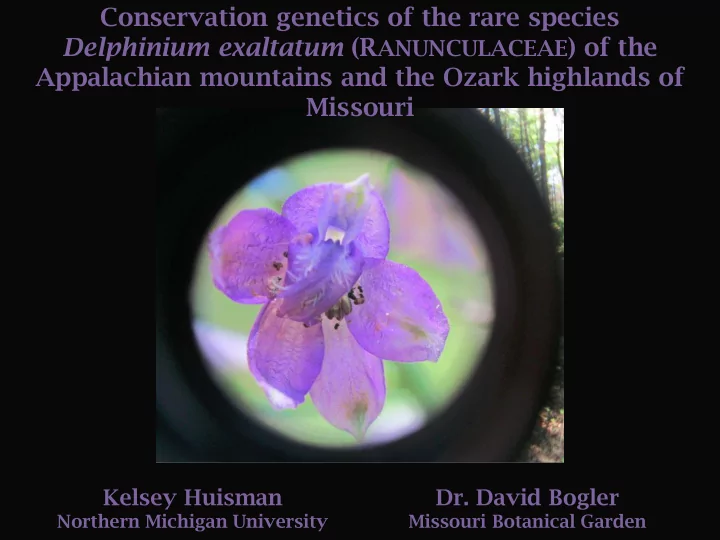
Conservation genetics of the rare species Delphinium exaltatum (R ANUNCULACEAE ) of the Appalachian mountains and the Ozark highlands of Missouri Kelsey Huisman Dr. David Bogler Northern Michigan University Missouri Botanical Garden I


slide-1
SLIDE 1

Conservation genetics of the rare species Delphinium exaltatum (RANUNCULACEAE) of the Appalachian mountains and the Ozark highlands of Missouri

Kelsey Huisman

Northern Michigan University

  • Dr. David Bogler

Missouri Botanical Garden

slide-2
SLIDE 2

INTRODUCTION

slide-3
SLIDE 3
  • bjective

Examine the genetic variation and differentiation within and among populations of D. exaltatum from the Appalachian mountains and the Ozark highlands of Missouri to distinguish the effects of geographic isolation.

slide-4
SLIDE 4

METHODS

slide-5
SLIDE 5

study sites

slide-6
SLIDE 6
slide-7
SLIDE 7
  • Habitat

– Dolomite glades with alkaline soils – An average of 65% shade – Primarily found on southwest to northwest facing slopes

  • Associated plant species

– >85% Chinkapin oak (Quercus muehlenbergii) – Hairy angelica (Angelica venenosa)

  • Encroaching plant species

– Cedar (Juniperus virginiana) – Sugar maple (Acer saccharum)

  • Cauline
  • Petiolate
  • Deeply lobed
  • Raceme of 8-30 blue to purple flowers
  • Individual

flowers are radially symmetrical with five sepals

  • One of the

sepals creates a spur

  • Height is between 4 – 6 feet,

and at times taller

life cycle

  • April-July: Vegetative
  • July-September: Flowering
  • August-October: Fruit
  • Mid to late November-March: Dormant
slide-8
SLIDE 8

extractions

slide-9
SLIDE 9

amplification

slide-10
SLIDE 10

1st PCR cycle

slide-11
SLIDE 11
slide-12
SLIDE 12

gel-stab technique

slide-13
SLIDE 13

2nd PCR cycle

slide-14
SLIDE 14
slide-15
SLIDE 15

sequencing

  • Yale University – DNA Analysis Facility
  • Sanger sequencing

Missouri, Howell County sample 11 – large band, forward sequence

slide-16
SLIDE 16

RESULTS

slide-17
SLIDE 17
slide-18
SLIDE 18

Figure 1. Likelihood analysis. Missouri populations are shown in green.

slide-19
SLIDE 19

DISCUSSION

slide-20
SLIDE 20

ACKNOWLEDGEMENTS

  • National Science Foundation
  • National Park Service

– Daniel Drees – Christine Steinwand

  • Missouri Botanical Garden

– Dr. David Bogler – Justin Zweck – Dr. Rosa Ortiz-Gentry – Missouri Botanical Garden Staff

  • REU Students
slide-21
SLIDE 21

Questions?!