Consistency of Strictly Impredicative NF and a little more... - - PDF document

consistency of strictly impredicative nf and a little more
SMART_READER_LITE
LIVE PREVIEW

Consistency of Strictly Impredicative NF and a little more... - - PDF document

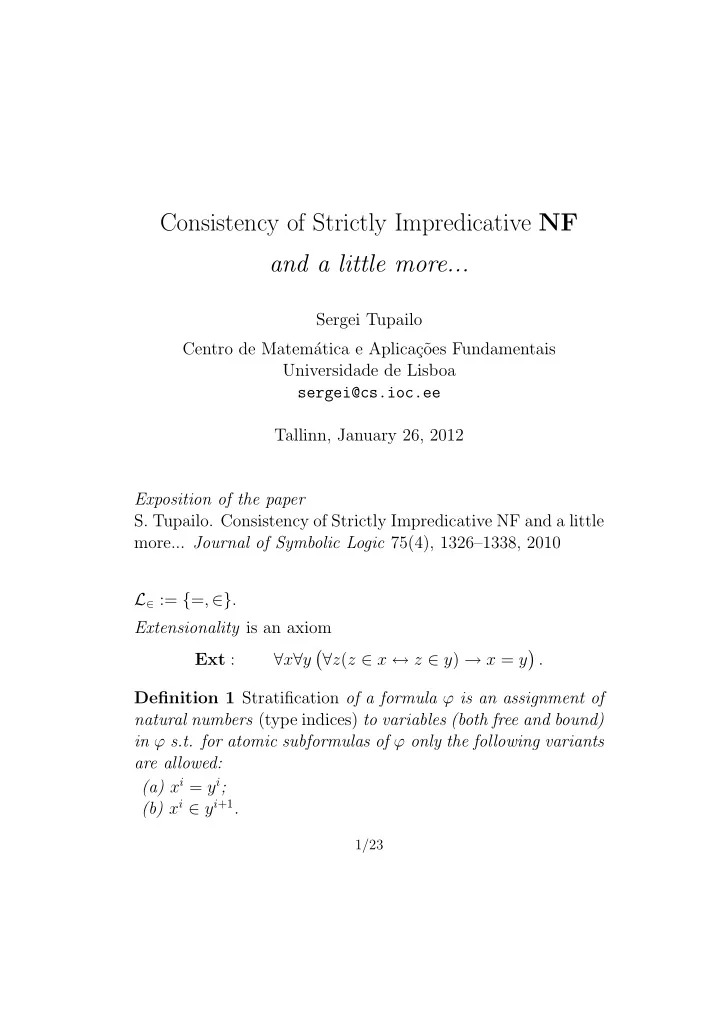
Consistency of Strictly Impredicative NF and a little more... Sergei Tupailo Centro de Matem atica e Aplica c oes Fundamentais Universidade de Lisboa sergei@cs.ioc.ee Tallinn, January 26, 2012 Exposition of the paper S. Tupailo.


slide-1
SLIDE 1

Consistency of Strictly Impredicative NF and a little more...

Sergei Tupailo Centro de Matem´ atica e Aplica¸ c˜

  • es Fundamentais

Universidade de Lisboa sergei@cs.ioc.ee Tallinn, January 26, 2012 Exposition of the paper

  • S. Tupailo. Consistency of Strictly Impredicative NF and a little

more... Journal of Symbolic Logic 75(4), 1326–1338, 2010 L∈ := {=, ∈}. Extensionality is an axiom Ext : ∀x∀y

  • ∀z(z ∈ x ↔ z ∈ y) → x = y
  • .

Definition 1 Stratification of a formula ϕ is an assignment of natural numbers (type indices) to variables (both free and bound) in ϕ s.t. for atomic subformulas of ϕ only the following variants are allowed: (a) xi = yi; (b) xi ∈ yi+1.

1/23

slide-2
SLIDE 2

A formula ϕ is stratified iff there exists a stratification of ϕ. Equivalently, a formula is stratified iff it can be obtained from a formula of Simple Type Theory by erasing type indices (and renaming variables if necessary).

  • Examples. The formula x ∈ y ∧ y ∈ z is stratified, but the

formula x ∈ y ∧ y ∈ x is not. Stratified Comprehension is an axiom scheme SCA : ∃y∀x

  • x ∈ y ↔ ϕ[x]
  • ,

for every stratified formula ϕ with y not free in ϕ. NF := SCA + Ext. V does exist: V := {x | x = x}. So, V ∈ V, V = P(V), etc. Foundation fails, Cantor’s Theorem fails, as well as many other ZFC theorems, too. Known facts:

  • Consis(NF + . . .) → Consis(ZF + . . .);
  • NF ⊢ ¬AC;
  • NF ⊢ Inf;
  • PA ⊢ Consis(NF3);
  • NF = NF4;
  • . . .

2/23

slide-3
SLIDE 3

Main unknown question (since 1937):

  • Consis(ZF + . . .) → Consis(NF) ?

[2] M. Crabb´

  • e. On the consistency of an impredicative subsys-

tem of Quine’s NF. Journal of Symbolic Logic 47, pp. 131–136, 1982. Definition 2 (Crabb´ e) An instance of Stratified Comprehen- sion SCA : ∃y∀x

  • x ∈ y ↔ ϕ[x]
  • ,

(1) is predicative iff there is a stratification of (1) s.t. the indices

  • f bound variables in ϕ are < type(y), and the indices of free

variables in ϕ are ≤ type(y). NFP is a subsystem of NF where SCA is restricted to pred- icative instances. NFI (”mildly impredicative”) is an extension

  • f NFP which allows bound variables in ϕ of types ≤ type(y).

Theorem 3 ([Crabb´ e 82]) Both NFP and NFI are consis- tent, where in addition |NFP| < |EA|, |PA2| ≤ |NFI| < |PA3|. Two kinds of proofs: model-theoretic (countably saturated mod- els) and proof-theoretic (cut-elimination). Theorem 4 ([Holmes 99]) |NFI| = |PA2|.

3/23

slide-4
SLIDE 4

Consider the Union axiom: U : ∀z∃y∀x

  • x ∈ y ↔ ∃v (v ∈ z ∧ x ∈ v)
  • .

(2) Note that U is in NF, but not in NFI: ∀z2∃y1∀x0 x ∈ y ↔ ∃v1 (v ∈ z ∧ x ∈ v)

  • .

Theorem 5 ([Crabb´ e 82]) NFP + U = NFI + U = NF. Definition 6 (S.T.) An instance of Stratified Comprehension SCA : ∃y∀x

  • x ∈ y ↔ ϕ[x]
  • ,

is strictly impredicative iff there is a stratification of it s.t. the indices of all variables in ϕ are ≥ type(y) − 1. Let NFSI denote a subsystem of NF where SCA is restricted to strictly impredicative instances. Then: Theorem 7 (S.T., 08) NFSI (and a little more, e.g. exis- tence of Frege natural numbers) is consistent, too. The proof uses a bit of Model Theory, and a lot of Set Theory (forcing).

4/23

slide-5
SLIDE 5

Theorem 8 ([Specker 62])

  • 1. NF is consistent iff there is a model of TNT [TST is fine]

with a type-shifting automorphism [=: tsau] σ.

  • 2. NF is equiconsistent with the Theory of Types, TNTA

[TSTA is fine] with the Ambiguity scheme, Amb, ϕ ↔ ϕ+, for all sentences ϕ. [ϕ+ is the result of raising all type indices in ϕ by 1.]

  • Proof. See [6].

✷ Specker’s proof generalizes immediately to subsystems of NF where SCA is restricted. For NFSI, an equivalent Type Theory is Ext plus Amb plus all instances of ∃yi+1∀xi x ∈ y ↔ ϕ[x]

  • ,

where all indices in ϕ are ≥ i.

5/23

slide-6
SLIDE 6

From the outset, we assume consistency of ZFC. Let M, ∈ be an Ehrenfeucht-Mostowski model of ZF + V = L, i.e. a countable model with a non-trivial external ∈-automorphism σ. W.l.o.g.w.m.a. that σ moves up at least one regular cardinal κ (in the sense of M):

In M, sets can be enumerated by ordinals, i.e. there is a formula ϕ(x, α) s.t. the sentence ”ϕ gives a (class) bijection between V and On” is true in

  • M. By Ehrenfeucht-Mostowski, σ(x) = x for some x ∈ M. Since we have a

definable bijection, σ(α) = α for some ordinal α ∈ M. If α < σ(α), fine; if not, take σ−1. In order to move up a cardinal, use a definable bijection α → ℵα. In order to move up a regular cardinal, use a definable injection α → ℵα+1.

By default, we will use forcing machinery (original results due to P. Cohen and R. Solovay) as laid out in [5] K. Kunen. Set Theory. An Introduction to Indepen- dence Proofs. Elsevier, 1980. Given a finite set S of TSTA-axioms, let n ≥ 2 be such that all indices i in S fall under 0 ≤ i ≤ n. For 0 ≤ i < n, let I Pi := Fn(σi+1(κ), 2, σi(κ)) (Cohen’s poset), where Fn(κ1, 2, κ0) := {p||p| < κ0 ∧ p is a function ∧ dom(p) ⊂ κ1 ∧ ran(p) ⊂ 2} (3) (see VII 6.1), and I P := I Pn :=

0≤i<n I

Pi. Note first that σ acts as a bijection between σi(κ) and σi+1(κ). Let G0 be I P0-generic over M. Then M[G0] | = ∃h0 h0:σ(κ)

bi

→ P(κ).

6/23

slide-7
SLIDE 7

Definition 9 P<ω(b) := {a ⊂ b | |a| < ω}. Let g0 ∈ M be such that g0:κ

bi

→ P<ω(κ). Defining gi := σi(g0), we get gi:σi(κ)

bi

→ P<ω(σi(κ)). (4) Lemma 10 Given M[G0] ∋ h0 : σ(κ)

bi

→ P(κ) and M ∋ g0 : κ

bi

→ P<ω(κ), there exists a bijection M[G0] ∋ f0 : σ(κ)

bi

→ P(κ) satisfying f0↾κ = g0.

  • Proof. Work in M[G0]. Since |P(κ)| = σ(κ), |P<ω(κ)| = κ and P(κ) =

P<ω(κ) P≥ω(κ), we must have |P≥ω(κ)| = σ(κ), i.e. there is a bijection h1 between σ(κ) and P≥ω(κ). Now, for a ∈ P(κ), define f ′

0(a) by

f ′

0(a) :=

  • g−1

0 (a)

if a ∈ P<ω(κ), κ + h−1

1 (a)

  • therwise.

(5) We claim that f ′

0 is a special bijection between P(κ) and σ(κ):

(i) f ′

0(a) < σ(κ) is seen from (5) and the fact that σ(κ) is an additive principal

number, i.e. an ordinal closed under ordinal sum; (ii) f ′

0 is onto: if α < κ, then by the first line of (5) f ′ 0(a) = g−1 0 (a) = α

for some a ∈ P<ω(κ); otherwise, α = κ + β for some β < σ(κ), and then f ′

0(a) = κ + h−1 1 (a) for some a ∈ P≥ω(κ);

(iii) f ′

0 is 1-1 follows from (5) and the fact that both g−1

and h−1

1

are 1-1; (iv) further, from the first line of (5) we have f ′

0↾P<ω(κ) = g−1 0 .

From (i-iv) above, f0 can be taken as the inverse of f ′

0.

Choose f0:σ(κ)

bi

→ P(κ) as guaranteed by Lemma 10.

7/23

slide-8
SLIDE 8

Let τ ∈ M I

P0 be a name for f0, so that

M[G0] | = τG0 :σ(κ)

bi

→ P(κ). (6) By the Forcing Theorem VII 3.6 ∃p∈G0

  • p

∗ I P0 τ :(σ(κ))I P0

ˇ

bi

→ P((κ)I

P0

ˇ )

M . (7) Taking p ∈ G0 from (7) and applying σi to this formula, we

  • btain
  • σi(p)

∗ I Pi σi(τ):(σi+1(κ))I Pi

ˇ

bi

→ P((σi(κ))I

Pi

ˇ )

M . (8) Define Gi+1 := σ′′Gi, 0 ≤ i < n − 1, and G :=

0≤i<n Gi. Then

each Gi contains σi(p) and is I Pi-generic over M – see Lemma 11. It’s easily verified that G is a filter on I P =

0≤i<n I

Pi, but it was more of an issue whether G is generic. Also observe that σi(τ) ∈ M I

Pi, for each i.

Lemma 11 (See pp. 219–220) G is P-generic over M ⇐ ⇒ σ′′G is σ(P)-generic over M.

  • Proof. ”G is a filter in P” being equivalent to ”σ′′G is a filter in

σ(P)” follows from σ being an isomorphism between P and σ(P). For the ”generic” part, it follows from ”D is dense in P” ⇔ ”σ′′D is dense in σ(P)” (σ isomorphism) and σ′′D = σ(D) (σ ∈-automorphism of M). ✷

8/23

slide-9
SLIDE 9

Starting with the complete embeddings I Pi →

0≤i<n I

Pi, define natural embeddings ıi:M I

Pi → M I P as in VII 7.12.

Lemma 12 For each i, 0 ≤ i < n, M[Gi] is a transitive sub- model of M[G].

  • Proof. Let x ∈ M[Gi].

Then x = ρGi for ρ ∈ M I

Pi.

Then ıi(ρ) ∈ M I

P and x = ρGi = (ıi(ρ))G by VII 7.13(a), so that

x ∈ M[G]. Now, assume x = ρGi = (ıi(ρ))G ∈ M[Gi], y = τG ∈ M[G], y ∈M[G] x. We need to show y ∈ M[Gi] and y ∈M[Gi] x. We compute: y ∈M[G] x ⇐ ⇒ τG ∈M[G] (ıi(ρ))G ⇐ ⇒ ∃p∈G (τ, p ∈ ıi(ρ))

VII 7.12

⇐ ⇒ ∃p∈G ∃pi∈Gi ∃δ∈M I

Pi (δ, pi ∈ ρ ∧ τ = ıi(δ)

∧ p = ∅, . . . , pi, . . . , ∅) = ⇒ y = δGi ∈ M[Gi] ∧ δGi ∈M[Gi] ρGi. ✷ See Picture 1. Interpret variables xi of LTSTn as x∈σi(κ), and interpret xi ∈i yi+1 as x ∈ (σi(τ))Gi(y). First note that from (8) we have M[Gi] | = (σi(τ))Gi :σi+1(κ)

bi

→ P(σi(κ)), (9) for each 0 ≤ i < n. For brevity, we denote fi := (σi(τ))Gi ∈ M[Gi]

  • L. 12

⊂ M[G].

9/23

slide-10
SLIDE 10

From Lemma 10, we have fi↾σi(κ) = gi. (10) We want to show that, under this interpretation, each axiom of TSTAn is true in M[G]. Let’s check Extensionality. We don’t claim (yet) that M[G] | = ZFC, but at least we have Lemma 13 M[G] | = Extensionality.

  • Proof. Follows from VII 2.14.

  • Remark. If G happened to be generic, then M[G] would be a

model of ZFC. We have to model ∀xi+1∀yi+1 ∀zi(z ∈i x ↔ z ∈i y) → x = y

  • ,

i.e. to prove, in M[G], ∀x∈σi+1(κ)∀y∈σi+1(κ)

  • ∀z∈σi(κ)(z ∈ fi(x) ↔ z ∈ fi(y)) → x = y
  • .

(11) Fix x, y ∈ σi+1(κ), and assume ∀z∈σi(κ)(z ∈ fi(x) ↔ z ∈ fi(y)). (12) Since (fi(x), fi(y) ∈ P(σi(κ)))M[Gi], we have (fi(x), fi(y) ⊂ σi(κ))M[Gi], so by absoluteness fi(x), fi(y) ⊂ σi(κ). Then, (12) can be re- duced to ∀z (z ∈ fi(x) ↔ z ∈ fi(y)), (13)

10/23

slide-11
SLIDE 11

which implies fi(x) = fi(y) by Extensionality of M[G]. Now, since the functions fi are 1-1 in M[Gi] (see (9)), by absoluteness they are 1-1 in M[G], so we can conclude x = y. For Ambiguity, it’s enough to model ∀xi∀yi+1 x ∈i y ↔ σ(x) ∈i+1 σ(y)

  • ,

i.e. to have, in M[G], ∀x∈σi(κ)∀y∈σi+1(κ)

  • x ∈ fi(y) ↔ σ(x) ∈ fi+1(σ(y))
  • ,

(14) 0 ≤ i < n − 1. Lemma 14 For each i, 0 ≤ i < n−1, there is an ∈-isomorphism σi of M[Gi] onto M[Gi+1] extending σ↾M; additionally, σi(fi) = fi+1.

  • Proof. See Lemma 15 – Corollary 19.

✷ Coming back to (14), fix x ∈ σi(κ), y ∈ σi+1(κ). Assume M[G] | = x ∈ fi(y) (the opposite direction being analogous). Since the formula ”x ∈ fi(y)” is ∆0, by absoluteness M[Gi] | = x ∈ fi(y). By Lemma 14, M[Gi+1] | = σ(x) ∈ fi+1(σ(y)). By absoluteness again, M[G] | = σ(x) ∈ fi+1(σ(y)).

11/23

slide-12
SLIDE 12

Lemma 15 (See p. 222) σ : M P

bi

→ M σ(P) and σ is an ∈- isomorphism between M P × P, M P and M σ(P) × σ(P), M σ(P) in the sense that for every µ, τ ∈ M P and p ∈ P, µ, p ∈ τ ↔ σ(µ), σ(p) ∈ σ(τ).

  • Proof. σ : M P

bi

→ M σ(P) follows from the fact that ”τ ∈ M P” is a formula of set theory with parameters τ, P. ∈ is preserved since σ is an ∈-automorphism. ✷ Definition 16 Σ = {τG, (σ(τ))σ′′G | τ ∈ M P}. Lemma 17 Σ is an ∈-isomorphism between M[G] and M[σ′′G]. Proof (sketch). We need to check four things: (a) Σ is a function; (b) Σ is onto; (c) Σ is 1-1; (d) Σ commutes with ∈. (b) follows from the fact that σ : M P → M σ(P) is onto, Lemma 15. (d): Let µG ∈ τG. Then ∃p ∈ G µ, p ∈ τ. Then σ(p) ∈ σ′′G and σ(µ), σ(p) ∈ σ(τ) (Lemma 15). This means (σ(µ))σ′′G ∈ (σ(τ))σ′′G. (a) Let τG = τ ′

G.

Then ∀µ ∈ M P (µG ∈ τG ↔ µG ∈ τ ′

G).

By (d) ∀µ ∈ M P ((σ(µ))σ′′G ∈ (σ(τ))σ′′G ↔ (σ(µ))σ′′G ∈ (σ(τ ′))σ′′G). By Lemma 15 this im- plies ∀µ ∈ M σ(P) (µσ′′G ∈ (σ(τ))σ′′G ↔ µσ′′G ∈ (σ(τ ′))σ′′G), i.e. (σ(τ))σ′′G = (σ(τ ′))σ′′G. (c) is analogous to (a): Σ−1 is a func- tion. ✷ Lemma 18 For every x ∈ M, (x)

ˇ

P = (x)

ˇ

σ(P) and Σ(x) =

σ(x).

12/23

slide-13
SLIDE 13
  • Proof. Since 1P = 1σ(P) = ∅, (x)

ˇ

P = (x)

ˇ

σ(P) is proved by induc-

tion on x. By Definition 16, Σ(x) = Σ((ˇ x)G)

  • Def. 16

= (σ(ˇ x))σ′′G

σ ∈-auto

= ((σ(x))

ˇ)i′′G = σ(x).

✷ Corollary 19 Σ↾M = σ. For Comprehension, we want to model ∀xi1

1 . . . ∀xik k ∃yi+1∀xi

x ∈i y ↔ ϕ(x, x1, . . . , xk)

  • .

This means to prove, in M[G], ∀x1∈σi1(κ) . . . ∀xk∈σik(κ)∃y∈σi+1(κ)∀x∈σi(κ)

  • x ∈ fi(y) ↔ ˜

ϕ(x, x1, . . . , xk, σι1(κ), . . . , σιℓ(κ), fj1, . . . , fjl)

  • ,

(15) where ˜ ϕ is a translation of ϕ by the rules above. Here I have a problem. It’s unlikely that M[G] satisfies (15) for every ϕ. One trivial result is immediate however from what stands: Consis(NF2). In that case in (15) i = j1 = . . . = jl, and the set A := {x ∈ σi(κ) | ˜ ϕ(x, x1, . . . , xk, σι1(κ), . . . , σιℓ(κ), fj1, . . . , fjl)} (16) is in M[Gi] by Separation; thus, also having A ⊂ σi(κ), y can be taken to be f −1

i (A).

13/23

slide-14
SLIDE 14

In general, everything boils down to showing A ∈ M[Gi], but if G is not generic, it’s even not clear whether A exists as a set in M[G]. — Assume in addition that G is I P-generic over M. Let an instance ∀x1 . . . ∀xk∃y∀x

  • x ∈ y ↔ ϕ(x, x1, . . . , xk)
  • (17)
  • f Stratified Comprehension be strictly impredicative. In that

case, under our interpretation, (17) is true in M[G]. Indeed, it’s enough to check only the case i = 0, for the general case follows then by Ambiguity. If i = 0, then A ∈ M[G] since M[G] | = Separation, and actually A ∈ M[G0] by VII 6.14 (forcing above doesn’t add subsets of smaller cardinals). — Can do more, even without assuming G being generic or an axiom strictly impredicative. For example, the axioms P7: ∀u∃v∀x∀y (y, x ∈ u ← → x, y ∈ v) 4 p.,∼s.i. P8: ∃v∀x (x ∈ v ← → ∃y(x = {y})) 3 p. can be pushed trough utilizing our careful choice of the initial bijection f0:

14/23

slide-15
SLIDE 15

(Frege natural numbers) P8.k is an axiom ∃v∀x (x ∈ v ← → ∃y1 . . . ∃yk (

  • 1≤ı,≤k;ı=

yı = y∧x = {y1, . . . , yk})). (18) ((18) asserts existence of a Frege natural number k ≥ 1. Note that (18) is predicative and not s.i. The reasoning below also works for k = 0, when we understand

∅ as ⊤ and ∅ as ⊥.)

That means that we must satisfy the following axiom of TSTAn: ∃vi+2∀xi+1 (x ∈ v ← → ∃yi

1 . . . ∃yi k (

  • 1≤ı,≤k;ı=

yı = y∧x = {y1, . . . , yk})). (19) (Our formula ϕ[xi+1] in this case is ”∃yi

1 . . . ∃yi k ( 1≤ı,≤k;ı= yı =

y ∧ xi+1 = {y1, . . . , yk})”.) Given that xi+1 = {yi

1, . . . , yi k} ⇐

  • 1≤ı≤k

yi

ı ∈ xi+1∧∀ui∈xi+1

  • 1≤ı≤k

u = yi

ı,

(20) we see that the translation of (20), for y1, . . . , yk ∈ σi(κ), x ∈ σi+1(κ), is

  • 1≤ı≤k

yı ∈ fi(x) ∧ ∀u∈σi(κ) (u ∈ fi(x) →

  • 1≤ı≤k

u = yı), i.e. fi(x) = {y1, . . . , yk}, (21) and in this case ˜ ϕ(x, fi) := ∃y1∈σi(κ) . . . ∃yk∈σi(κ) (

  • 1≤ı,≤k;ı=

yı = y∧fi(x) = {y1, . . . , yk}).

15/23

slide-16
SLIDE 16

According to p. 13, in order to verify P8.k under my interpre- tation, we must have A8.k := {x ∈ σi+1(κ) | ∃y1∈σi(κ) . . . ∃yk∈σi(κ) (

1≤ı,≤k;ı= yı = y ∧ fi(x) = {y1, . . . , yk})} ∈ M[Gi+1].

(22) (Note that A8.k ∈ M[Gi] ⊂ M[G] automatically, because fi ∈ M[Gi] and M[Gi] satisfies Separation, but what we actually need is A8.k ∈ M[Gi+1].) Can we arrange for this? What helps here is our special choice of fi’s: Claim 20 For y1, . . . , yk ∈ σi(κ), x ∈ σi+1(κ), fi(x) = {y1, . . . , yk} is equivalent to x ∈ σi(κ) ∧ gi(x) = {y1, . . . , yk}.

  • Proof. ⇐: Immediate from (10).

⇒: Let a = {y1, . . . , yk} ∈ P<ω(σi(κ)). From (9), (4) and (10), f −1

i (b) = g−1 i (b) for b ∈ P<ω(σi(κ)) (f −1 i

enumerates P(σi(κ)) in a special regular way). From fi(x) = a we have x = f −1

i (a) =

g−1

i (a) ∈ σi(κ) (see (4)), so we must have x ∈ σi(κ) ∧ gi(x) = a.

✷ Summarizing (see (20)–(21)), we have proved Lemma 21 Under y1, . . . , yk ∈ σi(κ), x ∈ σi+1(κ), (x = {y1, . . . , yk}) ˜ is equivalent to a ∆0 formula with parameters in M. — Coming back to P8.k, the formula ϕ8.k[xi+1] in this case is ”∃yi

1 . . . ∃yi k ( 1≤ı,≤k;ı= yı = y ∧ xi+1 = {y1, . . . , yk})”, and we

must check

16/23
slide-17
SLIDE 17

A8.k := {x ∈ σi+1(κ) | ˜ ϕ8.k[x]} = {x ∈ σi+1(κ) | ∃y1∈σi(κ) . . . ∃yk∈σi(κ) (

  • 1≤ı,≤k;ı=

yı = y ∧ (x = {y1, . . . , yk})˜)} being in M[Gi+1]. Lemma 21 actually gives us more: A8.k ∈ M ⊂ M[Gi+1].

17/23

slide-18
SLIDE 18

(G =

0≤i<n Gi is generic over M)

Lemma 22 (see VII Exercise B5) Assume A ∈ M, f : A → M and f ∈ M[G]. Then there is a B ∈ M such that f :A → B.

  • Proof. Let f = τG. We have

∀x∈A ∃!b∈M x, b ∈ f; this yields ∀x∈A ∃!b∈M ((op(ˇ x,ˇ b))G ∈ τG)M[G]. By VII 3.6 ∀x∈A ∃!b∈M ∃p∈G (p −

∗ op(ˇ

x,ˇ b) ∈ τ)M, implying ∀x∈A ∃!b∈M ∃p∈P (p −

∗ op(ˇ

x,ˇ b) ∈ τ)M, i.e. M | = ∀x∈A ∃!b ∃p∈P p −

∗ op(ˇ

x,ˇ b) ∈ τ. By Replacement (in M) M | = ∃B = {b | ∃x∈A ∃p∈P p −

∗ op(ˇ

x,ˇ b) ∈ τ}. We need to show f :A → B. Let x ∈ A and b ∈ M be such that (x, b ∈ f)M[G]. Then ((op(ˇ x,ˇ b))G ∈ τG)M[G], and, by VII 3.6, ∃p∈P (p −

∗ op(ˇ

x,ˇ b) ∈ τ)M, i.e. b ∈ B. ✷ Corollary 23 (see VII Exercise B6) Assume P ∈ M and α is an ordinal of M. Then (1) ⇒ (2), where (1) whenever B ∈ M, αB ∩ M = αB ∩ M[G]; (2)

αM ∩ M = αM ∩ M[G].

18/23

slide-19
SLIDE 19
  • Proof. Assume (1).

αM ∩ M ⊂ αM ∩ M[G] is obvious, so

we need to show the converse. If f ∈ αM ∩ M[G], then by Lemma 22 there is a B ∈ M s.t. f ∈ αB ∩ M[G]. By (1) we have f ∈ αB ∩ M, and, by transitivity of M, f ∈ αM ∩ M. ✷ VII 6.12. Definition. A poset P is λ-closed iff whenever γ < λ and {pξ | ξ < γ} is a decreasing sequence of elements of P (i.e., ξ < η → pξ ≥ pη), then ∃q∈P ∀ξ < γ q ≤ pξ. Lemma 24 Assume P is λ-closed and G is P-generic over M. Assume y ∈ M[G], y ⊂ M, (|y| < λ)M[G]. Then y ∈ M.

  • Proof. We have an α < λ and an f :α

bi

→ y with f ∈ M[G]. By VII 6.14, (1) of Corollary 23 is satisfied; consequently, so is (2). f ∈ αM, so by (2) f ∈ M, and thus y = ran(f) ∈ M. ✷ Lemma 25 Assume P is λ-closed and G is P-generic over M. Assume κ0 < κ1 and κ0 ≤ λ. Then (Fn(κ1, 2, κ0))M = (Fn(κ1, 2, κ0))M[G].

  • Proof. (Fn(κ1, 2, κ0))M ⊂ (Fn(κ1, 2, κ0))M[G] follows by abso-

luteness and M ⊂ M[G], so we need to show the converse. Let p ∈ M[G] and (p ∈ Fn(κ1, 2, κ0))M[G]. ∀z ∈p ∃x ∈ κ1 ∃i ∈ 2 z = x, i, so p ⊂ M. We have (|p| < κ0 ≤ λ)M[G], so by Lemma 24 p ∈ M. A bijection f ∈ M[G] between some α < κ0 and p is actually in M by VII 6.14, so that (p ∈ Fn(κ1, 2, κ0))M. ✷ Lemma 26 Assume P is λ-closed and G is P-generic over M. Assume κ0 < κ1, κ0 < λ, and G0 is Fn(κ1, 2, κ0)-generic over

  • M. Then G0 is Fn(κ1, 2, κ0)-generic over M[G].

19/23

slide-20
SLIDE 20
  • Proof. By VII 6.10, Fn(κ1, 2, κ0) has the (2<κ0)+-c.c. In M[G],

2<κ0 = κ0, since M | = GCH and by VII 6.14 M[G] doesn’t change powersets of cardinals below λ. Therefore, in M[G], every Fn(κ1, 2, κ0)-antichain has cardinality ≤ κ0. Now let D be a dense subset of Fn(κ1, 2, κ0) lying in M[G]. We must show that G0 meets D. By Zorn (applied in M[G]) let A be a maximal antichain consisting of elements of D (see Lemma 29). Then A has cardinality at most κ0. By Lemma 24 A lies in M. A is clearly a maximal Fn(κ1, 2, κ0)-antichain in the sense of M. But G0 is M-generic. So G0 meets A (see VII Exercise A12, Lemma 30). Hence G0 meets D. ✷ Corollary 27 Under the conditions of Lemma 26, G0 × G is Fn(κ1, 2, κ0) × P-generic over M.

  • Proof. Use Product Lemma VIII 1.4.

✷ Theorem 28 G =

0≤i<n Gi is I

P =

0≤i<n I

Pi-generic over M.

  • Proof. By backwards induction on j we prove that

j≤i<n Gi is

  • j≤i<n I

Pi-generic over M. The claim is obvious for j = n − 1; so we assume it for j, 0 < j < n, and try to prove it for j − 1. (We remind I Pj−1 = Fn(σj(κ), 2, σj−1(κ)).) By Corollary 27, it’s enough to see that

j≤i<n I

Pi is σj(κ)-closed. Each I Pi is σi(κ)- closed, see VII 6.13. It follows that each I Pi is σk(κ)-closed if i ≥ k, see VII 6.12. It follows that

j≤i<n I

Pi is σj(κ)-closed, see Jech [4, 15.12]. ✷

20/23

slide-21
SLIDE 21

(Two genericity Lemmas)

  • Cf. VII Exercise A12.

Lemma 29 Assume D ⊂ P is dense. There is a maximal an- tichain A ⊂ P s.t. A ⊂ D.

  • Proof. Let

A := {B ⊂ D | B is an antichain}. Order A by inclusion. Every chain in A has a supremum, namely its union, for if p1, p2 ∈ C, then ∃B1 ∈ C p1 ∈ B1 and ∃B2 ∈ C p2 ∈ B2; B1 ⊂ B2 ∨ B2 ⊂ B1; w.l.o.g.w.m.a. B1 ⊂ B2, then p1, p2 ∈ B2 and p1 ⊥ p2 since B2 is an antichain; thus C is an antichain ⊂ D, too. By Zorn’s Lemma, A has a maximal element A. We need to prove A is a maximal antichain, not only maximal in

  • A. Let A ∪ {a} be an antichain. Since D is dense, ∃q∈D q ≤ a.

A ∪ {q} is also an antichain, and A ∪ {q} ⊂ D, so q ∈ A. If a / ∈ A, we have a contradiction with A∪{a} being an antichain, since a ⊥ q. Consequently, a ∈ A, and A is a maximal antichain. ✷ Lemma 30 Let P ∈ M and G ⊂ P be a filter. The following two conditions are equivalent: (1) G meets every P-dense set which is in M (i.e., G is P-generic over M); (2) G meets every P maximal antichain which is in M.

  • Proof. (2)⇒(1) follows from Lemma 29. For (1)⇒(2), let A ∈

M be a P maximal antichain. Set D := {p ∈ P | ∃q∈A p ≤ q}. (23)

21/23

slide-22
SLIDE 22

Obviously, D ∈ M.

  • Claim. D is dense in P.

/- Assume not, i.e. ∃p∈P ∀q∈D q ≤ p. (24) Claim 1. p / ∈ A. /- If p ∈ A, then by (23) p ∈ D, contradicting (24). So p / ∈ A. Claim 1-/ Claim 2. A ∪ {p} is a P antichain in M. /- We are to show ∀q∈A p ⊥ q. Assume not, i.e. ∃q∈A ∃r∈P (r ≤ p ∧ r ≤ q). Since r ≤ q, by (23) r ∈ D. But this contradicts (24). Claim 2-/ Now we have a contradiction with A being a maximal antichain. Claim-/ By (1), ∃p ∈ G ∩ D. By (23), ∃q ∈A p ≤ q. Since G is a filter, q ∈ G ∩ A. ✷ Theorem 31 Strictly impredicative NF (and a little more) is consistent.

  • Proof. Above.

✷ So, this much effort it has taken to prove consistency of this fragment of NF. It remains to be seen how much effort it will take to prove consistency of the whole theory.

22/23

slide-23
SLIDE 23

References

[1] M. Boffa. ZFJ and the consistency problem for NF. Jahrbuch der Kurt G¨

  • del Gesellschaft (Wien), pp. 102–

106, 1988 [2] M. Crabb´

  • e. On the consistency of an impredicative sub-

system of Quine’s NF. Journal of Symbolic Logic 47, pp. 131–136, 1982 [3] T. E. Forster. Set Theory with a Universal Set, second

  • edition. Clarendon Press, Oxford, 1995

[4] T. Jech. Set theory, The Third Millennium Edition. Springer-Verlag, 2002 [5] K. Kunen. Set Theory. An Introduction to Independence

  • Proofs. Elsevier, 1980

[6] E. P. Specker. Typical ambiguity. In: E. Nagel (ed.), Logic, methodology and philosophy of science, Stanford University Press, pp. 116–123, 1962

23/23