Constrained dynamics Simple particle system In principle, you can - - PowerPoint PPT Presentation

constrained dynamics
SMART_READER_LITE
LIVE PREVIEW

Constrained dynamics Simple particle system In principle, you can - - PowerPoint PPT Presentation

Constrained dynamics Simple particle system In principle, you can make just about anything out of spring systems In practice, you can make just about anything as long as its jello Hard constraints Constraint force


slide-1
SLIDE 1

Constrained dynamics

slide-2
SLIDE 2

Simple particle system

  • In principle, you can make just

about anything out of spring systems

  • In practice, you can make just

about anything as long as it’s jello

slide-3
SLIDE 3

Hard constraints

slide-4
SLIDE 4
  • Constraint force
  • Single implicit constraint
  • Multiple implicit constraint
  • Parametric constraint
  • Implementation
slide-5
SLIDE 5

A simple example

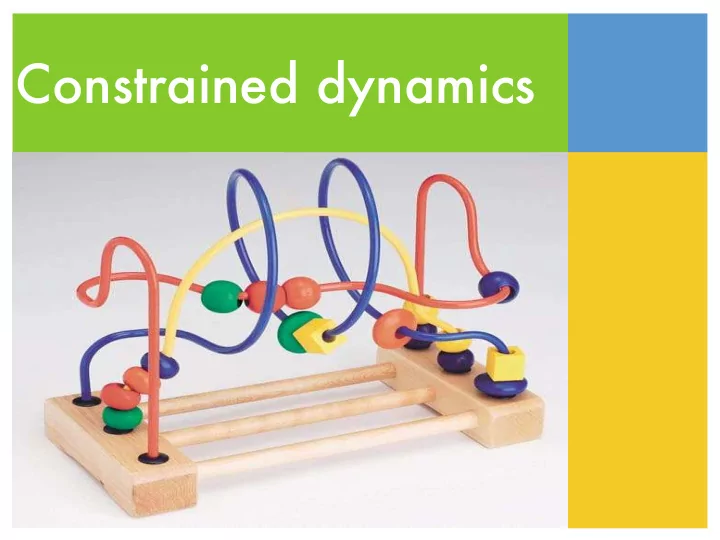
A bead on a wire

The bead can slide freely along the wire, but cannot come off no matter how hard you pull it. How do we simulate the motion of the bead when arbitrary forces applied to it?

slide-6
SLIDE 6

Penalty constraints

  • Why not use a spring to

hold the bead on the wire?

  • Problems:
  • weak springs won’t do

the job

  • strong springs give you

stiff systems

slide-7
SLIDE 7

fT

First order world

N

f fN

In this world, f = mv What is the legal velocity? What is the legal force?

f ′ = f + ˆ f

Add constraint force to cancel the illegal part of f

ˆ f ˆ f f ′

ˆ f = − N · f N · NN

slide-8
SLIDE 8

The real world

N

In the real world, f = ma What is the legal acceleration?

v a

depends on both and

N v

the faster you’re going, the faster you have to turn

f ˆ f?

Compute such that only generates legal acceleration

f ′ ˆ f f ′ = f + ˆ f

slide-9
SLIDE 9

Constraint force

  • Need to compute constraint forces that cancel the

illegal applied forces

  • Which means we need to know what legal

acceleration is

slide-10
SLIDE 10
  • Constraint force
  • Single implicit constraint
  • Multiple implicit constraint
  • Parametric constraint
  • Implementation
slide-11
SLIDE 11

Constraints

Implicit: Parametric:

θ x C(x) = |x| − r = 0

x = r cos θ sin θ

  • r
slide-12
SLIDE 12

Legal acceleration

What is the legal position? What is the legal acceleration?

C = 0 ˙ C = 0 ¨ C = 0

˙ C(x) = x · ˙ x = 0

What is the legal velocity?

¨ C(x) = ¨ x · x + ˙ x · ˙ x = 0 C(x) = 1 2x · x − 1 2 = 0

slide-13
SLIDE 13

Legal conditions

If we start with legal position and velocity We need only ensure the legal acceleration

¨ C(x) = 0 ˙ C(x) = 0 C(x) = 0

C = 0 ˙ C = 0 ¨ C = 0

slide-14
SLIDE 14

Constraint force

∂C ∂x · ˆ f = −∂C ∂x · f − m ˙ C ∂x ˙ x

Use the legal condition to compute the constraint force Rewrite the legal condition in a general form

¨ C(x) = ∂ ˙ C ∂x · ˙ x + ∂C ∂x · ¨ x = 0

¨ x = f + ˆ f m

Substitute ¨

x with

¨ C = ∂ ˙ C ∂x · ˙ x + ∂C ∂x · f + ˆ f m

= 0

: constraint gradient ∂C ∂x

slide-15
SLIDE 15

Constraint force

∂C ∂x · ˆ f = −∂C ∂x · f − m ˙ C ∂x ˙ x

How many variables do we have? Need one more condition to solve the constraint force

slide-16
SLIDE 16

Virtual work

Constraint force is passive - no energy gain or loss

T = 1 2m ˙ x · ˙ x

Kinetic energy of the system:

˙ C(x) = ∂C ∂x · ˙ x = 0

˙ x · ˆ f = 0, ∀ ˙ x | ∂C ∂x · ˙ x = 0

Make sure does no work for every legal velocity:

ˆ f

Virtual work done by and :

f ˆ f

= ˙ x · f + ˙ x · ˆ f ˙ T = ˙ x · m¨ x

slide-17
SLIDE 17

Constraint force

ˆ f = λ∂C ∂x λ = − ∂C

∂x · f − m ∂ ˙ C ∂x · ˙

x

∂C ∂x · ∂C ∂x

˙ x · ˆ f = 0, ∀ ˙ x | ∂C ∂x · ˙ x = 0

must point in the direction of ∂C

∂x ˆ f

∂C ∂x · ˆ f = −∂C ∂x · f − m ˙ C ∂x ˙ x

Substituting for in

ˆ f

slide-18
SLIDE 18

Two conditions

  • Legal acceleration
  • Principle of virtual work

∂C ∂x · ˆ f = −∂C ∂x · f − m ˙ C ∂x ˙ x ˆ f = λ∂C ∂x

slide-19
SLIDE 19

The Bead Example

N v

f ˆ f?

ˆ f = λ∂C ∂x λ = − ∂C

∂x · f − m ∂ ˙ C ∂x · ˙

x

∂C ∂x · ∂C ∂x

C(x) = 1 2x · x − 1 2 = 0

slide-20
SLIDE 20

Quiz

ˆ f = λ∂C ∂x λ = − ∂C

∂x · f − m ∂ ˙ C ∂x · ˙

x

∂C ∂x · ∂C ∂x

C(x) = 1 2x · x − 1 2r2 r = 2 m = 10kg g = (0, −9.8) x = (0, −2) ˙ x = (−4, 0)

What is the constraint force at the current state?

slide-21
SLIDE 21
  • In principle, ensuring legal acceleration can keep

the particle exactly on the circle

  • In practice, two problems cause the particle to

drift

  • numerical errors can accumulate when the ODE

is not solved exactly

  • constraints might not be met initially

Feedback

slide-22
SLIDE 22

Feedback

  • A feedback term handles both problems:

¨ C = −ksC − kd ˙ C instead of ¨ C = 0

slide-23
SLIDE 23

Quiz

λ = − ∂C

∂x · f − m ∂ ˙ C ∂x · ˙

x

∂C ∂x · ∂C ∂x

What is the new formula for lambda after adding the feedback term? ¨ C = −ksC − kd ˙ C

slide-24
SLIDE 24
  • Constraint force
  • Single implicit constraint
  • Multiple implicit constraint
  • Parametric constraint
  • Implementation
slide-25
SLIDE 25

Tinkertoys

  • Now we know how to simulate a bead on a wire
  • Apply the simple idea, we can create a

constrained particle system

slide-26
SLIDE 26

Constrained particles

  • Particles: each particle represents a point in the

phase space

  • Forces: each force affects the acceleration of

certain particles

  • Constraints:

Each is a function Ci(x1, x2, . . .) Constraint force: linear combination of constraint gradients ∂Ci

∂x , ∀i

Legal state: Ci(x1, x2, . . .) = 0, ∀i

slide-27
SLIDE 27

Constraint gradients

Legal states: the intersection of two planes Normal of the legal states: Normal of C1: ∂C1

∂x

Normal of C2: ∂C2

∂x λ1 ∂C1 ∂x + λ2 ∂C2 ∂x

slide-28
SLIDE 28

Implicit constraint

  • Each constraint is represented by an implicit

function

  • What does the normal of a hypersurface mean?

The direction where the particle is not allowed to move

  • What does the intersection of the hypersurface

represent? Legal state

  • The constraint force lies in the space spanned by

the normals of constraints

slide-29
SLIDE 29

Particle system notations

f1 f2 fn . . . Q

q: 3n long position vector

Q: 3n long force vector

: 3n 3n inverse mass matrix

W ×

General 3D case

... W

1 m1 I 1 m2 I 1 mn I

x1 x2 xn q

slide-30
SLIDE 30

Constraint notations

∂C1 ∂q1 ∂C1 ∂q2 ∂C1 ∂q3n ∂Cm ∂q3n

...

∂C2 ∂q1

J ...

∂ ˙ Cm ∂q3n ∂ ˙ C1 ∂q3n ∂ ˙ C1 ∂q1 ∂ ˙ C1 ∂q2 ∂ ˙ C2 ∂q1

˙ J λ1 λ2 λm λ

Additional notations

λ: m Lagrangian multipliers J: m 3n Jacobian matrix × ˙ J: time derivative of Jacobian matrix

slide-31
SLIDE 31

Constraint equations

¨ C = ∂ ˙ C ∂x · ˙ x + ∂C ∂x · ¨ x ¨ C = ∂ ˙ C ∂x · ˙ x + ∂C ∂x · f + ˆ f m = 0 ∂C ∂x · ˆ f = −∂C ∂x · f − m ˙ C ∂x ˙ x JW ˆ Q = − ˙ J ˙ q − JWQ ¨ C = ˙ J ˙ q + JW(Q + ˆ Q) = 0 ¨ C = ˙ J ˙ q + J¨ q ∂C ∂x · λ∂C ∂x = −∂C ∂x · f − m ˙ C ∂x ˙ x JWJT λ = − ˙ J ˙ q − JWQ

slide-32
SLIDE 32

Multiple force constraints

JWJT λ = − ˙ J ˙ q − JWQ

To solve for force constraints, we need to solve for this linear system One nice property of is that it is symmetric positive definite matrix

JWJT λ

Once the linear system has been solved, the vector is multiplied by to produce the global constraint force vector

JT ˆ Q

Can you prove that?

slide-33
SLIDE 33

Impress your friends

  • The requirement that constraints not add or

remove energy is called the Principle of Virtual Work

  • The λ’s are called Lagrangain Multipliers
  • The derivative matrix J is called the Jacobian

Matrix

slide-34
SLIDE 34

Quiz

C(x1, x2) = 1 2(x1 − x2) · (x1 − x2) − 1 2d2

Can you write down the formula of the Jacobian of this constraint?

slide-35
SLIDE 35
  • Constraint force
  • Single implicit constraint
  • Multiple implicit constraint
  • Parametric constraint
  • Implementation
slide-36
SLIDE 36

Constraints

Implicit: Parametric:

θ C(x) = |x| − r = 0

x = r cos θ sin θ

  • r

x

slide-37
SLIDE 37

Parametric constraints

θ

x = r cos θ sin θ

  • r

Constraint is always met exactly 1 degree of freedom:

f

Solve for

¨ θ x

slide-38
SLIDE 38

First order world

˙ x = T ˙ θ T = ∂x ∂θ

θ x

In this world, f = mv

˙ x = f + ˆ f m T ˙ θ = f + ˆ f m T · T ˙ θ = T · f m + T · ˆ f m

ˆ f = λ∂C ∂x = λN

N ˙ θ = 1 m T · f T · T

slide-39
SLIDE 39

The real world

¨ x = ˙ T ˙ θ + T¨ θ = f + ˆ f m ˙ x = T ˙ θ T = ∂x ∂θ T · ˙ T ˙ θ + T · T¨ θ = T · f m + T · ˆ f m ¨ θ = T · f

m − T · ˙

T ˙ θ T · T

θ x

In the real world, f = ma

N

slide-40
SLIDE 40

Particle system notations

x1 x2 xn q . . . f1 f2 fn . . . Q Q: 2n long force vector

General 2D case

: n long parameter vector

u

: 2n by 2n mass matrix

M

... M

mnI m1I m2I

q: 2n long position vector

u θ1 θ2 θn . . .

slide-41
SLIDE 41

Constraint notations

Additional notations

... J

∂q1 ∂u1 ∂q1 ∂un ∂q2 ∂u1

˙ J ...

∂ ˙ q1 ∂u1 ∂ ˙ q2 ∂u1 ∂ ˙ q1 ∂un

˙ J : time derivative of J J : 2n by n Jacobian matrix

∂q2n ∂u1 ∂q2n ∂un ∂ ˙ q2n ∂un ∂ ˙ q2n ∂u1

slide-42
SLIDE 42

Constraint equations

M¨ q = M( ˙ J ˙ u + J¨ u) = Q + ˆ Q JT MJ¨ u = −JT M ˙ J ˙ u + JT Q JT M( ˙ J ˙ u + J¨ u) = JT Q ¨ x = ˙ T ˙ θ + T¨ θ = f + ˆ f m ¨ θ = T · f

m − T · ˙

T ˙ θ T · T

T · ˙ T ˙ θ + T · T¨ θ = T · f m

T = ∂x ∂θ

where

J = ∂q ∂u

where

slide-43
SLIDE 43

JWJT λ = − ˙ J ˙ q − JWQ

Implicit

JT MJ¨ u = −JT M ˙ J ˙ u + JT Q

Parametric

Parametric vs. implicit

J = ∂q ∂u

where

J = ∂C ∂q

where Lagrangian dynamics

slide-44
SLIDE 44

Parametric constraints

  • Advantages:
  • Fewer degrees of freedom
  • Constraints are always met
  • Disadvantages:
  • Hard to formulate constraints
  • Hard to combine constraints
slide-45
SLIDE 45
  • Constraint force
  • Single implicit constraint
  • Multiple implicit constraint
  • Parametric constraint
  • Implementation
slide-46
SLIDE 46

How do we implement all this?

  • We have a global matrix equation
  • We want to build a model on the fly
  • Each constraint function knows how to evaluate

the function itself and its various derivatives

slide-47
SLIDE 47

How do we hook this up?

  • We have a basic particle system which main job

is to perform derivative evaluations

  • To add constraints to the basic system, we need

to modify

  • the data structure of the basic system
  • the “deriv eval” loop
slide-48
SLIDE 48

Basic particle system

system solver solver interface

GetDim

6n

Get/Set State

x1 v1 x2 v2 xn vn . . .

Deriv Eval

vn

fn mn

v1

f1 m1

v2

f2 m2

. . .

particles time n forces

slide-49
SLIDE 49

Constrained system

system particles time n forces ...

x1 v1 f1 m1 x2 v2 f2 m2 xn vn fn mn

F1 F2 Fp ... constraints C1 C2 Cm ...

slide-50
SLIDE 50

C

len

A Constraint

p

xp vp fp mp xq vq fq mq

global structure

J ˙ J ˙ C C λ ˙ q

apply_fun code that evaluates

C ˙ C

∂C ∂q ∂ ˙ C ∂q ˆ Q

j

slide-51
SLIDE 51

Jacobian matrix

n blocks m blocks xj xk Ci

Each constraint contributes

  • ne or more blocks to the

Jacobian matrix Sparsity: many empty blocks Modularity: let each constraint compute its own blocks Constraint and particle indices determine block location

slide-52
SLIDE 52

Deriv Eval

...

x1 v1 f1 m1 x2 v2 f2 m2 xn vn fn mn

  • 1. Clear force accumulators

F1 F2 Fp ...

  • 2. Invoke apply_force

functions

  • 3. Return derivatives to solver

˙ x ˙ v

  • =

v

f m

slide-53
SLIDE 53

Modified “Deriv Eval” loop

...

x1 v1 f1 m1 x2 v2 f2 m2 xn vn fn mn

  • 1. Clear force accumulators

F1 F2 Fp ...

  • 2. Invoke apply_force

functions

  • 4. Return derivatives to

solver

˙ x ˙ v

  • =

v

f m

  • 3. Compute and apply

constraint forces C1 C2 Cm ...

slide-54
SLIDE 54

Constraint force eval

  • After computing ordinary forces:
  • loop over constraints, assemble global structure
  • call matrix solver to solve for λ, multiply by JT

to get constraint force

  • add constraint force to the force accumulator in

the corresponding particle